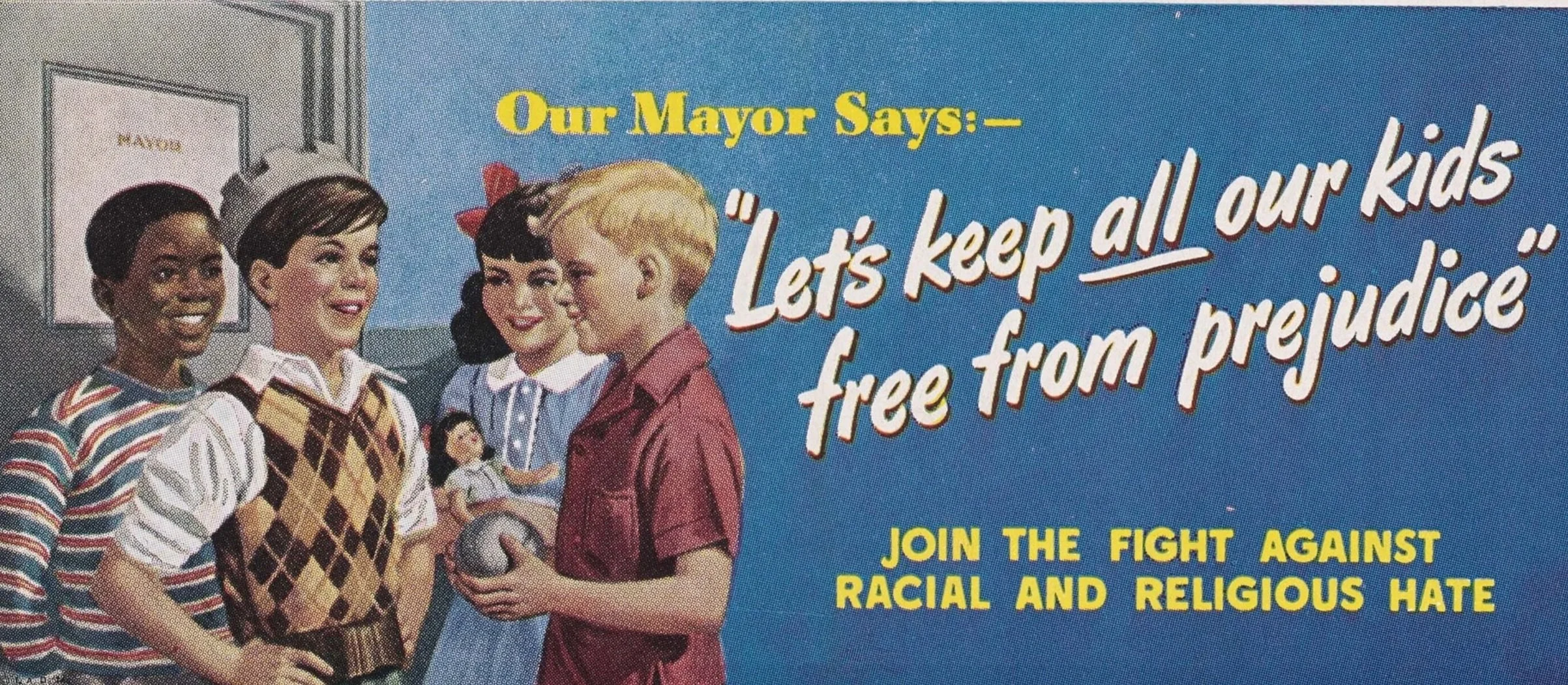
Highlights from the New York City Commission of Human Rights Collection
“It is a wonderful thing and it is a true strength of this nation that in times like these, with hate spreading ever faster throughout the world, we support a group whose selfless aim is the advance of human freedom and understanding.” Mayor Vincent Impellitteri, 1950-1953
This simple but poignant memo was written by MCOU Associate Director Rabbi Bernard Lander to Executive Director Dan Dodson. Lander would later go on to found Touro College and Dodson, an NYU professor, was also a member of the Mayor’s Committee on Baseball which helped integrate baseball in 1947.
On February 27, 1944, Mayor Fiorello H. LaGuardia created the Mayor's Committee on Unity in response to citywide concerns about race relations following riots in Harlem that occurred in 1935 and again in 1943. Its purpose was to "to observe and study unfavorable conditions and dangerous trends, and analyze objectively their causes and what steps may be taken to combat them." From that small committee was born the New York City Commission on Human Rights (CCHR), which today works to protect New Yorkers against discrimination based on race, religion, national origin, immigration status, and gender identity, among other protected categories.
1948 saw the introduction of an approval window placard for merchants in Harlem. Given by the Harlem Consumer Merchant Arbitration Board, the designation was an effort to assure shoppers that they would not be subject to price gouging, discriminatory hiring, or poor treatment, a direct response to issues of inequality in 125th Street businesses.
The records of the City Commission on Human Rights were transferred to the New York City Municipal Archives in the 1957 and between 1967 and 1999 and date from 1935-1987. The collection reveals how a first-of-its-kind city agency developed with the goal of improving civic life and unity for all citizens of New York City. The collection reflects challenging social problems, and how they were perceived and resolved. Many changes in social justice laws over a forty year period are represented in the correspondence and policy decisions of the Commission. Case files submitted to the CCHR include investigative materials, legal reports, staff correspondence, and court records for those cases that were found to have probable cause violations.
Beginning in 2025, with support from the National Historical Publications and Records Commission (NHPRC), the New York City Municipal Archives (MA) archivally processed, digitized and published select series of the collection. The records include minutes, reports, speeches, correspondence, and planning files created to fulfill the mission to address systemic injustice. The collection represents local and national responses to racial and socio-economic unrest, religious intolerance, and systemic discrimination practices from the post-World War II era through the 1960s and 1970s. The gallery highlights the history and working papers of a city agency working to protect the rights of all New Yorkers.