In the Details

In the summer of 2018, I began work at the Municipal Archives as the lead archivist on the Manhattan Building Plans Project, a much-anticipated, years-long undertaking to process and rehouse more than 100,000 architectural drawings that had been filed with the Department of Buildings between 1866-1977. The drawings had been transferred to the Archives from the Department of Buildings in the aftermath of a less-than-successful microfilming project in the late 1970s. The microfilming vendor, believing the original material was going to be disposed of, haphazardly and messily re-wrapped the plans in acidic paper. They tightly tied each “bundle” with damaging twine and labelled with minimal, and often insufficient, identification.

Pre-processing storage conditions of the Department of Buildings Collection, NYC Municipal Archives.

Post-processing (hooray!) storage conditions of the Department of Buildings Collection, NYC Municipal Archives.

My colleagues and I are processing and rehousing the plans to reestablish intellectual control over the material and to create more optimal retrieval and storage conditions. To do so, we un-roll the dusty bundles, identify the plans, sort, flatten, repair if damaged, count and catalog, carefully and neatly re-roll onto acid-free tubes, wrap with protective Mylar, and store in acid-free boxes.

We are organizing the plans according to BBL, or borough, block, and lot number, so that all the plans for all the buildings or structures built on a particular city lot, and all the changes and alterations made to an already existing building on that lot, are stored together. When sorting the plans, we verify the block and lot information and record it, as well as addresses, quantity of plans, dates, notes on architects, important features, and condition concerns. To date, we have processed and rehoused over 22,000 plans for buildings in lower Manhattan. They comprise all manner of architectural drawings—sections, elevations, floor plans, and details—as well as engineering and structural diagrams for every conceivable type of building—industrial, manufacturing, retail, financial, and residential. From stables to skyscrapers and everything in between.

Among the plans are obvious showstoppers, beautifully rendered elevations of well-known buildings splashed with color and architectural detail--what people think of when they think of historic New York City architecture. But most building plans are not that, and the vast majority of the tens of thousands of plans that we have viewed are far humbler and more mundane. They show alterations, fireproofing, elevator and boiler installations, signage, electrical work, and plumbing, plumbing and more plumbing. And they reveal a lot about the true nature of the building, the people who made and used it, and the city itself.

Wooden elevator shaft with dovetail detail, 129 Mercer Street, 1896. H.G. Knapp, architect. Department of Buildings Collection, NYC Municipal Archives.

When you look through 22,411 plans of the details of New York City, day in, day out, what catches your jaded eye? What are the small things that delight or confound you and make you stop for a moment and show your colleagues or take a photo with your phone to refer to later or simply to show a friend? For me these stop-and-look-closer moments seem to fall into three different categories:

1.   The “Awww! Pretty!” Plans

Finding beauty in unexpected places has been one of the highlights of the project. To see the intricate parts of a building drawn in two dimensions provides a new perspective that gives you the ability to appreciate the complexity and precision of something as ubiquitous as a foundation or a column or a plumbing fixture in a brand-new way.

Surprisingly delicate rendering of a foundation pier for the Bowling Green Building, 11 Broadway, 1895. W. & G. Audsley, architects. Department of Buildings Collection, NYC Municipal Archives.

Complex column details from an 18-story loft building, 460 West 34th Street, 1927. Parker & Shaffer, engineers and industrial architects. Department of Buildings Collection, NYC Municipal Archives.

Two images showing the artistry of plumbing fixtures from two very different buildings. On the left is the plan for the barber shop basins at the former New York Life Insurance Building, 346 Broadway, 1895, McKim, Mead & White, architects.

And on the right a plumbing detail from the plans for the “City Prison” [aka the Manhattan House of Detention], 100 Centre Street, 1937, Harvey W. Corbett & Charles B. Meyers, architects. Department of Buildings Collection, NYC Municipal Archives.

2.   The “Wait, what?” Plans

We process so many plans that you can’t take too much time perusing every drawing. But when a confounding phrase or image is spotted, you can’t help but look a little closer and do a bit of research. You can’t just let the Coloramas, movie theater train cars, and doughnut computers of the world pass you by.

Colorama display detail from a plan entitled “Colorama Room Plans and Traverse Sections, New Bank Entrance,” The Bank for Savings, 280 Fourth Avenue [now 280 Park Avenue South], 1953. Alfred Hopkins and Associates, architect. Department of Buildings Collection, NYC Municipal Archives. Coloramas were spectacular 18-foot by 60-foot color transparencies created by Eastman Kodak and displayed on the east balcony in Grand Central Terminal from 1950-1990. Only 565 were ever made and a few were later cut down in size and displayed elsewhere, which seems to be the case here. Department of Buildings Collection, NYC Municipal Archives.

Plan for alterations to theater interior, 46 East 14th Street, 1906. Department of Buildings Collection, NYC Municipal Archives. In the early 1900s the area around 14th Street had many nickelodeons and theaters competing for business. The Brady-Grossman Company featured Hale’s Tours, where patrons sat in simulated Pullman cars and watched films of picturesque railroad routes as if they were travelling. The “tours” became more and more sophisticated, with panoramas, sound effects, and a rocking motion making it feel like the “train” was moving; this seems to be an early version of the attraction.

Plan entitled “Additional Steel Support of IBM Units” for the Doughnut Corp. of America, 45 West 36th Street, 1954. J. Gordon Carr, architect. Department of Buildings Collection, NYC Municipal Archives. The Doughnut Corporation of America was founded in 1920 primarily to sell doughnut-making machines to bakeries. They later expanded to manufacturing doughnut mixes for home use as well as running a chain of coffee shops. They also founded the National Dunking Association in 1931 to encourage doughnut-eating. So it is really not too surprising that such innovators were also early adopters of the most modern (but heavy) technology.

3.   The “That’s so cool!” Plans

There are some things that are just too fun not to pay attention to. Whether it’s a hand-drawn detail that shows a draftsman taking artistic liberties or a floor plan that proves New York City building façades could contain any and all sorts of interesting enterprises.

A charming drawing for Bear & Son clothing store near Union Square, 50 East 14th Street, date unknown. Note that the draftsman went to the trouble to write in “Bear’s Head” and “Cub’s Head” at the top. Department of Buildings Collection, NYC Municipal Archives.

Floorplan for the Julian Billiard Academy, 138 East 14th Street, circa 1933. Department of Buildings Collection, NYC Municipal Archives. This second-floor pool hall was owned by the same family for over 50 years and its closing in 1991 was felt by many New Yorkers to be a real blow for “old New York.”

Longitudinal section drawing for Ogden & Wallace Iron Warehouse, 583 Greenwich Street, 1893. John A. Hamilton, architect. Department of Buildings Collection, NYC Municipal Archives. Though many architectural drawings depict both exterior and interior elements, this is the only one we’ve seen with such a cozy (lit!) fireplace.

Alteration plan for Electric Lady Studios, 52-54 West 8th Street, 1969. Storyk Design, architect. Department of Buildings Collection, NYC Municipal Archives. Soundproofing and vocal booth construction details for the recording studio built for Jimi Hendrix in 1970 and still in demand today. Very cool.

And I’ll close with one of the first drawings that caught my eye and is still one of my favorites It spans all three categories. It’s a beautiful drawing of a beautiful object, its history certainly deserves some further research, and the structure is a cool, and recognizable detail of New York City architecture.

Tank and tower drawing for House of Relief, 67-69 Hudson Street, 1912. Felber Engineering Works. Department of Buildings Collection, NYC Municipal Archives.

Like many New Yorkers, the Building Plans Team is telecommuting now, and the plans are waiting for our return. And with many tens of thousands of plans remaining, who knows what else we’ll find.
PPE in NYC

As the COVID19 pandemic continues, there has been much discussion surrounding personal protective equipment, or PPE.  Hospitals have struggled to get sufficient supplies of protective equipment for the healthcare professionals who are working tirelessly keep the public safe.  How would this be relevant to the Municipal Archives? Conservators and archivists in many cultural institutions, including the Municipal Archives, use PPE  such as N95 masks and nitrile gloves while working with items contaminated by dust, mold spores, or other harmful elements. Since we are now working remotely and not handling archival items, the Department of Records and Information Services (DORIS) recently donated its stock of N95 masks and nitrile gloves for use by healthcare workers.

Recent reports indicate that the City is receiving large quantities of PPE from around the country. But every bit helps and to donate boxes of unopened PPE visit NYC.GOV/ppedonations  

The existence of PPE goes back thousands of years. In the first century AD, Pliny the Elder wrote about using masks made from animal bladders to protect Roman miners from breathing in toxic dust. Wearing gloves and aprons for various purposes is so ancient that their origin cannot be traced. 

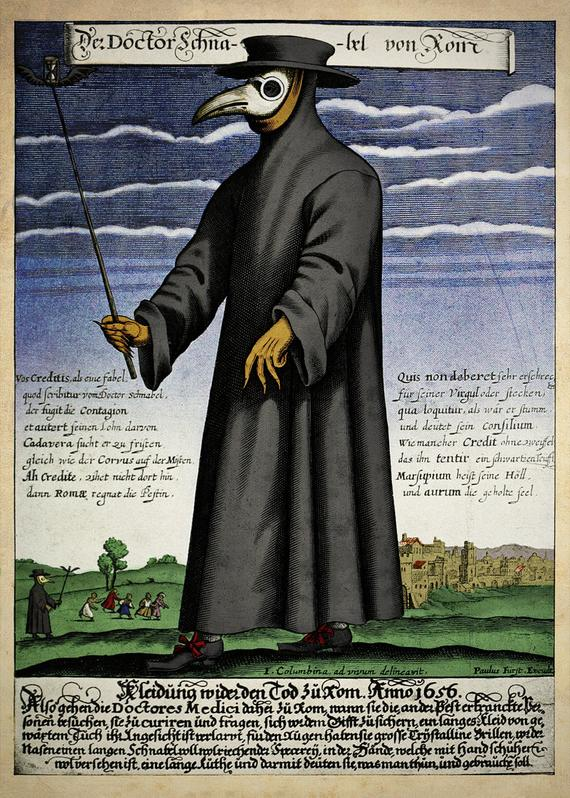
The use a full protective outfit for doctors probably originated in the early 1600s, when a French physician named Charles de Lorme proposed a head-to-toe protective costume for treating plague patients. The attire consisted of a long waxed coat, a brimmed hat, goggles, leather gloves, and a distinctive mask shaped like a bird’s beak. At the time, bad smells were thought to  cause  the plague, and the long beak was designed to hold flowers and fragrant herbs to mask this “miasma” while allowing the doctor to breathe. Over the next two centuries doctors adopted this distinctive get-up for treating plague victims.  The most obvious element—the bird’s beak mask—lodged itself so deeply in the popular imagination that it became a common feature of scary costumes for Venetian masquerades. The mere sight of the doctor’s mask was enough to terrify. 

Paul_Fürst,_Der_Doctor_Schnabel_von_Rom_(coloured_version).png

The  beaked mask may have hindered bad smells, but it was not effective at blocking germs. A better technology was a mask that passed air through a filter as the wearer breathed. In the 16th century, Leonardo da Vinci suggested using a wet cloth as a respirator to prevent inhaling toxic gas, a technique still used as a last resort in fire emergencies. By the end of  the 18th century, modern masks began to appear, some using charcoal to filter the air. In 1889, William Stewart Halsted invented surgical rubber gloves to protect doctors and nurses during medical procedures. By this time, medical personnel used cloth surgical masks during procedures, and lab technicians wore medical gowns over their clothes.

Wearing protective garment while developing X-rays, Municipal Sanatorium, Otisville, N.Y. Department of Public Charities Collection. NYC Municipal Archives.

Wearing protective garment while developing X-rays, Municipal Sanatorium, Otisville, N.Y. Department of Public Charities Collection. NYC Municipal Archives.

Operating room nurses with protective masks and gloves, Bellevue Hospital, May 1950. Department of Public Charities Collection. NYC Municipal Archives.

Operating room nurses with protective masks and gloves, Bellevue Hospital, May 1950. Department of Public Charities Collection. NYC Municipal Archives.

Masked operating room nurses, Bellevue Hospital, May 1950. Department of Public Charities Collection. NYC Municipal Archives.

Masked operating room nurses, Bellevue Hospital, May 1950. Department of Public Charities Collection. NYC Municipal Archives.

Masked operating room personnel, Kings County Hospital. Department of Public Charities Collection. NYC Municipal Archives.

Masked operating room personnel, Kings County Hospital. Department of Public Charities Collection. NYC Municipal Archives.

Not only did PPE change over time, but so did the way it was worn. As our understanding of infectious disease  grew, so has awareness of the most effective uses of PPE. Early photographs in the Department of Public Charities collection at the Municipal Archives show doctors wearing masks covering only their mouths. Today, this would be considered incorrect, as it still allows the wearer to breathe in unfiltered air. In fact, today, the goal is to prevent air from passing around the edges, forcing all air to be inhaled through the material of the mask. Modern masks are designed with a metal strip at the top that can be shaped to the bridge of the nose. The N95 mask also includes two straps that hold it tightly against the face. When worn properly, the N95 filters 95% of breathed air.

As a large city and trade port with a diverse population, New York City frequently has been at the forefront in the fight against infectious disease. Collections such as the Archives’ Almshouse ledgers, Department of Health and Mental Hygiene records, and Department of Public Charities and Hospitals photographs provide ample documentation for research in topics related to public health. Of particular relevance today is New York City’s response to outbreaks of diseases such as typhoid and cholera in the 18th and 19th centuries, and to the erroneously named “Spanish” flu pandemic of 1918.

“New Operating Room,” with models. Exhibit in the Golden Jubilee at the Grand Central Palace, 1948. Department of Public Charities Collection. NYC Municipal Archives.

“New Operating Room,” with models. Exhibit in the Golden Jubilee at the Grand Central Palace, 1948. Department of Public Charities Collection. NYC Municipal Archives.

Nurse taking notes with infant patient, Bellevue Hospital, 1950. Department of Public Charities Collection. NYC Municipal Archives.

Nurse taking notes with infant patient, Bellevue Hospital, 1950. Department of Public Charities Collection. NYC Municipal Archives.

“Surgery in Progress,” painting, Harlem Hospital Conference room. Public Design Commission Collection. NYC Municipal Archives.

“Surgery in Progress,” painting, Harlem Hospital Conference room. Public Design Commission Collection. NYC Municipal Archives.

Vinegar Syndrome Testing and the WNYC-TV Film Collection

Nothing is immune to time, but as any preservationist can tell you, there are many possible actions to delay the process of deterioration and prevent an asset from disappearing into oblivion. Although considered fairly stable, especially when compared to video formats, 16mm films can be susceptible to physical damage (such as base and emulsion scratches, torn sprocket holes, etc.) as well as breakdown of the magnetic stock, mold, color dye fading, and—if cellulose acetate-based—vinegar syndrome. Vinegar syndrome, also known as acetate film base degradation, is characterized by a strong vinegar smell and eventually buckling, shrinkage, and weakening of the film. Since this reaction is autocatalytic, it is important to identify compromised films and prioritize them in preservation plans.

The WNYC-TV Film collection contains over 4,500 films. Although there are 35mm films in this collection, the majority is made up of 16mm films. With the LGRMIF grant, we aim to digitize close 900 films, creating master preservation copies, access copies, and providing content online.

When the Municipal Archives was awarded the Local Government Records Management Improvement Fund (LGRMIF) grant to digitize 16mm films from the WNYC-TV collection, it was clear one of the first steps of the project would be to identify which films were suffering from vinegar syndrome, and which ones were at the later stages of this reaction.

The WNYC-TV Film collection is currently housed with other collections in a room where the relative humidity (RH) can range from 39% in the winter to 60% in the summer, and the temperature is kept at around 70°F. As we know, the relationship between temperature and RH has a direct impact on how fast acetate-based films decay, and since the Municipal Archives has housed the collection for over 30 years, we expected many of the films to already show signs of decay.

The Image Permanence Institute (IPI) time contours graphic estimates how many years it takes for the onset of vinegar syndrome in acetate-based films.

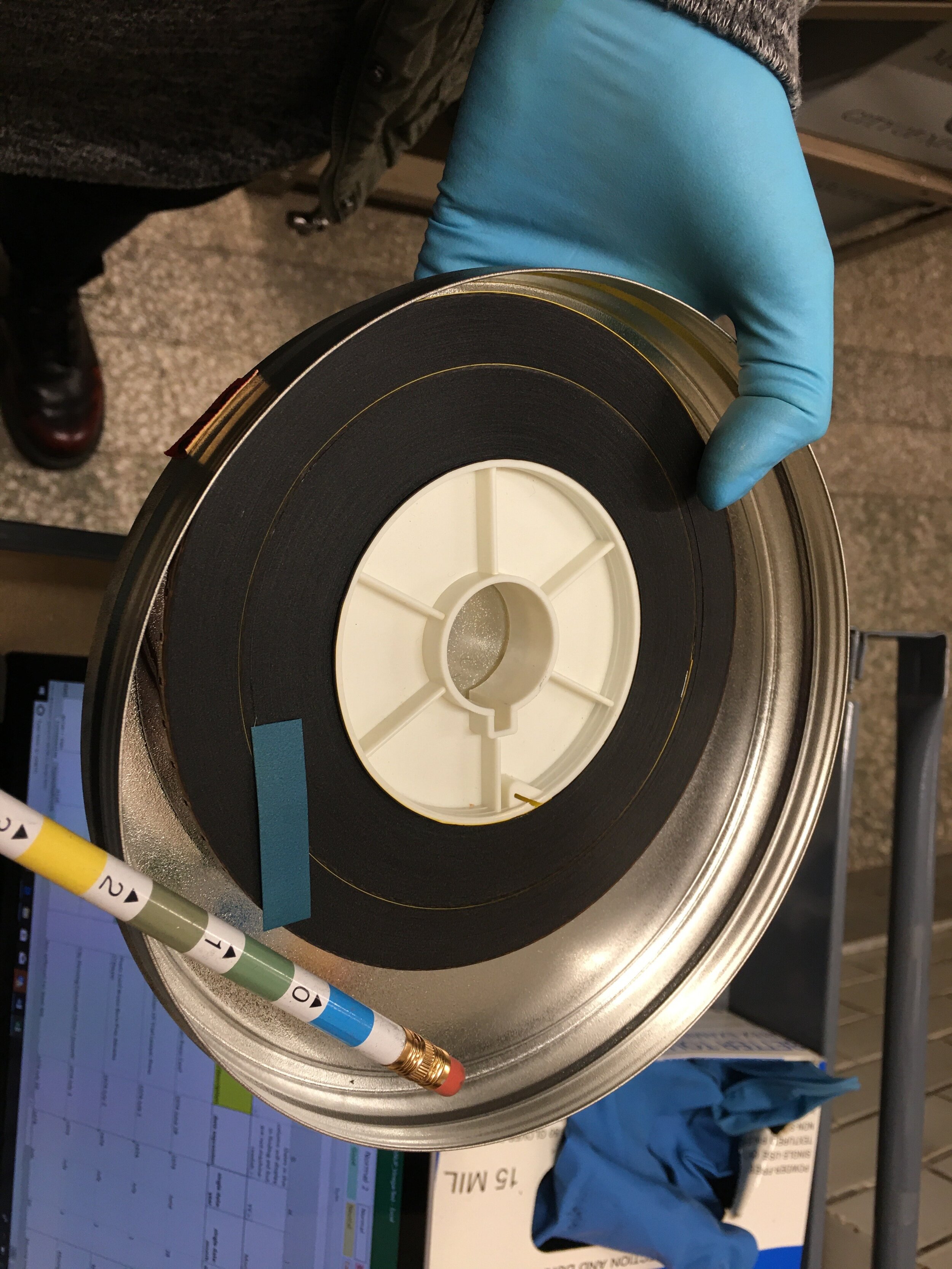
To test the films, we employed the use of A-D Strips—small paper strips coated in dye that react to the presence of acidic vapor. The strips change color from blue to yellow indicating the level of degradation of the film.

Because we have over 4,000 films in the collection and a limited amount of strips, we decided to run the A-D strip test in three phases.

Phase One consisted of placing from three to four A-D strips in each shelf dedicated to the WNYC TV collection, with one strip in each film can. We made sure to distribute the strips evenly, typically choosing cans that were in the middle of a stack. 251 films were tested during this phase and we kept careful documentation of which cans were being tested and the dates when the strips were placed.

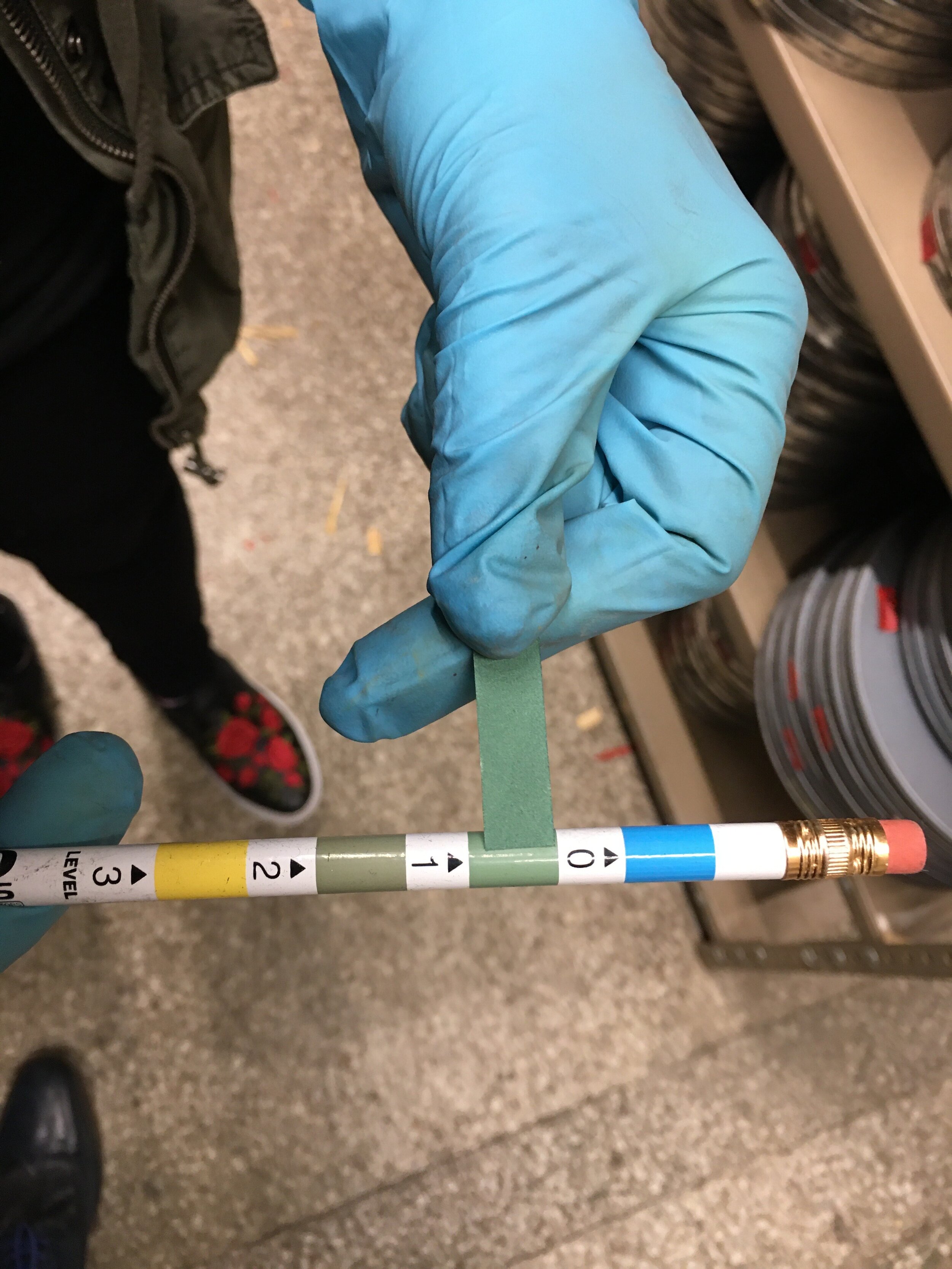
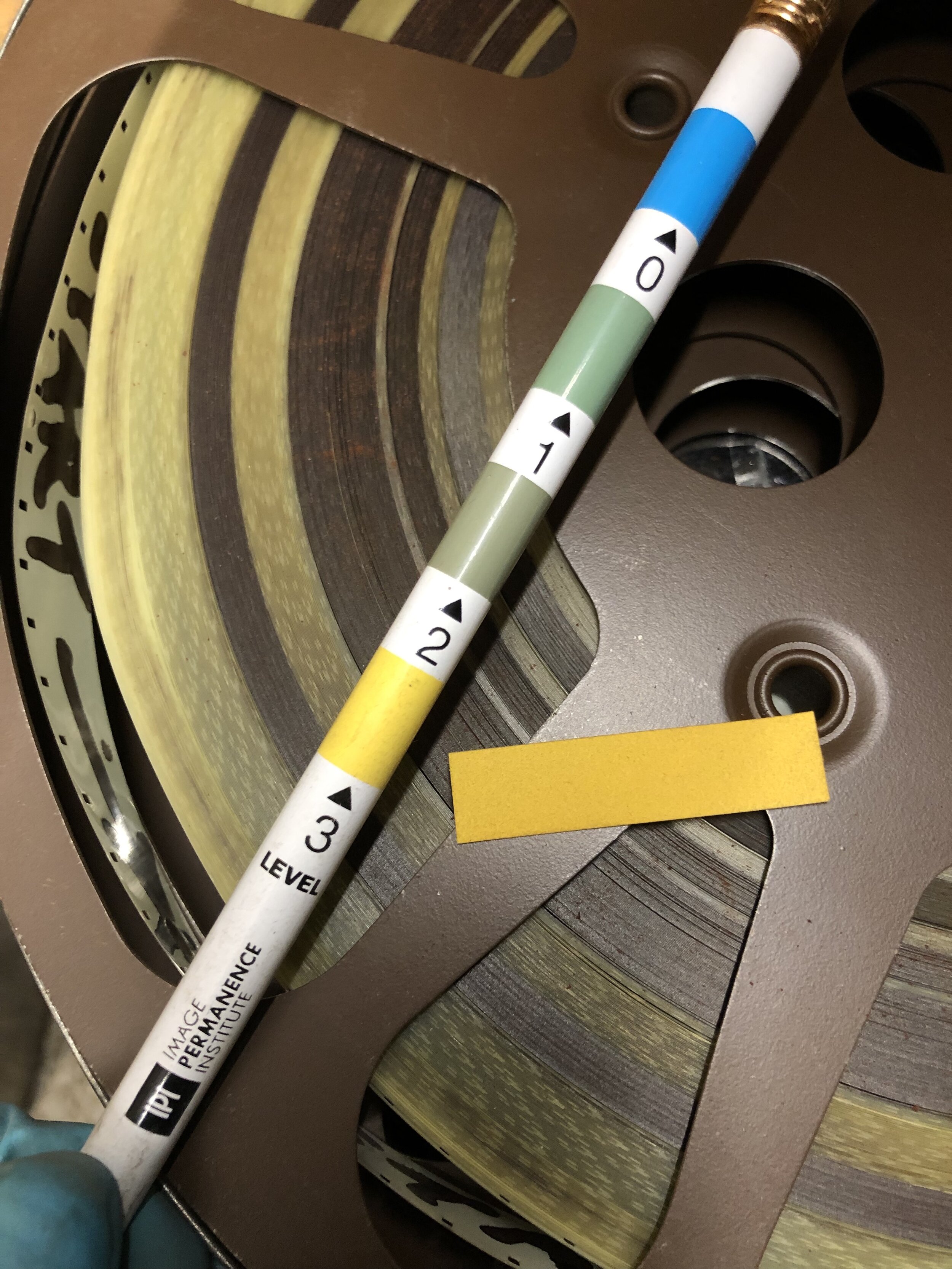
A-D strips come with a handy chart, printed onto a pencil. Since color variations can be subtle during testing, it is helpful to take pictures and use them as reference.

A full day after we placed the A-D strips, we started retrieving them and checking each strip's color to determine the amount of acidic vapor it had been exposed to. The strips are compared to a color chart that assigns each color a numeric value representative of stages of film deterioration, from zero (blue) to three (yellow) with varying levels of green between.

Out of the 343 films tested during Phase One, we documented:

  • 12 films scored 0.1

  • 76 films scored 0.25

  • 115 films scored 0.5

  • 77 films scored 0.75

  • 37 films scored 1.0

  • 2 films scored 1.25

  • 3 films scored 1.5

  • 1 film scored 2.25

  • 7 films scored 2.5

  • 7 films scored 2.75

  • 2 films scored 3

On Phase Two, we placed A-D strips on cans that were physically close to the ones tested during Phase One. The results were then documented 24 hours later and on the following days due to the high number of films being tested.

This phase produced some surprising results. Quite a few films that were located in close proximity to the ones that scored high levels during Phase One showed low levels of acidic vapor. Since these were sealed cans, the acidic vapors were most likely trapped in the can, adversely affecting the deteriorating film in the cans, but not spreading to the cans nearby. It would be interesting to investigate what other factors were keeping certain films healthy, even when located next to ones that were already showing signs of degradation.

We did notice some concentration on shelves where the older, sometimes even rusty cans were stored. It could be that the age of the films was key factor or perhaps the rusting cans were not air-tight and exposed the film to off-gassing and humidity fluctuations. Contrary, though, we also noticed higher levels in films stored in newer cans, which perhaps had been recanned at some point in an attempt to slow down degradation.

As a way to obtain more complete data on the collection, we used the remaining A-D strips on Phase Three, where we tested more than 200 additional films, focusing on shelves that had delivered higher scores. Over half of the films tested during this phase scored a 0.5 or higher.

Level three was noticed on magnetic tracks that carried sound effects, narrations, and music.

After compiling the test results from all three phases, we decided to prioritize all films that scored 0.5 or higher for digitization and recanning.

Although A-D strip testing can be considered slightly subjective as the reading of the test results is largely based on how the tester perceives color variation, it is a practical and nondestructive way to identify the severity of degradation in films. The process allowed us to create a prioritization plan for the next step in the efforts to preserve and increase access to the rich WNYC-TV film collection at the Municipal Archives.

Caroline Z. Oliveira is the film archivist digitizing the endangered WNYC films for a Municipal Archives project funded by the New York State Archives. Ms. Oliveira has already digitized much of the collection and the digitized content will be made available online sometime this year. Look for future blogs highlighting some of the footage in the collection.

Sources Reilly, James M. “IPI Storage Guide for Acetate Film,” 1993.

The Occupation of Sydenham Hospital

By 1975 New York City had run out of money. The City of New York faced a fiscal crisis that precipitated massive budget cuts to almost all public services. With the budget problems too big for the City to solve itself, the Emergency Financial Control Board was created to rein in spending. Run by New York State, the ECFB successfully slashed the City’s budget, defunding libraries, schools, welfare programs, public transit, hospitals and more.

One of those cuts was Sydenham hospital, a Harlem based health center that historically served and employed African Americans. Sydenham Hospital was founded in 1892 as a private hospital corporation but by 1949 due to shaky finances it became a part of the municipal hospital system. This meant that Sydenham became both funded by and controlled by local taxpayers and voters- or so they believed.

Edward I. Koch was elected Mayor in 1977 with the promise to revive the City.  Soon after taking office he announced that Sydenham Hospital in Harlem and the Metropolitan Hospital in East Harlem were to be closed. That same year, Harlem was designated a health disaster area by President Jimmy Carter’s Secretary of Health, Education and Welfare, Joseph Califano.

Harlem residents had been working with City government for decades to improve local healthcare outcomes and services to little avail. The Harlem Health Alliance was led by Marshall England, a long-time public health advocate with a focus on Manhattan’s poorer residents. He created a plan to improve Harlem’s healthcare system at the behest of Mayor John Lindsay, but the plan was never implemented. In the 1970s, Harlem residents worked with the Comprehensive Health Planning Agency, but still saw their healthcare quality decrease.

The Koch administration announced plans for new ambulatory clinics in Harlem, but it later became clear that these new clinics were meant to replace the much larger Sydenham and Metropolitan Hospitals. Despite the dwindling availability and level of care, healthcare costs continued to rise for Harlem residents.

The closure announcements immediately led to a backlash from Harlem residents. They formed groups like A Coalition to Save Sydenham that lobbied politicians, organized picket lines and tried to raise awareness of the implications of closing Sydenham. The Committee for Interns and Residents held a one-day walkout.

Although the hospital eventually closed in 1980 after years of debate between City and State government, protests grew in the lead up to its closure, ultimately resulting in an occupation by neighborhood residents who feared the loss of a vital part of their community. During the occupation the NYPD’s surveillance unit, the Bureau of Special Services and Investigation (BOSSI), created a number of 16mm black and white films to document the events and those involved.

Metropolitan Hospital in East Harlem was saved and still operates today but Sydenham could not be saved. In a final move, demonstrators forced their way into the building and began a 10- day occupation to halt the closure of the hospital.

The desperation of this move becomes more understandable when one compares the healthcare statistics of Harlem residents to other New York City neighborhoods. In 1977, the infant mortality rate in Harlem was twice that of the borough of Manhattan. The overall death rate in Harlem was 54% higher than other Manhattan neighborhoods, like Kips-Bay and Yorkville. Rates of tuberculosis infections in Harlem residents were more than twice that of the entire City in 19. Despite this glaring inequality, the City and State governments planned to close not one, but two public hospitals in Harlem against the wishes of the local taxpayers.

Although healthcare and poverty rates have improved in the City over the last 40 years, Harlem residents still suffer from higher infant mortality rates and premature deaths, less access to healthcare and far higher rates of asthma and other chronic conditions when compared to other parts of the City. In times of crisis, already underserved neighborhoods like Harlem get hit harder than others, further delaying the achievement of equitable healthcare outcomes for all New Yorkers. It is also in times of crisis that disparate communities come together in pursuit of a common goal. To those fortunate enough to have escaped the worst effects of the COVID-19 pandemic and its economic impact, please consider how you might be able to help those in dire need.

Years after he was no longer Mayor, Ed Koch famously said that closing Sydenham was a mistake.

Spring 2020

New Yorkers look forward to the first day of Spring. Sometimes the weather cooperates, but even if it does not, it marks a period of beginnings, new growth and hope. 

But this is not an ordinary year. Like all New Yorkers at this time, everyone at the Municipal Archives is doing their best to stay safe and healthy.  Closing the public reading rooms was a regrettable, but necessary, step to help prevent the spread of the coronavirus. During this hiatus, many Municipal Archives staff are ‘teleworking’ and using this time to improve intellectual control over our vast collections. They are transcribing inventories, editing descriptive information, and writing finding guides. This important work will greatly add to the usefulness of ArchivesSpace, the on-line tool we will be launching in 2020 to provide on-line information about dozens of important collections.   

In the meantime, we can take this opportunity to remind our patrons and friends that there is already a great deal of content readily accessible on our website. In the online gallery there are now more than 1.5 million photographs, moving images, maps, architectural plans, and ledgers to view (and order if one catches your fancy). Patrons are also invited to visit Archives.NYC to read through our blogs, catch up on our prior exhibits and review the shared histories developed jointly by the Amsterdam Archives and the Municipal Archives.

The Central Park Lake, ca. 1936. WPA FWP Collection. NYC Municipal Archives

The Central Park Lake, ca. 1936. WPA FWP Collection. NYC Municipal Archives

Here are more evocative images taken by City and WPA photographers early in the spring season, many decades ago.

On an early spring day in 1938 WPA photographer, E. M. Bofinger traveled around the City documenting parks, people and iconic venues. Fort Tryon Park was one stop on his journey. The Cloisters are in the background. E. M. Bofinger, April 17, 1938. W…

On an early spring day in 1938 WPA photographer, E. M. Bofinger traveled around the City documenting parks, people and iconic venues. Fort Tryon Park was one stop on his journey. The Cloisters are in the background. E. M. Bofinger, April 17, 1938. WPA FWP Collection. NYC Municipal Archives

A view of the Hudson River from Fort Tryon Park, with the George Washington Bridge in the background. E. M. Bofinger, April 17, 1938. WPA FWP Collection. NYC Municipal Archives.

A view of the Hudson River from Fort Tryon Park, with the George Washington Bridge in the background. E. M. Bofinger, April 17, 1938. WPA FWP Collection. NYC Municipal Archives.

Drinking Fountain, Prospect Park, Brooklyn, April 17, 1938, E. M. Bofinger. WPA-FWP Collection. NYC Municipal Archives.

Drinking Fountain, Prospect Park, Brooklyn, April 17, 1938, E. M. Bofinger. WPA-FWP Collection. NYC Municipal Archives.

Bowling Green Park, from the steps of the Customs House, Lower Broadway, Manhattan. E. M. Bofinger, April 17, 1938. WPA FWP Collection. NYC Municipal Archives

Bowling Green Park, from the steps of the Customs House, Lower Broadway, Manhattan. E. M. Bofinger, April 17, 1938. WPA FWP Collection. NYC Municipal Archives

Times Square, April 17, 1938. E. M. Bofinger, WPA FWP Collection. NYC Municipal Archives.

Times Square, April 17, 1938. E. M. Bofinger, WPA FWP Collection. NYC Municipal Archives.

As we said, spring weather is unpredictable. On March 19, 1940, the temperatures jumped up to summer-time levels and everyone headed to the beach. Orchard Beach, Pelham Bay Park, Department of Parks Collection. NYC Municipal Archives.

As we said, spring weather is unpredictable. On March 19, 1940, the temperatures jumped up to summer-time levels and everyone headed to the beach. Orchard Beach, Pelham Bay Park, Department of Parks Collection. NYC Municipal Archives.

The City and the Census

It’s census time. Once every ten years, the United States Bureau of the Census tries to count every person in the United States. The census is mandated by the U.S. Constitution and has occurred every 10 years since 1790. It is vitally important for all New Yorkers to be counted. Census information is used to determine the City’s fair share of billions of dollars in federal funds for public education, affordable housing, infrastructure, and more—as well as the number of seats we have in Congress. In the 2010 Census, the City’s self-response rate was less than 62%, compared to the national average of 76%. Let’s do better this time!  For the first time, the census can be filled out online. Here is the link to the census site: https://my2020census.gov/

In the past, New Yorkers loved a census. The Municipal Library and Municipal Archives holdings include information about several State and local census dating from the first decades after Independence. The earliest reference to a census can be found in Article 5 of the New York State Constitution of 1777: 

That as soon after the expiration of seven years (subsequent to the termination of the present war) as may be a census of the electors and inhabitants in this state be taken, under the direction of this legislature.”  Subsequently, electoral censuses were conducted in 1795, 1801, 1807, 1814, and 1821 “in compliance with this law.”

This requirement was only to count those eligible to vote—white men who had achieved full age and who possessed between 40 shillings and had paid taxes (to vote for Assembly members) and 100 pounds (to vote for Senators).  In addition, the Constitution provided that men in Albany and New York City who had been designated “free men” before October 14, 1775 were allowed to vote in Assembly elections. 

1786 New York Census. Common Council Records, NYC Municipal Archives.

New York City was counting all of its voters. The summary schedule from 1786, submitted by the sheriff, totaled 23,614 residents including four “Indians who pay Taxes.” The census was broken down by ward and categorized by “Citizens and Inhabitants” and “Slaves” and further enumerated by gender and age. The count shows 2103 enslaved people lived in the City. Among the interesting facts about this census is the inclusion of non-enslaved African Americans in the “Citizens and Inhabitants” categories. At this point the wards of the City also were named, not numbered including Montgommery Ward, Dock Ward, and Out Ward along with the East, West North an South Wards.

1806 New York Census. Common Council Records, NYC Municipal Archives.

By 1806 the City had renamed the wards more prosaically—one through ten. The format of the census document also changed to include multiple new categories including People of Color, Free Negros, and Slaves in the population total of 75,770 residents. It also showed out-migration from the City due to the “prevalence of the malignant fever of 1805.” And it included the number of Aliens (immigrants) residing in the City but who were not yet included in the population count. Written on the back of the document is the note, Increase of population in 5 years at the rate of 25 percent or 15,201 people.

1813 New York Census. Common Council Records, NYC Municipal Archives.

The Census of the total Population of the City and County of New York dated December 1813 includes information about those who conducted the count in each ward. Abel W. Hardenbrook was a tinner, Abraham Booker a cooper, John Anderson a carpenter and John Kiser a gentleman as well as several others. There also is what is akin to a draft, and then a more polished final version. The City’s population was 92,448. The number of enslaved people dropped to 1076 residents while the number of “colored inhabitants” increased to 7786 people.

On April 15, 1814, the New York State Legislature passed “An Act for Taking a Census of Electors and Inhabitants of this State,” which mandated that all areas of the State follow the City’s lead and include information about all inhabitants—women, children, slaves and all other free persons, not just the electors.

The Municipal Library collection includes the printed Sessions of the Legislature. NYC Municipal Library.

In 1816 New York City conducted yet another census, generally referred to as the Jury Census. Newly-elected Assistant Alderman Elisha W. King presented a resolution at a meeting of the Common Council on January 29th, for a “census of inhabitants and an accurate list of Jurors qualified to serve in the different Courts…” which was agreed upon by the Council. A committee was formed that included Asst. Alderman King, Alderman Augustine H. Lawrence, and Richard Riker, Recorder “to carry the same into effect.”

On May 17, 1819, the Council established a committee to again conduct a census to create a “Jury and Census list.” The census results were published in the Minutes of the Common Council on November 15, 1819. 

Account of Census of Population of City of New York from 1756 to 1819. Common Council Records, NYC Municipal Archives.

A document dated June, 1821 is a scrawled “Account of Census of Population of City of New York from 1756 to 1819. Penmanship makes the author’s name difficult to decipher. Even without the detail from the census reports, the document chronicles the City’s growth from a population of “15,000 souls” (10,468 whites and 2276 Negros) in 1756 to 119,657 residents in 1819. The New York State census of 1821 was also an electoral census (as had been in 1814), however, it introduced additional questions regarding agriculture and manufacturing. There was a special meeting of the Common Council on June 4, 1821 “for the purpose of Complying with the provisions of the Late act of the Legislature… by appointing Persons in each Ward to take the Census of said Ward.” In the meeting of June 11, 1821 there is discussion and resolutions made with the Finance Committee regarding compensation for the census takers.

Based upon the information in the Minutes of the Common Council both the 1816 and 1819 Jury Censuses were mandated by the Council. The 1821 Census was mandated by an act of the NY State Legislature and the Council complied with the directive from the state.

The extant census records created under the direction of these Common Council resolutions are in the Municipal Archives. They have been digitized and can be viewed in the Archives gallery.

1819 Census for the 6th Ward, Manhattan. NYC Municipal Archives

The collection consists of 21 bound volumes containing tally sheets of returns for the City and County of New York, organized by ward. There are tallies for 1816, 1819, and 1821. The tallies were taken to determine if residents were eligible for jury duty and include varying degrees of descriptive detail. For example, for 1816 and 1819 the returns are given in a double-page tabular format with column headings for the following categories: names of inhabitants, number of houses, name of street, occupation, freeholds of $150, age, reason for exemption from jury, total number of jurors, the number of male and female white inhabitants, aliens, colored inhabitants not slaves, slaves, freeholders of £100 and upwards, freeholds of £20 and under £100, tenants renting $5 per annum, total number of inhabitants, plus a column for remarks. For the 1821 census, the returns, in similar format, include data in these categories: name of the head of each family, number and street of residence, number of male inhabitants of the same family age 21 or upwards in four classifications according to value of freeholds and debts, military service and tax exemption or commutation. Other data includes: number of acres of improved land occupied by each person, as well as tallies of cattle, horses, sheep, and yards of various types of cloth manufactured by each family, and a count of mills, factories, distilleries, asheries (a place where potash is made), and machinery. Each tally is identified with this description: “RETURN, made pursuant to the Act, entitled, ‘An Act to provide for taking a Census, and for other purposes,’ passed March 16, 1821, from the City and County of New-York.

1819 Census, 6th Ward. NYC Municipal Archives.