Municipal Archives’ Conservation staff recently completed a major project to conserve the Brooklyn Bridge drawings collection, which consists of more than 11,000 drawing plans. With the support of a three-year Save America’s Treasures grant from IMLS and a one-year grant from the New York State Library, conservators worked diligently over a nearly five-year period to stabilize and photograph the collection. As part of the project, the Archives’ Conservation Unit collaborated with the Metropolitan Museum of Art’s Scientific Research Department to conduct scientific analysis of selected drawings to determine the composition of media and paper, causes of degradation, and to use infrared imaging techniques to enhance faded writing and drawing in graphite.
East River Bridge, “The Brooklyn Bridge Up Close.” Photograph by Elena Carrara, Metropolitan Museum of Art.
The successful collaboration also prompted the Met to mount an exhibition of seven important drawings from the collection in a joint special installation with their Education Department, which opened on December 8th. On view until February 22nd, the installation displays, for the first time since 1983, several of the large-scale presentation drawings created by John and Washington Roebling and Wilhelm Hildenbrand. The longest drawing in the collection, which depicts the full span of the bridge and measures more than 25 feet long, has never been exhibited before. Thus, the exhibition offers a rare opportunity to see these exquisite drawings in an equally exquisite setting.
Lindsey Hobbs speaking at the Metropolitan Museum of Art on December 9, 2025.
In conjunction with the exhibition, the Met invited me to participate in an “Expert Talk” on December 9th along with Marco Leona, the David Koch Scientist in Charge at the Met, and Met Curator, Elena Carrara. Open to the public, the panel spoke about the history and preservation of the collection, the scientific work performed by the Met, and the exhibition process.
Given the size of the collection, not to mention the colossal size of many individual drawings, preserving and exhibiting the collection presented numerous challenges. The Met may in fact be one of few institutions in the world that could successfully mount an exhibition on such a scale. In addition to size, the condition issues the drawings presented posed challenges for conservation, framing, and transport.
“The Brooklyn Bridge Up Close.” Photograph by Elena Carrara, Metropolitan Museum of Art.
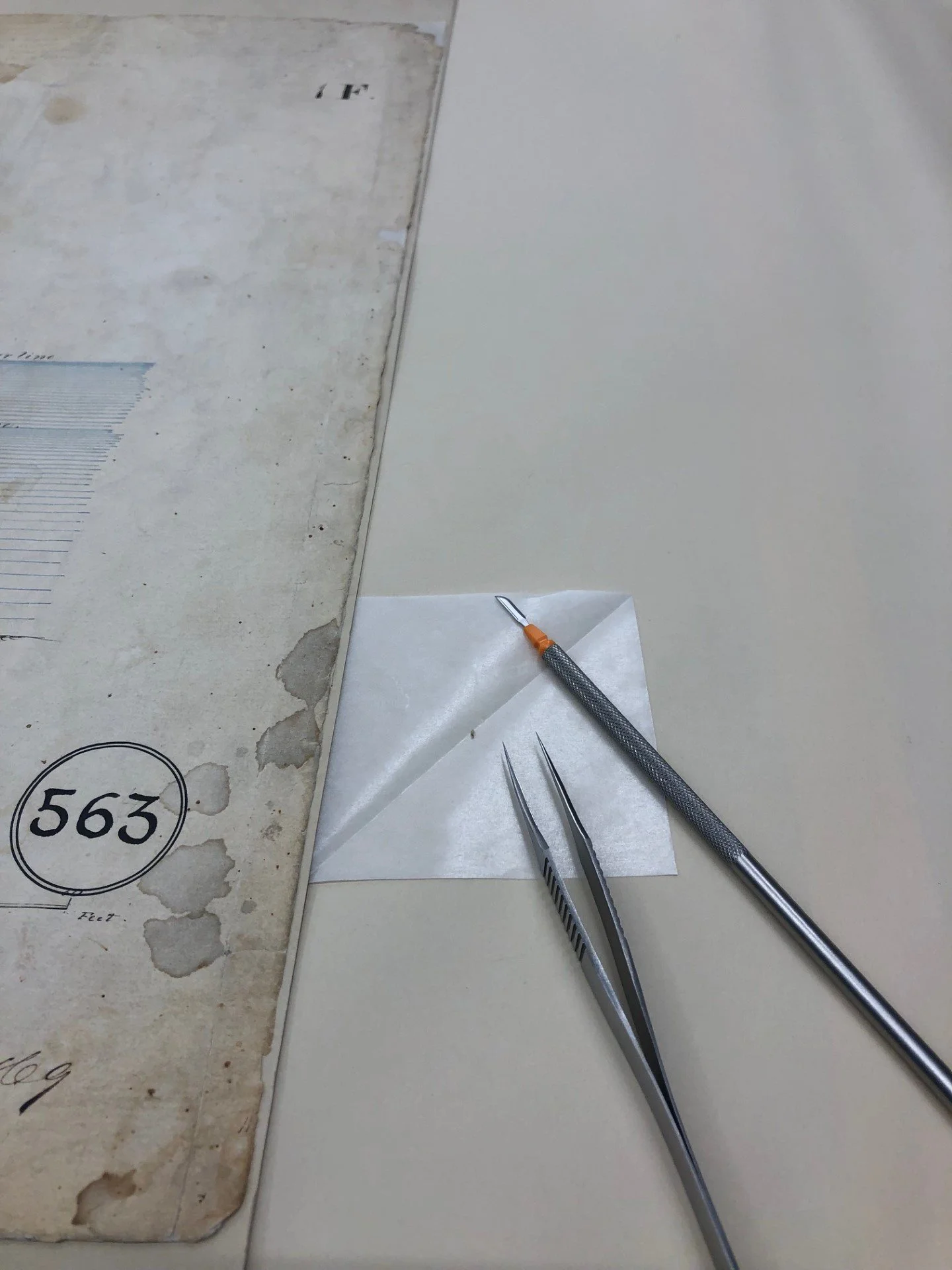
Prior to their accession by the Municipal Archives, the drawings spent the better part of a century in a dusty carpenter’s workshop beneath the Williamsburg Bridge under the purview of the Department of Transportation and its various historical iterations, where they were often consulted by City engineers for bridge repairs and renovations. Subjected to water leaks, mold, exhaust fumes from surrounding traffic, and rough handling, the drawings took a great deal of abuse. The primary condition issues we encountered included deteriorated paper supports, discoloration, tears and abrasions, local staining, faded media, and damage from mold and degraded adhesives.
To help us better understand how the drawings were created and what specific materials and media we were dealing with, I reached out to the Met’s Scientific Research Department in July 2023 and proposed a collaboration. The Met’s scientists often collaborate with smaller institutions via their Scientific Research Partnerships program to share their extensive analytical capabilities. Their enthusiastic yes to the proposal led to several visits between our institutions and a very productive partnership.
New York Approach, East River Bridge. “The Brooklyn Bridge Up Close.” Photograph by Elena Carrara, Metropolitan Museum of Art.
The Met’s findings confirmed the presence of certain pigments, such as vermillion, Prussian blue, earth pigments, and smalt, which helped to direct the methods used in our treatment of the drawings. Awareness of the presence of specific pigments also supports guidelines for light exposure given their known light sensitivity. Other findings revealed potential agents of deterioration in the paper substrates of some of the drawings, including rosin and kaolin. Infrared imaging allowed us to read for the first time some of the many notations written by Washington Roebling on the drawings and give a clearer view of intricate details. The imaging and analysis conducted by the Met not only supported our recent treatment efforts and understanding of drawings but will continue to support preservation of the collection in the future.
The work of Archives’ conservators along with the generous support of the Met’s Scientific Research and Education Departments have yielded insights into the Brooklyn Bridge plans that would not have otherwise been possible. The collaboration has been a wonderful opportunity to support a more nuanced approach to the drawings’ treatment and to expand the Archives’ audience for this remarkable collection.
https://www.metmuseum.org/exhibitions/the-brooklyn-bridge-up-close