Promotional card distributed by corporate participant, Sinclair Oil, 1964 New York World’s Fair.
The 1964-1965 World’s Fair began as an idea floated by lawyer Robert Kopple in 1958. In August, 1959 Mayor Robert F. Wagner declared that 1964 would mark the 300th Anniversary of the establishment of New York City to be commemorated by holding a World’s Fair. (This was before City government determined that the City’s actual origin date could be traced to the Dutch colonists who occupied the region and established government operations in 1624.)
An exhibit in the lobby at 31 Chambers Street, showcases highlights of the 1964-65 World’s Fair. The display draws heavily on brochures, reports and maps from the Municipal Library’s vertical file collection. The “vertical files” contain new clippings, handouts, media releases, leaflets and other documents that librarians compiled and stored in vertical file cabinets. The files on the 1964-65 World’s Fair are extensive. File folders in alphabetical order ranging from Accommodations to Women document both the 1939 and 1964 Fairs. The exhibit also includes items from the Municipal Archives, including donated ephemera such as a Sinclair Oil dinosaur.
Proposed exhibit for corporate participant, Sinclair Oil, 1964 New York World’s Fair.
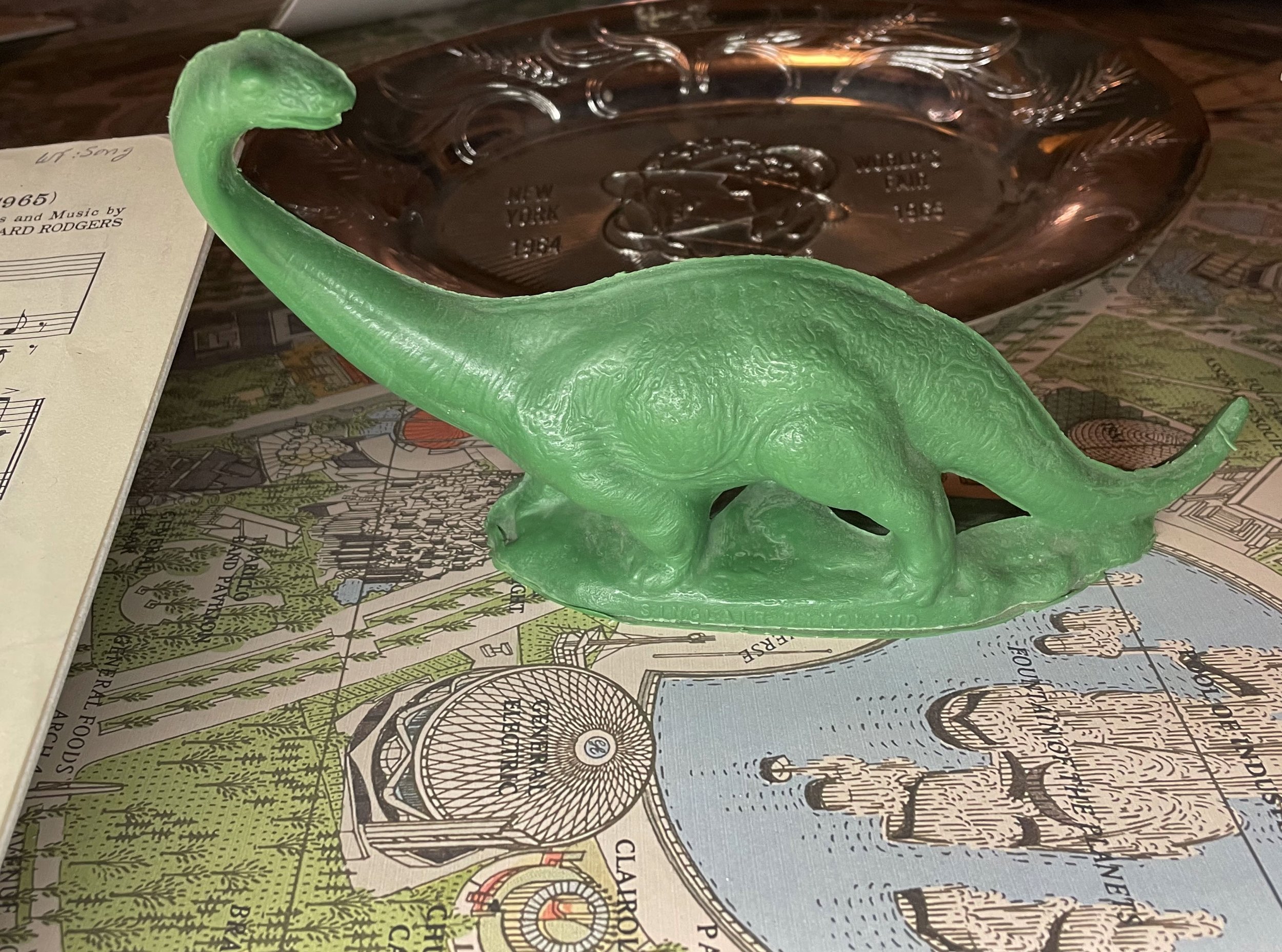
Sinclair Oil dinosaur mascot, plastic model, 1964 New York World’s Fair.
The Fair ran for two years, April 22 through October 18, 1964, and April 21 through October 17, 1965. Industrial and technological changes premiered at the Fair included color television, push button phones, and air conditioning. If you ask New Yorkers of a certain age what they recall about the 1964 World’s Fair, a flood of fond memories are disclosed. The 1964-65 fair conjures futuristic images, modern inventions and youthful excitement for those who attended. Some remember it as a monument to a less-troubled city and country. Others hold a less positive view of the Fair.
In The Power Broker, for example, author Robert Caro characterized it as Moses’ last grasp at immortality. It was a way to achieve a bigger goal: “…a dream out of his youth that had remained bright in his old age—a dream of a great park, the greatest in New York City, the greatest within the limits of any city in the world, the ultimate urban park, rus in urbe supreme, a park worthy of being named “Robert Moses Park…. The Fair, he realized at once, might at last be the means to achieve it. For the site of the Fair, like the site of the dream, was the Flushing Meadows.”
Brochures, 1964 New York World’s Fair.
Souvenir plate. 1964 New York World’s Fair.
According to Caro, ever since the 1920s, Robert Moses had envisioned turning the ash heap in Queens into a large park. In the mid -1930s he had a chance when the trio of federal, state and City governments funded park infrastructure to create the 1939 World’s Fair: The World of Tomorrow. Projected to reap a $4 million profit for the City that would fund a ribbon of parks throughout Queens, and managed by Grover Whelan, the Fair was a financial disaster. Most of the exhibits and buildings constructed for the event were bulldozed and debris littered the post-fair site which soon became overgrown and swampy. After World War II it was under consideration as the location for the United Nations, despite its deteriorated condition. The next evolution was the proposed 1964 World’s Fair with a theme, “Peace through Understanding.” Quite a lofty sentiment but one that did not suffuse the multi-year build or the Fair itself.
In 1959, Mayor Robert Wagner petitioned the federal government for authorization to hold the Fair in Flushing Meadow Park, formerly the site of the 1939 World’s Fair. The federal government approved the proposal. The governing body for world’s fairs (nowadays called Expos), the Bureau Internationale des Expositions, rejected the proposal because it violated rules on timing and location. Moses didn’t help matters. As a result, European countries boycotted the Fair, except for Spain.
This did not deter Robert Moses who had become the President of the World’s Fair Corporation, forcing Kopple out. Moses focused recruitment efforts on the rest of the world. Ultimately, the Fair’s 144 attractions included pavilions from 80 countries, 24 States and 350 companies, trade associations, organizations and religions.
The Clairol Building in the Industrial Area offered a hair color analysis to women over the age of 16. 1964 New York World’s Fair.
Twenty-four African countries showcased various cultural traditions in the pavilion dedicated to that continent. France, Denmark, Sweden and Greece were represented by commercial associations showcasing their wares. Swiss engineering was well-represented by the Sky Ride. The government of Israel declined to participate; a coalition established the American-Israel Pavilion. Close by, the Kingdom of Jordan displayed the recently discovered Dead Sea Scrolls and a poem decrying the status of Palestinian refugees which triggered substantial outcry and protests.
General Motors “New Futurama” show and the Vatican’s display of the Michelangelo sculpture Pieta were enormously popular. In Futurama, riders floated through various scenes imaging the ocean, desert, and city at a future point, showcasing new inventions. The “It’s a Small World” show produced by Pepsi Cola along with the Disney Corporation collected an entry fee, none of which actually went to UNICEF. Ford Motors debuted a new car: the Mustang. And Sinclair Oil’s dinosaur symbol was omnipresent. The beauty products manufacturer, Clairol, offered women older than 16 an opportunity to peer into a big plastic bubble for the purpose of receiving an analysis of the person’s best hair color.
Schaefer Beer, a Brooklyn brewery, sponsored a “Resturant of Tomorrow” along with a beer garden and exhibit on brewing in the F&M Schaefer Center. In addition to this pastel drawing, the Municipal Archives collection includes several plans in various formats for this pavilion. Schaefer was boycotted by the Congress for Racial Equality (CORE) for discriminatory practices. 1964 New York World’s Fair.
Almost all of the pavilions were temporary structures, demolished at the end of the Fair in 1965. Remnants of the Fair still exist in Flushing Meadow Park. They include the Unisphere, the New York State Pavilion, the Hall of Science and Industry, the Terrace on the Park, and the Marina, which was constructed especially for the Fair. The NYC Pavilion is now the home of the Queens Museum.
“Fair is Fair,” sheet music, 1964 New York World’s Fair.
The Fair opened at the height of the Civil Rights movement. The Reverend Martin Luther King Jr. had delivered his inspirational I Have A Dream speech at the March on Washington in 1963. A coalition of Americans, led by the Urban League, the Southern Christian Leadership Conference (SCLC), the National Association for the Advancement of Colored People (NAACP), the Student Nonviolent Coordinating Committee (SNCC), and the Congress for Racial Equality (CORE) were organizing around the country for the right to vote, leading to the enactment of the Voting Rights Act in 1965.
New York City was not immune from the battle for civil rights. The “Freedom Day” school boycott in February 1964, rent strikes, protests against employment discrimination, a six-day uprising after a detectives shot a young man in Harlem had all ratcheted up pressure for the City to address racial inequity. The Fair offered an opportunity to respond to demands for fair and equal employment, quality schools, substandard housing, discriminatory pricing, among other issues.
Site map, 1964 New York World’s Fair, Flushing Meadow, Queens, New York.
In early April, the Brooklyn chapter of CORE announced a “stall in” at which drivers would run out of gas or otherwise have their automobiles incapacitated along the five roadways leading to the Fair. The protest was opposed by CORE national leader James Farmer, but the local activists persisted. On opening day, the City deployed more than 1,000 police officers along the highways. Despite the local organizing, and perhaps because of City government’s threats, very few drivers participated, and the “stall in” was unsuccessful. But protests continued throughout the duration of the fair, including pickets at the Florida exhibit at which four young women were arrested for holding illegal placards and trespassing. Regular protests occurred at the Schaeffer Brewery location, protesting employment discrimination.
New York State Pavilion, color rendering. 1964 New York World’s Fair.
Speaking at the opening of the Fair in 1964, President Lyndon Baines Johnson addressed the Fair’s theme: Peace Through Understanding.
“This fair represents the most promising of our hopes. It gathers together, from 80 countries, the achievements of industry, the wealth of nations, the creations of man. This fair shows us what man at his most creative and constructive is capable of doing.
But unless we can achieve the theme of this fair--"peace through understanding"-unless we can use our skill and our wisdom to conquer conflict as we have conquered science--then our hopes of today--these proud achievements--will go under in the devastation of tomorrow.”
Student protestors drowned out portions of the President’s speech by shouting chants of “Freedom Now” and “Jim Crow Must Go” to the dismay of the leaders assembled for the event.
Even Dr. Ralph J. Bunche the Under-Secretary for Special Political Affairs at the United Nations had complaints. He wrote Governor Nelson Rockefeller about the limited representation of Black people in the film shown at the New York State Pavilion. The Governor defended the film, exhibiting a lack of awareness. For example, for the section depicting the City’s nightlife, he wrote “. . . in the section showing New York City at night, there are shots taken of chorus lines in two night clubs and the Rockettes . . . there is at least one Negro girl included in the Rockettes shown in the film.”
Aerial photograph of Flushing Meadow Park, 1961. New York World’s Fair Corporation Report #1, May 8, 1961.
Aerial photograph of Flushing Meadow Park, 1964. New York World’s Fair Corporation Report, January 1965.
Like its predecessor, the 1964-65 World’s Fair was not a money-maker. Moses and the Fair Corporation had projected a $53 million surplus in year one which would be used to repay the City, investors and to fund improvements to Flushing Meadow Park. Instead, the Fair ultimately operated at a loss. In July, 1964, a confidential letter to business and media executives called the Fair a fiasco. Only 27 million people visited the fair in its first year, far short of the 40 million promised by Moses.
The Department’s exhibit New York World’s Fair 1964-65 will be open to visitors through March 2026. The exhibit uses photos and ephemera from the Municipal Archives and Library collections to highlight key exhibits and features of the fair.
The symbol of the World’s Fair, the Unisphere, rose 140 ft. above a reflecting pool.