The Eternal Light Flagstaff in Madison Square Park

On Wednesday, November 11, 2020, New Yorkers observed Veterans Day. Until 1954, the annual November 11th observance had been known as “Armistice Day” commemorating the day and hour World War 1 hostilities ceased: the 11th hour of the 11th day of the 11th month of 1918. 

Celebrating the end of World War I on the steps of City Hall, November 18, 1918.  Grover Whalen Collection, NYC Municipal Archives.

Celebrating the end of World War I on the steps of City Hall, November 18, 1918.  Grover Whalen Collection, NYC Municipal Archives.

In November 1919, President Wilson proclaimed November 11th as the first commemoration of Armistice Day. In 1926, the U.S. Congress resolved that “…the recurring anniversary of this date should be commemorated with thanksgiving and prayer and exercises designed to perpetuate peace through good will and mutual understanding between nations.” Armistice Day became a federal holiday by an Act of Congress in 1938.  In 1954, Congress changed the holiday to “Veterans Day” in order to account for all veterans in all wars.

The eternal light on the top of the flagstaff was illuminated on Armistice Day, November 11, 1923, and the monument dedicated the following spring on June 7, 1924.  Flagstaff Memorial Monument, Madison Square Park, n.d. Art Commission Coll…

The eternal light on the top of the flagstaff was illuminated on Armistice Day, November 11, 1923, and the monument dedicated the following spring on June 7, 1924.  Flagstaff Memorial Monument, Madison Square Park, n.d. Art Commission Collection, NYC Municipal Archives.

In our blog commemorating Veterans Day last November [link], writer Stuart Marques explored the fascinating history of New York City’s “….elaborate welcome home events for our soldiers and the generals who led them, and often riotous celebrations.” This year we will examine a quieter tribute, the Eternal Light Flagstaff memorial monument. Located in Manhattan’s Madison Square Park, the memorial honors the United States Army soldiers and Navy sailors who fought in World War I. 

Grover Whalen, April 4, 1924.  Department of Bridges, Plant & Structures Collection, NYC Municipal Archives.

Grover Whalen, April 4, 1924.  Department of Bridges, Plant & Structures Collection, NYC Municipal Archives.

Like most New York City celebratory events of that era, Grover Whalen orchestrated the “Illumination Day” activities. Appointed by Mayor Hylan as the city’s official greeter in 1919, Grover Whalen had the idea to throw ticker-tape receptions for returning World War I soldiers and to continue the practice for distinguished guests over the next three decades. Famous for his top hat and the carnation he always wore in his lapel, Whalen presided over more than 1,000 public events, and organized more than 150 ticker-tape parades before he retired in 1953.

Department store magnate Rodman Wanamaker, a confidante and ally of Whalen, had donated the $25,000 cost of the flagstaff. On Illumination Day Wanamaker set alight the star on the flagstaff, and in brief remarks, said “. . .We are gathered here today to thoughtfully recall the valiant deeds of those who make it possible that our nation might be saved. We are here in memory of those who will never be here, but whose sacrifice has made possible our country’s preservation.”
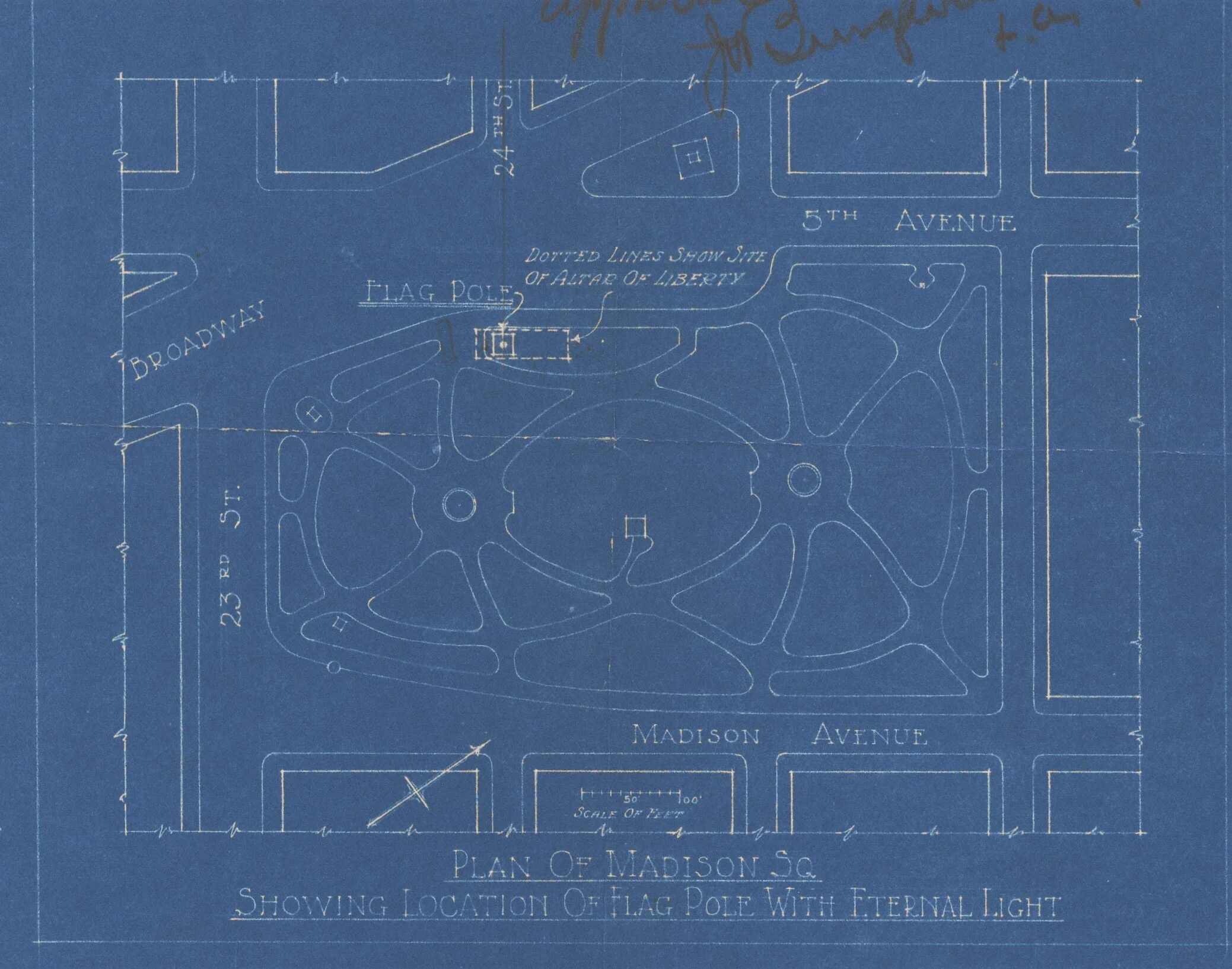
Plan of Madison Square showing location of flag pole with eternal light.  Blueprint, 1924.  Grover Whalen Collection, NYC Municipal Archives.

Plan of Madison Square showing location of flag pole with eternal light.  Blueprint, 1924.  Grover Whalen Collection, NYC Municipal Archives.

After the ceremony, the New York Times reported that Wilson and Randolph Hearst, the 7-year-old twin sons of newspaper publisher William Randolph Hearst, distributed cigarettes to the disabled soldiers, who later rode in trucks in the Armistice Day parade up to the Central Park mall.

The Municipal Archives’ collections of Whalen materials provides ample documentary evidence of Whalen’s organizational skills. No detail was too small. The papers in his collection related to the Eternal light illumination on November 11, 1923 are typically extensive.

Confirming arrangements for the November 11, 1923, illumination event.  Grover Whalen Collection, NYC Municipal Archives.

Confirming arrangements for the November 11, 1923, illumination event.  Grover Whalen Collection, NYC Municipal Archives.

Architect Thomas Hastings (1860-1929), of the firm Carrere and Hastings, designed the monument. Paul Wayland Bartlett (1865-1925), a student of French master sculptor Auguste Rodin, sculpted the decorative bronze cap at the base of the flagstaff including garlands and rams heads. The star-shaped luminaire at the top of the pole is intended to be lit at all times as an eternal tribute to those who paid the supreme sacrifice. 

According to the Department of Parks and Recreation, the original wooden flagstaff, towering 125-feet tall, was said to be hewn from a century-old tree culled from “the virgin forests of Oregon and transported over the Rocky Mountains.” The monument has been repaired and upgraded on several occasions. In 1976, the original wooden flagstaff was replaced with a metal mast. In 2017, the Madison Square Park Conservancy refurbished the luminaire, and in 2018 removed the fences that had confined the monument and redesigned the surrounding plaza. The Eternal Light continues to serve as the site where the annual citywide official Veterans Day ceremony takes place and the Veterans Day parade embarks up Fifth Avenue.

Mayor Robert Wagner (center) presided over the annual ceremony at the memorial flagstaff in Madison Square Park, on November 11, 1965.  Official Mayors Photograph Collection, NYC Municipal Archives. 
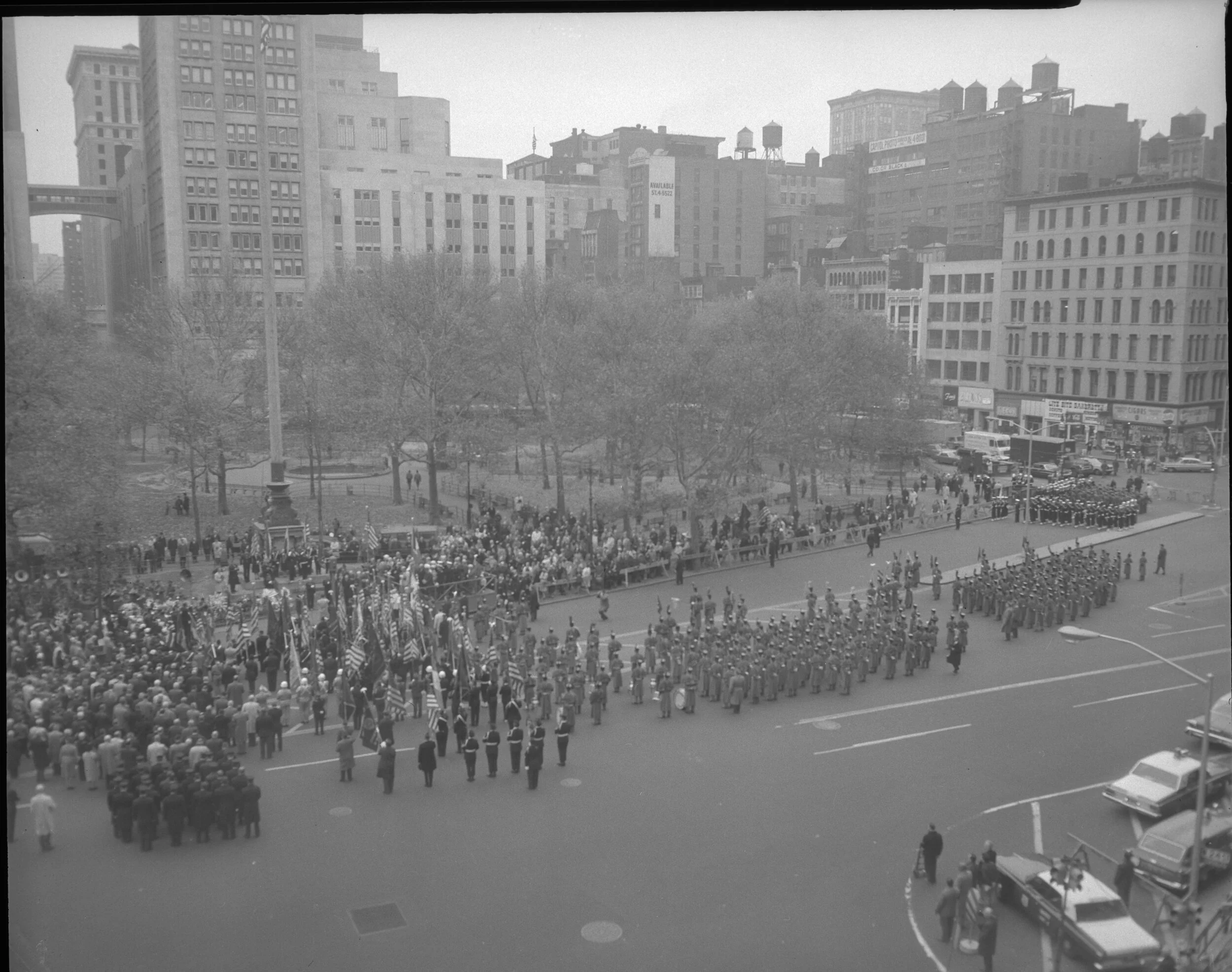
Mayor Robert Wagner (center) presided over the annual ceremony at the memorial flagstaff in Madison Square Park, on November 11, 1965.  Official Mayors Photograph Collection, NYC Municipal Archives. 

Annual ceremony at the memorial flagstaff, Madison Square Park, November 11, 1965.  Official Mayors Photograph Collection, NYC Municipal Archives. 
Annual ceremony at the memorial flagstaff, Madison Square Park, November 11, 1965.  Official Mayors Photograph Collection, NYC Municipal Archives. 

Brooklyn Bridge Architectural Drawings: Material Matters

During the past year, Municipal Archives conservators have been treating the original oversize plans for the construction of the Brooklyn Bridge to make them accessible to scholars and the public. The drawings are very large, very detailed, and in some cases very brittle. Naturally, as conservators, we have a lot of questions:  Why is some of the drawing paper so hard and brittle while some is not?  Considering that they are eight to twelve-feet in length (and some even longer), how were the drawings made? Are the inks soluble and will they bleed or smudge during treatment with water? A more in-depth look at the manufacturing and drafting processes helps to inform our treatment plan.

Paper

In the early part of the 19th century paper mills mechanized their processes to keep up with demand.  Later, chemical bleaching and alum-rosin sizing was introduced into the paper manufacturing process.

The standard type of paper available for drawings of this size was called “Manilla” so named because the abaca fiber used to produce the paper was recycled from ropes from Philippine ships. By the mid-19th century it was made with wood pulp and coloring to imitate the light yellow-brown color of the original. The paper produced was available in rolls and had a hard, smooth surface, perfect for drawing. It was cheaper than white drawing paper and could be cut to almost any length.

 “Sizing” is essentially a filler or coating applied to paper that alters the surface texture in order to prevent inks from bleeding into the absorptive fibers. Traditionally applied to the surface of each individual sheet, the modern paper mill could add sizing to the beaten pulp, streamlining the papermaking process. Rosin is an acidic resin that requires alum (a soluble aluminum-containing-product) to adhere to cellulose fibers. The rosin coated fibers resist the absorption of water (or inks containing water) improving the writing surface.


Due to the very smooth surface and internal sizing, water is not readily absorbed into these papers. NYC Municipal Archives.

Due to the very smooth surface and internal sizing, water is not readily absorbed into these papers. NYC Municipal Archives.

In addition, rosin sizing improved the formation and strength of each sheet as it sped through the iron rollers of the mills.  Rollers heated to higher temperatures would create a smoother and harder surface. A drawing with very fine lines requires paper with these qualities to keep the pen point from skipping and the ink from spreading. According to Cathy Baker in her excellent book, From the Hand to the Machine, “. . . alum was used rather indiscriminately to correct most problems in the manufacture of paper.” [1]

The acidic sizing process, plus the inherent acidity of the wood pulp paper fibers that the drawings are composed of, as well as almost 100 years of less-than-ideal storage conditions prior to their acquisition by the Municipal Archives all contribute to the extreme brittleness that these papers display today.[2]

Raking light highlights the subtle texture of cracking from embrittlement in this drawing).   NYC Municipal Archives.

Raking light highlights the subtle texture of cracking from embrittlement in this drawing). NYC Municipal Archives.

In order to make the drawings available for research, part of our treatment includes washing out acidic compounds to prevent further degradation. The paper must be submerged in and absorb water so that the the acids will wash out. Knowing that there will be resistance to that absorption allows us to modify the treatment to include a solvent in the water bath. The solvent helps break the bond of the resin to the paper fiber, allowing water in and out of the  fibers taking the acidic compounds along with it.  

Ink

Submerging the paper in water means that we would have to be certain that the drawing will remain in place.  Nineteenth century manuals for the practice of draftsmanship recommended that the “best” ink for drawing was “the cheapest” black India ink.[3] India ink is made from a combination of soot, or “lampblack” and gum Arabic with shellac or bicarbonate of ammonium or magnesium added to make it waterproof. The soot is the collected pure carbon formed when oil or tar is burned in a low oxygen environment. Essentially, the collected soot is ground into a very fine pigment and mixed with the water-soluble gum binder. The oldest true inks were made this way.

The first synthetic colored dye, Mauveine purple, was developed in 1856. Because of the immense commercial success of the dye (it could easily color cotton, making colored fabrics accessible to the new middle class) chemists raced to produce a rainbow. The first colors were in the red family—madders and carmines—purples and vermillion-like colors. The chemistry for blues did not arrive until 1863 and was quite expensive. The indigo plant remained the primary source for blue dye until the 1890s.

Three ink colors were used by draftsmen in the Brooklyn Bridge drawings:  black for the primary image and shading; red for measurement indications; and blue to highlight certain features like train tracks or architectural elements. If a color was used to indicate measurements, red was the standard. Blues were used to indicate metals such as cast- and wrought-iron and steel. 

The subtle red colored lines indicate measurements and the subtle blues indicate the steel railroad tracks on the bridge.  NYC Municipal Archives

The subtle red colored lines indicate measurements and the subtle blues indicate the steel railroad tracks on the bridge. NYC Municipal Archives

Professional draftsmen are artists, trained to produce mechanical or technical drawings that fully describe the way something functions or is constructed. A modern draftsman is highly-skilled in perspective drawing and graphic design, and knowledgeable regarding measuring systems, notational systems and engineering. Today, architectural drawings are largely finalized using CAD software. When the Brooklyn Bridge was built, the drawings were produced entirely by hand, using specialized tools and standardized drawing techniques.  The draughtsman’s work was relied upon to convey complex details—from the span of the bridge to the angle of the threads on the bolts that held it together—in a common pictorial language that would be understood by the numerous foremen, craftsmen, contractors and vendors involved in the production of the structure.

 The drawings were composed using a “T” square,  compass, protractor, French curves, set triangles, and metal fountain pens to make straight and precisely curved thin lines in black ink. Shading was done using patterns of lines drawn closely together or by color washes. Patterns for shading and methods for drawing plans were published in guidebooks to provide instructions on  the proper way to convey the details of the plans to others. [4]

 Although most black inks remain insoluble during aqueous treatments, they must always be tested for water-fastness. Not only because one’s eye is not necessarily the best judge of ink quality, but because water-soluble dyes (aniline reds or indigo blues, or both) were sometimes added to improve the richness of the black.

 Colored inks made with dyes were favored for fountain pens because the brightly colored liquid flows easily, but dye-based inks remain water soluble and fade in UV light. Colored inks must  always be tested when considering aqueous treatment to prevent bleeding or washing off.

We learned that the red and blue inks of the Brooklyn Bridge drawings are soluble in water to various degrees. Thus, conservators may use special methods of fixing the inks or masking off areas that may be negatively affected by water. Similar to the use of a mordant added to fabric dyes to prevent bleeding, conservators may use fixatives to keep inks stable during aqueous treatment. 

Ink test 1.jpeg
A water droplet is placed in an innocuous spot on the ink  to be tested. The droplet is blotted with a clean blotter paper. This test shows minimal solubility of the black ink.  NYC Municipal Archives.

A water droplet is placed in an innocuous spot on the ink  to be tested. The droplet is blotted with a clean blotter paper. This test shows minimal solubility of the black ink. NYC Municipal Archives.

There is always the expectation of a surprise when carrying out a complicated conservation treatment. That expectation is a motivating factor in planning a well- thought out and researched treatment protocol. Understanding the materials that make up your object contributes a great deal to performing a treatment without surprises.


[1] Baker, Cathleen A., From the Hand to the Machine. Ann Arbor, MI: Legacy Press, 2010. p. 72

[2] You can read about the discovery and storage conditions of the Brooklyn Bridge Plans before they were acquired by the archives here. Link to: https://www.americanheritage.com/treasure-carpentry-shop

[3] Camp, Fredrich T., “Draftsman’s Manual, or How Do I Learn Architecture?” New York: Comstock, 1883

[4] American Technical Society, “Cyclopedia of Architecture, Carpentry and Building,” Chicago: American Technical Society, 1912

Rochdale Village Protests

In October, 2019, the New York City Municipal Archives finished digitizing a collection of over 1,400 surveillance films created by the NYPD’s Bureau of Special Services and Investigations.  Many featured political protests and demonstrations from 1960 to 1980. Prior to the passage of the 1964 Civil Rights Act, this surveillance program focused intensely on actions carried out by members of the National Association for the Advancement of Colored People (NAACP) and the Congress of Racial Equality (CORE) as they protested racial injustice and unequal treatment. One of the longest of these actions was the protest against the construction of the Rochdale Village housing cooperative.

At the time of its opening in late 1963, Rochdale Village in South Jamaica, Queens was the largest integrated housing cooperative in the country.  Located within a community that was almost entirely African American, it was part of a City-wide effort to racially integrate New York’s communities. And yet, during that summer, a nearly three-month long protest against Rochdale Village was conducted by NAACP, CORE and inter-faith groups. Although the building was promised to have both black and white tenants, an all-white construction union was hired to build it. During the summer of 1963, dozens of protesters interrupted the construction using a wide array of civil disobedience techniques.

Rochdale Village, 133rd Avenue East and New York Boulevard [Demonstration against racial discrimination in hiring practices], August 9, 1963

These techniques were sometimes as simple as sitting in the street to block traffic to the construction site. Others were more clever and subtle, with protesters walking so slowly while they picketed the entrance to the site that trucks could not leave or enter. Other times, seemingly unrelated people would fall from their bicycles while riding right in front of construction trucks. Protesters would then rush to the fallen person’s side to provide help, blocking traffic at the same time. While police officers would quickly arrest those who sat in the street or chained themselves to construction equipment, the more subtle techniques seemed to genuinely complicate or challenge the ability to arrest protesters.

Rochdale Village, 133rd Avenue East and New York Boulevard [Demonstration against racial discrimination in hiring practices], August 9, 1963

William H. Booth was one leader of the protests. The president of the New York State chapter of the NAACP at the time, Booth can be seen in several films going back and forth between fellow protesters and the police, sometimes frustrated, sometimes laughing, often coaching those who were being arrested. Eventually, Booth himself was arrested along with 23 others, the most arrests in a single day during the months-long demonstration. Although they were charged with disorderly conduct for trying to block construction trucks, the charges were later dropped. Booth would be appointed to Mayor John Lindsay’s Commission on Human Rights from 1966 to 1969, only three years after the Rochdale Village protest. After that, he served as a New York judge for 13 years on the Criminal and State Supreme Courts. Booth passed away in 2006 at the age of 84.

Rochdale Village, 133rd Avenue East and New York Boulevard [Demonstration against racial discrimination in hiring practices], August 8, 1963

Rochdale Village was completed in the fall of 1963, with 10% of its low and middle income housing units going to families of color. Over the next two decades, the share of apartments occupied by families of color would increase as white families left Rochdale Village and urban centers more generally for the suburbs. Rising crime, increased carrying charges (equivalent to rent) and troubled schools helped fuel the exodus. The housing cooperative fell into disrepair during the 80s and most of the 90s, but as the City revitalized by the end of the 20th century, so too did Rochdale Village. Today, it is fully-occupied and boasts of being one of the most affordable housing cooperatives in the City.

During the early 1960s, the NYPD filmed several other NAACP and CORE protests against the use of segregated construction labor for more housing cooperatives, hospitals and other buildings. In addition to protesting segregated labor, the NYPD also recorded NAACP and CORE rallies against segregated schooling, the prevalence of police brutality against communities of color, and the Vietnam War. Over the course of the 1960s, the NYPD documentation of NAACP and CORE actions slowly diminished to be replaced by film of other organizations fighting for racial justice like the Black Panther Party. Films featuring demonstrations by the NAACP, CORE, the Black Panther Party and many others are now available  to browse on the New York City Municipal Archives online gallery: gallery


Elections in NYC

The United States is experiencing one of the most tumultuous national election cycles in our country’s history. Already, two weeks before Election Day, millions of people have voted either through early voting or with absentee ballots, also known as mail-in votes. On Saturday, October 24, voters in New York State will begin nine days of early voting. And on Election Day, November 3, registered voters will be able to cast their vote during a full day from 6 a.m. to 9 p.m.

We pulled some images and film footage related to campaigns and elections from our digitized collections to remind everyone of this country’s long history of the democratic process.  

Department of Public Works Commissioner Halleran standing by an election poster for President Abraham Lincoln and Vice President Andrew Johnson, the “Union Nomination,” n.d. Borough President Queens Photograph Collection. NYC Municipal Archives

Department of Public Works Commissioner Halleran standing by an election poster for President Abraham Lincoln and Vice President Andrew Johnson, the “Union Nomination,” n.d. Borough President Queens Photograph Collection. NYC Municipal Archives

Fiorello LaGuardia ran on the Fusion Party ticket in the 1933 election for mayor. He won. Poster, 1933. Mayor Fiorello LaGuardia Collection. NYC Municipal Archives

Fiorello LaGuardia ran on the Fusion Party ticket in the 1933 election for mayor. He won. Poster, 1933. Mayor Fiorello LaGuardia Collection. NYC Municipal Archives

In 1968, City Council President Paul O’Dwyer ran for the U.S. Senate. He won the primary, but lost in the November general election to the Republican Jacob K. Javits. Senate Campaign Poster. Municipal Archives Collection. NYC Municipal Archives.

In 1968, City Council President Paul O’Dwyer ran for the U.S. Senate. He won the primary, but lost in the November general election to the Republican Jacob K. Javits. Senate Campaign Poster. Municipal Archives Collection. NYC Municipal Archives.

Robert Kennedy served in the U.S. Senate representing New York from January 1965 until his assassination in June 1968. Campaign Brochure, 1965. Vertical Files. NYC Municipal Library.

Hubert Humphrey’s 1968 presidential campaign made a swing through lower Manhattan on October 8, 1968, captured in this silent film, NYPD Surveillance Film Collection. NYC Municipal Archives.

The Transcription Project, Early Mayors' Collection II

Recent blogs have described the work archivists have accomplished transcribing collection inventories, lists, finding guides and other descriptive materials into searchable databases and spreadsheets.  The transcription projects began when the Municipal Archives closed to the public on March 16, 2020, and all staff began to work remotely from home.  This week is the second installment describing the Early Mayors’ collection transcription project. 

Correspondence from the American Society for the Protection of Animals appears frequently in the collection; not surprising given the vast number of horses in the city and the potential for mis-treatment. The ASPCA’s interest was not restricted to the equine population. Letter from John P. Haines, President of the ASPCA to Mayor Thomas F. Gilroy, June 9, 1893. Early Mayors’ Collection. NYC Municipal Archives.

The Early Mayors’ collection includes correspondence and documents from New York City mayoral administrations from 1826 through 1897 and totals 157.5 cubic feet.  The collection had originally been assembled by Rebecca Rankin during her 32-year tenure as the Director of the Municipal Library between 1920 and 1952.  This was a core collection in the Municipal Archives when it opened in 1952 and remains one of the most important series documenting nineteenth-century government and policies.

The Early Mayors’ collection also includes typewritten summary descriptions of every document in the series prepared by archivists and librarians in the1950s and 60s. Mr. Idilio Gracia-Pena, Municipal Archives Director (1976-1989), and DORIS Commissioner (1990-1995), recently confirmed that these typewritten summaries had been produced under the direction of James Katsorhis.  He had worked as an assistant to Rebecca Rankin and took over as head of the Archives when Rankin retired in 1952.

New Yorker Jonathan Lawrence wrote to Mayor Wickham about the importance of having street signs at each corner. Lawrence notes that the Common Council had been petitioned on this subject every year, but had not acted. May 8, 1893. Mayor William Wickham. Early Mayor’s Collection. NYC Municipal Archives.

Conservator Cynthia Brenwall has been part of the team transcribing the Early Mayors’ collection typed inventories. In describing the work, she observed “…  average New Yorkers wrote to the mayor and city officials a LOT! They made complaints, asked for help, inquired about unusual topics and sent congratulations every day.  Apparently, New York was dirty! The amount of complaints about ashes and garbage, dead animals in the streets, stables located in basements and smells coming from the “offal docks” is astonishing.”

Brenwall also noted “…for the most part, women were irrelevant in public life at the time...at least as seen through these documents.  With the exception of a few public charities, searches for lost children and the ladies of houses of ill repute, women are very rarely mentioned in these letters.” 

Nora Casey, an emigrant who arrived in this country in June, had been diagnosed as “insane” and confined to the Emigrant Asylum, Ward's Island. On September 1, 1888, Ellie Casey informed the authorities that her mother would not be able to accompany her sister home to [County] Cahirciveen, Ireland. Other documents indicate that the mother and sister lived in Massachusetts and asked for her to be moved to live with them. But the Board reviewing whether immigrants might be a “public charge” were bound to send her back to Ireland, where there was nobody to take care of her. Mayor Abram Hewitt. Early Mayors’ Collection. NYC Municipal Archives.

Similar to archivist colleague Amy Stecher’s description of work on the Early Mayors collection transcription project, Brenwall also remarked on the staggering amount of corruption in the city. “From policemen taking bribes for not reporting gambling and prostitution houses in the 1880s to men stealing luggage from newly arrived immigrants at Castle Clinton. to election fraud and a whole scheme of illegal electrical wires run through the city...it seems like everyone was out to make a buck.”

Police Captains were required to reported on the condition of “panel” houses in their respective precincts. “Panel Houses” were houses of prostitution that were constructed with hollowed out walls where thieves could hide and wait for a chance to rob men patronizing the establishments. “Panel House” thieves relied on the reluctance of their victims to press charges and face publicity. Many of these houses were under the protection of the police. Police Captains report, April 1874. Mayor William Havemeyer. Early Mayors’ Collection. NYC Municipal Archives.

Licensing places of public assembly was among the New York Police Department responsibilities during the 19th century. Carnegie Hall received a good report from the NYPD, April 21, 1892. Mayor Thomas Gilroy. Early Mayor’s Collection. NYC Municipal Archives.

In 1890 a substantial portion of City residents were immigrants and City officials believed that its population was undercounted by federal census-takers. The Harlem Democratic Club, along with many other New Yorkers urged a re-count. Mayor Hugh Grant directed that the New York Police Department conduct another count. The result was the 1890 “Police” census which quantified the City’s contention that the numbers in the federal count were significantly lower. Harlem Democratic Club, September 1890. Mayor Hugh Grant. Early Mayors’ Collection. NYC Municipal Archives.

Mayor Grant’s efforts to persuade federal officials to accept the revised numbers were unsuccessful. The November 6, 1890, letter and eight-page attachment from the Department of the Interior to Mayor Grant made that clear. Early Mayors’ Collection. NYC Municipal Archives.

Ms. Brenwall concluded that the more thing change, the more they stay the same.  I was repeatedly struck by how many issues of the time are very similar to issues of today. Cholera and yellow fever outbreaks that caused quarantines, police force issues, citywide celebrations marked important occasions and give all residents a respite from daily life and the recognition that as New Yorkers we must take care of each other for the city to be successful.”

Railroad magnate Cornelius Vanderbilt complained to Mayor Edward Cooper that the conductor of a street car on which he was a passenger “willfully” obstructed another car on Christopher Street and should be reprimanded. July 5, 1879. Mayor Edward Cooper. Early Mayors’ Collection. NYC Municipal Archives.

Brenwall added that her work over the last several months has been “…an amazing deep-dive into Victorian-era New York! Creating a searchable document is going to such a great resource for researchers and history buffs alike once we completed this project.” 

We look forward to making available the results of this telework project undertaken by the Municipal Archives.

Unemployment in the Great Depression

As has often been stated, the Covid 19 pandemic has yielded the worst economic situation since the Great Depression.  The Bureau of Labor Statistics reports that unemployment now hovers just under 8%, after reaching a high of 14.7 % in April 2020.  At the peak of the Depression, however, national unemployment reached a high of 25% by 1933 and one third of New York City workers were unemployed.  In his book, The Lean Years, Irving Bernstein provides data from the federal Committee on Economic Security showing that the number of unemployed workers increased from 429,000 in October 1929, to 4,065,000 in January 1930.  By October 1931 nine million Americans were out of work.

Frequently, in discussing how NYC fought back during the Depression, the focus turns to Mayor Fiorello LaGuardia.  But, he wasn’t the Mayor at the inception of the Depression.  Instead it was James Walker, the so-called “Beau James” due to his spiffy clothes and nighttime gallivanting.  Elected in 1925 with the help of former Governor Al Smith and the Tammany machine, Walker defeated incumbent Mayor John Hylan.  Walker styled himself as the “people’s mayor”—he relied on publicity and wit, not policy or good government. Yet some observers of City government have described him as a decisive problem solver. He did oversee revisions to the Building Code and the City’s tax structure.  But, it was his public persona that people liked.   Opposed to Prohibition, he once staged a “We Want Beer” event in 1932 attended by 100,000 people.   In 1929 he ran for re-election, beating the Republican candidate—LaGuardia--handily.   Walker resigned in 1932 after a corruption inquiry revealed many “beneficences” given to him by City contractors.  

Mayor James J. Walker, seated at left, and film actress Marjorie King at the Motion Picture Club Ball, Waldorf Astoria, February 1932. Municipal Archives Collection. NYC Municipal Archives.

Mayor James J. Walker, seated at left, and film actress Marjorie King at the Motion Picture Club Ball, Waldorf Astoria, February 1932. Municipal Archives Collection. NYC Municipal Archives.

Walker was in the hot seat when the stock market crashed in October 1929.  Today, we are used to a centralized government that focuses resources on city problems but as Warren Moscow long-time New York Times reporter wrote in a 1976 reflection on Depression-era government. “there were no central departments of Highways, or Public Works. The city Street Cleaning Department did not extend to Queens and Richmond, where the Borough Presidents appointed their own men to lean on brooms. There were five separate Park Departments and no Department of Traffic, although the police were beginning to restrict some side‐streets, but not avenues, to one‐way use.”  Although Walker created the Department of Hospitals which put all of the municipal hospitals under one charge and developed large-scale construction projects such as the TriBorough Bridge and the West Side Highway, City government did not have a mechanism to provide large-scale relief.   At this point, unemployment insurance didn’t exist anywhere in the United States.  New York City, like all other municipalities relied on a patchwork of philanthropic and charitable societies to provide assistance to the poor, the unemployed, the homeless and the hungry, with those most indigent sent to almshouses.  Despite valiant efforts, the Depression would change that system.  

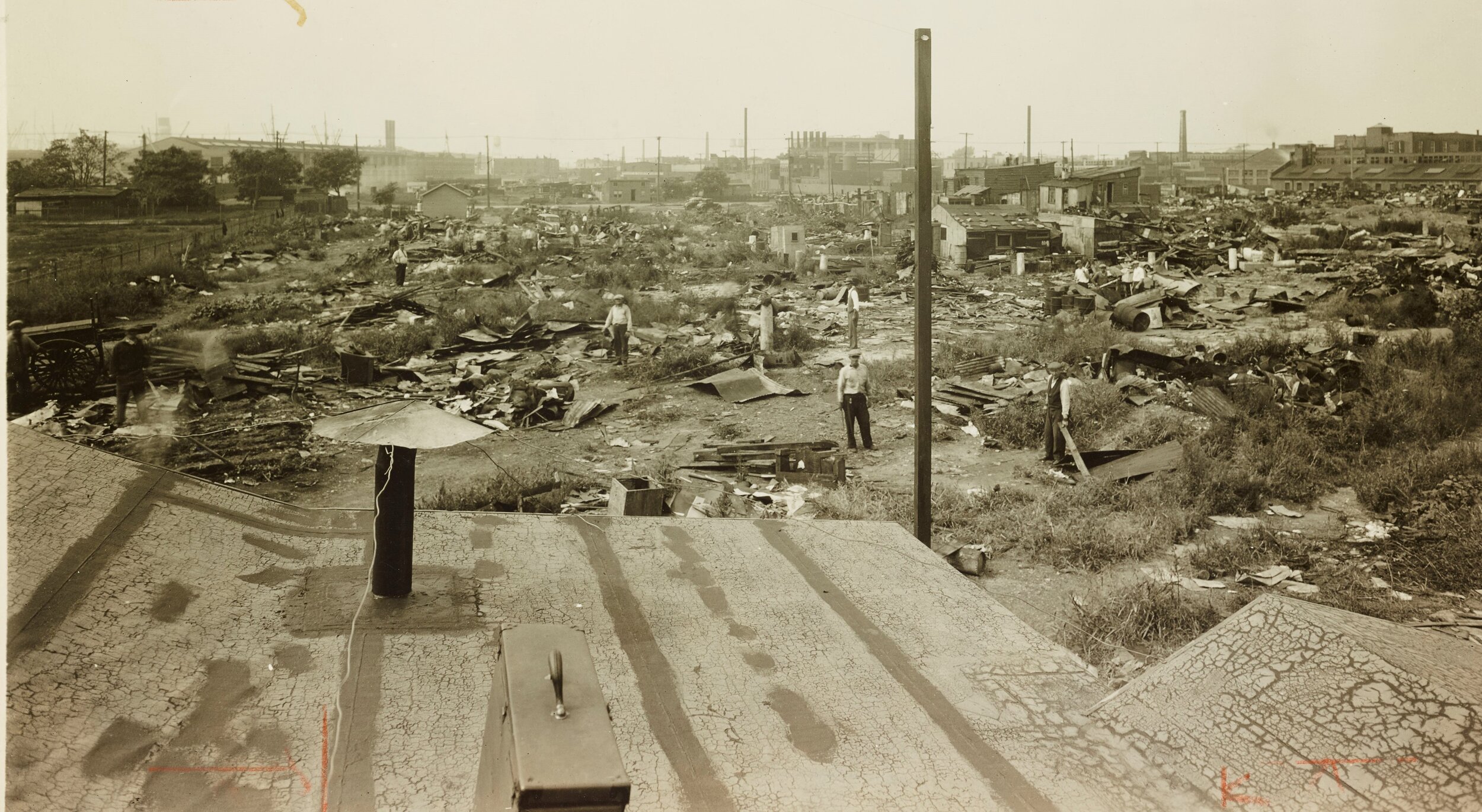
Known as “Hoovervilles,” large makeshift encampments of unemployed and homeless New Yorkers began to appear around the city during the Great Depression. Red Hook, Brooklyn, ca. 1931. Municipal Archives Collection. NYC Municipal Archives.

Known as “Hoovervilles,” large makeshift encampments of unemployed and homeless New Yorkers began to appear around the city during the Great Depression. Red Hook, Brooklyn, ca. 1931. Municipal Archives Collection. NYC Municipal Archives.

In March 1930, the New York Times reported that 35,000 people protested unemployment in the City as part of an International Unemployment Day by the Communist Party.  Protesters marched toward City Hall only to be violently stopped by police officers.

Also in March, a coalition of trade union leaders wrote the Mayor with proposals that “will bring an immediate measure of relief.” They focused on public works; creating a system to provide direct relief and a process for finding work without paying private employment agencies.  In doing so, they noted that the City’s public works program fell short and that “rather than a speeding up of public works an actual recession in the letting of contracts has been the case.” They cited the reduction in contracts for subway construction, the lack of funding for slum clearance and housing construction and the lack of a system to provide relief.  “Daily reports reveal that the private welfare agencies are swamped with requests for assistance.  In the meantime, the Department of Public Welfare, which has as its chief function the relief of the destitute, has no funds available to meet this emergency.  In fact, it is the practice of the department to shift applications for relief to the private charity agencies which have publicly stated their inability to meet the heavy demands being made on them.  The responsibility of the city towards its workers demands not charity but that the city provide immediate relief for the jobless who are in dire straits through no fault of their own.  It would be a lasting disgrace if in the richest city of the world a single man, woman or child should go hungry.”

The Department of Public Welfare operated a Lodging House on the Pier at East 25th Street, November 22, 1930. Photographer: Eugene de Salignac. Department of Bridges, Plant & Structures Collection. NYC Municipal Archives.

The Department of Public Welfare operated a Lodging House on the Pier at East 25th Street, November 22, 1930. Photographer: Eugene de Salignac. Department of Bridges, Plant & Structures Collection. NYC Municipal Archives.

A report from the Welfare Council of New York City discussed the pressure on the city’s employment and welfare agencies noting there was “a serious falling off in placement of workers in jobs and a corresponding increase in the number of homeless men, seamen and families applying for assistance.”   The report also discussed “the disastrous consequences” for the unemployed and their families.  “Constant anxiety and undernourishment bring suffering to the worker and his family.  Undermining of physique and the loss of self-respect which accompanies weeks of fruitless search for work gradually bring mental and moral degeneration, and from being merely unemployed the worker becomes unemployable.  His troubles do not cease when a job is found.  The physical and mental deterioration consequent upon a long period of unemployment, a lowered standard of living and the burden of accumulated debt are long continued.”

Initially, data was unreliable and incomplete.   In the April 23, 1930 edition of “Library Notes” a publication of the City’s Municipal Library, Rebecca Rankin wrote about the difficulty in obtaining accurate figures of how many people had been affected.  “Owing to the inaccuracy and incompleteness of any figures available on unemployment at any one time, there seems to be some doubt as to whether times are as bad as portrayed.”

W.E.B. DuBois wrote Mayor Walker in 1931 asking for “information as to what was accomplished for the relief of unemployed Negroes last year in New York and what plans you have for the coming year.“  The response from the City was that relief funds were not segregated by race and  further, that if the information could now be obtained by investigation, it does not seem to me desirable to obtain it.”

The impact of the Crash is not initially apparent in the correspondence of the Department of Welfare.  But by June 1930, the Mayor and other officials were receiving letters requesting assistance.   Welfare Department Commissioner Frank J. Taylor wrote several acknowledgements to the Secretary to the Mayor, Charles S. Hand.  Invariably they would begin, “I am in receipt of your letter of the (date) instant enclosing a communication from…

Mrs. Mary Streppone in which she complains that family is in destitute condition and husband is out of work…

Manuel Manzano, who states that he was hurt while employed by the U. S. Electrical Mfg Corp…and desires assistance in his case with the Bureau of Workmen’s Compensation, as he is penniless and sick with a wife and three children dependent upon him…

Edward Reynolds, relative to his mother and her application for pensions for five of her grandchildren, whose parents are dead. …

Max Warsinger who is badly in need of help and requests some kind of work…

In all cases, Taylor promised that a representative from the Department would visit the writers to see if there is something to be done “to help them out.”  The end result is not summarized in the files.

Richmond Borough President John Lynch to Mayor’s Committee Secretary McAndrews regarding contractors, telegram, November 20, 1930. Mayor James J. Walker Subject Files. NYC Municipal Archives.

Richmond Borough President John Lynch to Mayor’s Committee Secretary McAndrews regarding contractors, telegram, November 20, 1930. Mayor James J. Walker Subject Files. NYC Municipal Archives.

Mayor’s Committee Secretary McAndrews request to Brooklyn Borough President regarding contractors, telegram, November 19, 1930. Mayor James J. Walker Subject Files. NYC Municipal Archives.

Mayor’s Committee Secretary McAndrews request to Brooklyn Borough President regarding contractors, telegram, November 19, 1930. Mayor James J. Walker Subject Files. NYC Municipal Archives.

In October 1930, Mayor Walker created the Mayor’s Official Committee for Relief of the Unemployed and Needy which consisted of himself as the Chair, the Commissioner of the Department of Public Welfare, Frank J. Taylor as the Vice Chair, the City Chamberlain, Charles A. Buckley was treasurer, and the secretary to the Mayor, Thomas F. McAndrews was the Secretary.  A slew of other city officials were listed as members. In the announcement he said, “The first cold spell that falls on this city is going to find a terrible condition.  I want to be prepared for it.  I want to feel that during it and after it, this administration, this group of men that make up this administration, have not left a thing undone that they could have brought about as a contribution to the alleviation of any suffering that will be found in this city.“ 

By November 1930, American City, a monthly magazine providing policy, equipment and other advice to city leasers reported on how cities were tackling unemployment.  New York had a lot going on: “A City Employment Bureau is functioning; a police census of unemployed is in progress; the eviction of needy families for non-payment of rent is being halted; the police and other employees are arranging to donate extensively to unemployment relief; Mayor Walker has appointed a Cabinet Committee on Unemployment to deal with questions of food, clothing, jobs and rent; municipal lodging facilities are being added to.  At the same time an effort is being made to prevent a flood of unemployed men from pouring in upon the city.”

The New York Life Insurance Company donated space to be used as the committee’s headquarters.  The Committee drew upon eighty-one City workers assigned by departments as diverse as Transportation, Fire, Law, Police Tenement House among others.   Salaries were paid by the originating agencies, thus reducing the operating costs of the Committee.  The Police Department received a special acknowledgement in the 1931 report.  “The members of the Police Department unstintingly gave of their personal time and energy in the field as investigators and reporters for the Committee.  During the long hours of the night, patrolmen in the seventy-seven precincts packed and wrapped food packages.  Even on Sundays, they prepared for the coming weekly distribution of food.  The Welfare or Crime Prevention Bureaus of the police precincts coordinated in the work with the patrolmen on post.” 

Five Months of City Aid for its Unemployed, 1931. Mayor James J. Walker Subject Files. NYC Municipal Archives.

Five Months of City Aid for its Unemployed, 1931. Mayor James J. Walker Subject Files. NYC Municipal Archives.

In its first eight months, the Committee raised roughly $1.626 million and paid out $1.487 million according to a report on its activities through June 30, 1931.  Nearly 11,000 families had been paid direct monetary relief.  Eighteen thousand tons of food was distributed to close to a million families including a Kosher distribution to 6,000 families for the religious holidays.  Other disbursements were for coal, shoes, clothing and a donation to the City of Utica for their unemployed.  In the same period, the Welfare Council spent more than $12 million for relief and emergency work wages, all raised through voluntary contributions.

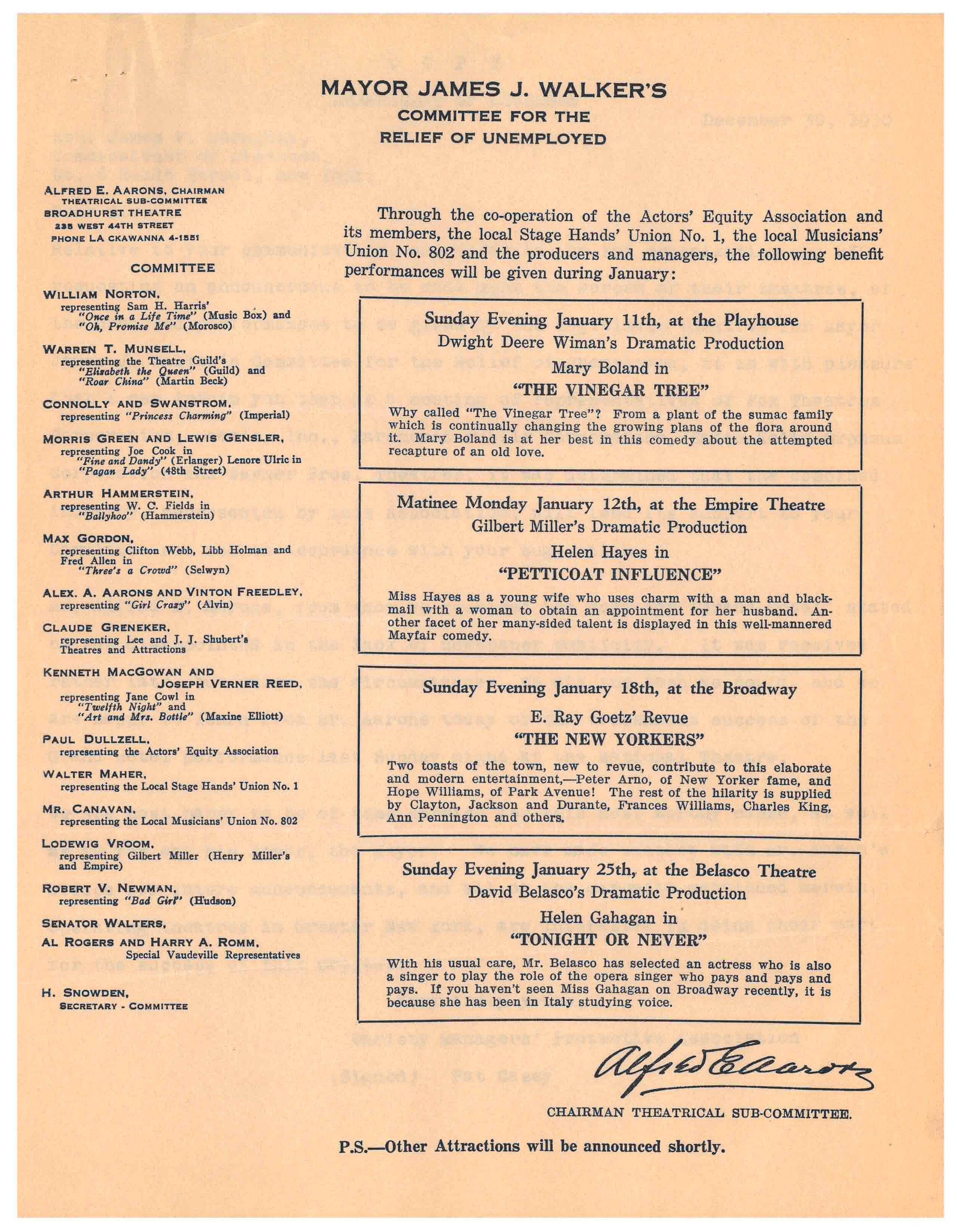
Was there any reason to worry, given the daily contributions received in City offices, earmarked for the unemployed and relief?  While sceptics might question if any of the funds were skimmed, the accounts from the committee clearly show the amounts received and disbursed.  The largest source of funds was from city workers who donated 1% of salaries to help the City’s needy, yielding $1.56 million of the money raised.  Other sectors also contributed.  Sports teams held matches and games.  The Notre Dame football team played the New York Giants, raising $115,153 for the fund.   Broadway also stepped up staging nineteen performances that raised nearly $18,000.    

Mayor James J. Walker’s Committee for the Relief of Unemployed. Schedule of Benefit Performances through the co-operation of the Actors’ Equity Association, 1931. Mayor James J. Walker Subject Files. NYC Municipal Archives.

Mayor James J. Walker’s Committee for the Relief of Unemployed. Schedule of Benefit Performances through the co-operation of the Actors’ Equity Association, 1931. Mayor James J. Walker Subject Files. NYC Municipal Archives.

Any notion that the times weren’t so bad had vanished by April 1931.  In Library Notes, Rankin wrote that the City helped 30,000 families in February, an increase of 60% over 1930.  “Estimates indicate that 750,000 persons, ordinarily employed in gainful occupations are now without jobs.”  The $8 million in funding for wages paid to workers on public works jobs had been spent.  The State Legislature appropriated $10 million for wages and the Board of Aldermen approved $2 million in revenue bonds to be used for supplies and labor on public improvements and in public institutions—on such public work as will be of permanent value but which the City would not now perform except for the present unemployment emergency.”

A report in the Municipal Library’s vertical files written by economist Edna Lonigan for the Welfare Council of New York City issued in 1931 analyzed the number of unemployed New Yorkers by Occupational Groups.  She estimated that 25% of waiters, 20% of musicians, 15% of deliverymen, 50% of longshoreman, 10% of telegraph operators and 33% of organized construction workers, among other occupations, were unemployed in December 1930.  A memo from the Welfare Commissioner cited census statistics in estimating that 640,000 New Yorkers were unemployed—more than 10% of the population.

“The conditions are so extreme…”  Letter to Mayor Walker from Raymond Ingersoll, March 6, 1931.  Mayor James J. Walker Subject Files.  NYC Municipal Archives.

“The conditions are so extreme…” Letter to Mayor Walker from Raymond Ingersoll, March 6, 1931. Mayor James J. Walker Subject Files. NYC Municipal Archives.

As the economy continued in a downward spiral, it became clear that the well-intentioned private welfare organizations and one-off City efforts could not keep up with the need.   Rankin wrote, “The most pressing problem for every municipality at this time is unemployment.”

Message to the Legislature from Governor Franklin Delano Roosevelt… proposing comprehensive plans for meeting the crisis in New York by State participation, 1931. Mayor James J. Walker Subject Files. NYC Municipal Archives.

Message to the Legislature from Governor Franklin Delano Roosevelt… proposing comprehensive plans for meeting the crisis in New York by State participation, 1931. Mayor James J. Walker Subject Files. NYC Municipal Archives.

In a move that foreshadowed elements of the New Deal, New York State Governor Franklin D. Roosevelt submitted several proposals to the New York State Legislature for enactment in August 1931.  The package contained five bills. The first set up a temporary administration, appropriated $20 million to fund employment on State and local public works programs, permitted the money to be used for food, fuel and rent but prohibited using the money as direct relief.  The second bill increased the personal income tax by 50% and authorized the Comptroller to offer bonds immediately in anticipation of the increased tax revenue.  The third bill gave local governments the ability to issue three-year bonds to fund public works which would reduce unemployment. Bill Number Four established a five-day work week on all public works. And the final bill allocated funds to pay bonuses to soldiers as required by an earlier law.  In the transmittal message Roosevelt wrote: “—upon the State falls the duty of protecting and sustaining those of its citizens who, through no fault of their own, find themselves in their old age unable to maintain life.

But the same rule applies to other conditions.  In broad terms I assert that modern society, acting through its government, owes the definite obligation to prevent the starvation or the dire want of any of its fellow men and women who try to maintain themselves but cannot.”

Sounding familiar today, he assailed the federal government.   “It is idle for us to speculate about actions which may be taken by the Federal Government…It is true that times may get better; it is true that the Federal Government may come forward with a definite construction program on a truly large scale; it is true that the Federal Government may adopt a well though out concrete policy which will start the wheels of industry moving and give to the farmer at least the cost of making his crop. The State of New York cannot wait for that.  I face and you face and thirteen million people face the problem of providing immediate relief.”

Taylor testified on behalf of the City in support of the proposed legislation.   In doing so, he praised New York City’s work and noted that the City’s experience was unrivalled by any other unit of government.  Calling the Governor’s relief request “conservative rather than extreme” he forecast that the City would spend $37.9 million on relief in 1931 or approximately $648 million in today’s dollars.    

List of contributions received in the Office of the Mayor during the month of February 1931. Mayor James J. Walker Subject Files. NYC Municipal Archives.

List of contributions received in the Office of the Mayor during the month of February 1931. Mayor James J. Walker Subject Files. NYC Municipal Archives.

The final report of the Mayor’s Official Committee described the money raised and disbursed between October 1930, and June 1932.  In total, they collected $3, 124,345 and spent $2,930,566.  The report noted that for each $1 spent, 99 cents “went to the needy.”  The monies were used for direct payments to the needy as well as food, clothing and coal for heating. 

Walker was brought down after an investigation and legislative hearings headed by Judge Samuel Seabury.   In January 1932, Assistant to the Mayor Charles F. Kerrigan wrote an eleven-page letter to the State’s legislative leaders requesting them to cease funding the investigation.   In closing he stated, “We are now engaged with all our might in trying to avert a great calamity in this city and this country.  We have engaged men and women of the highest talents and public spirit to assist us.  The $400,000 wasted on this Investigation would have provided for feeding 4,400 people daily since the investigation began.  The $2,000 a day now being used would feed 4,400 starving men, women and children every day this winter.   The taxpayers of the State and all local governments are now being burdened with heavy costs to relieve the widespread suffering and want… This Investigation should be halted at once, and the balance of the fund, if any remains should be returned to the State Treasury for the relief of the taxpayers and to meet a part of the mounting deficit of the State government.”

In 1932, the year Walker resigned, the American electorate voted Herbert Hoover out of office and elected FDR to lead the country.  The resulting New Deal and partnership with eventual mayor LaGuardia transformed the country and the City.