Mayor Gaynor and Children in the City

This is the third selection from “Some of Mayor Gaynor’s Letters and Speeches,” a volume in the Municipal Library’s rare book collection.  Published in 1913, it is a compendium of the Mayor’s writings on “…a wide range of topics . . . from lively to severe,” as noted in the introduction by W. B. Northrop.  In this series of letters Gaynor addresses some of the city’s youngest residents (and two apparently not-so-young resident).    

Child Health Station No. 42, North 1st Street, Brooklyn., n.d. Municipal Archives Collection.  NYC Municipal Archives.

Child Health Station No. 42, North 1st Street, Brooklyn., n.d. Municipal Archives Collection. NYC Municipal Archives.

Boys in Streets, August 10, 1911

To: Mrs. Jessie F. Stearns, New York City

Dear Madam:  Your favor complaining of boys playing in the streets is at hand.  You ask if a law could not be passed prohibiting boys playing in the streets, saying that it “would be a blessing to humanity.”  I might ask you whether if such a law were passed you think it could be enforced?  Our boys have a hard time to get along in the crowded districts of the city.  They must play somewhere. I went around to the recreation piers the other night and found great numbers of them there, but they cannot all go there.  We must bear with them.  Have you any boys?  If you had, do you think you could keep them off the streets?

Gymnasium Class, n.d.  Department of Public Charities Collection.  NYC Municipal Archives

Gymnasium Class, n.d. Department of Public Charities Collection. NYC Municipal Archives

Street Ball Playing, August 10, 1911

To:  Masters LeGrande Sampson, William E. Westbrooke, Samuel C. Ward Jul, Joseph Carey and Raymond Luetke, New York City

Dear Boys:  It is too bad that you cannot play ball somewhere in peace.  Of course the police cannot always let you play on the street, but now and then they can wink so hard with both eyes as not to see you when you are doing no harm to passersby and the street is not crowded.  In the parks, you may only play on the places assigned to baseball playing.  The keepers will not chase you out unless you play where baseball is not permitted.  I wish we had the grounds for you all to play, but unfortunately we have not.  So boys, do the best you can, and I will help you a little now and then if you send me word.

Inwood Park Day Camp, August 20, 1934.  Department of Parks and Recreation Collection.  NYC Municipal Archives.

Inwood Park Day Camp, August 20, 1934. Department of Parks and Recreation Collection. NYC Municipal Archives.

The “Wink” Letter to a Little Girl, September 15, 1911

To:  Miss Helen Roth

Dear Miss Roth:  I have received your letter of September 11, telling me that you and the little girls in your neighborhood have no place to play after school, and that wherever you go to play you are chased.  I am very sorry about it, and I will see if I can do something for you.  Some people think you ought to stay in the house all the time.  But you must go out, and you must play somewhere, and we must let you play in the streets until there is some other place provided.  Do you know I receive letters daily from men and women who hate to see the children play in the streets at all.  But on inquiry I always find out that they are people who have no children of their own. You say you want to skate on roller skates.  Maybe I can get the police up that way to wink so hard with both eyes that they won’t see you when you go by on your roller skates.  But be careful not to run into anybody or bump into an automobile.  But there are very few accidents of that kind.  When one such accident happens a lot of people write to me as though it were the rule instead of the exception. 

Rooftop playground, n.d. Department of Public Charities Collection. NYC Municipal Archives

Rooftop playground, n.d. Department of Public Charities Collection. NYC Municipal Archives

Roof Playgorunds, August 29, 1911

To:  Master Benjamin Blau, Crotona                                                                       

My Dear Boys:  Your several letters informing me that you won the ball game on the roof playground of Public School 188 last Thursday night, and reminding me of my promise to send a set of balls and gloves to the winners are at hand.  I note that one of your letters seems to betray doubt that I will keep my word.  I do not blame the writer for his doubts, considering the many ill things which are being publicly said of me. They may well create doubts even in the minds of the boys.  I am sending you a box of twelve balls, and also a set of mitts and gloves.  I want to tell you how much I enjoyed my visit to the roof playgrounds of the public schools last Thursday night.  I never saw finer dancing by girls.  I hope that the boys will be given dancing lessons next year.  I regret that these playgrounds were closed so early as August 26 for lack of music.  Next year, we will try to remedy that also.  The playgrounds and piers ought to be kept open as late in the season as possible.  I also thank you for electing me an honorary member of your ball club.

The first day of school, September 9, 1992.  Mayor David N. Dinkins Collection.  NYC Municipal Archives.

The first day of school, September 9, 1992. Mayor David N. Dinkins Collection. NYC Municipal Archives.

Police and Boys Playing Ball, May 15, 1912

To:  Master Charles Van Buren,  Brooklyn, N.Y.

Dear Master Van Buren:  Your letter complaining of the police chasing you and your companions out of the lot where you play ball is at hand.  I will take charge of the matter and see what we can do.  Most of the police behave with intelligence, but I am sorry to say there are a few stupid ones on the force yet that we would like to get rid of.  A policeman ought to be the friend of the boys on his beat.  I am very desirous of having the police let the boys play on every available lot or space in the city.  In this case you have the permission of the owners, and I do not see why the police meddle with you, except to see that your ball does not fly over the fence and hit someone.  You boys have to play somewhere.  The people who think you ought to stay in the house all the time are also very stupid or else very ill-natured.

Roller-skating in Central Park, June 1937.  WPA Federal Writers’ Project Collection.  NYC Municipal Archives.

Roller-skating in Central Park, June 1937. WPA Federal Writers’ Project Collection. NYC Municipal Archives.

Children in Her Way, October 31, 1912

Dear Mrs. _____:  I thank you for your letter.  But the children on roller skates think you and your motor car are in their way, while you think they are in your way.  Which is right?  The point of view is everything, or not at all events very much, as is the case in all things.  Now you will say that I am joking with you again.  Show this to you husband and I will leave him to say whether I have not got back at you pretty well.  We are trying to diminish the roller skating in places where it is dangerous for the children to use roller-skates.  But of course, we cannot

Moving the Archives, part II

“The City of New York is finally catching up with over two centuries of neglect in the care of its records.” Thus began an October 1953 article in the American Archivist touting the 1952 creation of the New York City Municipal Archives and its integration into a records management program. At the time, the Municipal Archives and Records Center was housed in the Rhinelander Building, and the Municipal Reference Library was still a branch of the New York Public Library (NYPL). As of December 1952, the Archives had an estimated 12,000 cubic feet of material, and “no standard storage or filing material.” The collection has grown significantly since then, by more than a factor of ten, and as the diversity of its collections has grown, the limitations of standard storage shelves has made preservation difficult.

This past January we described the construction of the Municipal Archives’ new off-site storage space in Industry City. A lot has happened to the world since then. However, we are happy to report that after a shutdown of several months, the project continues. We have had to adjust the schedule due to COVID-19 and, like a lot of construction projects, supply chain issues are still creating delays. But, our new custom shelving is going up, HVAC equipment is installed, and we are starting to see the shape of what will be.

HVAC equipment being lifted to the roof of Building 20, Industry City.

Rails being installed for the movable shelving.

Shelving going in above the decking and rails for the compact movable storage system.

The HVAC system required an enormous amount of ductwork.

Insulated elevator vestibules will prevent energy loss and protect collections from dust intrusion.

In 1953 the Municipal Archives and Records Center installed a state-of-the-art microfilm laboratory. Now, almost 70-years later, we are building a state-of-the-art digitization lab in the new space, with workstations for digitizing motion picture films, magnetic video tapes, still film, and flat art. New high-speed scanners that are gentle on archival materials will allow the mass digitization of paper records.

Floor plan for the new digitization lab at Industry City.

The new research room for patrons taking shape.

In 1953 it was reported that “As yet relatively little reference use has been made of the archives. Reference services in 1952 averaged about 35 a month. Chairs and tables are available for use by researchers, but the supervisor has not as yet felt sufficiently prepared to cope with a heavy reference load and thus has not publicized the collection very much.” While the new Industry City space will have chairs and tables for researchers, our digitization programs have allowed us to reach far more researchers through our online portals than could ever visit our offices. An average of 740 people a day are visiting our nyc.gov site. Over the last several years the Archives has provided reference service to more than 50,000 patrons annually and the on-line gallery had over 200,000 users last year.

Not much had changed since 1952 for the “Typed guides and inventories… available as finding aids to help researchers,” but over the past few years archivists have been inputting all those inventories into ArchivesSpace, work that they were able to continue remotely during the COVID-19 pandemic. A new integrated access portal now under way will allow researchers to search across all Library and Archives collections.

Insulated walls being installed for the cold storage vault.

A new cold storage room will house the photographic and magnetic tape collections of the Municipal Archives, including thousands of original WNYC broadcast tapes recently accessioned from the NYPL.

By early next year, we will have moved 140,000 cubic feet of New York City government’s historical records into this new space, including mayoral records, maps, photographs, ledgers and other documents. These records will be available to researchers onsite instead of being trucked to Manhattan, thus making a contribution to a greener City. Seventy years hence there undoubtedly will be different preservation and storage solutions for the born-digital records of today’s government. But the foundational documents at our Industry City location will be safe, secure, and available.


Source: Jason Horn, Municipal Archives and Records Center of the City of New York, American Archivist, volume 16, issue 4, 1953: https://americanarchivist.org/doi/pdf/10.17723/aarc.16.4.h1335164g7567424

The Transcription Project, Early Mayors’ Collection

Two recent blogs described the work archivists have accomplished transcribing the original hand-written captions for the Brooklyn Grade Crossing Commission and Condemnation Proceeding photograph collections into searchable spreadsheets. The transcription projects began when the Municipal Archives closed to the public on March 16, 2020, and all staff began to work remotely from home. This week the blog describes the Early Mayors’ collection transcription project.

The Early Mayors’ collection includes correspondence and documents from New York City mayoral administrations from 1826 through 1897 and totals 157.5 cubic feet. The collection had originally been assembled by Rebecca Rankin during her 32-year tenure as the Director of the Municipal Library between 1920 and 1952. This was a core collection in the Municipal Archives when it opened in 1952 and remains one of the most important series documenting nineteenth-century government and policies.

Noteworthy stationery is one of the auxiliary benefits of researching 19th-century correspondence. Letter of recommendation, May 22, 1886. Early Mayor’s Collection, William R. Grace. NYC Municipal Archives.

Noteworthy stationery is one of the auxiliary benefits of researching 19th-century correspondence. Letter of recommendation, May 22, 1886. Early Mayor’s Collection, William R. Grace. NYC Municipal Archives.

In the early 2000s, the National Endowment for the Humanities awarded a grant to the Archives to microfilm the collection. Subsequently, the finding aid has been edited and made accessible on the agency website. More recently, the Archives began digitizing the microfilm edition to make it available for on-line research.

Typically, archivists catalog correspondence and office records to the ‘folder-level,’ meaning that descriptive information provided to a researcher includes only whatever had been written on the folder label by the record creator, e.g. “Mayor’s Correspondence, April – June 1897.”   What is unusual about the Early Mayors’ series is that the librarians and archivists who first cataloged the materials in the 1950s and ‘60s also typed brief descriptions of every letter or document in the collection. 

Archivist Alexandra Hilton, has been coordinating the work of the archival staff transcribing these descriptions while working remotely. Ms. Hilton explained how she stumbled across the typed description tucked away in one of the storage rooms in 2012:  “Back then, I was doing research for exhibits and events. Finding this was such a stroke of luck – I photocopied the whole thing, put it in binders, and read it cover-to-cover, marking it up with notes. It’s a great resource that depicts women and minorities, groups of people that are typically difficult to find in a collection of mid-to-late-19th century governmental records.

Letter from Ella Wilson, aged 15, to Henry Bergh, asking whether something cannot be done for the relief of the poor dogs and the unjust proceedings of the dog catchers, February 14, 1886. Henry Bergh was the founder of the American Society for Prevention of Cruelty to Animals in 1866 and a co-founder of the New York Society for the Prevention of Cruelty to Children in 1875. Early Mayor’s Collection, William R. Grace. NYC Municipal Archives.

Ms. Hilton added, “I never thought we’d get a chance to transcribe the descriptions so I’m pretty thrilled that we are because it is so dense that browsing it as a physical document is only practical if you have a lot of time. At the start of the project, based on the number of pages scanned, I estimated that the index was a little over 2,500 pages, and described over 27,000 items.”

Archivist Amy Stecher has been transcribing indices of correspondence in the collection that relate to both larger departments such as the Department of Buildings and the Department of Docks, and smaller ones such as the Bureau of Weights and Measures, and the Dog Pound and the Public Pound (for animals other than dogs).

Ms. Stecher describes her work,  “I’ve been surprised by the amount of big-picture information you can derive from the indices alone. Everything I’ve transcribed so far, regardless of subject, is really about the exponential growth of the city’s population and the need to get control over it. This is obvious with something like the creation of the Department of Buildings. But it can also be seen in correspondence related to smaller agencies such as the Bureau of Weights and Measures and the documents indexed under “Lamps and Gas.” These records show the expansion of lamp-lighting services to parts of the city that never needed lighting before.  It reveals a fascinating story of the battle among private companies to win gas-supply (and later, electricity) contracts. 

Letter to Mayor Wickham from Theodore F. Little, of Summit, New Jersey, regarding a letter found in the street, exposing the sale of counterfeit money in New York City, January 22, 1876. Early Mayors’ Collection, Mayor William H. Wickham. NYC Municipal Archives.

Ms. Stecher noted a pervasive theme in the records—the amount of corruption evident in every department and at every level: “Political cronyism—Tammany Hall is mentioned across various indices—but also fake Weights and Measures Inspectors; drunken, thieving dog-catchers; complaints to the mayor about lottery and other scams; officials removed from office for taking bribes or stealing funds; dereliction of duty at the city-run asylums and hospitals. It is clear that many people took advantage of so much growth and too little oversight.”    

Ms. Stecher, continued, “There is also evidence of some remarkable parallels with the city today: the fascinating and timely Health Quarantines and measures the city took to deal with cholera and yellow fever epidemics, including the establishment of the Quarantine Islands. The Department of Charities and Corrections index lists voluminous correspondence among city officials, outside groups, and individual citizens trying to tackle the dual problems of the ever-increasing number of homeless and displaced persons, which resulted in the creation of the position of the Superintendent of Out-Door Poor. Increasing levels of poverty, despair, and mental and physical health issues highlighted the need for the perpetually-overwhelmed and continually-criticized city-run hospitals and asylums.”

Letter to Silas C. Croft, President of the Department of Public Charities, from Frederick E. Bauer, following-up on an inquiry about the whereabouts of orphaned children Mamie, Tessie, Sadie, and Washington Gleason, September 17, 1897. Early Mayor’s…

Letter to Silas C. Croft, President of the Department of Public Charities, from Frederick E. Bauer, following-up on an inquiry about the whereabouts of orphaned children Mamie, Tessie, Sadie, and Washington Gleason, September 17, 1897. Early Mayor’s Collection, Mayor William L. Strong. NYC Municipal Archives.

“References to pandemics, the Civil War and its aftermath are evident as well as immigrants and displaced persons making their way to the city and needing help. Many people reach out personally to the mayors and sometimes get results in the form of inquiries and investigations. Reformers such as Henry Bergh turn up in more than one index.”

Based on the transcription work, Ms. Stecher concluded that “these documents make crystal clear that life in New York City was very hard for those with little money or few resources, and could be very rewarding for those with much and many.”


Look for future blog posts describing Municipal Archives transcription projects.

A False Police Report on a Boy’s Arrest

This is the second selection from “Some of Mayor Gaynor’s Letters and Speeches,” a volume in the Municipal Library’s rare book collection. Published in 1913, it is a compendium of the Mayor’s writings on “…a wide range of topics . . . from lively to severe,” as noted in the introduction by W. B. Northrop. This letter, entitled “A False Police Report on a Boy’s Arrest,” had been sent to Rhinelander Waldo, Esq., Commissioner of Police, on December 19, 1911. Look for more of Mayor Gaynor’s literary output in future blogs.

Mayor William J. Gaynor, frontispiece, “Mayor Gaynor’s Letters and Speeches,” New York, Greaves Publishing Company, 1913. Municipal Reference Library

Mayor William J. Gaynor, frontispiece, “Mayor Gaynor’s Letters and Speeches,” New York, Greaves Publishing Company, 1913. Municipal Reference Library

Mayor William J. Gaynor, portrait, frontispiece, “Mayor Gaynor’s Letters and Speeches,” New York, Greaves Publishing Company, 1913. Municipal Reference Library

Mayor William J. Gaynor, portrait, frontispiece, “Mayor Gaynor’s Letters and Speeches,” New York, Greaves Publishing Company, 1913. Municipal Reference Library

Sir:  Some months ago I wrote to you of the case of the eighteen year old boy William Eagen, who called upon me in person and made his complaint. He had been well brought up, and has always lived at home with his parents at 53, 4th Avenue, Brooklyn. Detective Barry arrested him in the street near his home on August 24th last without a warrant. He had never before been arrested or accused of any offense. He was taken to the station house and locked up over night in a cell. The next morning the said officer arraigned him before a magistrate, and made a written complaint on oath that he was a vagrant, i.e., a person without a home, wandering about, and with no means of support. The officer knew that this was untrue. The boy lived at home and worked daily with his father who is a janitor of 17 buildings. When the case was called on August 28th for a hearing, the officer stated that he could l not prove the charge, and the boy was discharged. In my letter to you I asked for a full report of the matter. Later you sent to me the report of Inspector Hughes, chief of the detective bureau, concurred in by the Second Deputy Police Commissioner. That report disclosed that the real reason for the boy’s arrest was that a burglary of the apartments of C. W. Daniels, at 449, State Street, Brooklyn, had been committed, and that the boy was “suspected” of having committed the same. The things stolen were a watch, engraved with Mr. Daniels’ name, a locket, studded with diamonds, and engraved in the same way, and a double chain and fob. The reason for such suspicion given in the said report was that the father of the boy was janitor of the building in which Mr. Daniels had his apartments, that the bulldog did not arouse Mr. Daniels when the burglar entered, that therefor the burglary was committed by someone good terms with the bulldog, and that therefore the burglar was probably young Eagen. Such was the farfetched if not ridiculous theory. The report went on to state that after being arrested and on his way to the station house young Eagen told the officers who had him in charge that the locket lost by Mr. Daniels contained 17 diamonds, that it had been broken up, and that it was useful to look for it. The report also states that while young Eagen was locked up in the cell another officer heard him state to a prisoner in an adjoining cell, he had been arrested on suspicion of the same offense, “I think they have got it on us,” to which the other prisoner responded, “Shut up, some one might be listening.” The name of this other prisoner is Grant, hereinafter mentioned. To this report was attached a letter of the Second Deputy Commissioner to you stating that in his opinion the action of the officer who made the arrest and false charge of vagrancy was justifiable. I felt constrained to write to you that his conduct was unjustifiable.

10th Police Precinct at Bergen Street and Sixth Avenue, Brooklyn.  1940 Tax Photograph Collection. NYC Municipal Archives.

10th Police Precinct at Bergen Street and Sixth Avenue, Brooklyn. 1940 Tax Photograph Collection. NYC Municipal Archives.

The boy was not a vagrant, and the charge against him was false. The alleged confessions were stated to have taken place after the arrest, and were not revealed to the magistrate at all. I also expressed the view that the so-called evidence given in the report that the boy had committed the burglary was no evidence, and that the alleged confessions stated in the report were trumped up after the boy’s discharge, and after I had called for a report, for the purpose of trying to justify the arrest  Nothing further was done at that time, however, as the said chief of the detective bureau said that the investigation was still going on and that it was expected that sufficient evident would be obtained against the boy. But instead of any evidence being obtained against him, one Alexander Moore has since been arrested, indicted and convicted of the burglary and is now serving a term in State’s Prison therefore, as I have learned. Pawn tickets for the stolen articles were found in his pockets. The stolen articles were all obtained from the pawn shop. The diamonds had not been taken out of the locket.

The report also states that when the boy was discharged by the magistrate his mother who was present exclaimed: “I am going to write to Mayor Gaynor and give you fellows the same dose that Duffy gave the officers in his case”—alluding to young Duffy who was arrested time after time by the police and locked up, and his picture put in the Rogues’ Gallery, for no offense whatever. I have sufficiently ascertained that she had not up to that time ever heard of the Duffy case, and therefore could not have made such a remark. Also she is not a woman who would express herself in that manner.

The case calls for discipline of the officers engaged in it. It is also necessary that this matter be made public so this boy may be fully vindicated instead of being injured for life. It will never do for the police to treat boys in this way. I should also mention that another young fellow named Henry Grant was arrested on suspicion for the same crime. The chief reason for his arrest seems to have been that when a boy he had served a term in the Elmira Reformatory. He was discharged as reformed. The police should be very careful about arresting boys who have served a term in a reformatory. To follow them up and arrest them on sight, on the slightest suspicion, or on no suspicion, as is often the case, after they come out, and even follow them to the places where they are employed, and procure their discharge, is to leave no course open to them except to become habitual criminals. This boy Grant was employed as a chauffeur. I understand that he lost his place because of his arrest. I trust that this vindication of him will suffice to enable him to get other work to do. The police must be made to understand that they cannot arrest and lock people up as they like, but they must keep within the law. The only way to enforce the laws is the way prescribed by law. That which cannot be done lawfully must not be done at all by the police or any other public offices from the President of the United States down. This is a government of laws and not of men.

Thank you, Mayor Dinkins

For two weeks at the end of every summer, tennis fans around the world look to the Arthur Ashe Stadium in the Billie Jean King National Tennis Center in Flushing Meadow Park, Queens, for the annual US Open Tennis Tournament. And unlike most major sporting events that have been postponed, cancelled or drastically altered this year, the U.S. Open Tennis Tournament, will take place, just as it always does, with one big exception—there will be no fans in attendance at the stadium. In a normal year, up to 50,000 spectators pack the arena each day of the tournament and generate an estimated $750 million in economic activity. 

Often chided in the press for his devotion to the game, it is Mayor David N. Dinkins we must thank for a hard-fought and farsighted deal he negotiated with the United States Tennis Association in 1993 that ensured the prestigious US Open Tennis Tournament would stay in New York City for at least twenty-five and potentially ninety-nine years.  

Mayor Dinkins with tennis champion Jennifer Capriati and Parks Commissioner Betsy Gotbaum in Central Park, August 21, 1990. Photographer: Joan Vitale Strong. Mayor David N. Dinkins Photograph Collection. NYC Municipal Archives.

Mayor Dinkins with tennis champion Jennifer Capriati and Parks Commissioner Betsy Gotbaum in Central Park, August 21, 1990. Photographer: Joan Vitale Strong. Mayor David N. Dinkins Photograph Collection. NYC Municipal Archives.

Tennis has a long history in New York City.  An English import, tennis courts first appeared in Staten Island 1874. By the early 1890s, tennis enthusiasts had 125 courts to choose from in Manhattan’s Central Park. The West Side Tennis Club which began in 1892 on Central Park West, migrated to 238th Street and Broadway in 1898, to 117th Street and Morningside Drive in 1902, and to Forest Hills, Queens in 1914. The West Side club in Forest Hills was the site of the United States Open tennis championships from 1915 to 1920 and again from 1924 to 1977. 

U.S. Open Tennis Tournament, men’s singles championship game, Forest Hills Stadium, Queens, N.Y., September 1937. WPA Federal Writers’ Project Photograph Collection. NYC Municipal Archives.

U.S. Open Tennis Tournament, men’s singles championship game, Forest Hills Stadium, Queens, N.Y., September 1937. WPA Federal Writers’ Project Photograph Collection. NYC Municipal Archives.

By the 1970s, the USTA had tired of the lack of space and amenities at the exclusive Forest Hills club. In 1977 they moved a short distance in Queens to Flushing Meadow Park and agreed to reconfigure a 1964 World’s Fair-era arena that had been re-named for jazz legend and Queens resident Louis Armstrong in the early 1970s. Although the USTA continued to host the U.S. Open over the next decade there were rumblings of possibly moving the prestigious event out of New York City.

Soon after his inauguration as Mayor on January 1, 1990, Dinkins, a long-time tennis fan, along with Parks Department officials and the City’s Economic Development Corporation began negotiations with the USTA for a new deal. Formally announced in February 1991, it called for the USTA to build a new 23,500-seat stadium, renovate the existing Louis Armstrong Stadium, and create 38 new outdoor tennis courts. In return, the city would allow the association to enlarge its footprint in Flushing Meadow Park by an additional 21.6 acres to a total of 46.5 acres. The USTA would also create an $8 million endowment fund to finance improvements to the park.   

Tennis champions Arthur Ashe (left) and John McEnroe (right) join Mayor Dinkins to announce an agreement between the city and the United States Tennis Association that will keep the U.S. Open Tennis Tournament at the Flushing Meadows-Corona Park in …

Tennis champions Arthur Ashe (left) and John McEnroe (right) join Mayor Dinkins to announce an agreement between the city and the United States Tennis Association that will keep the U.S. Open Tennis Tournament at the Flushing Meadows-Corona Park in Queens, April 22, 1992. Photographer: Joan Vitale Strong. Mayor David N. Dinkins Photograph Collection. NYC Municipal Archives.

Not surprisingly, the proposal met with opposition; the taking of city park land for a private enterprise seemed the most significant of the complaints. But Dinkins persevered, and after another year of negotiations, he announced an agreement that would guarantee the U.S. Open tournament would remain in New York for at least for at least twenty-five and potentially ninety-nine years. Plus, the city would receive $400,000 a month in rent and a percentage of the center’s gross revenue. The USTA upped their investment to $172 million for the new 23,500-seat stadium adjacent to the existing arena. Construction would be financed by bonds issued through the Industrial Development Agency.

By all accounts it was a complex agreement, but as Carl Weisbrod, president of the city’s Economic Development Corporation observed to the New York Post: “To me, this an extremely good deal for New York City.” It would be another year before Dinkins and his administration received the needed approvals from the City Council, the State Legislature, and local Community Boards in Queens so the deal could be finalized. 

Mayor Dinkins and Billie Jean King at the TeamTennis clinic in Central Park, New York, August 20, 1992. Photographer: Edward Reed. Mayor David N. Dinkins Photograph Collection. NYC Municipal Archives.

Mayor Dinkins and Billie Jean King at the TeamTennis clinic in Central Park, New York, August 20, 1992. Photographer: Edward Reed. Mayor David N. Dinkins Photograph Collection. NYC Municipal Archives.

Finally, on December 22, 1993, within days of his departure from City Hall, Mayor Dinkins inked his signature on the agreement. By then, Mayor-elect Rudolph Giuliani had voiced disapproval and urged the Mayor not to sign the long-term pact. But Dinkins went ahead anyway, remarking at the signing ceremony, “There are those who would say I should wait for him [Giuliani] to sign a 99-year lease.” Why?  So he can sign a 98-year lease?”

The new stadium, named for the late Arthur Ashe, the first African-American U.S. Open champion, opened on August 25, 1997. Dozens of past U.S. Open champions, including Pete Sampras, Monica Seles, Chris Evert, Rod Laver and John McEnroe were serenaded by Whitney Houston at the gala dedication ceremony. Every local politician attended:  all but one—Mayor Giuliani.  Still piqued by Dinkins’ refusal to defer to his demand  not to sign the agreement, Giuliani refused the USTA’s invitation to speak at the dedication. “I’m not going,” the Mayor said, explaining that it was the only way he could protest the 1993 lease singed by Mayor Dinkins over his protests just before the change of administrations.    

Once again, the Municipal Library’s vertical files help tell this story of what proved to be significant victory for Mayor Dinkins during a troubled administration. As Dinkins biographer Chris McNickle wrote in The Power of the Mayor: “The agreement Dinkins struck at the very end of his term with the United States Tennis Association to keep the U.S. Open in New York has served the city and tennis fans everywhere to this day, bringing prestige, national television coverage, and tourist dollars to the city every fall.”

Thank you, Mayor Dinkins.

https://www.archives.nyc/dinkins-gallery

Remarks of Mayor LaGuardia at the Annual Meeting of the Welfare Council of New York City

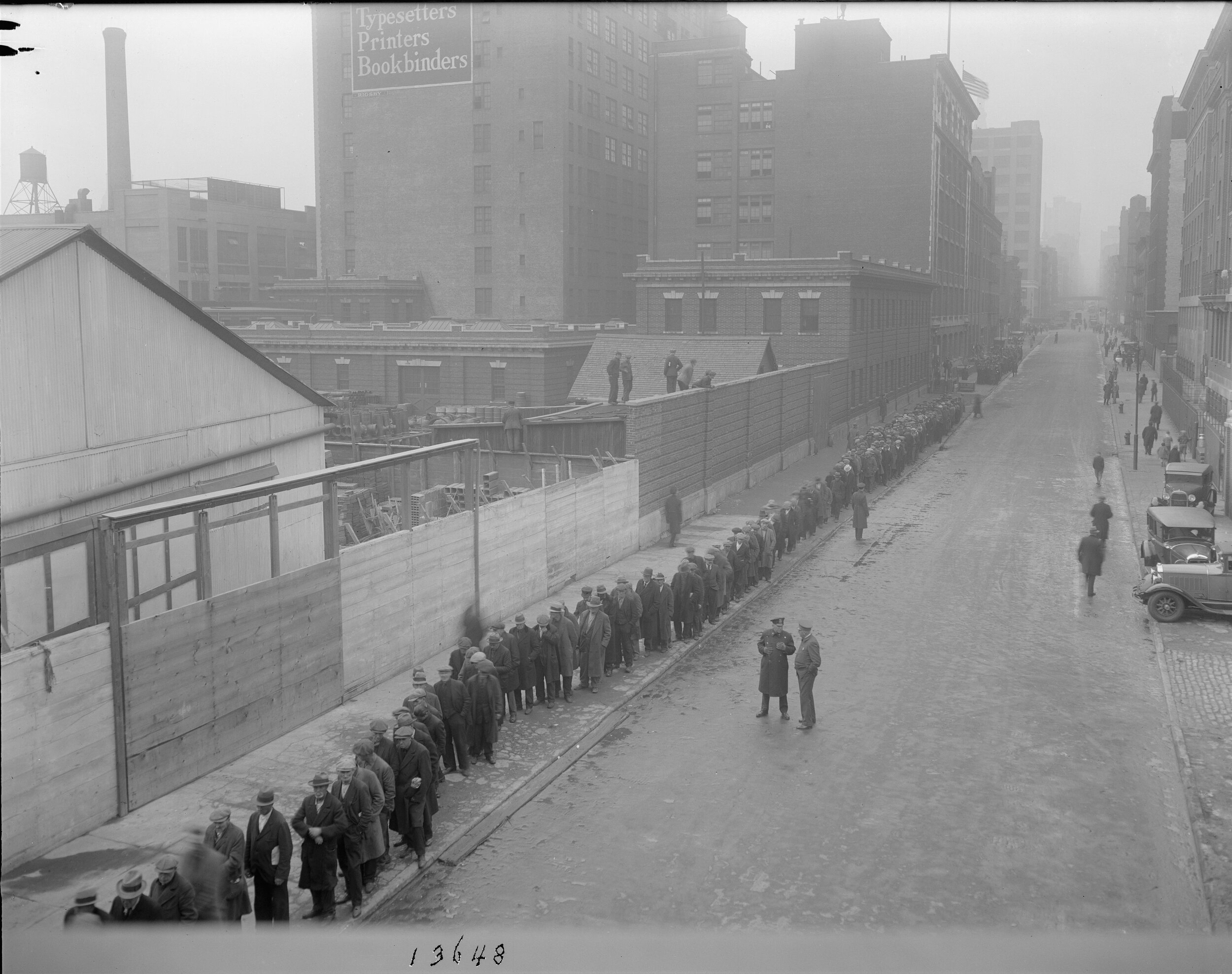
On May 28, 1935, Mayor Fiorello LaGuardia spoke about unemployment and economic conditions in the United States at the Annual Meeting of the Welfare Council of New York City. The following is a transcript of his remarks.


This question of relief in its present magnitude is one that seems baffling and difficult. There are some who say that it came suddenly upon us. To that I do not subscribe. Anyone with any vision or with any understanding of the economic condition of the country and the pace we were going could tell some ten years ago that a crash was inevitable and that we would have a large number of men and women unemployed in this country.

Waiting to enter the Municipal Lodging house, Department of Public Welfare East 25th Street, November 22, 1930. Photographer: Eugene de Salignac. Department of Bridges, Plant & Structures Photograph Collection, NYC Municipal Archives.

Waiting to enter the Municipal Lodging house, Department of Public Welfare East 25th Street, November 22, 1930. Photographer: Eugene de Salignac. Department of Bridges, Plant & Structures Photograph Collection, NYC Municipal Archives.

When we suggested in the peak of the so called period of prosperity that we provide a national system of unemployment insurance—and this was in Congress back in 1924, 1925, and 1926 – we were ridiculed, called radicals and destructionists and were told of the amount of gold that the American working man had in his teeth!

We are still approaching it as if it were something temporary. I suppose many of you here have stiff necks from looking around the corner for prosperity to come back. We must realize sooner or later that we will soon reach a new normal. With the revival of normal business and industry we know now or at least it should be known that all the employable men and women would not be employed. Our productivity in the factory or from the soil is such that we can produce everything which this country could consume without employing all the men and women unemployed today. That being so, what we must do sooner or later is to adopt some plan, either to create the necessary spread of employment or some means to care for the surplus man-power that we know we have.

In the meantime it becomes necessary to take care of these millions of people in the country who through no fault of their own find themselves in need.

Relief for the Unemployed, Christmas, showing distribution of food, 23rd Precinct, December 24, 1930. Photographer: Eugene de Salignac. Department of Bridges, Plant & Structures Photograph Collection, NYC Municipal Archives.

Relief for the Unemployed, Christmas, showing distribution of food, 23rd Precinct, December 24, 1930. Photographer: Eugene de Salignac. Department of Bridges, Plant & Structures Photograph Collection, NYC Municipal Archives.

Under our form of government of course I necessarily find very often this conflict of jurisdiction or division of responsibility – the state, the national government and the municipality or county as the case may be. The person who is in need is very little concerned with the source of relief. He must have it. I remember during my days in Congress when we sought to get federal aid for the people in drought-stricken areas of Arkansas, we were told of constitutional limitations – and we have them in Congress today – that it was not the function of the federal government; that belonged to the Red Cross. Then the Red Cross came before our Commission and testified. I went down to listen to them. Instead of listening to a humanitarian, we listened to an adding machine. They told us about the families to be supported in Arkansas on $2.50 a month, told us about the cornmeal.

I repeat this because I do not think you have any idea of what some of us suffered during that period in seeking to impress upon our national government the necessity of bringing relief to those people when their state and county were unable to do so. Now we have gotten beyond that point. The federal government is furnishing relief. I always felt it was the highest function of government to preserve life. That is what the federal government is doing now. I appreciate it, first, because I lived through that period of resistance of any appropriation from the federal treasury, and second, because – having had the responsibility for nearly one and a half years, I do not know what would have happened in this city without the aid of the federal government. We have been investigated and re-investigated. That is all right. I do not object to it at all. I have started too many investigations myself as a legislator to object to anyone else’s.

Who is to do this job? That is not so important, as long as it is done well. I expect Mr. Wardell (Allen Wardell, Chairman of Governor’s Lehman Commission on Unemployment Relief) will make some very useful and constructive suggestions based upon our actual experience. In a few days we will embark on a new system and it is inevitable we should have changes from time to time because it is all so new to us.

Another system commencing July first will be to get as many people on work relief as is possible. That is sound. The question has already been raised as to the latitude to be allowed the person on home relief, whether or not he is going to take a work relief job. I do not know. We can make that as difficult or as simple as you want. How many of you have seen “Thumbs Up?” I suggest everyone here go to see it. Someone wants to order some small cards. He goes into a printing office and it is suggested that a meeting be held at Union Square, one at Madison Square, and then a march!

Now to me it is very simple. Nobody is forced to work who does not want to. If you are going to start saying, “I am very sorry” and you approach a man timidly and say – “I beg your pardon, would you care to take a job?” – he is not going to take it.

We are going to have a great many jobs – I don’t know how many. They will be offered to the recipients of relief and they will be drawn from the relief rolls and put to work. That is all there is to it. The Supreme Court of the United States reduced the standards of wages yesterday. I believe the work projects will not be run in competition with private employment. Why do we make it so difficult? It is all so very simple in England. Some of you have attended the boards of review there. I have sat with them. They came up on the charge of not genuinely seeking employment and the employment service appears and says -- “Yes, we have offered a job to this person on this date, refused; offered again, refused; offered again and refused.”

Work relief program. Track Removal on 66th Street and 2nd Avenue, looking west, January 9, 1935. Borough President Manhattan – Civil Works Administration Photograph Collection, NYC Municipal Archives.

Work relief program. Track Removal on 66th Street and 2nd Avenue, looking west, January 9, 1935. Borough President Manhattan – Civil Works Administration Photograph Collection, NYC Municipal Archives.

I repeat – these projects will not be in competition with private employment. The wages have been fixed in accordance with the available funds and the number to be provided for. The city and state will have to continue to look after the unemployables. We do that now. Superannuated workers are receiving the old-age pension. Widows with children are receiving aid from the Board of Child Welfare. As I see it, if this system functions properly, we will know exactly how many unemployables we have to take care of in this city.

The present economic condition has brought many other loads and burdens to the city. We are troubled, as you all know, in caring for the sick. Our hospitals are overcrowded with the increasing load and demand upon us all the time. By reason of the economic stress, we find that private hospitals are having an increasing burden also, and it is impossible to add to this burden. I am seeking to do as much as I possibly can on preventive work. We are seeking to construct and operate a series of health stations. We want to establish clinics of contagious and infectious diseases and do more preventive work. That is not as easy as it seems, because we have to meet opposition from the profession, opposition from organizations and other associations and progress is not as rapid as some of us would like to see it.

We are going to continue to carry on this program of preventive medicine on a very large scale in the hope that thereby we can meet the hospital problem that is pressing us at this time. We have three hospitals completed, without the funds to provide equipment. An application was made to the federal government for a loan but that was not granted. We already appropriated for the equipment of Harlem Hospital last Friday and will borrow the money for it. We are pressing as rapidly as we can for the Queens Hospital and hope to be able to get funds for the construction of an additional hospital on Staten Island to take care of the charges which they now have on Randall’s Island.

As to the organization of the relief problem – as I stated, when I took office, I found it was a temporary makeshift organization and it is that now. Were it permanent, naturally it would be under civil service. In the personnel of that organization – and it is a very large personnel – any executive would find trouble in either seeking to control the appointments or refraining from doing so. There was one thing I insisted upon and that was that the organization would be non-political. I cannot tell you what tremendous pressure has been brought to bear on me from many sources for appointments. When I selected the Commissioner of Public Welfare, I gave him the responsibility of selecting his personnel. If his selection is good, the credit is his. If his is bad, the responsibility is mine and I have taken it. I do not permit any political member to control that organization and I refuse to build up a personal machine from that organization.

Sidewalk encroachment, West 16th Street, Manhattan, ca. 1935. Borough President Manhattan – Civil Works Administration Photograph Collection, NYC Municipal Archives.

Sidewalk encroachment, West 16th Street, Manhattan, ca. 1935. Borough President Manhattan – Civil Works Administration Photograph Collection, NYC Municipal Archives.

I saw in the papers a few days ago, that some person said there were still some employees from the old administration there. I was very glad to hear this. I would not have made some of the selections William Hodson, Commissioner of Public Welfare, and until recently, Chairman and Executive Director of the Emergency Relief Bureau, made, but once I gave him the responsibility, it was his to make the appointments.

We are going to have more trouble and will continue to have more trouble, because everyone who does not get a job is sore, and everyone who is fired has a story to tell. You can imagine how it is with an organization of 14,000 people. We will continue to do the best we can.

My political friends downtown tell me there is one organization that is even more potent than our politicians and that is the social workers group. I never knew there was so many of you in the whole world!

The home relief work will be materially reduced as we increase the work relief. I am going to recommend to my director of relief and to the Emergency relief Bureau, who I hope will recommend to the T.E.R.A., who will recommend to Mr. Wardell, who will recommend to the Governor, that everyone on home relief will have to report at certain intervals at the employment offices to find out if there is an available job. And I do not mean private employment offices. I do not believe it is unfair to require some amount of work from everyone who are receiving relief of one kind or another, except the unemployables.

I am so tired of hearing about those chiselers. I do not know whether they are there or not. I tell you that I think every relief worker who states that there is a certain percentage of chiselers ought to be sent out in his district to find them, or be fired.

All these systems of relief are temporary. It is the job and the responsibility of the leadership and the statesmanship of the country to find a permanent solution. The permanent solution must be uniform throughout the country. We cannot establish high standards of family life, sanitary conditions, employment liability and insurance and child labor laws in the State of New York if some other state is going to operate in competition against us. You cannot have a State economy and a National economy. You cannot take the constitutional limitations and construe them in 1935 in the same light that they were construed 75 years ago. You cannot leave the destinies of the American people in the hands of any tribunal no matter how well meaning it may be. We are either going to have a representative form of government or not. If Congress does not carry out the wishes of the American people, they have the complete control in sending a new Congress two years later.

If our constitution does not permit of proper regulation of our industrial system; if it does not permit of regulating it so that the willing working men and women of this country can get a job; if it is so to be construed that we are to have 12,000 people in the country on the relief rolls all the time – then the thing to do is to amend the constitution, to meet the situation.

Mayor Fiorello LaGuardia, City Hall, n.d. Photographer: Bob Leavitt for American Magazine. Mayor LaGuardia Photograph Collection, NYC Municipal Archives.

Mayor Fiorello LaGuardia, City Hall, n.d. Photographer: Bob Leavitt for American Magazine. Mayor LaGuardia Photograph Collection, NYC Municipal Archives.

There is the problem of providing adequate labor conditions throughout the state, particularly in the employment of children. We here so much about the tyranny of the federal government coming into the home and taking our children. I will trust the federal government. I would sooner trust the federal government to take care of my children than I would the owner of a southern mill.

We must have uniformity. We must have national uniformity in the old age pension system. We must create the spread of employment by fixing the hours of labor. Intra-state and Inter-state? Yes. When the constitution was drafted and ratified, when you had thirteen separate, distinct colonies, without railroads, when it took two or three weeks to go from Philadelphia to New York or from Philadelphia to Washington; when there was no telephone system, no telegraph system, then you had intra-state problems.

Today we find that unemployment down in Georgia affects workers in New York. Today we find if the farmer in Iowa and Kansas is not working and cannot get enough for his produce, the needle-trade worker in New York City will suffer.

The whole country has been woven into one economic fabric and the quicker we realize it and the quicker we so adjust ourselves to meet that situation, the quicker will we get out of our present problems.