This Day in History

Reception Banquet Program for Charles Lindbergh, June 14, 1927. Mayor James J. Walker Collection,  NYC Municipal Archives.

Reception Banquet Program for Charles Lindbergh, June 14, 1927. Mayor James J. Walker Collection, NYC Municipal Archives.

Interior, Reception Banquet Program for Charles Lindbergh, June 14, 1927.  Mayor James J. Walker Collection, NYC Municipal Archives.

Interior, Reception Banquet Program for Charles Lindbergh, June 14, 1927. Mayor James J. Walker Collection, NYC Municipal Archives.

We are all familiar with “This Day in History” reminders. They usually commemorate a notable event or person. On June 11, 1927, for example, President Calvin Coolidge awarded the Distinguished Flying Cross medal to American aviator Charles Lindbergh for his record-breaking non-stop flight across the Atlantic. Two days later, on June 13, New York City celebrated Lindbergh’s achievement with a ticker-tape parade, and on the 14th, the Mayor feted him at gala banquet. These occasions are well documented. But what documentation is there for the non-famous events of an ordinary June 11 in New York City?

This is where the photograph collections of the Municipal Archives demonstrate their exceptional value. Most of the pictures were created by agency staff photographers performing their assigned tasks such as documenting a road construction project, or bridge repair. Their jobs took them to all corners of the city, on a daily basis. And thanks to accurate date and place identification of their images, we can now travel back in time to see what was going on in the city on any given day. And it is probably accurate to say that what we now find fascinating or interesting in these pictures—the signs on the buildings, the cars in the street—often has nothing to do with the intended subject of the picture.   

Let’s take a look at what was going on in New York City on this date, June 11, through the eyes of the city’s dedicated photographers.
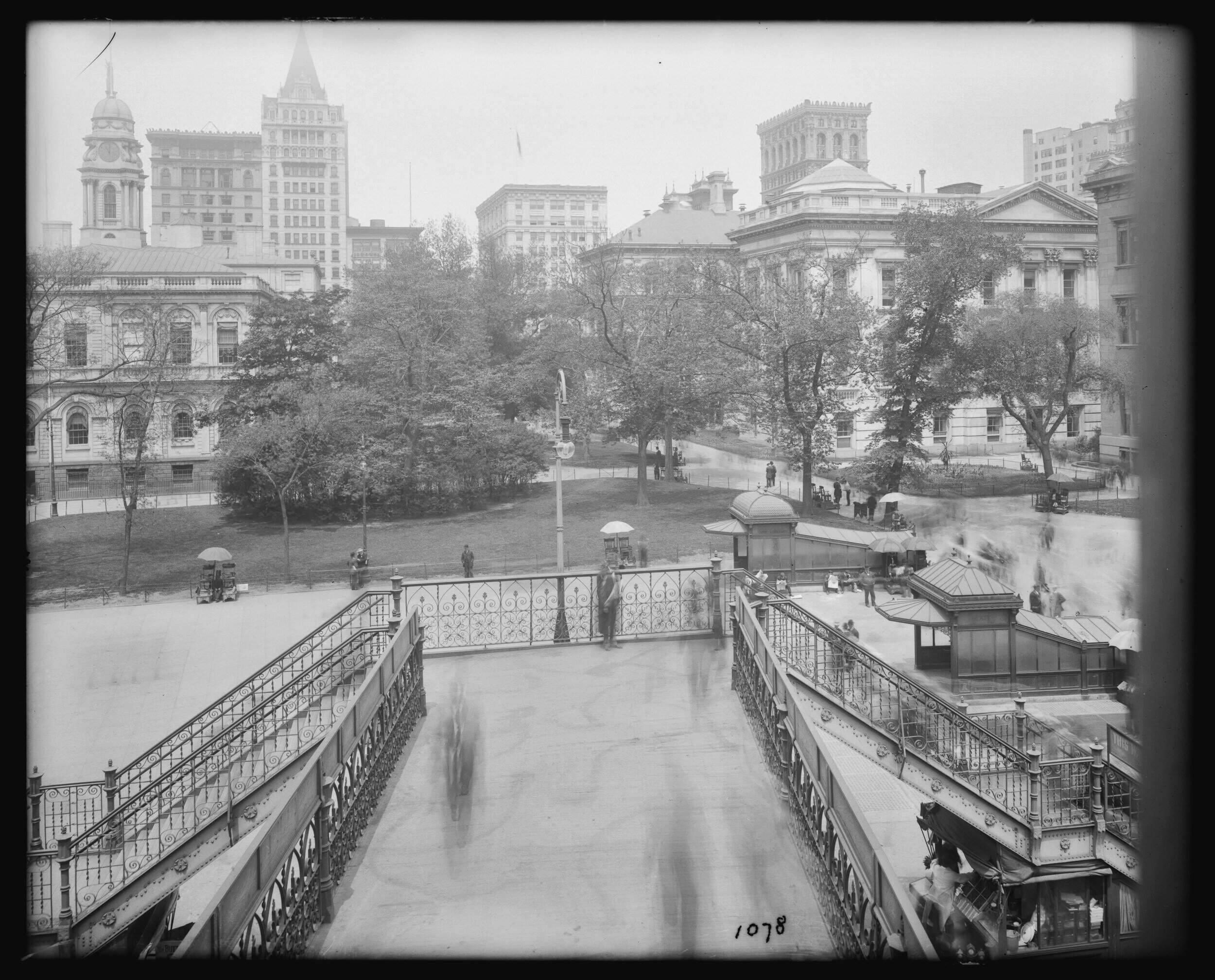
Brooklyn Bridge trolley terminal mezzanine, June 11, 1907. Photographer: Eugene de Salignac. Department of Bridges/Plant & Structures Collection, NYC Municipal Archives.Eugene de Salignac was staff photographer of the Department of Bridges/Plant & Structures from 1906 to 1934. On June 11, 1907, he was assigned to photograph the Manhattan terminal of the trolley line that ran across the Brooklyn Bridge. His photograph captured City Hall, the Tweed Courthouse, and a tiny slice of the old Hall of Records on the right.
Brooklyn Bridge trolley terminal mezzanine, June 11, 1907. Photographer: Eugene de Salignac. Department of Bridges/Plant & Structures Collection, NYC Municipal Archives.

Eugene de Salignac was staff photographer of the Department of Bridges/Plant & Structures from 1906 to 1934. On June 11, 1907, he was assigned to photograph the Manhattan terminal of the trolley line that ran across the Brooklyn Bridge. His photograph captured City Hall, the Tweed Courthouse, and a tiny slice of the old Hall of Records on the right.

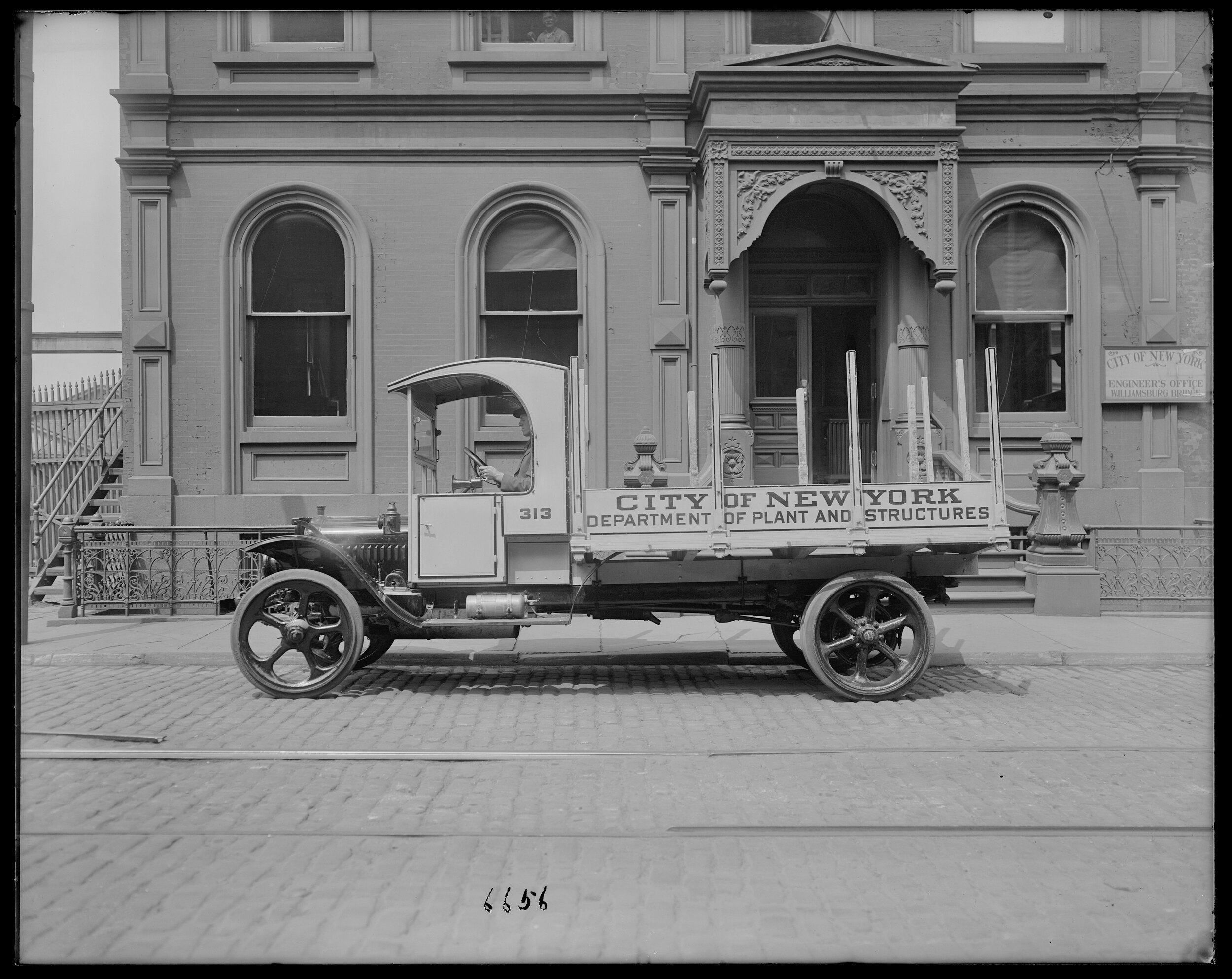
Williamsburg Bridge view of auto truck side, June 11, 1921. Photographer: Eugene de Salignac. Department of Bridges/Plant & Structures Collection, NYC Municipal Archives.On June 11, 1921, Department of Bridges staff photographer Eugene de Salignac took a picture of the agency’s new “Auto truck” near the Williamsburg Bridge.

Williamsburg Bridge view of auto truck side, June 11, 1921. Photographer: Eugene de Salignac. Department of Bridges/Plant & Structures Collection, NYC Municipal Archives.

On June 11, 1921, Department of Bridges staff photographer Eugene de Salignac took a picture of the agency’s new “Auto truck” near the Williamsburg Bridge.

Vernon Avenue, Queens, June 23, 1905. Photographer: Joseph Palmer. Department of Bridges/Plant & Structures Collection, NYC Municipal Archives.Although this photograph dates about two weeks after June 11, it is an excellent example of how the city photographers used serendipitous moments to enhance their images.

Vernon Avenue, Queens, June 23, 1905. Photographer: Joseph Palmer. Department of Bridges/Plant & Structures Collection, NYC Municipal Archives.

Although this photograph dates about two weeks after June 11, it is an excellent example of how the city photographers used serendipitous moments to enhance their images.

Laying paving stones on the Queensboro Bridge, June 11, 1935. Department of Bridges/Plant & Structures Collection, NYC Municipal Archives.

Laying paving stones on the Queensboro Bridge, June 11, 1935. Department of Bridges/Plant & Structures Collection, NYC Municipal Archives.

Automobile accident on the Queensboro Bridge, June 11, 1920. Photographer: Eugene de Salignac.  Department of Bridges/Plant & Structures Collection, NYC Municipal Archives.

Automobile accident on the Queensboro Bridge, June 11, 1920. Photographer: Eugene de Salignac.  Department of Bridges/Plant & Structures Collection, NYC Municipal Archives.

Fourth Avenue, looking south from East 13th Street, Manhattan, June 11, 1926. Photographer: Savastano Studio. Borough President Manhattan Photograph Collection, NYC Municipal Archives.More than a century ago, car traffic was already a feature of city life.

Fourth Avenue, looking south from East 13th Street, Manhattan, June 11, 1926. Photographer: Savastano Studio. Borough President Manhattan Photograph Collection, NYC Municipal Archives.

More than a century ago, car traffic was already a feature of city life.

Riders on the Central Park Bridle Path, June 1937. WPA Federal Writers’ Project Photograph Collection, NYC Municipal Archives.New Yorkers took advantage of the pleasant June weather in 1937.

Riders on the Central Park Bridle Path, June 1937. WPA Federal Writers’ Project Photograph Collection, NYC Municipal Archives.

New Yorkers took advantage of the pleasant June weather in 1937.

NYPD FDNY Intramural baseball game, Polo Grounds, June 11, 1938. New York Police Department Photograph Collection. NYC Municipal Archives.  The New York Times reported that more than 25,000 spectators at the Polo Grounds watched the New York Fire Department team defeat the Police Department in their annual intramural game. Mayor Fiorello LaGuardia threw out the first ball from the grandstand and later presented the Mayor’s Trophy to the victorious Fire Department team.

NYPD FDNY Intramural baseball game, Polo Grounds, June 11, 1938. New York Police Department Photograph Collection. NYC Municipal Archives. 

The New York Times reported that more than 25,000 spectators at the Polo Grounds watched the New York Fire Department team defeat the Police Department in their annual intramural game. Mayor Fiorello LaGuardia threw out the first ball from the grandstand and later presented the Mayor’s Trophy to the victorious Fire Department team.

Ribbon-Cutting, Heliport #2, June 11, 1953. Department of Marine and Aviation Photograph Collection, NYC Municipal Archives.On June 11, 1953, Department of Marine and Aviation Commissioner Edward F. Cavanagh, Jr. (center), dedicated Heliport #2, on Pier A in the Hudson River near the Battery.

Ribbon-Cutting, Heliport #2, June 11, 1953. Department of Marine and Aviation Photograph Collection, NYC Municipal Archives.

On June 11, 1953, Department of Marine and Aviation Commissioner Edward F. Cavanagh, Jr. (center), dedicated Heliport #2, on Pier A in the Hudson River near the Battery.

Police helicopter landing at Heliport #2, June 11, 1953. Department of Marine and Aviation Collection, NYC Municipal Archives. An NYPD helicopter lands at the new Heliport #2 on Pier A during the dedication ceremony.
Police helicopter landing at Heliport #2, June 11, 1953. Department of Marine and Aviation Collection, NYC Municipal Archives.

An NYPD helicopter lands at the new Heliport #2 on Pier A during the dedication ceremony.
 

The Fulton Fish Market:  An unpublished Works Progress Administration (WPA) manuscript

Our recent blog highlighting Municipal Archives collections that document the New Deal included a description of the records of the New York City Unit of the WPA Federal Writers’ Project. The NYC FWP provided meaningful employment for more than 300 writers, journalists, editors and photographers during the Great Depression. Although the collection includes research materials and draft manuscripts for 64 books, only a handful were published, notably the New York City Guide, and New York Panorama.

This week we are posting an article about the Fulton Fish Market from one of the unpublished manuscripts – Feeding the City. As is typical of many FWP manuscripts, the name of the author is not clear (it may have been “McLellan”), but it is dated: October 1940.


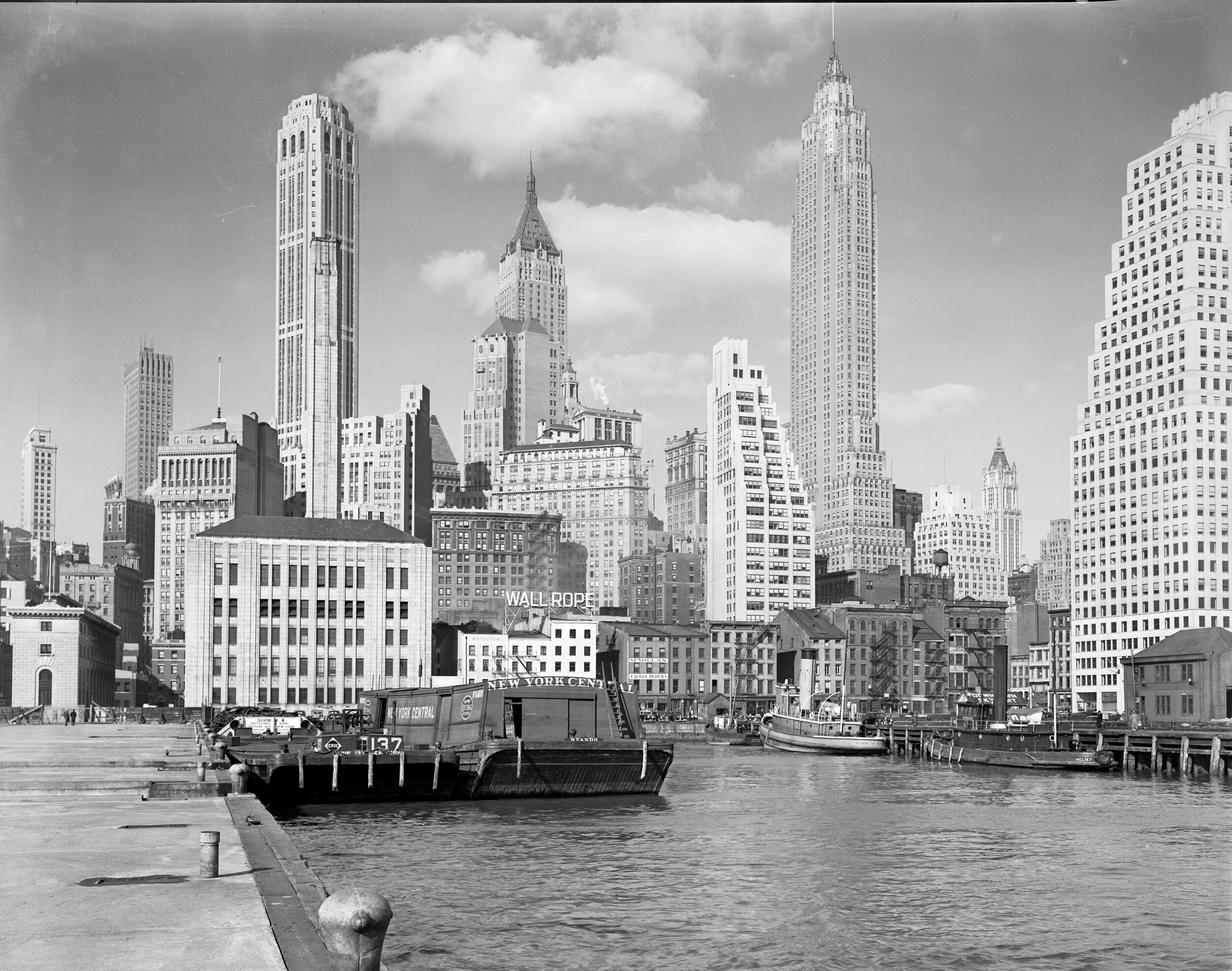
“Manhattan Casts its Reflection in East River,” South Street, from pier, ca. 1937. WPA Art Project Photograph. Photographer: Suydam. WPA FWP Collection, Municipal Archives.

“Manhattan Casts its Reflection in East River,” South Street, from pier, ca. 1937. WPA Art Project Photograph. Photographer: Suydam. WPA FWP Collection, Municipal Archives.

No other wholesale market anywhere offers such an extensive supply of sea food as Fulton Fish Market. London’s famous Billingsgate has long been the world’s largest fish market, but in variety Fulton far surpasses it. During the busy season, early spring to late fall, 160 varieties of fishes and shellfishes from all parts of the world are available here to the 1,633  retail outlets that cater to the City’s diverse tastes.

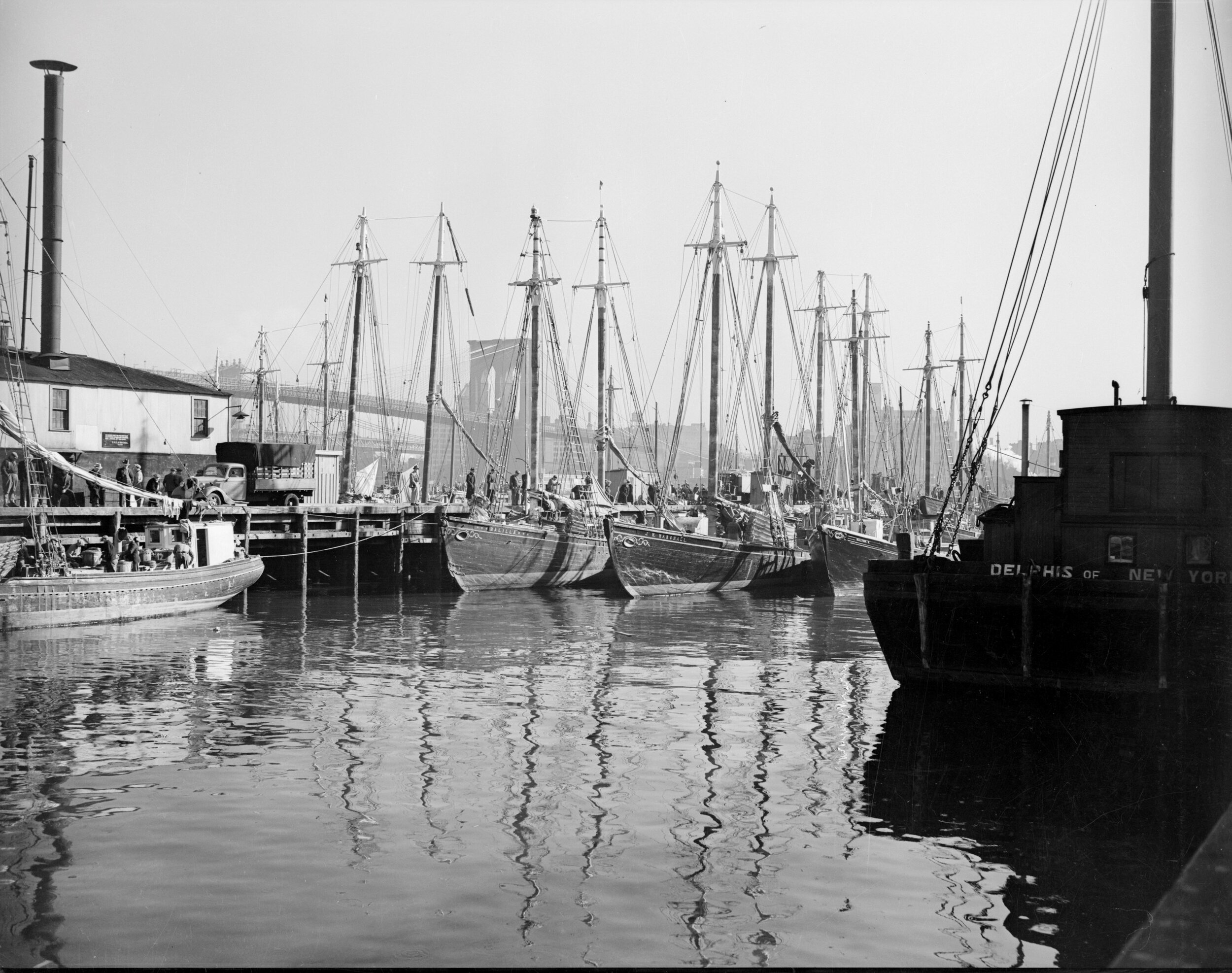
Fishing boats at the dock, East River, November 1937. WPA FWP Photograph. Photographer: E.M. Bofinger. WPA FWP Photograph Collection, NYC Municipal Archives

Fishing boats at the dock, East River, November 1937. WPA FWP Photograph. Photographer: E.M. Bofinger. WPA FWP Photograph Collection, NYC Municipal Archives

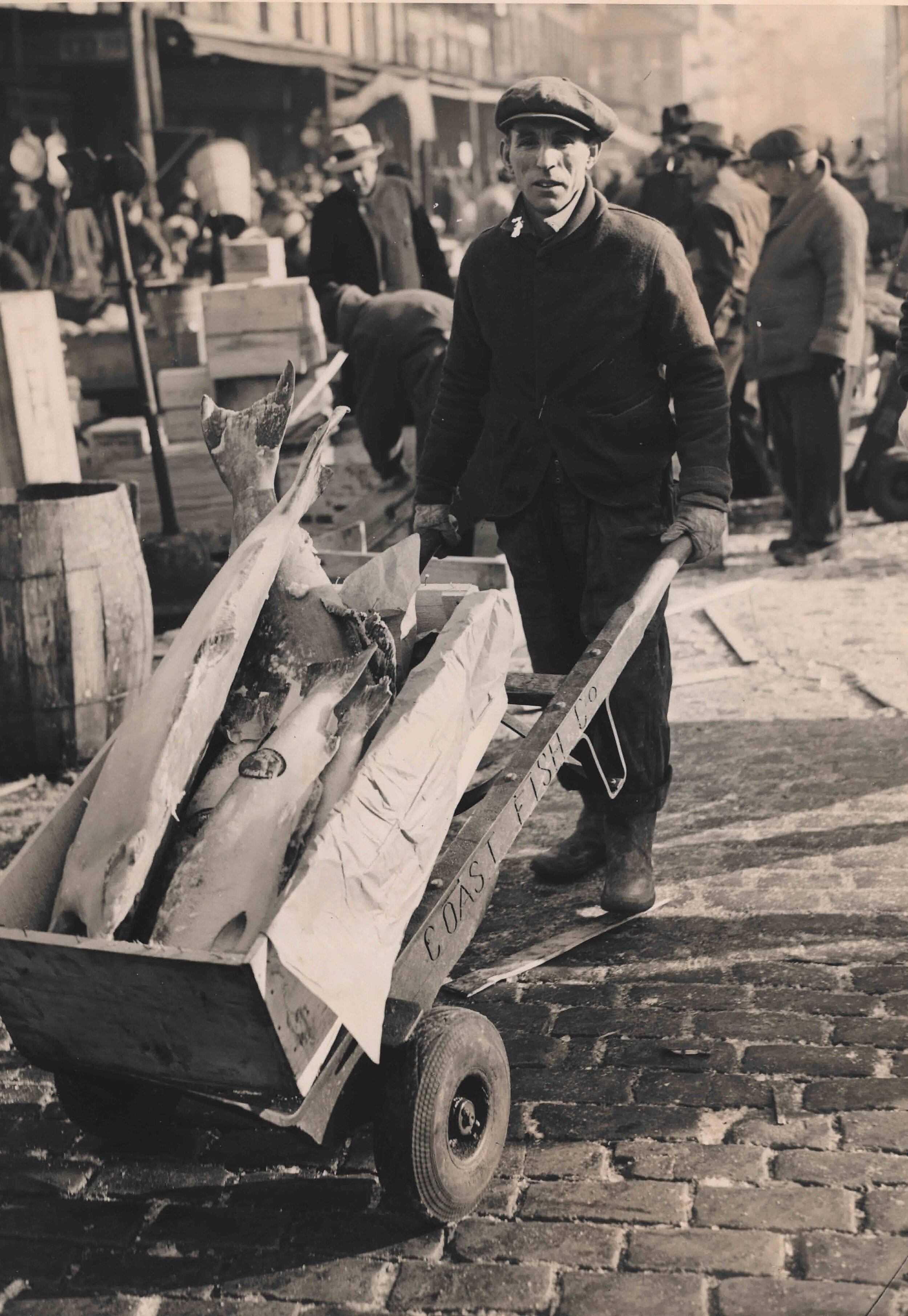
Delivering halibut, Fulton Fish Market, ca. 1937. Fishery Council Photograph. WPA FWP Collection, Municipal Archives.  

Delivering halibut, Fulton Fish Market, ca. 1937. Fishery Council Photograph. WPA FWP Collection, Municipal Archives.  

The Department of Markets estimates that no more than one-quarter of these fishes and shellfishes arrive by boat. The bulk is brought in trailer trucks from railroad terminals and points along the coast. Fresh-water fishes such as eels and carps, bought by certain racial groups, are shipped in alive by rail or are water-borne by Hudson River barges. Freshly caught whole fishes come in by the boatload, but gutted and packaged fishes, both fresh and frozen, arrive by truck from sheds and icehouses adjoining the landing piers in the ports of Boston, Gloucester, and New Bedford. Enormous frozen swordfishes, stiff salt cods, and millions of tins of sardines, sprats, tunas, mackerels and kippered herrings arrive by tramp steamers and transatlantic freighters. Not more than 10 per cent comes from waters contiguous to the City. The major portion is from commercial fisheries whose boats operate on the Newfoundland Banks and off the New England coast, from Gulf fisheries, and those of the Pacific coast. The greater part of the live-lobster supply comes from Maine, while from South Africa come large shipments of frozen tails of the spiny lobster. Other varieties of frozen or preserved fishes and shellfishes come to Fulton Fish Market from points as far distant as Japan, the Baltic states, Portugal, North Africa, and Alaska. Dried and flaked fishes are shipped from Newfoundland and Nova Scotia, from Maine and Massachusetts. From the Mississippi and its tributaries in the southern States and from the Great Lakes arrive the fresh-water fishes so important in the diet of the City’s Jewish population.

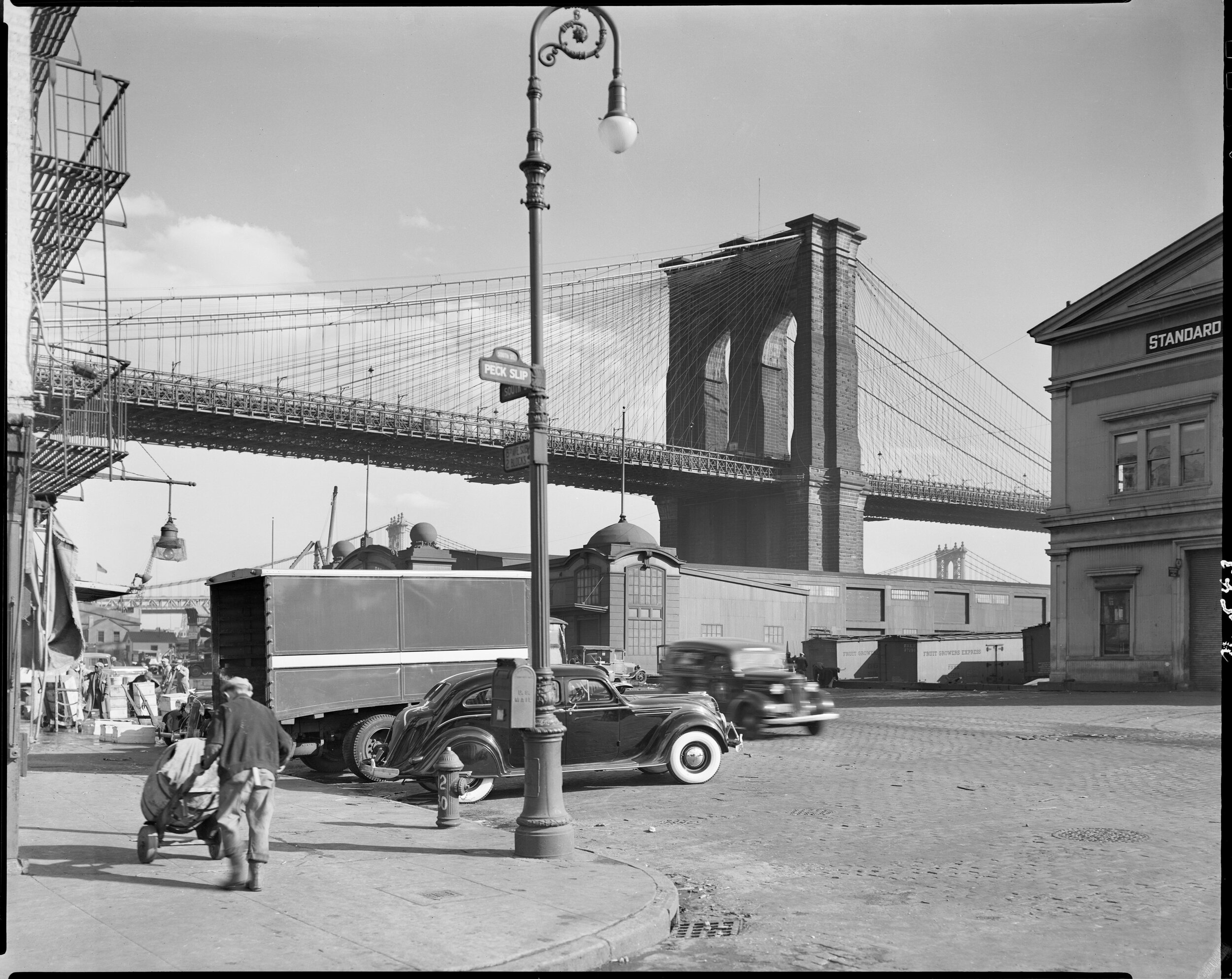
South Street, near Peck Slip, October 1938. WPA Art Project Photograph. Photographer: Libsohn.  WPA FWP Collection, Municipal Archives.   

South Street, near Peck Slip, October 1938. WPA Art Project Photograph. Photographer: Libsohn.  WPA FWP Collection, Municipal Archives.   

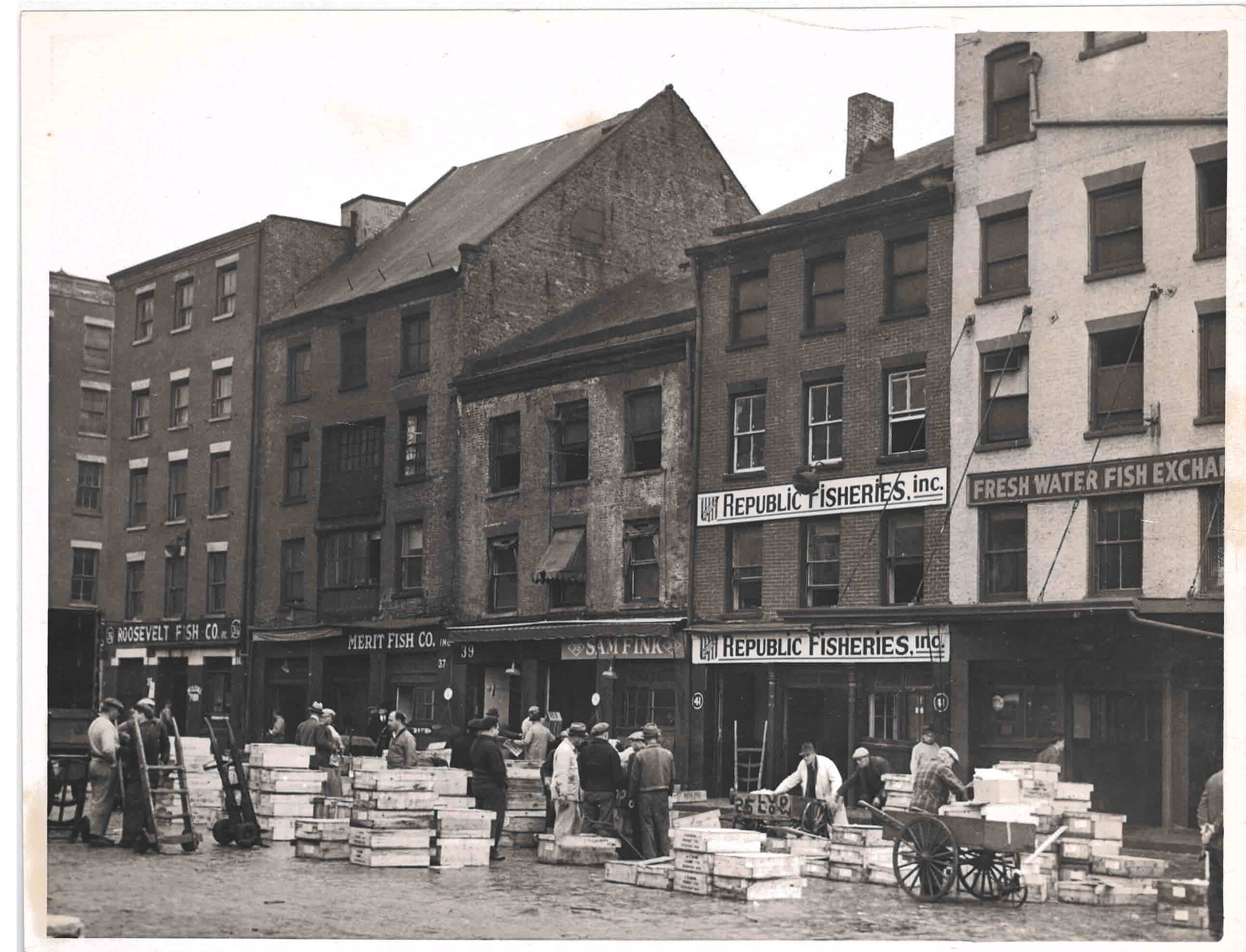
The day’s work begins in Fulton Market at 2 a.m. when trawlers, draggers, and smacks draw into the docks along the lower East River to discharge their cargoes. Selling begins precisely at 6 a.m. when a gong clangs three times. Buyers, representing jobbers and retailers, scurry among the stalls of the market’s 100 wholesale dealers, making their selections. Stalls are on piers, in the market’s new buildings, and in the nine-block area west of South Street.

Fish vendors, South Street, ca. 1937.  WPA Federal Writers’ Project Photograph. Photographer:  Clifford Sutcliffe. WPA FWP Collection, Municipal Archives.

Fish vendors, South Street, ca. 1937. WPA Federal Writers’ Project Photograph. Photographer: Clifford Sutcliffe. WPA FWP Collection, Municipal Archives.

Ninety per cent of the market’s sales are handled on a commission basis and selling must be concluded by one o’clock in the afternoon. After the boats unload, workmen begin wielding knives, cleavers, clippers, and scalers, preparing tons of fishes, and arranging them on beds of cracked ice for rush delivery to jobbers and retailers. The action along the waterfront is fast and furious since fish is one of the most perishable of commodities. 

Hundreds of trucks are unloaded along the sidewalks where countless crates, vaporous and dripping wet from over-night refrigeration, are piled high. Empty trucks rumbling away are replaced by others belatedly reaching their destination. Retailers’ and jobbers’ trucks are loading up, a seemingly interminable stream of vehicular traffic.

Sidewalk stand, Fulton Fish Market, October 1937. WPA FWP Photograph. WPA FWP Collection, Municipal Archives.

Sidewalk stand, Fulton Fish Market, October 1937. WPA FWP Photograph. WPA FWP Collection, Municipal Archives.

“Whale and five chickens,” shouts a floor salesman, moving about in thick-soled rubber boots. A handler disappears into a refrigerated compartment and emerges hugging a huge halibut and five small ones. He drops these into a barrel and the “whale and five chickens” are ready to be packed for the last lap of their journey from the salty depths to the neighborhood fish store.

Monday is the big day at Fulton Fish Market. Produce sold on Mondays is in the retailers’ stores on Tuesdays, and so the shrewd housewife does not have to wait until Thursday or Friday to shop for sea food. On Tuesdays, stocks are fresher and larger, and prices are apt to be lower than during the rush later in the week.

When South Street was a cobblestone thoroughfare, unpleasant odors hung over this 200-year-old market. Today odors are being banished, for South Street, 75 feet wide, is now paved with asphalt, and new buildings constructed between Piers 17 to 20 by the Department of Markets form the beginning of a model fish market.

Peck Slip and South Street, ca. 1937. WPA Federal Art Project Photograph. WPA FWP Photograph Collection, NYC Municipal Archives.

Peck Slip and South Street, ca. 1937. WPA Federal Art Project Photograph. WPA FWP Photograph Collection, NYC Municipal Archives.

The huskies who man the fishing boats are among the most picturesque of those who go to sea for their living. Many are of Norse origin. Others are down-easters whose Yankee forebears fished the banks along the North Atlantic coast; Portuguese, Italians, and Newfoundlanders also form a large group. Like other seafarers, these fishermen have their superstitions. Few will leave the piers on Fridays. When the Friday morning rush is over, they descend into their cabins and sleep until Saturday morning, or wander along South Street on shopping tours.

The entire supply of sea food once came by boat, but the fishing fleet is gradually diminishing. Skippers in the distant fishing grounds head their craft for home port, to load the catch into railway express cars or specially constructed trucks with insulated bodies, which rush to the wholesale markets. The airplane, too, enters into the picture, bringing from the west coast, southern, and Canadian waters luxury sea food such as turtle, terrapin, salmon, pompano, Florida crabmeat and stone crab, mountain stream trout, and frog’s legs. Many of these expensive products are packed in special tins and cartons for flight to LaGuardia Field, and are trucked to the market or delivered direct to retail outlets, clubs, and hotels.

Peck Slip, between Front and South Streets, ca. 1937. World Telegram Photograph. WPA FWP Collection, Municipal Archives.  

Peck Slip, between Front and South Streets, ca. 1937. World Telegram Photograph. WPA FWP Collection, Municipal Archives.  


New Yorkers expect many types of food to be available at stores and markets.  This manuscript shows that this is not something new but a long standing tradition.

Memorial Day

Mayor Fiorello LaGuardia places a wreath on the tomb of Captain Eddy Grant, a former New York Giants third baseman who died in 1918 during the World War I battle at Argonne Forest, France.  LaGuardia was joined by members of the 307th Infantry Regiment during the ceremony at the Polo Grounds in upper Manhattan, May 30, 1935.  Mayor Fiorello LaGuardia Photograph Collection.  NYC Municipal Archives.

Mayor Fiorello LaGuardia places a wreath on the tomb of Captain Eddy Grant, a former New York Giants third baseman who died in 1918 during the World War I battle at Argonne Forest, France.  LaGuardia was joined by members of the 307th Infantry Regiment during the ceremony at the Polo Grounds in upper Manhattan, May 30, 1935.  Mayor Fiorello LaGuardia Photograph Collection.  NYC Municipal Archives.

On Memorial Day we honor the men and women who died while serving in the United States military.  Originally known as Decoration Day, it originated in the years following the Civil War and became an official federal holiday in 1971. 

How to Research the Vital Records Collection

This is the first ‘how to conduct research’ blog in On the Record. It provides essential information about the vital records collections at the Municipal Archives. This blog is adapted from a program Marcia. Kirk recently recorded for a genealogy seminar. A subsequent blog will take us “beyond the basics.” Future blogs by subject-matter experts will provide instructions on how to research other Municipal Archives collections. 

What are vital records, and why are they important? Vital records document major events in a person’s life: people are born, sometimes they get married, and unfortunately, they die.

Historical records of births, deaths and marriages that occurred in New York City are maintained in the Municipal Archives. If the event occurred outside the five boroughs, the record would be on file at the New York State Department of Health in Albany, or in some instances, with the clerk of the local town. Births reported after 1910, and deaths reported after 1948 are available from the Department of Health and Mental Hygiene and marriages reported after 1949 are available from the Office of the City Clerk.

The holdings of the Municipal Archives include all extant vital records for the five boroughs as well as the towns and villages that were consolidated into the Greater City of New York in 1898. Municipal Archives Genealogy Collections

Researching the records

The birth, death and marriage records are filed and indexed according to the Borough where the event took place.

Most of the vital records are in a certificate format. The certificates are numbered consecutively beginning with certificate number one on January 1 of each year. The records of each Borough are filed separately.

To find a certificate, it is necessary to search an index to identify the Borough, year filed, and the certificate number.

Where are the indexes? 

Most of the indexes are available online. They are available on the local Italian and German genealogy organization website; at www.Ancestry.com; and at www.Familysearch.org. Most online indexes were created by people transcribing and/or machines reading the original hard-copy indexes which means there are mistakes in the online versions.

At the Municipal Archives researchers can view the online indexes as well as the original indexes. Sometimes it is necessary to go to the original indexes when a mistake is found in the on-line version.

Locating a certificate requires the researcher to use an index to search for the Borough, year filed and the certificate number.

Births records:

It is important to note that about 25% of births during the time correlated with the Municipal Archives holdings (prior to 1910) were not reported to City government. Children were born at home and sometimes the family or persons assisting at the birth did not know the requirement or perhaps were not literate in English. More consistent birth registrations began when new legislation was enacted in 1913. (The Municipal Archives birth holdings date prior to 1910.)

When conducting a search in the indexes it is really important to keep the search terms as broad as possible. Sometimes a person’s first name is not what it is thought to be.

I came across an unfamiliar name when researching my own family. I asked my Aunt who said, “oh, that’s cousin Dolly!” Another problem is one I encountered when researching my McCabe ancestors. McCabe is a common name and there are hundreds of people with the same name.

The Municipal Archives collection of birth records totals more than 2 million certificates.  All of them have been digitized. 

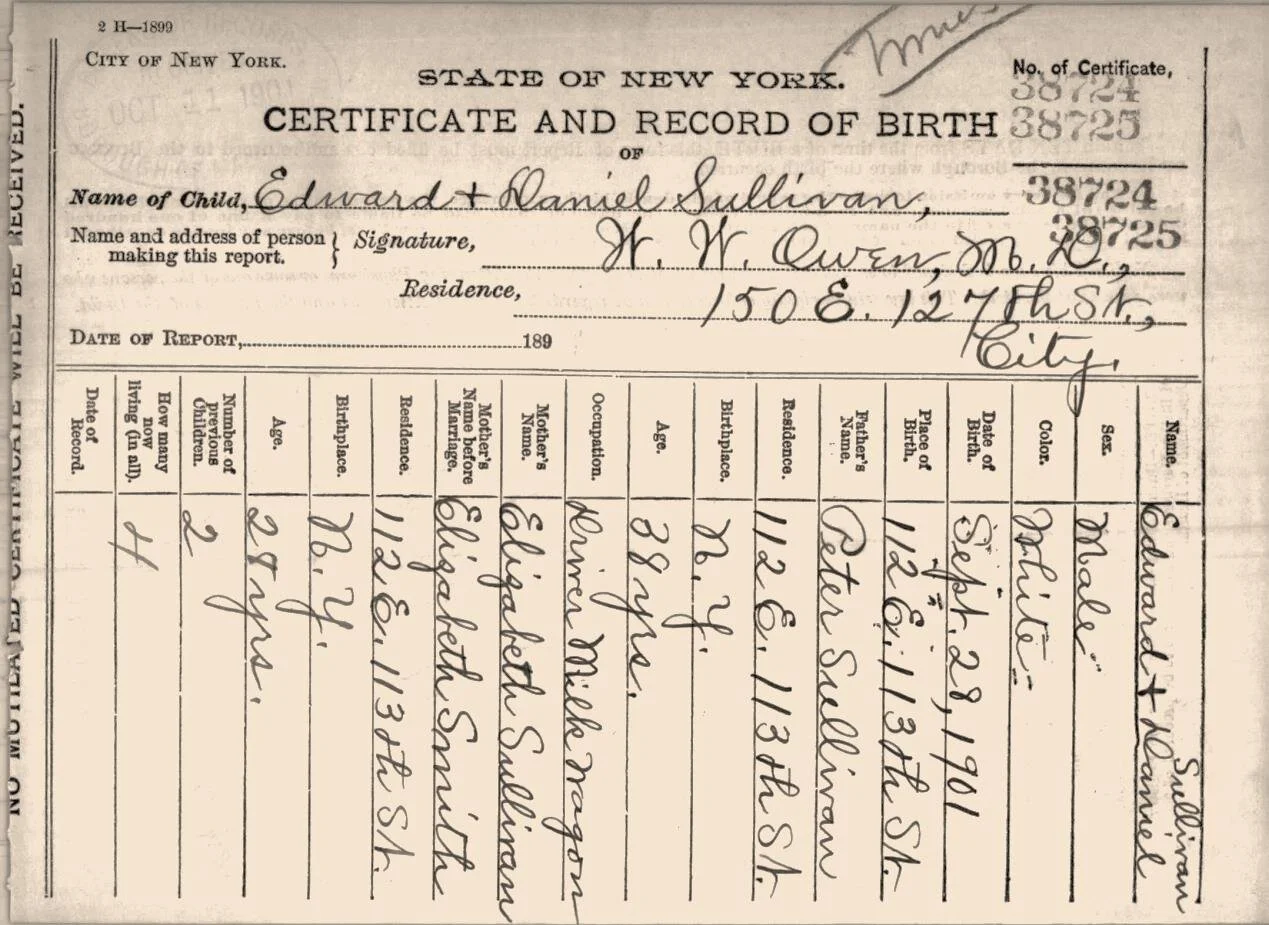
This is an unusual example.  The birth certificate documents twins; most of the time there would be two separate certificates numbered consecutively, but in this case, there is one certificate, with two numbers. 

This is an unusual example.  The birth certificate documents twins; most of the time there would be two separate certificates numbered consecutively, but in this case, there is one certificate, with two numbers. 

Birth certificates contain lots of good information: the name of the person making the report – usually a doctor, but sometimes a midwife or perhaps a neighbor. There are the basics – name, race, date of birth, father’s name, age, occupation and birthplace. And most important, the mother’s name and her name before marriage, the number of children were born to her previously and the number still living.

Here is another example.This is the actor Humphrey Bogart’s birth certificate. He was born at the Sloane Maternity Hospital on December 25, 1899. His original name was Bogart de Forest. But his mother’s name was Maude Humphrey. 

Here is another example.

This is the actor Humphrey Bogart’s birth certificate. He was born at the Sloane Maternity Hospital on December 25, 1899. His original name was Bogart de Forest. But his mother’s name was Maude Humphrey. 

Special and Delayed birth certificates

They are not what you think. Sometimes, when searching in the birth index there is an “S” or a “D” after the certificate number. “S” means “Special,” and “D” means “Delayed.”

The “Special” and “Delayed” births were called that because the birth was reported to the Health Department long after the child was born, or in some instances, the record was amended (father’s name added, etc.) at a later date.

By the way, the Archives does not correct information on vital records – even if there is an obvious misspelling of a name. If a certificate must be amended for some legal purpose, the Archives staff will not make the change, but will instead provide an official letter stating that any vital record in the Municipal Archives cannot be amended.

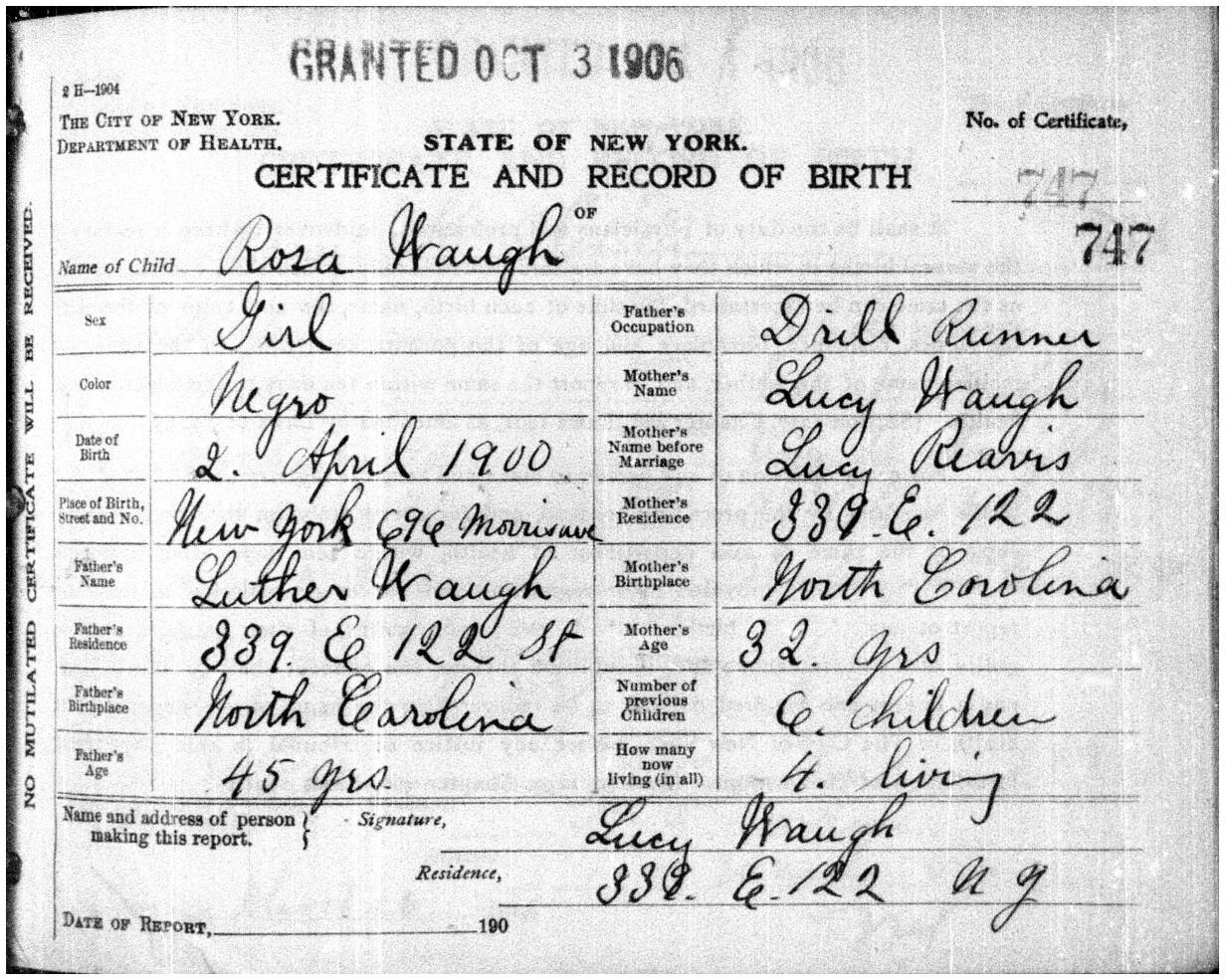
In this example, Rosa was born April 2, 1900; however, the record was not filed until 1906. 

In this example, Rosa was born April 2, 1900; however, the record was not filed until 1906. 

This is an example of a birth ledger.  Records for Manhattan and Brooklyn prior to 1866 and the other Boroughs prior to 1898 exist in this format.  The information recorded is essentially the same as would appear on a certificate.   

This is an example of a birth ledger.  Records for Manhattan and Brooklyn prior to 1866 and the other Boroughs prior to 1898 exist in this format.  The information recorded is essentially the same as would appear on a certificate.   

Geographic Birth Indexes

The standard birth index is arranged by last name. However, we also have another type of index for births – the ‘geographic’ index.  In this index the births are listed by place of birth.

In this example, these card lists all the births that took place at 410 and 411 West 54th Street, in Manhattan between 1880 and 1883.

In this example, these card lists all the births that took place at 410 and 411 West 54th Street, in Manhattan between 1880 and 1883.

There are geographic indexes for births from 1880 through 1909 for Manhattan, and from 1898 through 1909 for the other four Boroughs. 

Marriage Records

Marriage records are more complicated because there are two completely separate series:  The Health Department marriage certificates (1866-1937), and the City Clerk “licenses,” (1908-1949). When researching a marriage index, it is important to notice whether the index is for the Health Department certificates, or the City Clerk licenses.

For marriages prior to 1908, the only record is the Health Department certificate. In 1908, New York State passed a law that required any couple wishing to get married to first obtain a license. In New York City, the City Clerk issues these licenses.

The license record consists of three documents: 1) “affidavit,” filled out by the couple; 2) “license” issued by the Clerk; and 3) “certificate” filled out by person who performed the wedding ceremony.

The Health Department certificate series continued through 1937 which means that from 1908 to 1937, there are potentially two marriage records: the Health Department certificate and the City Clerk affidavit, license, and certificate. The basic information on each is the same except the City Clerk license series lists the country of birth of the parents of the bride and groom, and the bride’s occupation.

This is the Health Department record of Franklin Delano Roosevelt and Eleanor Roosevelt’s 1905 marriage (Eleanor was a distant cousin of Franklin). The marriage was witnessed by Eleanor’s Uncle (and sitting President) Theodore Roosevelt and his wife Edith.

This is the Health Department record of Franklin Delano Roosevelt and Eleanor Roosevelt’s 1905 marriage (Eleanor was a distant cousin of Franklin). The marriage was witnessed by Eleanor’s Uncle (and sitting President) Theodore Roosevelt and his wife Edith.

All of the Health Department marriage records have been digitized.

Marriage licenses

The index to the license series is available at www.Ancestry.com and on microfilm at the Municipal Archives. There are more than three million records in this series; digitization is underway. The list below shows the records currently available in digital format.

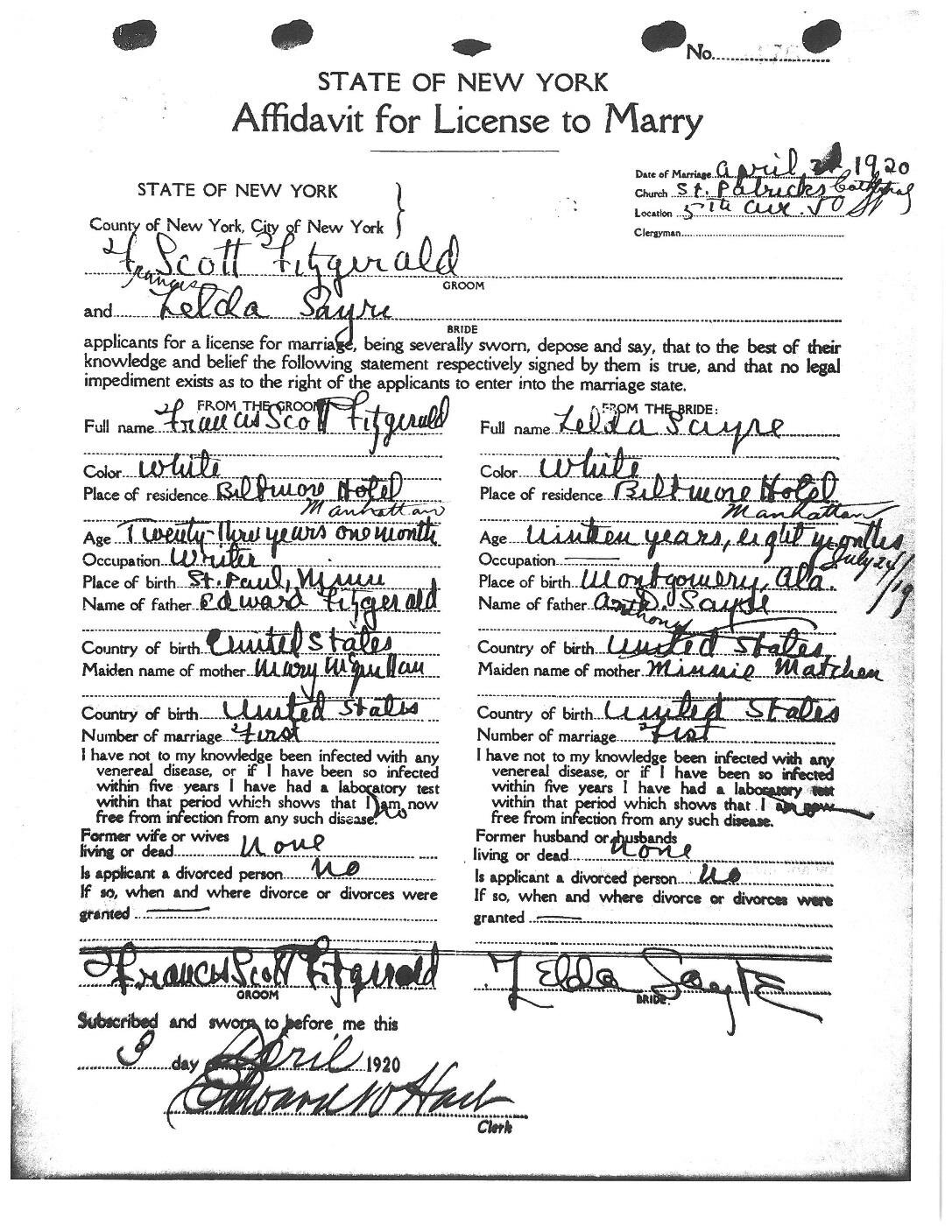
This is the affidavit F. Scott Fitzgerald and Zelda Sayre filled out for the license to marry at St. Patrick’s Cathedral in 1920.

This is the affidavit F. Scott Fitzgerald and Zelda Sayre filled out for the license to marry at St. Patrick’s Cathedral in 1920.

As noted in the above affidavit from F. Scott Fitzgerald and Zelda Sayre, there are three documents. The first is the affidavit filled out by the couple. It shows where they were living – in this case, both F. Scott and Zelda were residing at the same hotel in Manhattan. F. Scott was born in St. Paul, Minnesota. and was 23 years old. His parents’ names and their birthplaces are also recorded, along with his mother’s maiden name. It was his first marriage. Zelda was 19. She did not list an occupation; she was born in Montgomery Alabama.

The next document is the license, which is confusing as the document is titled: “New York State Department of Health.” The license contains essentially the same information as the affidavit.

The third document is the “certificate.  It was filled-out by the officiant and signed by the officiant and witnesses. It’s always a good idea to pay attention to the witnesses; you might find out about other family members and close friends.

F. Scott Fitzgerald and Zelda Sayre’s marriage license.

F. Scott Fitzgerald and Zelda Sayre’s marriage license.

The next document is the license, and this is where it gets confusing as the document is titled: “New York State Department of Health.”  The license contains essentially the same information as the affidavit. 

F. Scott Fitzgerald and Zelda Sayre’s marriage certificate.

F. Scott Fitzgerald and Zelda Sayre’s marriage certificate.

The third document is the “certificate. It was filled-out by the officiant and signed by the officiant and witnesses. It’s always a good idea to pay attention to the witnesses; you might find out about other family members and close friends.

Death records.

Information on the death certificate was not provided by the person in question, for obvious reasons. The information was supplied by someone other than the deceased, usually a family member. But because the information is supplied by someone other than the deceased, there can be mistakes. It’s best to keep that in mind when using information on death certificates. Another important point is that death certificates were filed according to the place of death, not the place of usual residence, or the burial place. 

Death certificates always indicate the place of burial. If the place is listed as “City Cemetery,” that means the “Potter’s Field” on Hart Island. The Archives has the burial records for the City Cemetery, in ledger format, on microfilm, dating from 1872 to the 1980s, but there are big gaps from the late 1950s through the 1970s due to loss of records from water damage from flooding on the Island. Also, note that the City Cemetery burial records are not indexed; names are listed by date of burial.  We suggest using the death certificate indexes to identify the date.

There are more than five million death certificates in the Municipal Archives collection. All death certificates filed in The Bronx, Brooklyn, Queens and Staten Island have been digitized. The Manhattan certificates are partially digitized. The list below provides the description of what is currently available in digital format.

George Herman Ruth’s death certificate.

George Herman Ruth’s death certificate.

In this example, the deceased had been living at 110 Riverside Drive in Manhattan for 26 years. He was married. George Herman Ruth is of course the famous baseball player, Babe Ruth. He died in 1948 of natural causes and is buried in Gate of Heaven Cemetery which is in Westchester County.

city cem.jpg

Going back to the City Cemetery for a minute, we do have the burial records, in ledger format, on microfilm, dating from 1872 to the 1980s, but there are big gaps from the late 1950s through the 1970s due to loss of records from water damage due to floods on the Island. Also, note that the City Cemetery burial records are not indexed; names are listed by date of burial. We suggest using the death certificate indexes to identify the date.   

How to Access Vital Records

Although the Municipal Archives facilities remain closed to the public, copies of records may be ordered online or via regular mail. If the record has been digitized and you would like a PDF copy, we can email the record within about five days. PDF copies are not certified, however. If you request a record that has not been digitized, or if you need a certified hard copy, the current processing time can be eight weeks or longer.

Here are the certificates that are available in digital format:

We look forward to helping our patrons research their New York City roots and providing more in-depth ‘how-to’ guides to our rich collections.

We look forward to helping our patrons research their New York City roots and providing more in-depth ‘how-to’ guides to our rich collections.

Documenting the New Deal

There has been much speculation in recent months concerning whether President Joe Biden’s infrastructure projects and related programs, if given the green light, would prove as transformative for the nation as President Franklin Delano Roosevelt’s New Deal was in the 1930s.

A life-long swimmer, Parks Commissioner Robert Moses vastly expanded access to aquatic facilities for New Yorkers.  In 1936, he opened ten new swimming pools and during his long tenure he built and improved public beaches throughout the city. “Swim” original art for subway. Tempura water-color on tissue paper, 1937; artist unknown.  Department of Parks General Files, 1937.

There is no question, however, that the New Deal transformed New York City.  The Works Progress Administration (WPA) was the capstone of Roosevelt’s efforts to recover from the Great Depression. Established as part of the Emergency Relief Appropriations Act of 1935, the WPA was the largest jobs initiative in American history. When the federal funding for the WPA became available, Mayor Fiorello LaGuardia persuaded Roosevelt to release billions of dollars for construction projects. It was a partnership that would forever change the city.

New York received more federal funds than any other city in the nation and employed more than 700,000 people through the Depression years. They built or renovated schools, bridges, parks, hospitals, highways, airports, stadiums, swimming pools, beaches, hospitals, piers, sewers, libraries, courthouse, firehouses, markets and housing projects throughout the five boroughs. The Triborough Bridge, the Holland and Lincoln Tunnels, the FDR Drive, the Henry Hudson and Belt Parkways, and the New York Municipal (LaGuardia) Airport are just some of the WPA-funded projects that have served New Yorkers over the past eight decades.

To the eternal benefit of generations of historians and researchers, the Archives holds extensive collections essential for exploring the New Deal in New York City.

Mayor Fiorello LaGuardia to Harry Hopkins, Administrator Works Progress Administration, Postal Telegram, May 19, 1936.  Fiorello LaGuardia Collection, subject files. NYC Municipal Archives.

Documenting the New Deal in the city is largely a tale of two remarkable New Yorkers: Mayor Fiorello LaGuardia and ‘master builder’ Robert Moses. Archival records showing their influence and impact on the city total more than 1,500 cubic feet.

Of particular interest to New Deal historians are Mayor LaGuardia’s subject files. There are 27 folders with content specifically labeled as relating to the WPA.  In addition, there are files pertaining to all of the public works construction projects–housing, highways, parks, swimming pools, etc., as well as the Civilian Conservation Corps, and other New Deal programs such as Social Security. In addition, there is a separate series of correspondence with federal officials in Washington D.C. totaling five cubic feet. Not all of it specifically pertains to the WPA, but given the importance of the various programs and the billions of dollars flowing from Washington, information about the massive federal program is well represented in the correspondence.

Mayor Fiorello LaGuardia to Miss Sue Ann Wilson, Federal Theatre Project, November 24, 1936. Fiorello LaGuardia Collection, correspondence with federal officials. NYC Municipal Archives.

LaGuardia’s records have been available at the Municipal Archives since its founding in 1952. The Robert Moses collection is a more recent addition. In 1984, city archivists visited a Department of Parks and Recreation storage facility at the Manhattan Boat Basin under the Henry Hudson Parkway, where they discovered 800 cubic feet of material—about 400,000 items—from 1934 through the 1970s, that included an extensive record of the WPA-funded projects during Moses’s long reign as a New York power broker. LaGuardia appointed Moses as Commissioner of the Department of Parks in 1934 and he served in that capacity until 1960, during which time  he also held at least a dozen city and state positions.

79th Street Boat Basin, Henry Hudson Parkway, ca. 1937.  Municipal Archives Collection, NYC Municipal Archives.

The records found at the Boat Basin were in remarkably good condition, consisting of carbons or originals of Moses’s correspondence, memoranda, transcripts, reports, contracts, news clippings, maps, blueprints, plans, printed materials, press releases, invitations, and photographs. There are 121 folders specifically labeled “WPA,” in the “General Files,” series but, similar to the LaGuardia papers, Moses’ correspondence relevant to New Deal programs are evident throughout the collection.

No detail was too small or building too insignificant for Moses and his talented team of architects as illustrated by the handsome design of this concession stand and comfort station. Pelham Bay Park, October 22, 1941. Department of Parks Collection. NYC Municipal Archives.

The third trove of WPA-related materials in the Archives is the WPA Federal Writers’ Project collection. The WPA did not just improve parks and build roadways—a portion of the money was set aside for unemployed professionals in the “arts.” As WPA director Harry Hopkins explained, “they have to eat like other people.” It was called Federal Project Number One, and consisted of Art, Music, Theatre and Writers’ Projects. The Federal Writers' Project (FWP) was the only one to operate in all 48 states and the territories of Alaska, Hawaii, Puerto Rico, and the Virgin Islands, as well as New York City.  At its peak, in April of 1936, there were 6,686 on the payroll nationwide; approximately 40% were women.

Triborough Bridge, December 1937. WPA Federal Writers’ Project Photograph Collection. NYC Municipal Archives.

New York City housed the largest FWP Unit, employing nearly 300 people. The writers produced the New York City Guide, New York Panorama, Almanac for New Yorkers, a number of ethnic studies, Who’s Who in the Zoo—a total of 64 proposed books. The New York City Guide proved so durable and popular that it was re-published in 1966, 1982 and again in 1992. To illustrate the books, the NYC unit acquired photographs from trade organizations, other branches of Federal Project One, and sent staff photographers to document many aspects of New York City.

Feeding the City, reference materials, brochure, ca. 1937. WPA Federal Writers’ Project Collection. NYC Municipal Archives.

Two years ago, a manuscript and research files from this collection documenting the consumption and preparation of food in the City were showcased in an exhibit Feeding the City at the Municipal Archives.

Manhattan approach to the Holland Tunnel, December 6, 1936. WPA Federal Writers’ Project Photograph Collection. NYC Municipal Archives.

Shortly after the commencement of World War II hostilities, the WPA discontinued Federal Arts programs around the country and many shipped their records to Washington, D.C. (most went to the Library of Congress). The records of the NYC Unit of the Writer’s Project did not leave the City, however. They were deposited in the Municipal Library. Although there is not extant documentation to confirm this, it seems likely that the FWP staff had been regular patrons of the Municipal Library and well known to long-time Library Director Rebecca Rankin. Perhaps she suggested that her Library would provide a good home to their records. And indeed it did; the FWP collection (eventually transferred to the Municipal Archives) has served as a rich research resource for many decades.

Bookbinder. WPA Miscellaneous Projects, Bookbinding, ca. 1937. WPA Federal Writers’ Project Photograph Collection. Photographer: Ralph DeSola (Federal Art Project). NYC Municipal Archives.

WPA instructors held classes in designing and staging puppet shows, Tompkins Square Boys Club, January 1937.  WPA Federal Writers’ Project Photograph Collection, Photographer: von Urban (Federal Art Project). NYC Municipal Archives.

The photographs in the collection are of particular relevance to documenting what the WPA accomplished in New York City. The FWP staff arranged the pictures by subject, e.g. “Bridges, Triborough Bridge,” or “Transportation, Tunnels.”  “WPA Activities” was another subject heading and reviewing the list of sub-headings provides an indication of the wide scope of the WPA: construction projects, music project, nursery schools and parent education project, puppet teaching project, sewing project, theatre project, etc. 

It is too soon to know whether  President Biden’s proposed programs will have the same transformative effect as the New Deal. But if a model is needed for a successful economic recovery with a lasting impact, one need look no further than New York City.

Portions of this article appeared in The Living New Deal an organization dedicated to research, presentation and education about the immense riches of New Deal public works. 

The Eastern District of Brooklyn

There is, in the Municipal Library, a charming tome titled The Eastern District of Brooklyn with Illustrations and Maps. Published on May 7, 1912, its author, Eugene L. Armbruster, was a preservationist long before that was a recognized field. An immigrant from Germany to the United States, he devoted years to documenting Long Island (which included Brooklyn and Queens) with photographs, pamphlets and other publications. Thousands of his photos are in collections at the New York Historical Society, the Brooklyn Public Library and the Queens Public Library.

Ferry Landing, Grand Street, Williamsburgh, 1835. Illustration from The Eastern District of Brooklyn with Illustrations and Maps, 1912. NYC Municipal Library.

Armbruster frequently answered questions posed by readers of The Brooklyn Eagle in a section of the paper titled “Questions Answered by the Eagle.” This idiosyncratic feature contained a hodge-podge of information in response to inquiries such as, “Is there a Shenandoah in New York?” submitted by BLANK…. Yes, in Dutchess County.  “What is meant by the seven ages of man and who was the author?” posed by Mrs. D.H. … It’s from As You Like It by William Shakespeare spoken by the Duke in Act 2 (although the better-known portion of that speech is “all the world’s a stage and all the men and women merely players”). Labeled “the local expert on Brooklyn history,” Armbruster fielded questions related to events and places in Brooklyn, such as the original location of Litchfield Mansion. Right where it remains at 5th and 9th Ave., also known as Prospect Park West.

The book itself is tiny, about the size of a box of notecards but it contains a host of information in its series of brief sketches, appendices and hand-drawn illustrations and maps. The titles themselves are beguiling: a settlement named Cripplebush, one appendix titled, “The Solid Men of Williamsburg, 1847,” and the illustration listed as Literary Emporium. Is there such flora as a cripplebush and if so, what does it look like? Were the Williamsburg men particularly chunky? Was the emporium a bookstore or early library?  The answers lie ahead.

Junction of Broadway, Flushing and Graham Avenues. Illustration from The Eastern District of Brooklyn with Illustrations and Maps, 1912. NYC Municipal Library.

Written shortly after the consolidation of the Greater City in 1898, the author intended to provide an overview of the Eastern District of Brooklyn to assist future historians. “If a history of the City of New York will ever be written, its compiler will look around for historical matter relating to the old towns, now forming parts of the metropolis, and this book was written that the Eastern District of Brooklyn may be represented then. But, what exactly is this Eastern District? Armbruster explained that during an earlier Kings County consolidation, the towns of Williamsburg, Bushwick and North Brooklyn were combined into the Eastern District. There also was a Western District that “included the remainder of the enlarged city” which was the portion of Kings County that comprised the City of Brooklyn. But that’s not all. There was a “sparsely settled” 9th ward between the two districts and a 26th ward that “was never a part of the Western District, but a town by itself until annexed in 1886 by the late City of Brooklyn.” Clear as mud!  

Suffice it to say that the book is about a series of settlements that became villages, towns and cities between 1638 and 1910. These include what are now Ridgewood and Long Island City (now in Queens), Bushwick, Greenpoint, Williamsburg and East New York. The boundaries of the settlements shifted based on grants issued by the West India Company, colonial governments and eventually through Acts of the State Legislature.   

Armbruster appears not to have accessed primary source documents and instead relied on several historical analyses. Mostly but not entirely written in the mid-to late 19th  century, the authors include Henry R. Stiles, a physician and historian who penned the multi-volumed The Civil, political, professional and ecclesiastical history, and commercial and industrial record of the County of Kings and the City of Brooklyn, N.Y. from 1683 to 1884, and E.B. O’Callaghan who is best known for his (flawed) translation of original Dutch government and West India Company records.

Burr & Waterman’s Block Factory, Kent Avenue and South 8th Streets, 1852. This factory made “patent blocks” bricks of patented designs that were stamped with a company logo. Illustration from The Eastern District of Brooklyn with Illustrations and Maps, 1912. NYC Municipal Library.

One issue with the writing is the description of Native Americans in derogatory terms that are based on a versioning of history in which the European settlers were beneficent and the original residents of the land somehow miscreants. For example: “Over the morass led narrow trails, known to the redskins and the wild beasts, but treacherous to strangers.”  Even when reporting on the murder of Native American families ordered by the Director General Willem Kieft, Armbruster maintains this form.  

“In an evil hour Kieft ordered some of his men to the tobacco-pipe-land and another band to the Indian village, Rechtauk, situated two miles north of the fort on the East River (the present Corlear’s Hook), while both places were occupied by some fugitive Wesquaesgeek Indians, and had them cruelly slaughtered, men women and children, under cover of night. When the savages found out that  the white men had committed the outrage, which they had first believed to be the work of an hostile Indian tribe about a dozen of the neighboring tribes of River Indians rose up against them and attacked the several plantations.” Who, one asks, should be more appropriately termed savage?

He devotes a brief chapter to the town records of Bushwick (Boswijck from “bos,” meaning a collection of small things packed close together, and from “wijk”—retreat, refuge, guard, defend from danger). This topic interests researchers and staff at the Municipal Archives. “When Bushwick became part of the City of Brooklyn the records were, in accordance with an article of the charter of the enlarged city, deposited in the City Hall. They were sent there in a movable bookcase, which was coveted by some municipal officer, who turned its contents upon the floor, whence the janitor transferred them to the papermill.”

Not all went to the papermill.  The Municipal Archives collections includes the Old Town records which includes 60 volumes from the towns and villages in Kings County during the Dutch and English colonial periods.

In one beautifully written paragraph, Armbruster describes the rise and fall of the four mile stretch of Nassau River, known at the time of publication and today as Newtown Creek. “In the background were the hills covered with trees…  At that time the creek, with the several gristmills, and the farms bordering thereon, differed in no way from the rural scenes, which are often seen as typical of Holland, except for the hills in the background. But since then the mills have vanished and factories and coal yards have taken their places and commercialism in general, with no eye for landscape beauty has taken hold of the territory. The water of the creek has been polluted to such a degree that the name of Newtown Creek has come into ill-repute, and it is well that the waterway, when cleansed and improved, will be known by the euphonious name of Nassau River.

Williamsburgh Gas Works Office, 93 South 7th Street, 1852. Illustration from The Eastern District of Brooklyn with Illustrations and Maps, 1912. NYC Municipal Library.

Phoenix Iron Works, 230 Grand Street, 1852. Illustration from The Eastern District of Brooklyn with Illustrations and Maps, 1912. NYC Municipal Library.

On the list of federal Superfund sites for the past decade, perhaps when the Environmental Protection Agency does undertake cleaning up the toxic waste, Newtown Creek will be again named Nassau River.

Map of the area north of Newtown Creek. Illustration from The Eastern District of Brooklyn with Illustrations and Maps, 1912. NYC Municipal Library.

The appendices include three sections providing census information. Number 9 from the Census of Kings County circa 1698, lists the names of freeholders, and enumerates their family members, apprentices and enslaved people within Kings County “on Nassauw Island.” There were 51 freeholders, including four women. Eleven were of French ancestry; one was English and the remaining 39 were Dutch. In addition to the freeholders there were 49 women (presumed wives) 141 children, 8 apprentices and 52 enslaved people.

Appendix Number 12 provides the number of all inhabitants in the Township of  Bushwyck, male and female; black and white, in 1738. The total of 325 “Ziele” (souls) listed 41 freeholders, including six women. There were 119 white males; 130 white females, 42 black males and 36 black females.

Appendix 13 offers a list of householders in one district of Bushwick. The 22 householders enslaved 20 men and 21 women.

A list of all the Inhabitants of the Township of Bushwick-Both White and Black-Males and Females, in 1738. An illustration from The Eastern District of Brooklyn with Illustrations and Maps, 1912. Appendix XII. NYC Municipal Library.

This data shows that the colonial households and economy of Bushwick grew increasingly reliant on slave labor. The 1698 census shows that 21 households included enslaved people and five of the 30 remaining households listed  apprentices. By 1738, 25 of the 41 households in the census listed black residents, who we presume were enslaved.

And now, to our initial questions.

Cripplebush was an area of land that stretched from Wallabout Bay to Newtown Creek and so named because of the thick scrub oak that flourished there, which the Dutch called kreupelbosch meaning thicket. The actual hamlet, which received a patent in 1654 was located around what today is South Williamsburg, just north of the Marcy Houses operated by NYCHA.

In 1847, a publication was issued listing the men of  Williamsburgh and City of Brooklyn who owned $10,000 or more in personal property or real estate. The Solid Men of Williamsburgh refers to the 44 men living in that town who met this economic threshold.

As for the Literary Emporium—who knows.  The illustration does not offer a clue as to its purpose.

Literary Emporium, corner of 5th and Grand Streets, 1852. Illustration from The Eastern District of Brooklyn with Illustrations and Maps, 1912. NYC Municipal Library.