Genealogy

Mr. George Rex, “The Last Slave”

Recently, the Department of Health and Mental Hygiene (DOHMH) asked the Municipal Archives to participate in a panel discussion The Birth of Identity: Race, Racism, and Personhood in New York City Health Records. Organized by Dr. Michelle Morse, Acting Commissioner and Chief Medical Officer of the DOHMH, the panelists explored the importance of birth certificates and how they record essential facts about a person’s identity. The panel also addressed how race data on birth records informs DOHMH work in pre-natal, maternal wellness, and health outcomes.

Dr. Morse extended the invitation when she learned about the Archives collection of records that document the births of enslaved children. They consist of more than 1,300 entries in local government records throughout the five Boroughs of New York City. These records had been created in response to the 1799 Act for the Gradual Abolition of Slavery in New York State. The Law stated that children born to enslaved women after July 4, 1799, would be legally freed after 25 years for women, and 28 years for men. In most instances, enslavers reported births of the children in recorded statements before Town clerks or other officials.

To prepare for the panel discussion, City archivists considered whether the Historical Vital Records (HVR) and related vital record ledger collections could potentially augment information about the enslaved children documented in the manumission records. Although vital records for the towns and villages in Brooklyn and Queens, where most of the manumissions took place, only date back to the early 1880s, research in the series is now significantly easier thanks to a completed digitization and indexing project.

Town of Newtown, Queens death ledger, 1881-1897. Historical Vital Record collection, NYC Municipal Archives.

To test their theory, City archivists began reviewing the Town of Newtown, Queens, death ledger (1881-1897), and soon came across a startling entry: No. 982; date of death: March 2, 1885; name of deceased: George Rex; age: 89. In the column for “Occupation,” the clerk wrote, very clearly, “The Last Slave.” Oh!

Apparently, the clerk somehow knew that Mr. George Rex had been born enslaved and was described in his community as the last person with that background. The research journey that led to Mr. Rex was conveyed at the DOHMH panel, with a suggestion that further research in the Archives might provide “The Last Slave” with a greater sense of identity and dignity.

Subsequent to the panel discussion, City archivists began building a family tree for Mr. Rex. Based on his apparent renown in the community, it seemed possible that his death may have resulted in a local news article. And indeed it did. In fact, the Brooklyn Daily Eagle newspaper (digitized and available on-line via the Brooklyn Public Library) published several articles about Mr. Rex. “Frozen to Death,” ran on March 3, 1885. The subhead added, “George Recks, the Missing Negro, Found after Three Weeks’ Searching the Woodside, L.I. Woods.”

The story related that Recks is the “. . . aged negro who mysteriously disappeared from his home on Quincy Street, near Lewis Avenue [Brooklyn], about three weeks ago.” The story stated that he had been owned by the Rapelye family of Brooklyn and “. . . was believed to have been the last negro slave freed on Long Island.” It also added that George Reck’s father was named George Rex, after the then King of England, but the spelling of the family name had been changed to Recks.

Marriage certificate for Phoebe Ricks and Joseph Trower, 1879. Historical Vital Record collection, NYC Municipal Archives.

Would the Historical Vital Record (HVR) collection provide a greater identity and more information about Mr. George Rex/Recks? The answer is yes. The newspaper article stated that Recks had been the father-in-law of “J. C. Trower.” With that clue, archivists quickly located the 1879 marriage of Phoebe Ricks to Mr. Joseph Trower. The marriage certificate confirmed Pheobe’s parents, George Ricks and Isabella Crips. (The name was variously spelled as Ricks or Recks in the vital records.)

Continuing to search in the HVR, looking for death records indexed as Recks/Ricks resulted in the death certificate of George’s wife Isabella Crips, on July 4, 1871. According to the certificate, she had been born in Virginia in 1809, and her place of death, Quincy Street, near Stuyvesant Avenue, matched George’s residence. The certificate also indicated that Isabella was buried at the “Weekesville” Cemetery. One of the largest free Black communities in pre-Civil War America, Weekesville is currently an historic site and cultural center in Central Brooklyn.

The HVR index also led to information about George and Isabella’s other children. In addition to Phoebe, they had at least two other daughters, Margaret and Jane. Their sons William, Thomas and Peter all died at a young age. 

Death certificate for George’s son, Thomas Rix, 1862. Historical Vital Record collection, NYC Municipal Archives.

Continuing research on Phoebe and James Trower, revealed that they had at least two sons, Walter and Herbert. Both lived, married and died in Brooklyn; their records consistently stated Mother’s name Phoebe Ricks, and Father’s Name Joseph A. Trower. Further research will focus on whether either of their sons had children. Perhaps these inquiries will lead to descendants of George Rex/Recks/Ricks alive today. 

Other Municipal Archives collections have proved useful in confirming additional information about George Rex/Recks/Ricks, in particular his residence on Quincy Street in Brooklyn. On March 4, 1885, the Eagle published a follow-up article. The story related that “The deceased... was born on the farm where he died. Alderman Collins, for whom Recks worked as a gardener... will see that his body is given a proper burial.”  The article added that “Mr. Collins’ wife is a daughter of Jeremiah J. Rapelye, who built for Recks a house on Quincy Street when that populous neighborhood was almost as lonely as Montauk Point.”   

Annals of Newtown, 1852. Courtesy NYPL.

The Town of Newtown death ledger entry for George Rex’ death indicated his place of birth as “Trains Meadows on the Rapelye-Purdy Farm.” Seeking to know more about this reference led to a volume, Annals of Newtown, in the Municipal Library. The book included a map insert that showed the exact location of Trains Meadows, and that it bordered both the Rapelye and Purdy farms.     

The Municipal Archives map collections and the Assessed Valuation of Real Estate ledgers confirmed the newspaper story about the Quincy Street house. The 1886 atlas of Brooklyn (Robinson’s) showed that the residence was clearly within the boundaries of what had been the Rapelye farmland in Brooklyn. The assessed valuation of real estate ledgers for Brooklyn also corroborated the news account. The Brooklyn 19th century assessment records are arranged by Ward number and further by block and lot numbers. The related series of Ward Maps helped identify the necessary numbers for the Quincy Street property: Ward 9 (later Ward 21), block 192, lot 18.   

Robinson’s Atlas of Brooklyn, 1886. NYC Municipal Archives.

Unlike the Manhattan annual assessment ledgers, each Brooklyn book spans several years. The Ward 21 ledger for 1869 through 1873, lists “J. Rapelye” as the “owner” of block 192, lot 8. Under “description of property” the clerk scribbled what looks like the number “2” indicating a two-story structure. According to later assessment records, within a few years after the death of George Rex, his property had been divided into lots and sold for residences.       

Record of Assessed Valuation, Brooklyn, Ward 21 for 1869 through 1873. NYC Municipal Archives.

George Rex’s house, lot 18, sat in the corner of what had been the Rapelye farm. Robinson’s Atlas of Brooklyn, 1886. NYC Municipal Archives.

Returning to information in the Newtown death ledger, under “cause of death” the clerk wrote “Inquest Pending” by medical attendant Coroner O’Connell. The Archives Old Town Records collection, recently processed with support from the National Historical Publications and Records Commission, includes several ledgers created by town coroners including O’Connell. Regrettably, the oldest surviving ledger maintained by Coroner O’Connell only dates back to November 1885; several months after the death of George Rex. However, on March 4, 1885, the Brooklyn newspaper reported that the cause of death had been confirmed as exposure.

Record of Assessed Valuation, Brooklyn, Ward 9 Atlas, 1863. NYC Municipal Archives.

The Municipal Archives recently launched a transcription project that will greatly enhance access to the manumission records. Born before enactment of New York State’s law for gradual emancipation in 1799, George Rex’ name will not appear in that series.  Using the Old Town records, vital records and other collections, it may be possible to identify and develop fuller histories of other member of the Rex family.

The research will continue. Mr. George Rex, “The Last Slave” will not be forgotten! 

Mystery Item, Part II

A whole season has passed since DORIS kicked off its popup exhibit 400 Years of NYC Government Records, 1636-2025, featuring some of our favorite items from the Municipal Archives and Library. We also included a “mystery item” from within the Old Town Collection. It looked like a genealogical chart, but its presence generated questions such as, who were these people and how did we end up with it? We put it on display and asked attendees for opinions—and we received some great answers—and some laughs. And, as promised, we’re back with updates. 

Our “mystery item,” believed to be part of the Old Town Records. NYC Municipal Archives.

A few days after the exhibit, digitization specialist Matthew Minor (who has an interest in heraldry) emailed archivist Alexandra Hilton asking if she had more information about the mystery item. She thought that perhaps they could join forces to learn more. Matt made high-quality scans of the bifold document, a side for each of the four lineage charts, to help with the analysis. 

Now, Alex and Matt share their exploration of the origin and meaning of our mystery item.  


Alex: With the magic of digitization, the document suddenly became a lot easier to read. Scanning it over, something caught my eye, and my heart stopped for a second. Was that “Tudor” I just read? I took a second look—yes, yes it definitely was Tudor. Feeling a little faint with excitement by this discovery, I start doing the Tudor genealogy in my head as I glanced at the bottom of the chart, verifying the names I was expecting to see—Queen Mary I of England with her husband, King Philip II of Spain, beside her. 

I didn’t want to spoil the fun for Matt but couldn’t resist sending him a message to get excited, promising him that I wouldn’t spoil anything until he had a turn. Meanwhile, I discovered the four couples whose lineage is charted in the document. 

  1. King Philip II of Spain (1527–1598) & Queen Mary I of England (1516–1558) 

  2. King Francis II of France (1544–1560) & Mary, Queen of Scots (1542–1587) 

  3. Philibert II, Duke of Savoy (1480–1504) & Margaret of Austria (1480–1530) 

  4. King James V of Scotland (1512–1542) & Margaret of Valois (1523–1574) 

Annotated sheet showing the ancestors of Philibert II, Duke of Savoy and Margaret of Austria.

Matt: My background is in art, so I was struck by all the vivid, finely drawn heraldry. Preferring not to work on a screen, I printed a poster-size copy and pored over it. Eventually, I recognized a few names, and by using online resources, came to the same conclusions as Alex. 

“So, someone was trying to marry a hypothetical child of Mary, Queen of Scots to a child of Mary I and Philip II?” I asked her. 

She noted that such a marriage would be a way of preserving Catholicism in Britain. We discussed this and other possibilities (all while exchanging funny memes about royalty). Alex’s knowledge of European royalty is quite a bit more extensive than mine. 

Annotated sheet showing the ancestors of King James V of Scotland and Madeleine of France.

Alex: Luckily, I knew the perfect British person to pepper with all my questions. She’s a DORIS alum and current archivist at The London Library, the one and only—Nathalie Belkin! Likely laughing at my American excitement for finding something “old,” she told me that “these types of things were commonplace around that time” but if we could figure out the type of paper it was on and its dimensions, she’d share it with a contact. 

Matt: I took the document to one of the conservators, Nora Ligorano. Examining it over a lightbox, Nora told me that it was handmade paper, most likely linen fiber. We also noticed that the paper had two watermarks. One was a shield with three fleurs-de-lis, the coat of arms of French royalty. The other we couldn’t quite make out. Since the document was found in an American archive, Nora checked the watermarks against a catalog of historical American watermarks but did not find any matches. This lends weight to the idea that the document (which we measured at 31.5 x 41.5 cm) was made in France, perhaps for official use.  

Alex: Nathalie’s friend got back to her and suggested that we send close-up images of the watermarks to the British Association of Paper Historians. 

Watermark, visible when viewed on a lightbox. Old Town Records. NYC Municipal Archives.

Watermark, visible when viewed on a lightbox. Old Town Records. NYC Municipal Archives.

She also recommended checking out Briquet Online, a watermark database containing the works of noted Swiss filigranologist Charles Moïse Briquet (1839–1918). The idea is to compare a watermark to the images in the database to come up with an estimated date of creation. It’s tedious work but we’re dropping the images of the watermarks here in case you want to try your hand at searching and comparing! 

Matt: In the past, I had studied basic heraldry, so I noted a few interesting things on the document. 

First, several of the escutcheons (heraldry speak for shields) had what looked like collars underneath them. By enlarging my scans and doing a deep dive online, I figured out that the collars show membership in orders of chivalry—specifically, the Order of the Golden Fleece and the Order of Saint Michael. These are the two most prominent Catholic orders, the former founded by a Holy Roman Emperor, the latter by a French King. 

Second, it was fascinating to look at how the different shields were combined in successive generations to show family heritage. It was also interesting that both men and women have escutcheons on the chart, rather than the traditional shield for men and lozenge (diamond shape) for women.  

Our “mystery item,” believed to be part of the Old Town Records (verso). NYC Municipal Archives.

Finally, some of the shields showed the French arms with white fields instead of blue. There were multiple variations for certain families, such as the Tudors. This isn’t strange, and in most cases, I could find a record of them somewhere, but a few stood out. Specifically, the arms used for Elizabeth Woodville (Queen of England and wife of King Henry IV) were unusual. Elizabeth used several coats of arms throughout her life—the Woodville arms, her first husband’s arms, and her own version of the royal arms of England—but none of them look like the shield on the document.  

Having hit a wall, I contacted the College of Arms in London to ask if they could help. I got a response from John Petrie. Sir John is the Windsor Herald, the royal family’s official authority on British heraldry. He told us that unfortunately he could not add much information, although he did note that the pedigrees from this period in the archives of the College of Arms usually don’t have this much heraldry on them. 

Our Findings 

Why was it created? 

While we don’t know for sure, the presence of both the House of Burgundy and the House of Bourbon alongside the Habsburgs, Tudors, Valois, and Stuarts suggests that this document isn’t merely a diplomatic artifact or a marriage chart. Rather, it likely has dynastic, genealogical, and possibly propagandistic significance, meant to trace or emphasize the convergence of major royal bloodlines. 

  • Dynastic display and propaganda: Charts like these were often created to demonstrate the legitimacy, nobility, and interconnectedness of royal bloodlines. The presence of so many recognizable arms—Burgundy, Bourbon, Savoy, Castile, Aragon, Valois—suggests a deliberate effort to underscore shared ancestry among Europe’s Catholic monarchies. 

  • Catholic dynastic unity: These charts visually affirm the intermarriage network of Europe’s Catholic ruling houses at a moment (mid-16th century) when the Protestant Reformation fractured traditional alliances. The selection of these four couples highlights the Catholic dynastic web uniting Spain, France, Scotland, England (via Mary I), and Savoy. 

  • Heraldry as genealogical proof: Before printed genealogies became widespread, heraldic genealogy served as visual proof of lineage. Each shield isn’t decorative—it encodes descent. Blue fields with golden fleurs-de-lis signal France; the red-and-yellow quarterings denote Castile and Aragon; the white cross on red signifies Savoy. 

  • Political statement: By linking these lineages, the document could have served a courtly or diplomatic purpose—perhaps created for a Habsburg or Savoy court—to illustrate how Europe’s greatest royal lines were intertwined and how legitimate claims to multiple thrones (Spain, France, England, Scotland, Savoy) derived from common ancestry. 

What do the four lineages have in common? 

  • All descend from or marry into Burgundian and Bourbon bloodlines. 

  • All represent Catholic royal houses interconnected through diplomacy and marriage. 

  • All reflect dynastic consolidation efforts through intermarriage rather than conquest. 

  • Each marriage carries political symbolism: union of realms, alliance against Protestant England, or reinforcement of Habsburg-Valois power balance. 

What are its origins? 

The document’s characteristics strongly indicate that it’s of French origin, created sometime during the 16th to early 17th century: 

  • The language is primarily early modern French, with some Latinized forms for titles and connective words (e.g., ex, uxor, filius, filia). 

  • The handwriting is a French humanist cursive typical of courtly genealogical manuscripts from about 1550–1620. 

  • The mix of Latin for formal lineage notation and vernacular French for commentary was standard for genealogical charts produced for noble patrons in this period. 

And why is it at DORIS? 

We’re still not sure. It’s not an organic fit for either the Old Town or Dutch records collections but could be part of the early Common Council papers. It would be an unusual gift to the Mayor, but that is a possibility as well.   

Our research has concluded for now, but we’d love to hear your comments! Share what you know below. 

The 1890 Police Census–Digitized

The Municipal Archives recently completed digitizing the 1890 Police Census. Supported by a generous grant from the Peck-Stackpoole Foundation, project staff reformatted all 894 extant volumes of the collection to provide access (113 volumes are missing from the collection). They re-housed the volumes in custom-made archival containers to ensure their long-term preservation. Long prized by family historians, the census provides unique documentation of approximately 1.5 million inhabitants of New York City. To further enhance access to the valuable information in this series, the Municipal Archives has invited anyone with an interest to participate in a transcription project.

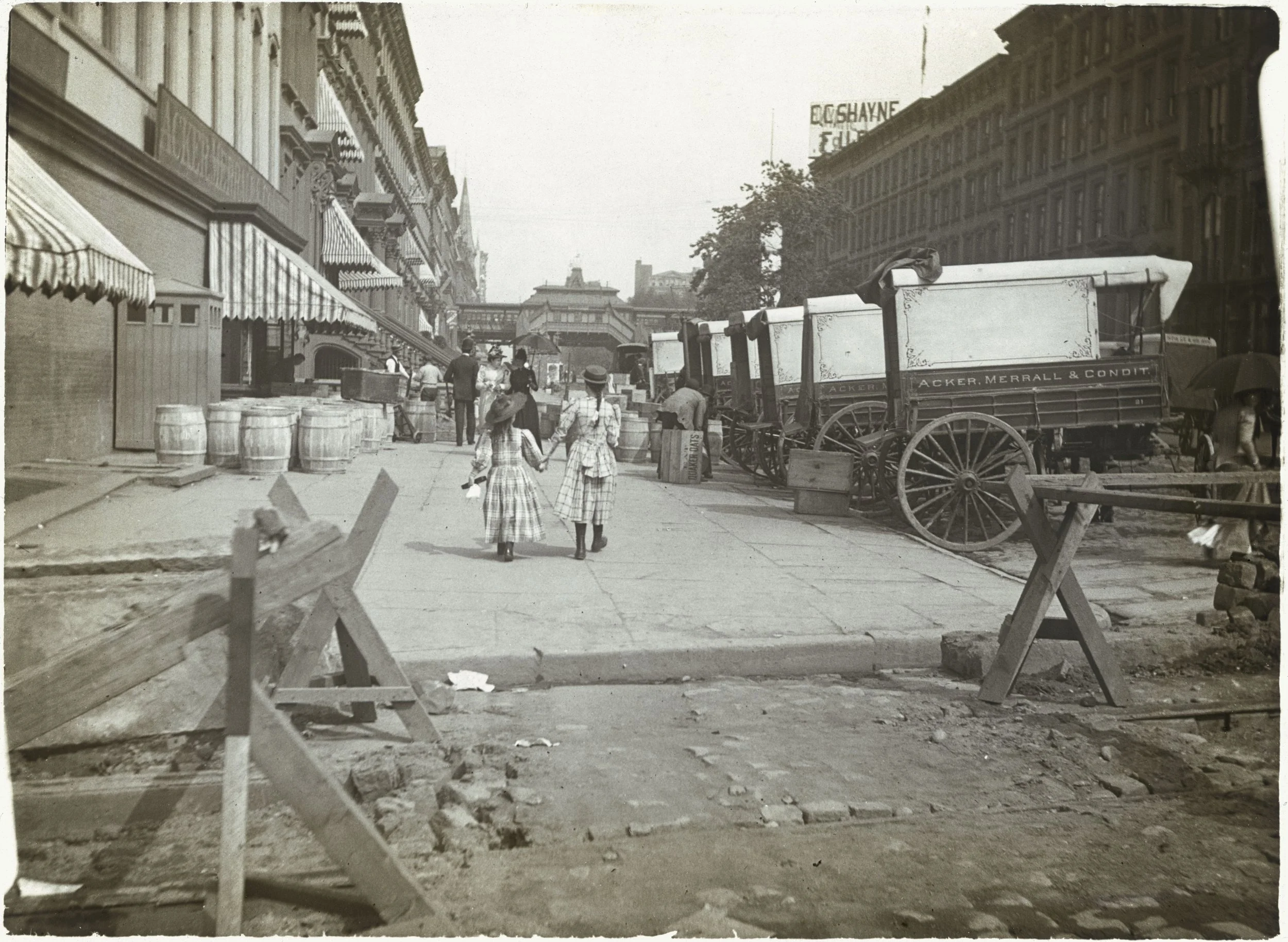
42nd Street, looking east to 6th Avenue Elevated, ca. 1890. DeGregario Family Collection, NYC Municipal Archives.

Provenance of the Census

“It is the right of the people of New York to be counted accurately and to have representation in Congress and in the Electoral College proportionate to their population. In their name, I demand as their right, that the federal authorities make an accurate enumeration of all the inhabitants of the City of New York.”  Mayor Hugh Grant, October 16, 1890.

As it had done every ten years since 1790, federal census takers conducted an enumeration of the City in 1890. The count took place between May and June. New York City Mayor Hugh Grant and other city officials believed the federal census significantly undercounted inhabitants. To support their claim, Grant ordered the Police Department to conduct another census. It took place between September 29, and October 14, 1890. The new count showed a gain of 200,000 people in the population, compared to the federal number.


“Not Allowed”

Based on the results of his “police” census, Mayor Grant submitted a letter to the Superintendent of the Census in the Department of the Interior requesting a re-count. The Federal office refused. Grant submitted a second request; also denied. The Municipal Archives mayoral records from the Hugh Grant administration includes the lengthy correspondence from the Department of the Interior detailing their reasons for not conducting another census of the City. In his cover letter to Mayor Grant dated October 27, 1890, Interior Secretary John W. Noble concluded, “There is sent you herewith an opinion answering your demand for a renumeration of the inhabitants of your city, which, for reasons therein set forth, is not allowed.” Noble attached a fifteen-page document listing the reasons for declining to conduct another census.

Noble’s analysis included the statement that part of the difference can be attributed to the “...matter of common observation that many thousands of people of the City of New York give up their abodes in June of each year for vacation or recreation abroad or in the surrounding country, and many thousands more go to service with them...” Noble also observed “There is also a natural increase of population in one fourth of a year.” At that time, the arrival of new immigrants, many thousands per month, could account for the greater population recorded by the City in October, compared to the federal count in June. Mayor Grant’s second request resulted in another denial with a similar eight-page attachment.

Lower East Side street, ca. 1890. Department of Sanitation Photograph Collection, NYC Municipal Archives.

It is important for researchers to note that Mayor Grant’s outgoing correspondence in this matter will be found in the “letterpress” volumes. Maintained as a separate series, outgoing correspondence from mayoral offices during the latter part of the nineteenth century is in the form of carbon copies on thin onion-skin paper bound into volumes. There are approximately 160 volumes in the series; each volume is generally indexed by the name of the correspondent, or subject. Collection Guides provides further information and an inventory of the series.

The whereabouts of Mayor Grant’s “police” census within New York City government offices after 1890 is not known. Likewise, there is no documentation of when the Municipal Archives received the census volumes, but it has been part of the collection since at least the early 1970s. There is also no information about the 113 missing volumes.

The fate of the federal 1890 census is known, however. In 1921, a fire in the basement of the Commerce Building in Washington, D.C. damaged hundreds of thousands of pages. Although the charred pages were salvaged, in December 1932, the Chief Clerk of the Bureau of the Census submitted a record disposal application to the Librarian of Congress that included what remained of the 1890 census record. On February 21, 1933, Congress authorized destruction. [1]

High view looking north from 23rd Street up Broadway, ca. 1890. William T. Colbron, photographer. DeGregario Family Collection, NYC Municipal Archives.


The Digitization Project

In 2022, the Peck Stackpoole Foundation awarded the Municipal Archives a grant to determine the feasibility of digitizing the census collection. Based on productivity achieved during the pilot, the Foundation awarded a second grant in 2024 to complete digitization.

The Municipal Archives employed a digitization technician, Marie Cyprien, to complete the task. In accordance with Federal Agencies Digital Guidelines Initiative (FADGI) recommendations, Ms. Cyprien captured the images using an overhead camera. She converted the raw images to other formats via batch processing. She created preservation format TIFF files and applied file-naming standards according to Municipal Archives standards.

Completed in December 2024, digitization of the 894 ledgers in the 1890 New York City Police Census collection resulted in 77,844 images. Ms. Cyprien also completed the necessary collection rehousing into 39 custom boxes, barcoding, and labeling the volumes.


The 1890 Police Census

239 East 114th Street, home of the “Marks” family, with children “Leo and Adolph,” better known as Chico and Harpo, of the Marx Brothers. Julius, aka “Groucho” Marx, was just missed in the census as he was born at this address on October 2, 1890. 1890 census, NYC Municipal Archives.

The 1890 New York City Police Census produced 1008 volumes; 894 volumes are still extant. Each volume lists the population of one election district in New York County. A map of the election district boundary can be found on the last page of each volume. Prior to the consolidation of New York City in 1898, the boundary of New York County was contiguous with the island of Manhattan, plus annexed districts of what is now the Bronx. The 1890 census includes the western portion of the Bronx that was annexed in 1874, but not the eastern portion annexed in 1895. As Brooklyn, Queens, and Staten Island would not be boroughs of the city until 1898, they are not included in the census.


New York City police officers conducted the census. The handwritten entries record election district, assembly district, police precinct, name of the police officer/enumerator, and the address, name, gender, and age of each resident. There is no indication of the relationship of one person to another, occupations, or other demographic information.


Significance of the collection

Loss of the federal 1890 census makes the City’s version uniquely valuable in bridging the gap in demographic information between 1880 and 1900. Immigration to the United States surged during that period; in 1890, newcomers comprised 42 percent of New York City’s total population. The census is particularly useful in documenting children. Due to language barriers and differing cultural traditions, many families failed to report the births of their children to the City’s Health Department. The 1890 police census can be used to identify the names and approximate date of birth for the estimated 15-20 percent of children without civil birth records.


Next Steps

The Municipal Archives Collection Guides describes the census record and provides a link to the digital images. Interested persons are invited to visit From The Page  for information about the recently launched project to transcribe and index the1890 census. Look for future For the Record articles that will describe how to use this essential research resource.

1. Manhattan Mistabulation: The Story of the 1890 New York City Police Census, By Andy Mccarthy, Librarian II, New York Public Library, May 10, 2019.

Tracts, Farms, and the Great Reindexing Project of 1911-1917

Introduction: why archive? 

Archives preserve materials for many reasons, some of which are not immediately obvious. It’s certainly true that some archived items have obvious historic importance, such as the Grand Jury indictments for the murder of Malcolm X.

Indictment, People v. Hagan, Butler, Johnson, 1965, NYDA Closed Case File Collection. NYC Municipal Archives.

Other items combine artistic merit with their historic significance, such as Calvert Vaux’s drawings for the design of Central Park.  

Danesmouth Arch, Central Park, Rendering, 1859, Department of Parks Drawings Collection, NYC Municipal Archives.

Inventory List, Frederick Johnson, 1863, Draft Riot Claim Collection, NYC Municipal Archives.

Most archival collections derive their value from larger social or political themes that scholars discern in studying otherwise humble-appearing documents, such as a payment claim for losses incurred in the notorious New York City Civil War Draft Riots of 1863.    

In three related collections at the New York City Municipal Archives, thousands of cryptic slips of paper bear witness to an enormous but now nearly-forgotten project where dozens of New York City employees labored for years in the service of—you guessed it—Manhattan real-estate records. This is the tale of how New York devoted more than a million person-hours (well, man-hours according to personnel lists) to achieve an apparently quotidian goal: making Manhattan’s property deeds more accessible, in an era where digital searches weren’t possible and using a typewriter to store data was considered technologically advanced. Let’s unpack the story.


The Problem: 600,000 deeds and no single index

Real estate has always ruled Manhattan. By the late 19th century, it was clear that the remaining tracts of open property uptown would soon be developed, and the traditional system of describing property by “metes and bounds”—using descriptors such as a mark cut into the trunk of a large oak tree near the river—was obsolete. Real estate law relies on an unbroken list of transaction records, called a “chain of title,” to assure that someone selling a piece of property is its legitimate owner. The New York State Legislature passed a law in 1891 requiring all subsequent real estate transactions in New York City to use a new block-and-lot system to describe property—the same one used today—but it failed to reckon with 200 years of conveyance records. How to take the 600,000 accumulated deeds, called “conveyances” that were stored in 2,000 fat volumes in the office of the City Register, and convert them to the block-and-lot system?

Furthermore, those old records weren’t organized geographically: the volumes (called “libers”) had been filled sequentially as deeds were brought to the City Register for filing and were indexed volume-by-volume based on the names of the buyers and sellers. Searching through these thousands of volumes was the province of title searchers. Title companies, frustrated with the primitive and archaic system of deed indexing, created their own proprietary indexes which made their searches more efficient and reliable—but assured that access to these public records was for all practical purposes controlled by private firms!

Deed, 1804, Office of the City Register.


The Solution: Reindex 

In 1910 the state legislature addressed the problem by directing the office of the City Register to create its own index of real estate “instruments” that filled the gap between 1891 and the earliest recorded land grants of the 17th century, and to establish trustworthy title chains. The law allocated $100,000 per year for the task, which was expected to take a decade to complete. The City Register created a dedicated Reindexing Department and hired nearly 80 men at salaries ranging from $1,000 to $1,320 per year. The team was put to work preparing summaries of each deed, called an abstract. Once an Abstractor made sense of the deed description and summarized it on a slip of paper, a Locator interpreted the description and attempted to superimpose it on a modern block plan of Manhattan. Once located, a Draftsman drew a map summarizing the work of the Abstractor and the Locator. The work was checked by Examiners and finally signed off by the Chief Surveyor. An elaborate system of review was implemented because the City Register recognized that this was an effort that would never be repeated—it had to be done right the first time. Old property deeds were notoriously difficult to interpret—and often were a challenge just to read!    

Abstracting slip from the Reindexing Department, NYC Municipal Archives.

And yet just three years after the work began in January 1911, outgoing Register Max S. Grifenhagen called reporters into his office and announced that the index, “more comprehensive, more perfect, more exact than is to be found in any other large city in the world,” was complete.(1) The new index was organized geographically and took the form of 12 x 17.5-inch pages (typists were paid 25 cents for each completed index page) filled with chronologically-ordered conveyance data. Manhattan was divided into “key blocks,” each encompassing several city blocks. Every key block featured its own conveyance index with verified liber citations as well as a map showing the names of early owners during the period when Manhattan land was still owned in large pieces called “tracts.”       

Key block map and page from a reindexed block on the Upper West Side of Manhattan, NYC Municipal Archives.

Between 1914 and 1917, the abstracting work was extended to hundreds of thousands of mortgage records. At the same time, the Reindexing Department turned its attention to working out the boundaries of approximately 200 old “farms and tracts” that had once made up most of the privately-owned property above 14th Street. Many of these bore familiar names from Manhattan history: Dyckman, Stuyvesant, Delancey, Astor, Roosevelt. The old conveyance deeds did not contain sufficient information for this task, so the team also drew upon “records on file in the various city departments, historical societies, libraries and in the offices of Trinity Church, Trustees of Columbia College, Sailor’s Snug Harbor and many other similar offices.”(2) As the data was gathered in the form of 6.5 x 10-inch slips organized into more than 1,000 “Tract Reports,” draftsmen distilled the information into 46 plates collectively called the General Map of Tracts and Farms, encompassing all of Manhattan. The draftsmen used an interesting system of lettering:  the names of owners were written in a mashup of styles and sizes designed to make it easier to distinguish overlapping names.    

Tract and Farm Plate 34, R.D. Map Collection, NYC Municipal Archives.


Job (almost) Done! 

The Reindexing team still wasn’t finished—they next converted data on each original farm or tract into a narrative document called a Farm History. A Farm History begins with narrative text from 2 to 22 pages long describing the extent of the original property and presenting an outline of the transactions that broke it into pieces. Many of the Farm Histories include one or two beautiful maps superimposing the farm onto a modern Manhattan block map, as well as a kind of descendancy chart akin to a family tree, with landowners’ names presented as if they were generations of children who bought or inherited pieces of the original farm. Each line of descent terminated in a reference to the city blocks that make up the land owned by the most recent names on the chart. In a 1917 summary of the work of this office, City Register John J. Hopper wrote that “a reference to the proper farm history is made in the front of each block,”(3) by which he meant in the conveyance index volumes. This was never done, nor do the farm histories appear to be complete: only about two dozen out of 120 bear approval dates, and many lack texts, maps, or descendancy charts. Genealogist and historian Aaron Goodwin has speculated that World War I may have interfered with the project’s completion.(4) 

James W. De Peyster Farm, Farm Histories Collection, NYC Municipal Archives.

Ownership Descendancy Chart for the Dutch colonial era farm of Jacobus Van Orden, Farm Histories Collection, NYC Municipal Archives. 


So, How Much of this Stuff is in the Municipal Archives? 

This largest output from the Reindexing project were hundreds of index volumes.  Those remain in the City Register’s office in Jamaica, Queens, because after more than 100 years, they’re still in active use! The original conveyance libers through 1886 have been scanned and are available online.(5) The Municipal Archives holds three collections at its 31 Chambers Street location:

  • ACC 1983-037, consisting of large original sheet maps that show the location and boundaries of old tracts and farms together with the names of their owners and Tract Report references. 

  • ACC 1983-038, consisting of approximately 1,000 Tract Reports on slips of paper that were used to create ACC 1983-037 and ACC 1983-039. 

  • ACC 1983-039, consisting of approximately 100 Farm Histories with text, maps and descendancy charts of ownership. The Farm Histories are available on a microfilm in the Reading Room of the Municipal Library at 31 Chambers Street.   Please consult the Municipal Archives Collection Guide for additional information about the Office of the City Register Reindexing Department maps, tract reports, and farm histories. 


A Final Word 

Returning to the theme of modest-looking archival materials that bear witness to colossal efforts made by city employees performing tasks that must have been tedious at best, the efforts of the World War I-era Reindexing Department of the City Register have benefitted generations of property owners, local historians, and—yes—attorneys. The names and addresses of the Reindexing Department team members were published in The City Record along with their salaries and hire dates.(6) A handful were even photographed for a 1913 newspaper story about the department,(7) so let them be anonymous no more!  

Members of the Reindexing Department, July 1916, NYC Municipal Archives. 

The reindexing team at work in 1913, NYC Municipal Archives. 


(1) “Title searching in N.Y. County Simplified.” NY Tribune 21 Dec 1913, page 34.

(2) John J Hopper 1917, Four Years Report Showing the improvements made during the years 1914-1917 in the Register’s Office, of New York County, with recommendations for its future growth and advancement, pages 43-44

(3) Hopper, loc. cit.

(4) Aaron Goodwin. 2016 New York City Municipal Archives: An Authorized Guide for Family Historians, page 104

(5) “United States, New York Land Records, 1630-1975.” https://www.familysearch.org/search/collection/2078654

(6) The City Record 31 Jul 1916 Supplement 9, page 245.

(7) “Title Searching in N.Y. County Simplified,”loc. cit.

The City Cemetery on Hart Island

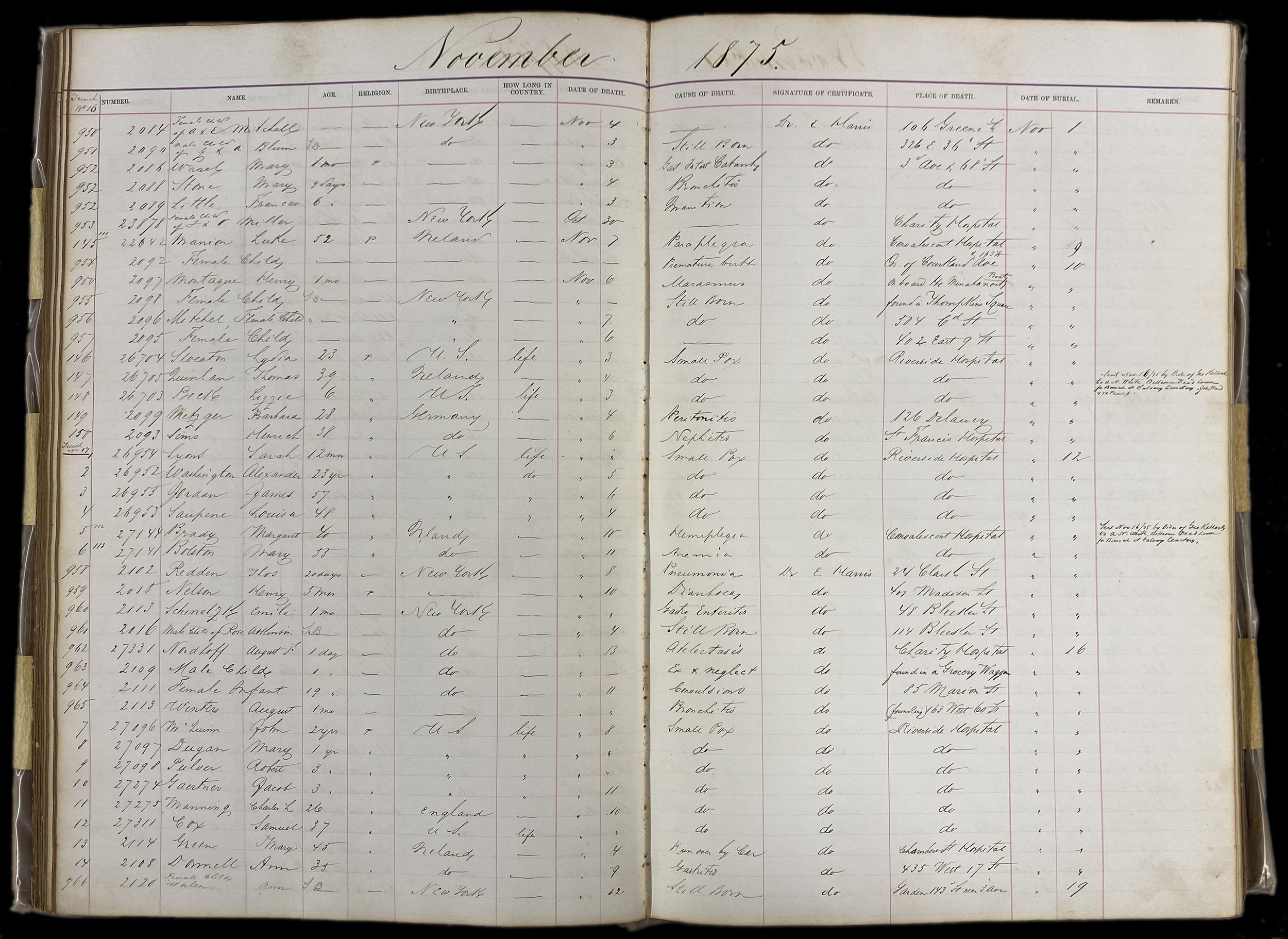
On February 26, 1875, Mary Halpine, age two months, was buried in trench no. seven at the City Cemetery on Hart Island. According to the cemetery burial ledger, Mary was born in New York City and died from Atelectasis (collapsed lung) at Bellevue Hospital on February 25.   

Hart Island Bulk Head, January 13, 1972. Department of Marine and Aviation Collection, NYC Municipal Archives.

The entry recording the death and burial of Mary Halpine is the first one in a ledger recently donated to the Municipal Archives collection of City Cemetery burial records.

The City of New York purchased Hart Island in 1868 and designated it for the burial of indigent and unclaimed persons. The Department of Public Charities and Corrections was given responsibility for the burials and record-keeping.

In 1988, City archivists transferred all extant burial records dated prior to 1975 that had been stored on the Island, to the Municipal Archives. The earliest ledger in the series recorded burials beginning in May 1881. There are significant gaps in the collection during the 1950s and 1960s due to water damage. In 2018, the Archives accessioned a ledger, with entries dating from May 1872 through February 1875, from the Department of Corrections Historical Society. The latest addition to the Archives collection of City Cemetery ledgers lists burials beginning in February 1875, through 1877.    

City archivists transferred City Cemetery burial ledgers to the Municipal Archives from Hart Island on a Department of Corrections vessel, 1988. NYC Municipal Archives.

The City Cemetery burial records provide significant data for both family history research and investigation into broader topics such as immigration, public health, and social services. The ledgers list the name of the deceased person (if known), age, birthplace, how long in the country, date, cause and place of death, and date of burial. The ledger also indicates religion, although this information appears to have been inconsistently recorded, likely due to a lack of knowledge about the decedent’s affiliation. There is also a remarks column.    

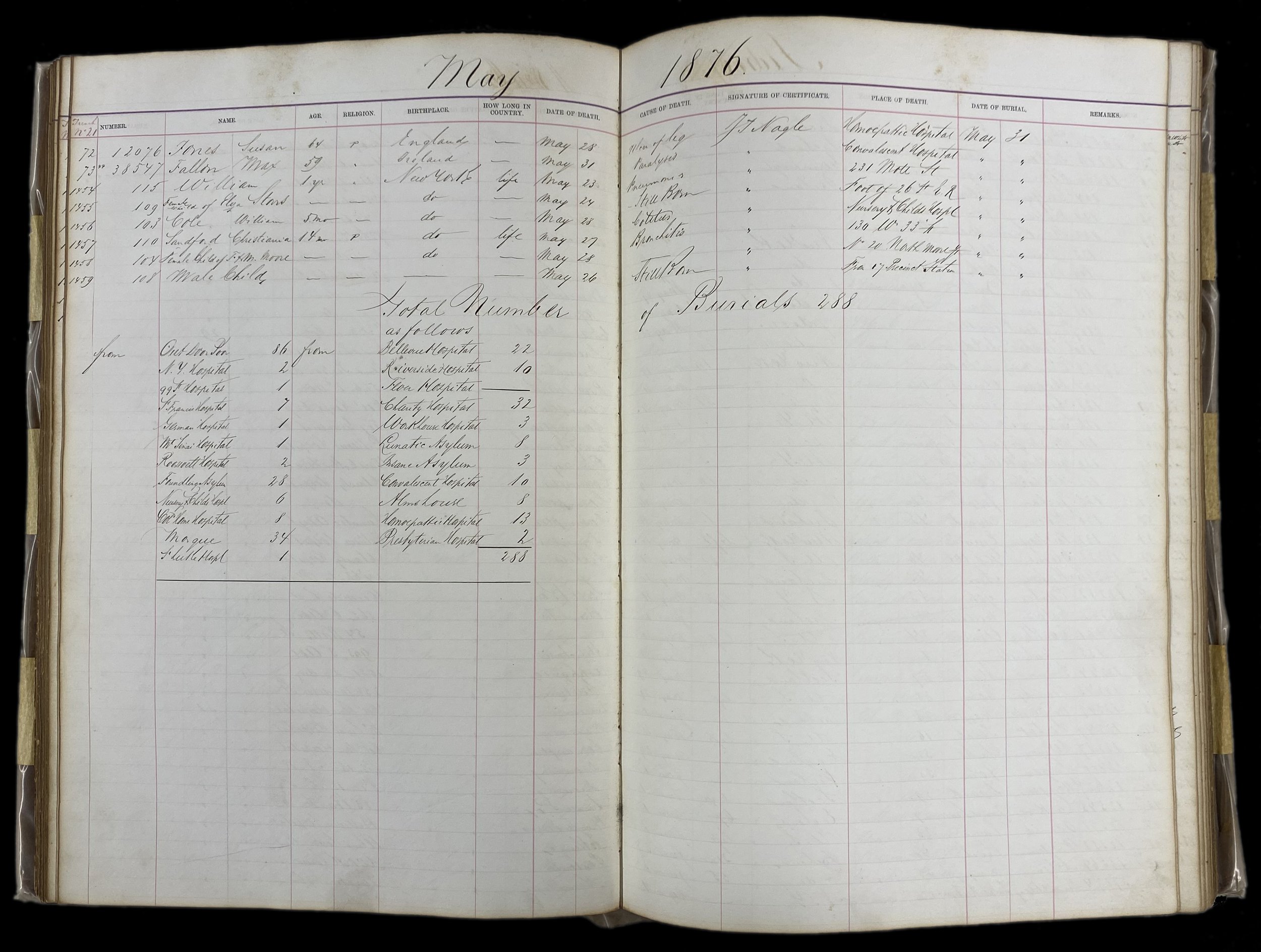
At the conclusion of each month the clerk maintaining the ledger carefully tallied the total number of burials, and where the deaths occurred. The greatest number of deaths are recorded as “outdoor poor” which means they occurred somewhere other than an institution—at home, on the street, aboard a ship etc. Bellevue, Almshouse, Charity Hospital, Foundling Asylum, Riverside Hospital, Small Pox Hospital and Lunatic Asylum, account for the majority who died in institutions.    

City Cemetery Burial Ledger, February 1875 – January 1878. NYC Municipal Archives

The birthplaces of the deceased reflect early-to-mid-nineteenth century immigration patterns in New York City. Most decedents are native born, or from northern European countries. For example, between June 5 and June 9th, the decedents’ birthplaces included Germany, Ireland, France, Scotland, Austria and New York.    

Cause of death information also reflects the reality of New York City life at that time. Although the clerk did not tabulate causes, reviewing the list shows a world without good health care and modern medicine. Small pox, tuberculosis, pneumonia, and diptheria are just a few of the diseases that took the life of many city residents. Which is probably why “old age” is  rarely recorded as a cause of death. Some of those who died of advanced years are Alice Crosby, age 68, born in Ireland, died on July 2, 1876; Ann Kiernan passed away on July 7, 1876, age 69, and Philip Mitchell, on March 25, 1876 age 70. 

Also notable is the frequency of “drowning” as a cause of death. But based on the place of death, it appears that most were probably not related to recreational activities. During the first week of June1875 three unrelated persons drowned: an unknown man, age 40, found at Pier 9, in the East River; John Maurer, age 50, in the Harlem River, and another unknown man, no age, found at Pier 42, North River.  

Most persons listed in the cemetery ledger died of “natural” causes. However, German-born Fritz Reichardt, age 54, died on May 29, 1877, of a “pistol shot wound of head” on 7th Street between 8th and 9th avenues.    

City Cemetery Burial Ledger, February 1875 – January 1878. Recapitulation, May 1876. NYC Municipal Archives

The remarks column is mostly blank except for notations regarding disinterment and reburial. In one instance, in August 1876, an “unknown man” was apparently later “recognized as William Bement,” age 60. He died in the “woods on 128th Street near 10th Avenue.” His body was disinterred and delivered to Taylor & Co., at 16 Bowery, for removal to Elmira, N.Y.  Most “unknown” burials did not have such a conclusive ending.

Scanning the names recorded in the ledger, one is immediately struck by the number of children buried in the cemetery. Indeed, the second page of the ledger is almost entirely children: Bridget Daily, age one month, from smallpox; Thomas Dowers, twenty-days, of marasmus (mal-nourished); six still births—boy of Anne Purvis, girl of N. Sullivan, girl of Catherine Beaufort, and an unnamed male and female. Mary Ann (no last name), a two-year old founding, died of Scarlatina on 68th Street, between 8th and 9th Avenues.   

Some clerks appear to have been more diligent in recording information about deceased children; or perhaps they simply had access to more specific data. Listings during the last week of July 1877, for example, include several premature and stillborn children. On this page, the clerk carefully wrote “female child of George and Carol Briner (stillborn); female child of John and Mary Ray (stillborn).”

New York City continues to bury its indigent and unclaimed deceased persons on Hart Island. In 2021, the City transferred jurisdiction over the Island from the Department of Corrections to the Department of Parks and Recreation. During Covid, the Department of Corrections had been overwhelmed by the quantity of burials and this function was transferred to contractors. Subsequently, the Human Resources Administration has assumed responsibility for the burials and record-keeping.

The Last Muster

On February 15, 1898, the United States battleship, Maine, sank in Havana harbor, Cuba, after an explosion that killed 260 men. Turmoil in Cuba arising from the push for independence from Spanish rule had led the U.S. to dispatch the Maine to protect American interests on the island.   

USS Maine Monument, Central Park, Art Commission Photograph Collection, NYC Municipal Archives. 

The sinking of the Maine produced an outcry against Spain particularly by the more jingoistic newspapers which held the Spanish government responsible for the disaster. The cause of the explosion was never satisfactorily explained, but the incident helped precipitate the Spanish-American war.

The intellectual content of Municipal Archives collections is often claimed to inform not only local, but national and even international events. Would this reputation hold in researching an important, but distant, incident, the sinking of the USS Maine?

The answer is yes, although as often happens, the research led to unexpected results. In this instance, the search helped explain the provenance of a series in the Municipal Archives’ historical vital records collection, titled, “Cuba and Puerto Rico—U.S. Soldiers—Deaths, 1898–1900.”

Available on microfilm in the Municipal Archives’ reading room since 1988, but rarely consulted, the material seemed to be an anomaly. Why would the City of New York maintain records with information about soldiers and sailors who died many thousands of miles away? Except for the fact that the records had been transferred to the Archives from the Department of Health, there was no provenance information.

Arthur K. Barnett, Cuba and Puerto Rico—U.S. Soldiers, Death Record, 1899. NYC Municipal Archives.

Arthur K. Barnett, Interment Record, 1899, National Archives (via Ancestry.com).

The record series, “Cuba and Puerto Rico—U.S. Soldiers—Deaths, 1898–1900, consists of certificate forms. They are bound in alphabetical order according to the last name of the deceased serviceman. The name of the deceased soldier or sailor is recorded on each form, along with his military rank and affiliation, date, and cause of death. Sergeant Adolph J. Robinson, for example, from Company D. of the 9th U.S. Volunteer Infantry died of tuberculosis on October 22, 1898. There are approximately 800 items in the series.   

Why had these records been created? Although similar to death certificates filed by the Department of Health, death records are generally created and filed in the locality where the death took place. Each of these servicemen had died in Cuba or Puerto Rico. What is the connection to New York City? 

Charles R. Barnes, Cuba and Puerto Rico - U.S. Soldiers, Death Record, 1898. NYC Municipal Archives.
Charles R. Barnes, Interment Record, 1898, National Archives (via Ancestry.com).

Perhaps using the name and date information to search additional information available from other online resources would help answer the question. For each representative sample of names and dates entered into the Ancestry.com portal, the result was an interment record from the National Cemetery in Arlington, Virginia. (The interment records are held by the National Archives and accessible via Ancestry.com.) But again, if these servicemen died in Cuba or Puerto Rico, and had been buried in Arlington, Virginia, what is the connection to New York City? 

Further examination of the interment records provided a clue. In the “remarks” section of the record for Lieutenant Arthur K. Barnett, for example, this somewhat cryptic language had been recorded: “Orig. bur: Cuba  Recd. N.Y. on “Crook” Apl. 27/99 #122512.” Translation: Lt. Barnett had been originally buried in Cuba; then disinterred and transported to New York aboard the “Crook,” arriving on April 2, 1899.    

Adolph J. Robinson, Cuba and Puerto Rico - U.S. Soldiers, Death Record, 1898. NYC Municipal Archives.
Adolph Robinson, Interment Record, 1898, National Archives (via Ancestry.com).

What was the “Crook”? “The Dead on the Crook—Soldier's Bodies from Cuba to be Buried at Arlington,” read a New York Times headline on April 28, 1899. “The United States transport Crook, employed in the service of bringing home the bodies of American soldiers who fell in battle or died of disease in Cuba and Puerto Rico, and which arrived here on Wednesday evening, left her anchorage off Liberty Island early yesterday morning and proceeded to the Government pier at the foot of Pacific Street, Brooklyn. The Crook brought 356 bodies, 355 which are those of soldiers and civilians who paid the price of our nation’s victories. One body is that of a woman, Mrs. Ziegerfoos, the wife an American mine owner of Santiago [Cuba], who helped along in every way possible the American cause during the war.”

The article explained that 245 deceased soldiers had been transported from Santiago, Cuba; 98 from Puerto Rican ports and twelve from Guantanamo. Given an outbreak of yellow fever in Cuba at that time, the authorities decided that all the bodies from Cuba would be buried at Arlington Cemetery, “...with the provision that the relatives may claim their own during next Winter.” The twelve from Guantanamo “will be turned over to the navy yard authorities for burial in the naval cemetery.” The article further noted that the Crook had brought additional remains in earlier trips, and that “There yet remain about 700 dead in Cuba. No more bodies will be brought home until the cool weather sets in next Winter.” The article concluded: “The bodies were taken at once onboard lighters for transportation to Jersey City, when a funeral train will leave this evening.” Examining other interment records revealed additional shipments of caskets from the Caribbean for burial in the States via New York City.

That was the answer. Although the article did not mention the presence of officials from New York City’s Department of Health, it is clear that creation of the records arose from their efforts to prevent infectious disease from entering the City’s population. The attestation on each of the certificates, usually by a U.S. Army surgeon, that “...remains have been placed in a proper hermetically sealed casket, and that their removal will not endanger public health,” points to this concern.

A. G. Anderson, Cuba and Puerto Rico - U.S. Soldiers, Death Record, 1898. NYC Municipal Archives.

A. C. Anderson, Interment Record, 1898, National Archives (via Ancestry.com).

It is reasonable to conclude that this series was created under the same motivation as the Department of Health’s “Bodies in Transit” collection in the Archives. Although the Transit series date span ends in 1894, the Department of Health apparently continued the practice documenting the transportation of deceased persons within New York City.

The data on the New York City records, plus the information recorded on the Arlington Cemetery records provides a significant resource for historians and family genealogists. Noting that most of the servicemen died of disease and not battle wounds is just one valuable observation. The records have been slated for digitization and online access.

Once again, historical records in Municipal Archives prove their utility for research on topics both local and national. And in this example, what started as a simple query about an event one hundred twenty-five years ago, has resulted in information that enhances the research value of a previously little understood collection.

Mrs. Eliza A. Ziegenfuss, Cuba and Puerto Rico - U.S. Soldiers, Death Record, 1899. NYC Municipal Archives.

Returning to the Times story, the unnamed author of the article described a somber scene upon the ship’s arrival at the dock. “There was nothing of sentiment in the lifting of the pine boxes, one by one, over the side of the vessel, and the only persons there to greet them were a corps of clerks from the Army Quartermaster’s office who called out the name of each as the pine box was swung over the ship’s side. It was the last muster.”