Brooklyn

How Many Mayors really?

A recent For the Record blog received a good deal of attention and triggered a recalculation of the number of New York City mayors.  Was it 111 or 112?  Eventually, including all of the New York mayors from colonial times to the present, the conclusion was that the current mayor, Zohran Kwame Mamdani, is mayor number 112.

New York’s first government, authorized by the Dutch West India company and established in 1653, consisted of a sheriff, two burgomasters (who had duties similar to mayors) and five legislators as described in this blog post.
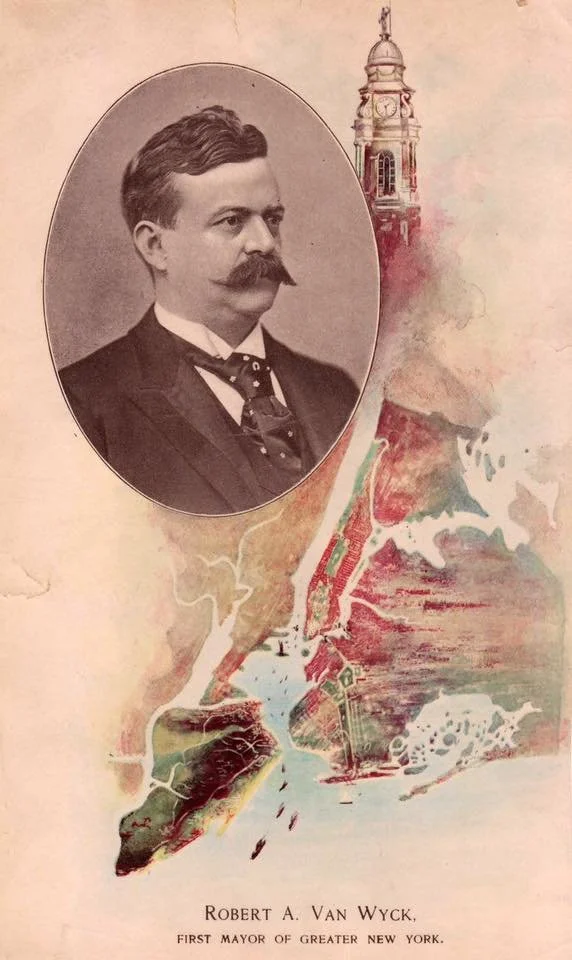
Robert Van Wyck, First Mayor of Greater New York.

From that auspicious beginning, subsequent English charters issued in 1655, 1686, 1708 and 1730 “all provided for an appointed mayor,” according to a 1929 article written by Rebecca Rankin, the City’s principal librarian. By 1775, the mayor was appointed by the Royal Governor, who in turn, was appointed by the King of England. Mayoral duties included Water Bailiff, Clerk of the Markets, and Justice of the Peace, as reported in the 1976 Green Book.

The majority—92 of the 112 mayors—presided over a smallish island, sometimes called Manhattan or New York. In the late 1800s, New York County annexed a large portion of what is now Bronx County including the towns of Morrisania and Kingsbridge. It became the last county in the State in 1914. The mayoral count does not include mayors of the City of Brooklyn or Long Island City… just those from Manhattan. Between 1834 and 1898 the City of Brooklyn had 27 mayors. Seth Low, Mayor of the City of Brooklyn from 1882-1885, went on to become the second elected mayor of the Greater City of New York. Williamsburg received city status in 1851 only to be annexed by the City of Brooklyn in 1854, along with Bushwick. The New York mayors held no sway over Staten Island, Brooklyn, Queens and the many towns and cities located in those counties.

The title page for the 27th Annual Report of the Department of Parks of the City of Brooklyn, shows the changes in governance that occurred between 1897 and 1898. NYC Municipal Library.

On January 1, 1898, the City of New York was transformed, becoming the largest city in the country—second largest in the world, behind London. Government and civic leaders had discussed and debated combining the cities of New York and Brooklyn for approximately 20 years prior to consolidation. Andrew Haskell Green, a storied civic leader whose ventures included creating the New York Public Library and Central Park, is largely credited with the notion of combining the four counties, the annexed Bronx territory and the many small municipalities into one entity.

Green conceived of one great metropolis—a city that had uniform regulations instead of the inconsistent and conflicting rules that made the multiple governments inefficient. Opponents to the scheme expressed concern about taxes—would Brooklyn be saddled with New York’s debt? They also questioned political control: the dread Tammany machine ran politics and government in New York while the Republicans controlled Brooklyn. Brooklyn was the third largest city in the country and its leaders were loath to cede power.

An earlier blog post dealt with the origin of the Greater City of New York, describing efforts that led to the consolidation of unannexed territory and local governments.

Another post showed the evolution of the mayoralty from 1810 when the Council elected the mayor from among its members to direct elections in 1834 (although only a small portion of residents could vote) and the increasing power of the office.
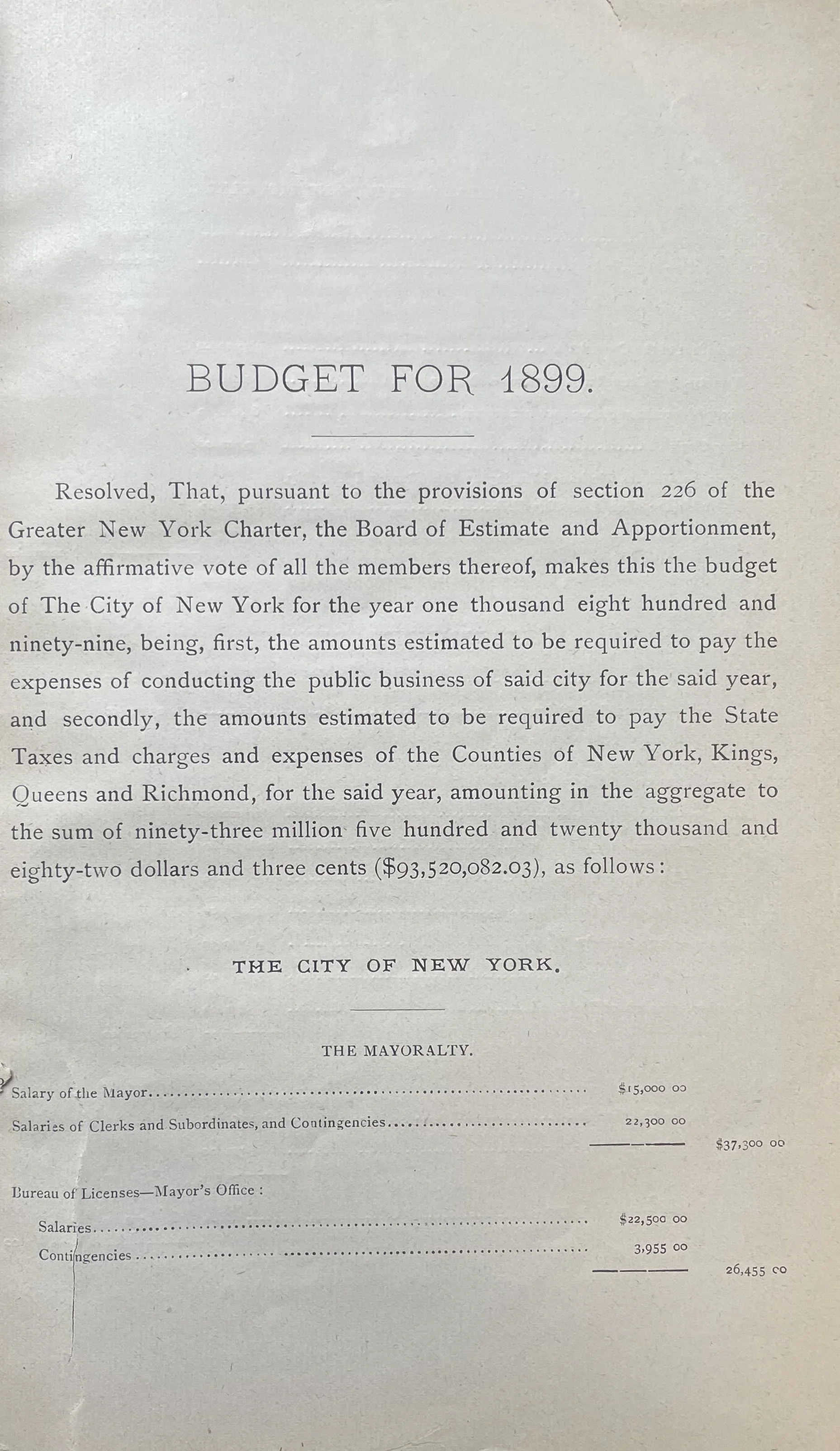
The budget for the fiscal year of 1899 was the first for the consolidated greater New York. NYC Municipal Library.

The creation of the Greater City of New York combined existing municipalities and counties into one government consisting of five boroughs: Brooklyn, the Bronx, New York, Queens and Richmond. A new government was established with a mayor, a board of estimate that included representatives from all of the boroughs as well as the Comptroller. This effectively ended the run of mayors from the preceding governments, including that of New York.

If the question instead is: How many Mayors have represented the Greater City of New York, the city that includes 50 Bronx neighborhoods, 76 in Queens, 77 in Brooklyn, 63 Staten Island neighborhoods and the 57 in Manhattan, the answer is very different. There have been 23 mayors representing the millions of City residents since 1898, including Acting Mayors Ardolph L. Kline, Joseph V. McKee and Vincent R. Impelleteri, who was subsequently elected Mayor.

Some might suggest that this is an outer-borough gripe. But, really it is a claim for full representation of the wonderful diversity that comprises the Greater City of New York.
Transcribing Records of Enslaved New Yorkers

New York City Mayor Eric Adams recently announced an ambitious project at the Department of Records and Information Services to make accessible historical records documenting thousands of formerly enslaved New Yorkers. The records in the Municipal Archives date from 1660 through 1827 when New York State abolished the practice of slavery.

Slave and School Records in Kings County, 1799-1819. Old Town Records, Gravesend, NYC Municipal Archives.

The records are part of the Old Town Records collection. This series includes records created by the towns and villages in Kings, Queens, Richmond, and Westchester Counties prior to consolidation in 1898. Recently processed and partially digitized during a project funded by the National Historical Publications & Records Commission, the records provide unique documentation of communities now part of the Greater City of New York. Over the course of the processing project, For the Record published several articles tracking progress and highlighting aspects of this collection. Processing the Old Town Records Collection, Oyster Boards in the Old Town Records and The Genealogical Possibilities of Manumissions in the Old Town Records are a few of the articles.

This week, For the Record interviewed Arafua Reed for information about the transcription project and how interested persons can volunteer to participate. Arafua is a City Service Corps volunteer with AmeriCorps and NYC Service, currently serving as DORIS’ DEIA Coordinator.

For The Record: Arafua, what are the records that are being transcribed?

Arafua Reed: It’s going to be a phased project. The focus of phase one is birth certificates and manumission documents, along with some court minutes from the Old Town Records collection. During the second phase we will transcribe information recorded in other collections such as the Records of New Amsterdam and the Common Council.  

FTR:  Can you tell us about the provenance of these records?

AR:  Most of these documents resulted from the Act for the Gradual Abolition of Slavery enacted by New York State in 1799. The law stated that children born to enslaved women after July 4, 1799, would be legally declared “free.” Since these children were still considered property with material value, this came with a loophole that their freedom would become valid only after a certain amount of time had elapsed—25 years of age for women, and 28 years for men—meanwhile these children were still required to work. Therefore, enslavers were required to record the children’s births on legal documents.

Certificate of Birth for Harry, a male child born on October 25, 1804, reported by John Vanderbilt on September 5 1805. Records of the Town of Flatbush, Old Town Records collection, NYC Municipal Archives..

Enslaved people born prior to July 4, 1799, were re-categorized as indentured servants; this language (using “servant” instead of “slave”) appears throughout the manumission documents. Typically, the document includes the enslavers statement reporting the birth, and a corresponding certification of its accuracy by the town clerk. In rare instances, there is text in a will document freeing an enslaved person.

FTR:  Do you know about how many individuals will be identified by the transcription project?

Birth records, ledger, 1826, Town of Flatlands, Old Town Records collection, NYC Municipal Archives.

AR: There are about 1,300 birth and manumission records in the books slated for transcription during this phase.

FTR:  Please describe the transcription process.

AR: The Municipal Archives is using an online service called From The Page for the transcription project. Once logged-in, volunteers will click on a book and select a page. Or, they can click “Start Transcribing” (just above the list of volumes) and will be taken to a random page that hasn’t been worked on yet. The format of volunteer submissions are split into two sections: there’s a text area field, where the entire page will be transcribed in full. Just below this text box is a spreadsheet, where volunteers will insert the information about children born to enslaved mothers.

We’re asking that volunteers type what they see and to keep in mind the transcription tips that sit in the middle of every page. It’s an easy process to get into; reading some of the handwriting is probably the most difficult part of it.

FTR:  Are transcribers provided any assistance with reading the hand-written records?

Birth records, 1810-1811, transcribed in ledger, Town of Flatlands, Old Town Records collection, NYC Municipal Archives.

AR: That’s my current responsibility. There’s a convenient Notes and Questions box under each transcription page, so if volunteers need help with some of the words, or if they want a review of something very specific on one of their pages, or even if they find something interesting, they can send that message there. These notes are public, so if volunteers want to engage with someone else’s comments, they can.

FTR:  How will you make sure that the transcribers do not make mistakes?

AR: That is another part of my responsibility. I don’t expect anyone to complete these pages to perfection and, when I see mistakes, I can easily correct them. I’m currently reviewing the submissions page by page, but there are ways for volunteers to note specific pages that they need help with. After a submission is all typed out, volunteers can check a box by the Preview and Save buttons that says, “Needs Review.” This lets me know that a transcriber would like someone to look over the work before it’s considered complete. These notes are very helpful for me to track progress. In some cases, I might need to adjust the transcription conventions to include things that people struggle with often.

Certificate of Birth for Henry Lynes, a male child, born on November 5, 1804, reported by Simeon Buck, November 26, 1804. Records of the Town of Flatbush, Old Town Records collection, NYC Municipal Archives.

FTR:  How will the transcribed information be made available?

The Archives will publish the birth records as a database in Collection Guides. In addition, the Archives has curated a sub-collection for birth records of enslaved people and a webpage on archives.nyc devoted to holdings featuring Records of Slavery and Emancipation.

FTR:  It looks like a significant impediment to using manumission records to trace ancestry is the lack of surnames. In the example below, we know that “Tom” was born on March 28, 1806, to “Bet,” but we do not know their surnames. Do you have any advice about how to overcome this impediment?

Certificate of Birth for Tom a male child born on March 28, 1806 to Bet, reported by George Lott on September 27, 1806. Records of the Town of Flatlands, Old Town Records collection, NYC Municipal Archives.

AR: We suggest that researchers try using vital record collections of the communities where enslaved persons resided. Given that we know the date of birth and a first name, and if the formerly enslaved person remained in the community, it might be possible to find additional demographic information in vital records. The Municipal Archives collection of vital records includes records of birth, death and marriage in many of the Old Town communities.

FTR:  What should a person do if interested in participating in the project?

AR:  To start working, a volunteer can visit the Records of Slavery page that lives on the website.

The Old Town Records Collection: A Frenchman’s Possessions

Records in the Municipal Archives sometimes offer a glimpse of what people owned in the past. An entry in the Town of Bushwick records gives us a rare glimpse into the belongings of a Brooklyn resident more than 350 years ago. The entry is titled “Inventory of the property which was found in the house of Jan Maljaart, a Frenchman, on April 29, 1664.”

New Utrecht: A Library Catalogue, circa 1796

New Netherlands. Long Island. Kings County. Brooklyn. New York City. New Utrecht can claim being part of all these jurisdictions during its long history. Established in 1652 as one of the original six towns in Kings County, New Utrecht is now better known as the Bay Ridge and Bensonhurst neighborhoods in the Borough of Brooklyn.   

Recently, archivists processing the Old Town record collection discovered a document titled, “Catalogue of Lane District Library New Utrecht” that gives us unique insight into colonial-era libraries and schools.

Brooklyn’s 370-Year Heritage of Stray Goats

During the 17th century, New Utrecht was one of several Dutch colonial settlements and the Town records during that period were written in Dutch. On March 16, 1648, the entry in [New Utrecht ledger title] is short and to the point: “The officer may seize and take possession of the goats which run without keepers, since they injure all the fruit trees and do other damage.” There were not further entries in the ledger concerning these marauding orchard raiders, but we can assume they were properly rounded up and returned to their home farms.

The Genealogical Possibilities of Manumissions in the Old Town Records

The Department of Records and Information Services is currently digitizing New York colonial and early statehood administrative and legal records dating from 1645 through the early 1800s under a grant generously funded by the National Historical Publications and Records Commission. The records pertain to Dutch and English colonial settlements in New York City, western Long Island, and the lower Hudson Valley.

Families have a sense of themselves. Who they are, where they came from, how they came to be the group they are now. It’s a sense of identity. Many African Americans today are exploring their genealogy but can only go so far because of the legacy of slavery in America and a past obscured by the lack of records. However, there are records in the Municipal Archives that might help fill this knowledge gap. One collection is the Old Town Records, which includes documentation of manumissions and slave births in New York City. While the information may not be new, access to it over the years has been limited. This is changing thanks to a new digitization project. With a grant from the National Historical Publications and Records Commission (NHPRC), the Municipal Archives has been processing the collection. It is comprised of records created in the villages and towns that were eventually consolidated into the Greater City of New York in 1898. They date back to the 1600s and consist of deeds, minutes from town boards and meetings, court records, tax records, license books, enumerations of enslaved people, school-district records, city charters, and information on the building of sewers, streets and other infrastructure.

Manumission of Benjamin Matt by Jacob Hicks, March 4, 1817. Old Town Records, NYC Municipal Archives.

“Manumission” is a legal term that is similar to “emancipation” but slightly different in the way it was performed. Manumission refers to the legal release of enslaved people when slavery is still sanctioned by law, as opposed to emancipation, which follows abolition and releases all people formerly enslaved. Most slave manumissions were conferred by slaveholders who released their slaves either by a living deed of gift or last will and testament. For the Record  examined the subject in The Slow End of Slavery in New York Reflected in Brooklyn’s Old Town Records. Additionally, several collections in the Municipal Archives contain records documenting enslaved people, notably the Common Council Papers. A sampling of NYC Slavery Records can be viewed online in “From the Vaults.”

Manumission of Nancy by Jeremiah Remsen, June 30, 1820. Old Town Records, NYC Municipal Archives.

Manumission of Betsey by Gerreta Polhemus, August 29, 1820. Old Town Records, NYC Municipal Archives.

More than 11,000 pages from the 189 Old Town Ledgers have been digitized to date. The digitization is 20% complete and the final count will be exponentially higher at the project’s end. This process can seem slow at times, requiring care for the material that’s being worked on. Sometimes there are opportunities to review the books being worked on and sometimes the entries stick out. This was the case with many manumissions as they were digitized for the collection. Individual names of former slaves along with their former owners are in plain ink on the pages—their lives dramatically changed so many years ago. Most manumissions are only a few simple lines of text, yet their ramifications are so powerful.

Manumission of Sylvia by John Van Nostrand, April 10, 1799. Old Town Records, NYC Municipal Archives.

I’m not African American but I am a New Yorker. I’ve lived in Brooklyn for over twenty years and am familiar with the city’s history. I was aware of the city’s past connections to slavery but I had never seen written evidence of it until I began digitizing the records of places I walk through so often—Bushwick, Gravesend, Sheepshead Bay and other locations. People of all heritages live in these places now, but at the time the manumissions were written these were small farm towns and slavery was common. It is easy for that past to never come to mind; it’s a stretch of imagination to envision the humble towns they were when walking in the urban centers they have become. But that past is very real and the people in the Old Town Records Collection walked many of the same streets we walk today. It is possible their distant relatives may also tread those same streets and not know the connection to their past.

I recently saw similar records of emancipation change how a person thought about herself. After I had been digitizing this material during the day I put on Finding Your Roots, a popular TV show about genealogy on PBS. [https://www.pbs.org/weta/finding-your-roots/] The program has aired over eight seasons and has previously consulted the Municipal Archives to research its guests’ histories.

Manumission of Phillis by Joseph Fox July 11, 1812, and Dianna Orange by Nicholas Beorum, April 12, 1813. Old Town Records, NYC Municipal Archives.

Manumission of Cornelia Brown by Andrew Mercein, April 13, 1813. Old Town Records, NYC Municipal Archives.

This was an episode that featured the musician/actress Queen Latifah and as the story of her heritage unfolded she found some of her ancestors had been manumitted from slavery. The documents presented on the show were from another state and another archive but their value was the same as the lines of text I had digitized during the day. It was freedom; it was another life; it was a new beginning for that person and their family. Those events occurred so long ago and as Queen Latifah read out the words for the camera she had no idea this had ever happened. [https://www.pbs.org/weta/finding-your-roots/watch/extras/queen-latifah-meets-the-woman-that-freed-her-ancestors]. As she talked about what she read she noted that it changed the way she thought about herself, her own personal struggles and how she thought of her family. She was eager to share that information with the people she holds dear. Her whole family would see their history differently. They would see themselves differently. A family that didn’t previously know their past, a family that didn’t know with whom or when their freedom came would now have an entire history opened up by a few lines of writing found in a book in an archive. As the TV show played I reflected on the digitization I perform and knew the same impact is possible through the Old Town Records Collection. The way entire families see and know themselves could shift in an instant from the few words the Municipal Archives makes electronically accessible.

Many things shape family identity but few are as profound and long lasting as information. Personal past. Collective past. They can shape who you are, who you think you are and who you can be. Who an entire family can be. The wider availability of the Old Town Records Collection has the potential to do that for so many families who research their genealogy. We can look forward to more Americans finding themselves.

Manumission of Margarett by Anna Vanderbilt, September 4, 1820. Old Town Records, NYC Municipal Archives.