This week, For the Record celebrates Women’s History Month with the story of Edith Alexander. An extraordinary woman, Alexander’s work to end discrimination led to creation of the City’s Commission on Human Rights (CCHR). For the Record articles “New Project: Processing and Digitizing Records of the New York City Commission on Human Rights,” “Human Rights Day: How Human Rights Discourse has Impacted the New York City Government since the 1940s,” “Breaking the Color Line: Mayor LaGuardia and the Fight to Desegregate Baseball,” and “NYC Commission on Human Rights, project update,” describe the Municipal Archives’ project to process and digitize records of the CCHR.
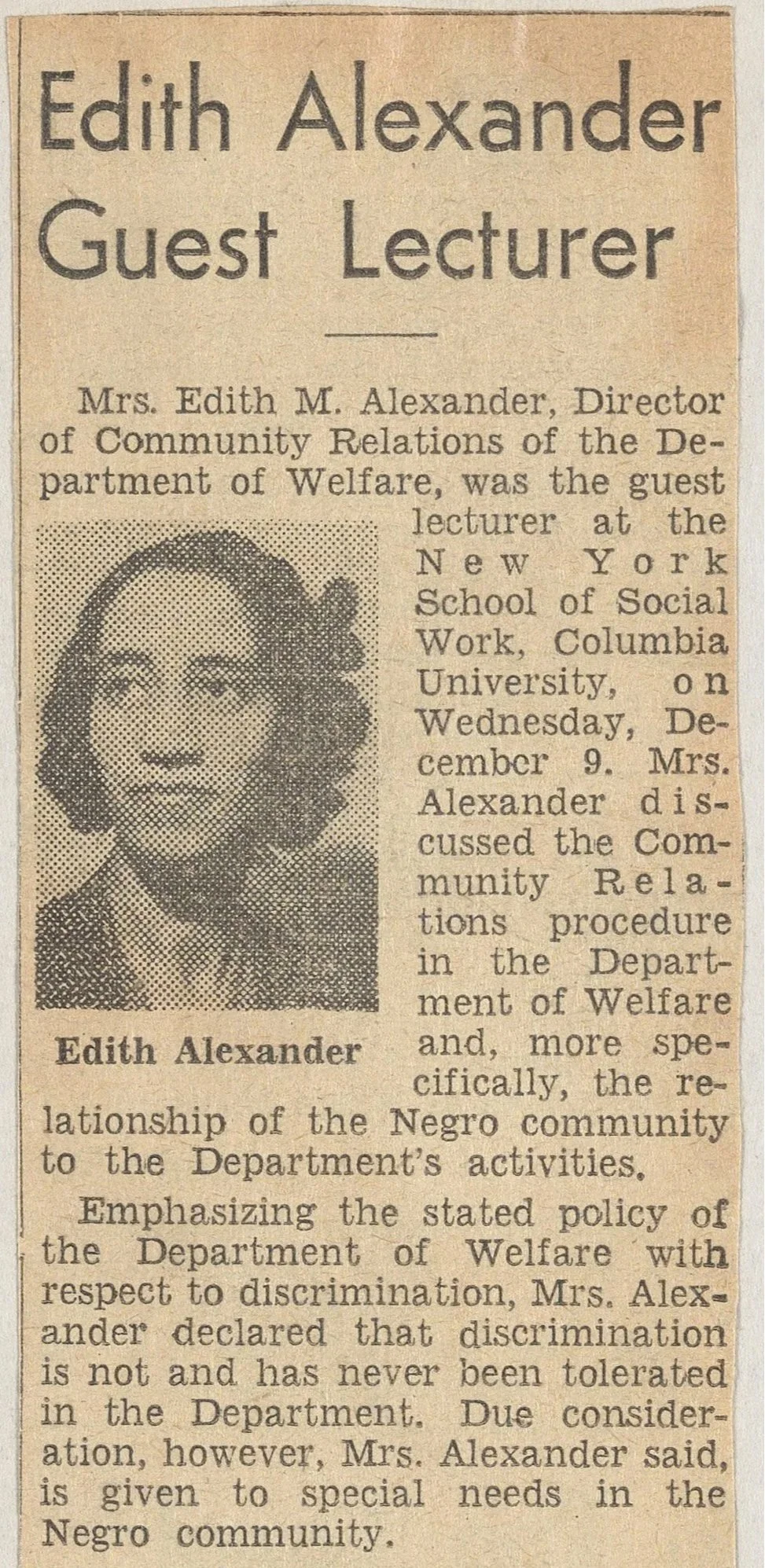
Amsterdam News, December 19, 1942. In 1942, Alexander was a guest lecturer at the New York School of Social Work at Columbia University while working at the Department of Welfare. New York City Human Rights Commission, NYC Municipal Archives.
Born in Yonkers, N.Y. in 1901, Edith Alexander studied at the New York University School of Commerce earning a degree in business administration. The first fourteen years of her career, she served as a manager for the Philip Payton Company, a pioneering Harlem real estate business with progressive ideas that helped maintain Black home ownership.
With an established history of working professionally in Harlem, Alexander made her move to New York City service. From 1933-1944 she served as Director of the Division of Staff and Negro Community Relations at the Department of Welfare, precursor to the Human Resources Administration. In addition, she worked as the secretary of the Harlem Children’s Camp Fund and served on the Board of Directors of the Greater New York Urban League.
In 1944, Mayor Fiorello La Guardia established the Mayor’s Committee on Unity in response to growing concerns about race relations. City leaders recognized that concrete action was needed to address racial disparities. As in many cities across the country, New York, and Harlem in particular, experienced racial tension, police violence, with unrest flaring in 1935, and again in 1943. The Unity Committee was the first to be established in the country with a goal to “make New York City a place where people of all races and religions may work and live side by side in harmony and have mutual respect for each other, and where democracy is a living reality.”
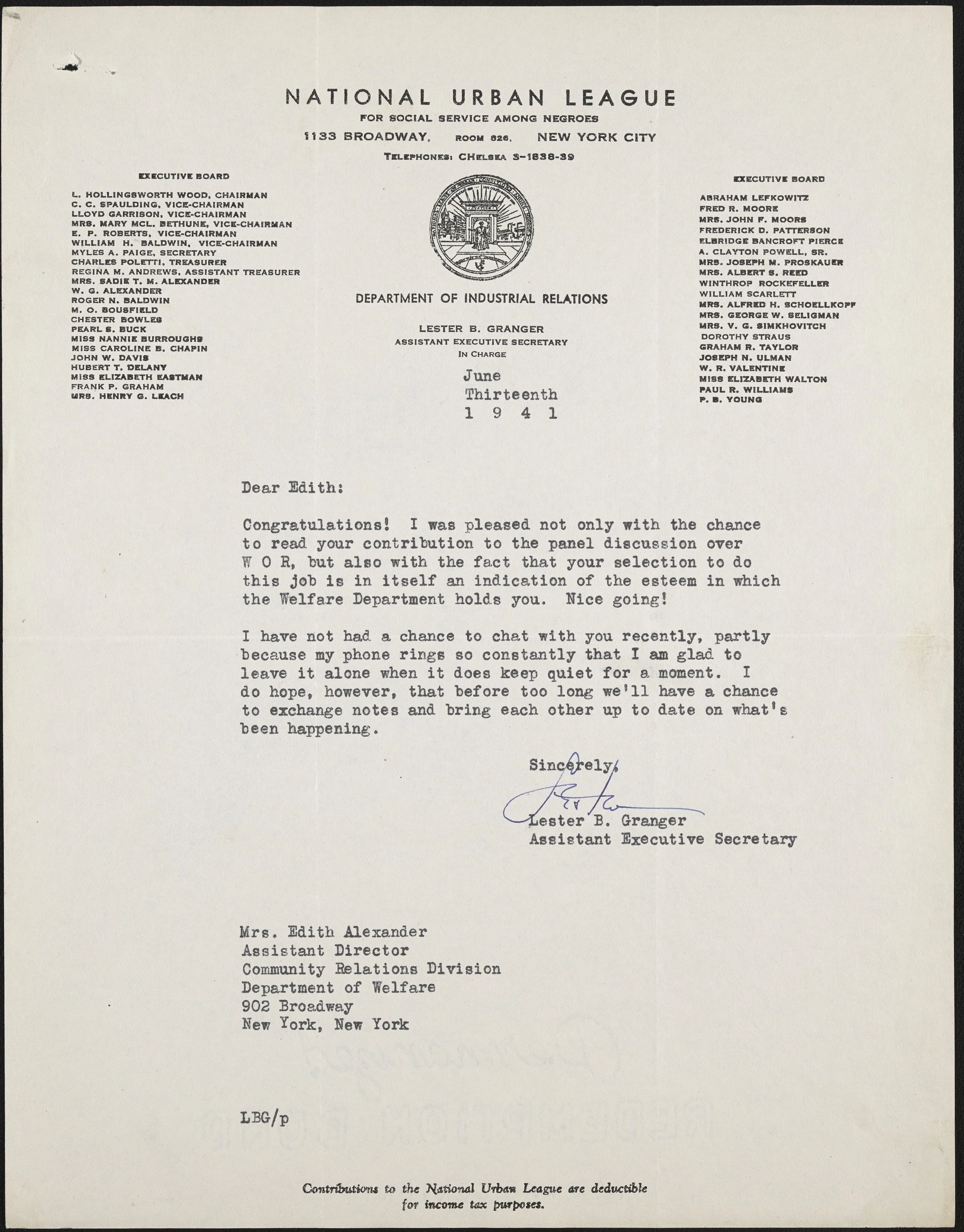
In 1941, Alexander began working at the Department of Welfare in the Community Relations Division. Lester Granger of the National Urban League sent a congratulatory letter on her new position. New York City Human Rights Commission, NYC Municipal Archives.
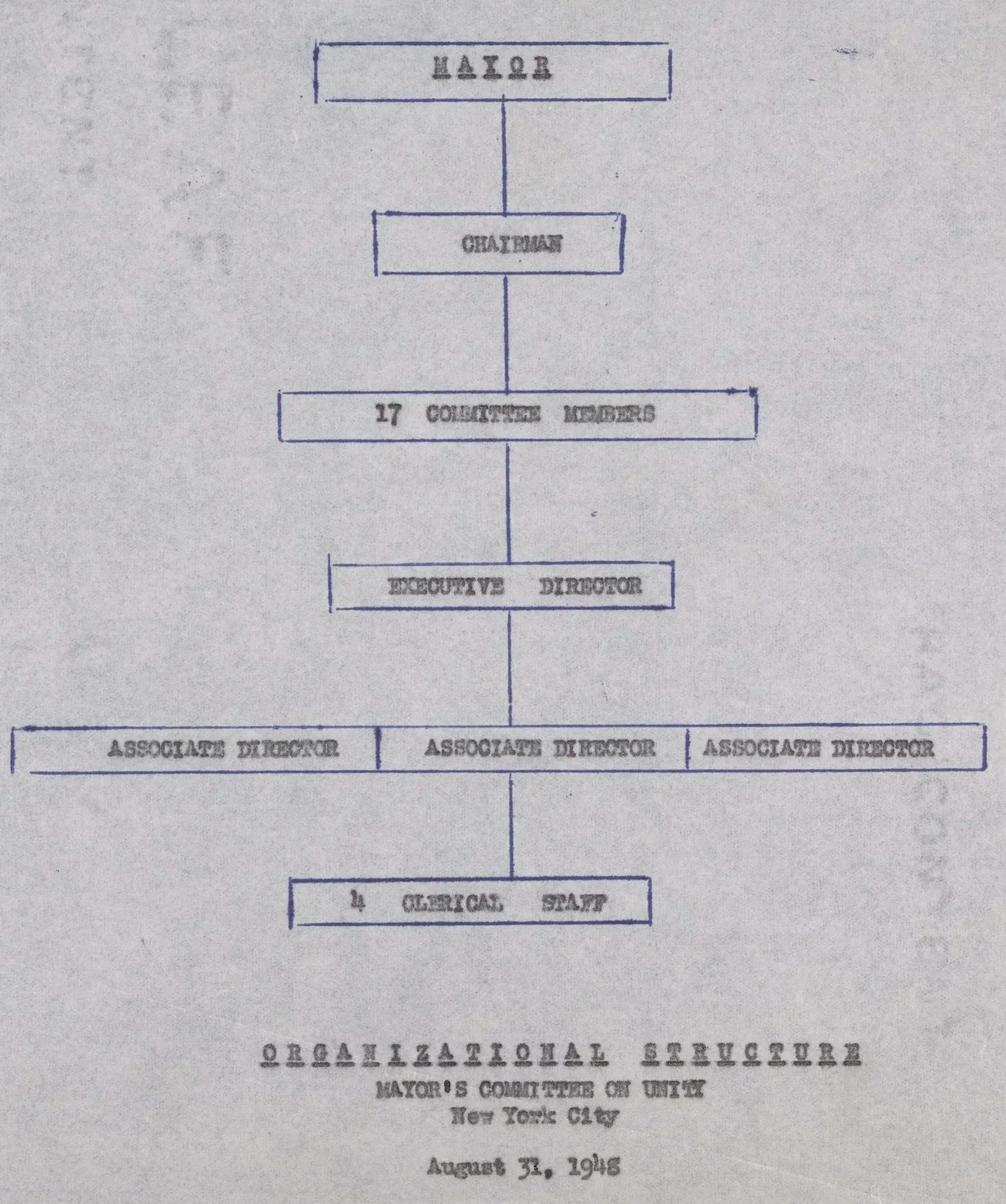
Organizational chart of the Mayor’s Committee on Unity. New York City Human Rights Commission, NYC Municipal Archives.
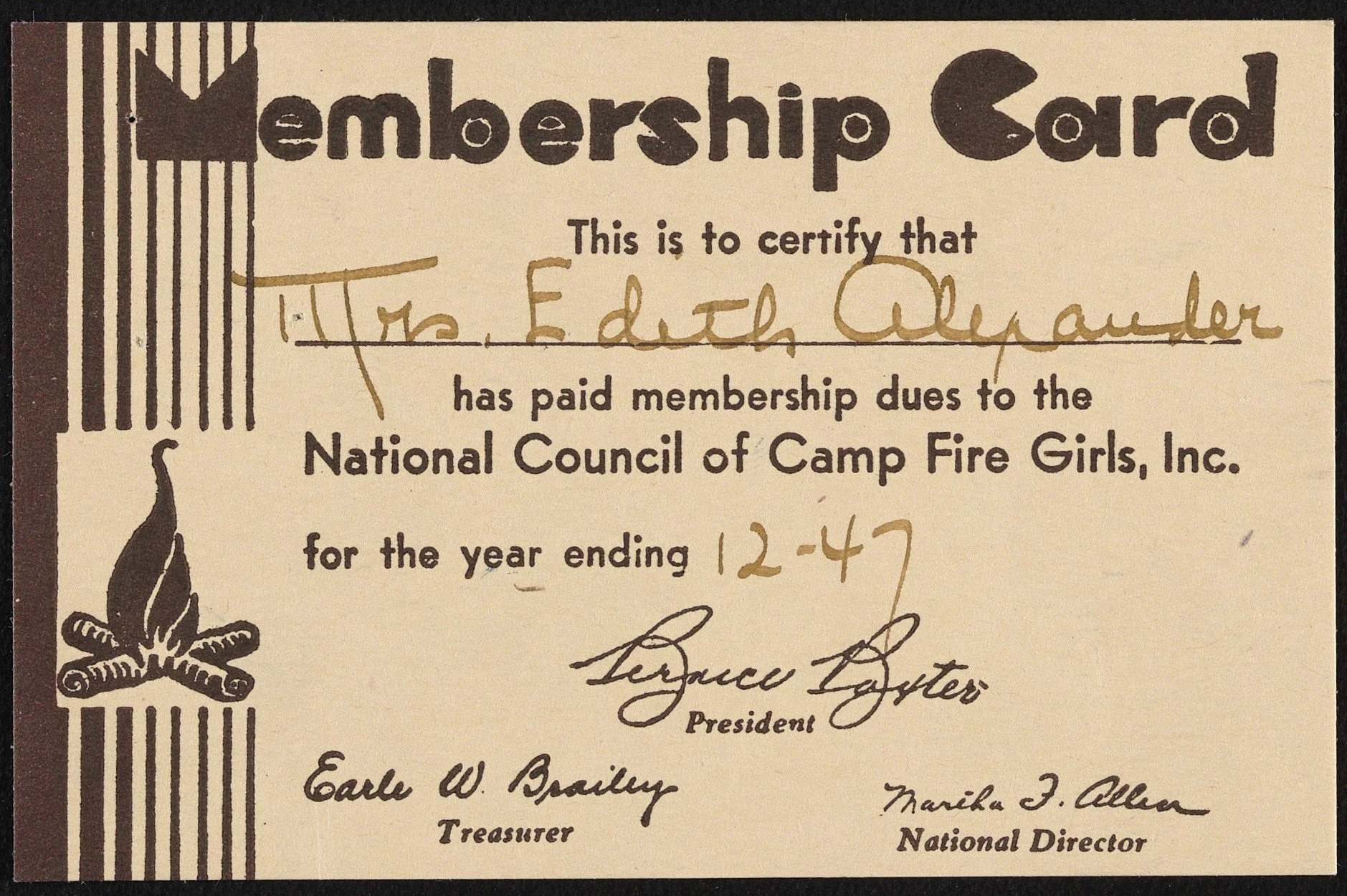
Membership card for the National Council of Camp Fire Girls. As Executive Director, Edith Alexander maintained relationships with civic groups in the City and throughout the country, especially those relating to children. New York City Human Rights Commission, NYC Municipal Archives.
Composed of seventeen diverse volunteer members, the privately-funded Unity Committee had a wide-ranging mission: to investigate racial and religious tensions, propose solutions for neighborhood disputes, push for anti-discrimination laws, and tackle the everyday issues stemming from discrimination. The leadership team of the new organization reflected key racial and religious groups in New York City at the time. Among its first leaders were Executive Director Dan Dodson, a white Protestant man, and three associate directors—Edith Alexander, a Black woman, Bernard Lander, a white Jewish man, and Schuyler Warren, a white Catholic man. From this group Edith Alexander emerged as the Committee’s most influential figure.
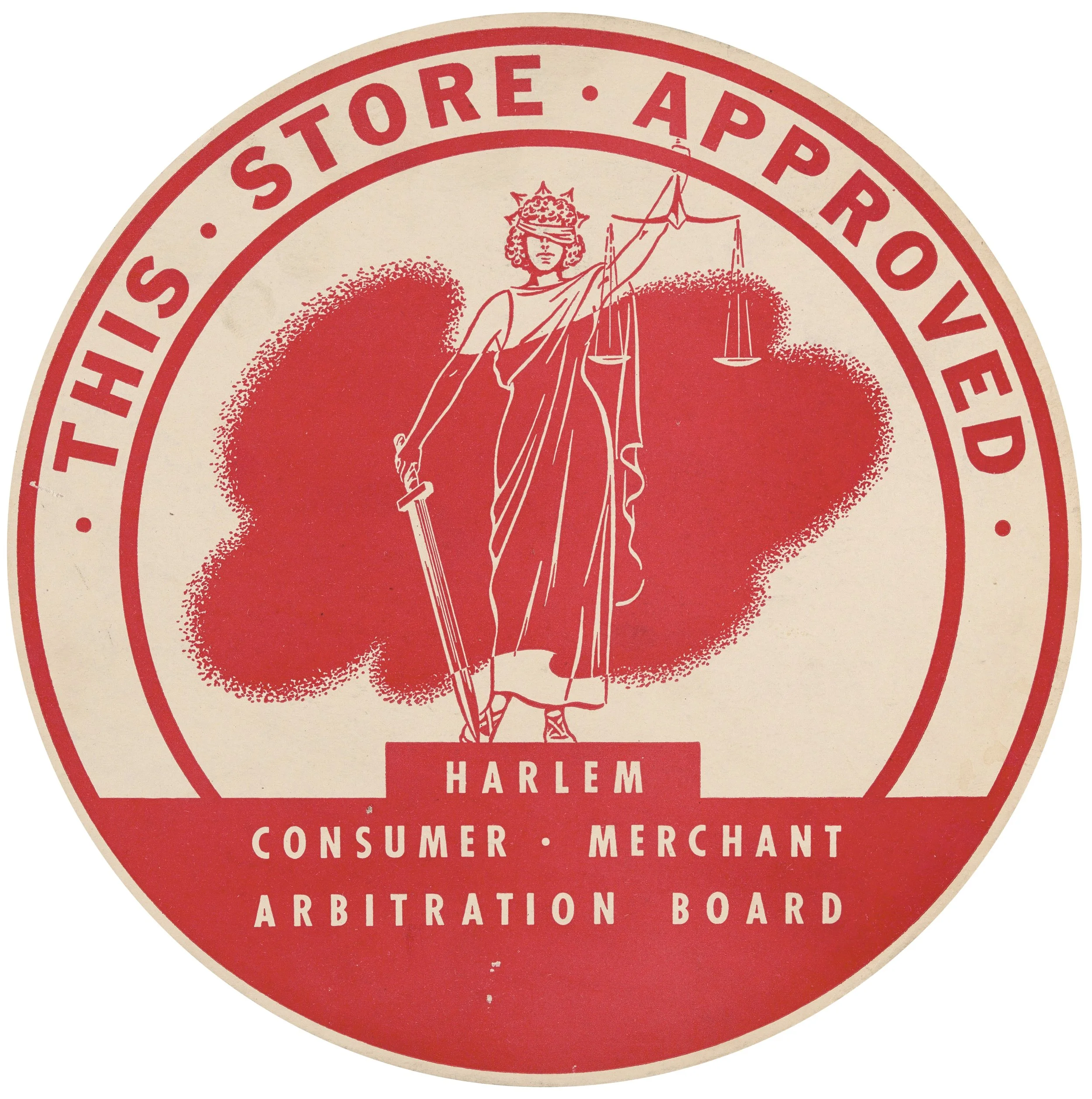
Price gouging was a major issue in Harlem in the 1940s and the Mayor’s Commission worked with local civic groups to end the problem. When placed in a storefront window, this placard indicated that the merchant was taking care to treat all customers equally. New York City Human Rights Commission, NYC Municipal Archives.
Alexander’s role was far-reaching. By 1949, she was named executive director and became the face of the organization. With no formal legal power, the group established subcommittees that researched all aspects of discrimination and made recommendations on how to alleviate tensions within the city. Alexander worked with outside groups, gave talks and lectures, organized national conferences, and conducted on-site visits to understand conditions in the City.
During the ten years of its existence, the Committee addressed citizen complaints and created reports regarding discrimination in higher education, housing, shopping and market pricing, police hiring practices, press treatment of Black citizens, and insurance coverage, to name a few. In a final project, the Committee published a directory on intergroup relations which helped other urban areas establish local and federal commissions against discrimination.
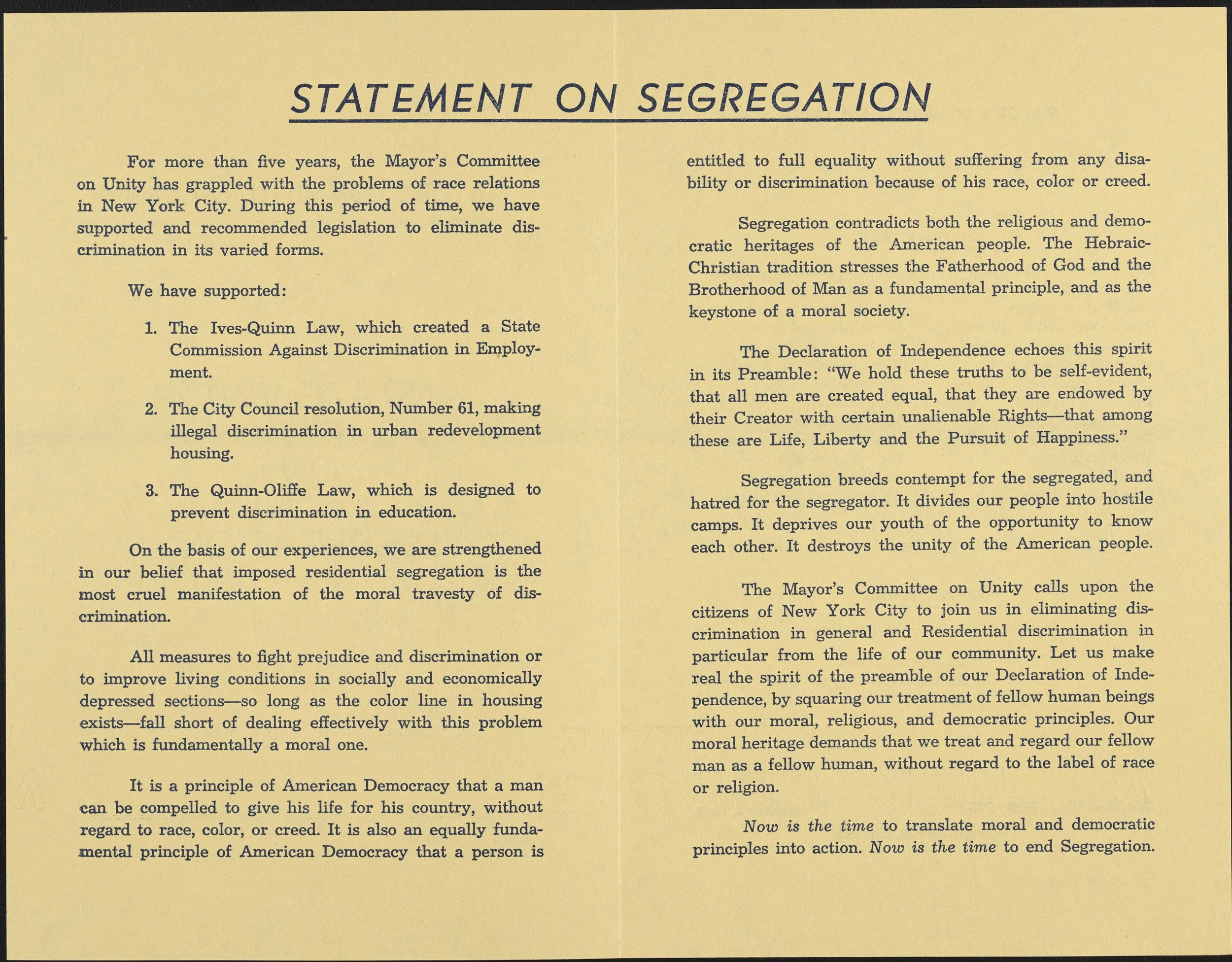
Statement on segregation. The committee prepared this statement which states that residential segregation is, “the most cruel manifestation of the moral travesty of discrimination.” New York City Human Rights Commission, NYC Municipal Archives.
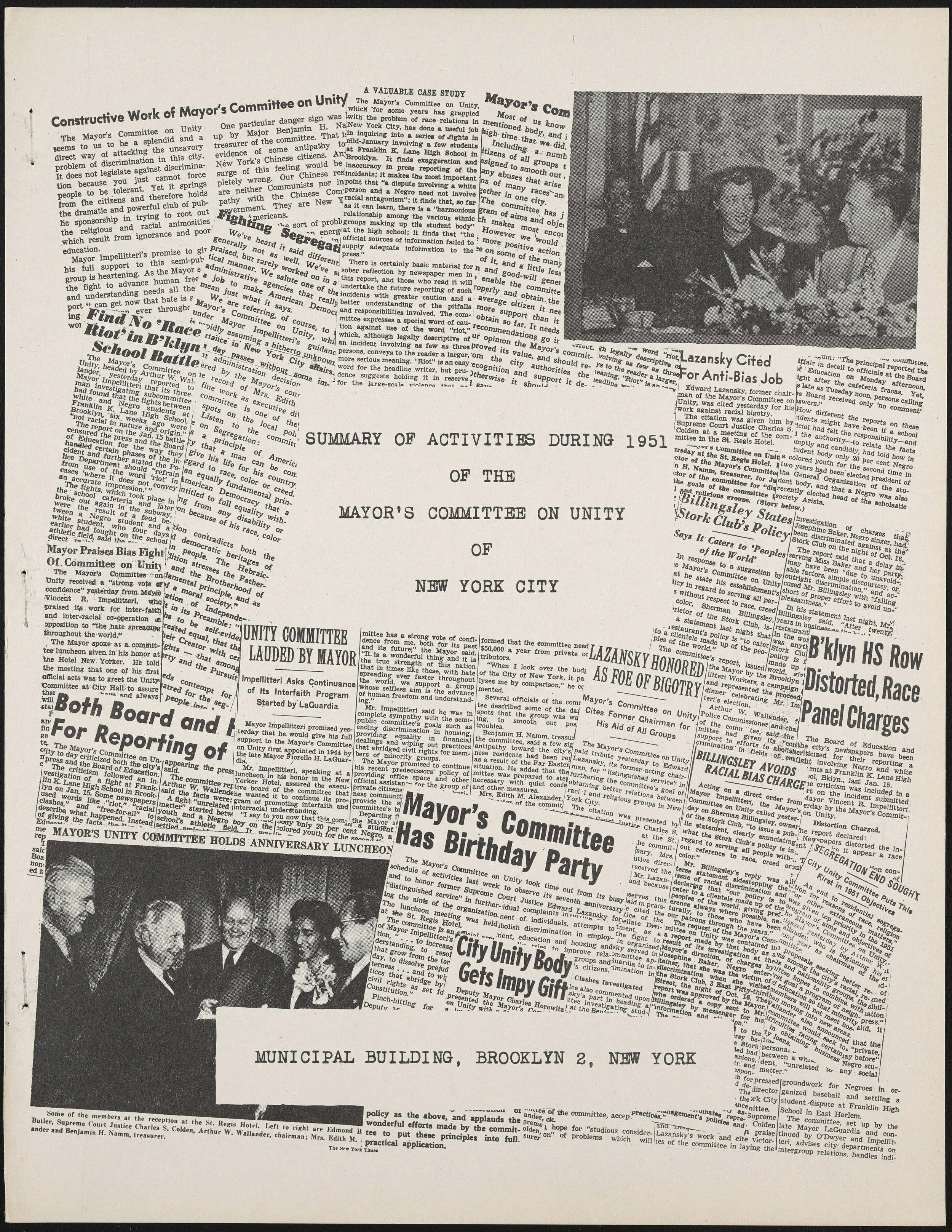
1951 Activity Report. Each year the Mayor’s Committee on Unity produced an activity report which highlighted the work of the committee throughout the previous year. New York City Human Rights Commission, NYC Municipal Archives.
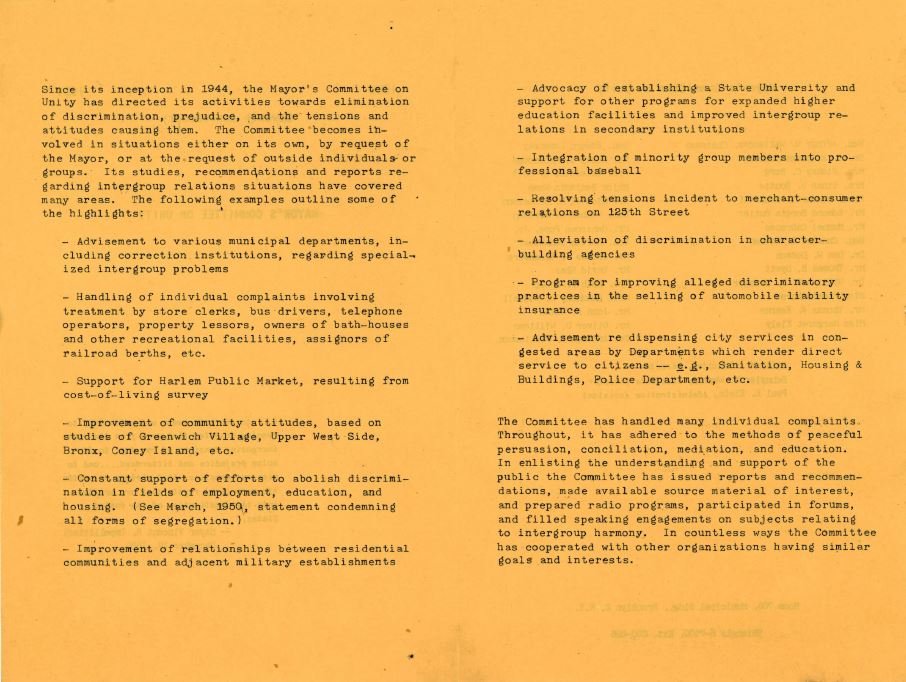
1951 Activity Report. Each year the Mayor’s Committee on Unity produced an activity report which highlighted the work of the committee throughout the previous year. New York City Human Rights Commission, NYC Municipal Archives.
One aspect of Edith Alexander’s role as executive director was to engage the community at public speaking events. During her tenure she gave speeches to civic groups, attended luncheons, and organized public events. In 1952, she was one of the two designated speakers for the St. George Association at the Department of Welfare. New York City Human Rights Commission, NYC Municipal Archives.
By 1954, it was clear that the committee needed required legal authority to address issues rather than just suggesting ways to alleviate discrimination. It was at this point that the committee transitioned into the Commission on Intergroup Relations, empowered to take legal action against discrimination. It also marked the end of Edith Alexander’s tenure with the committee.
In addition to her Committee work, in 1948, Raymond Jones, the Deputy Commissioner of Housing, designated Alexander as a presidential elector from the Twenty-second Congressional district. Jones said that the selection of a Black woman by the Democratic party for this honor was “possibly without precedent in the entire country.” After she left the Mayor’s Community on Unity, Alexander took on the role of Associate Executive Director of the Mayor’s Advisory Council until her retirement in 1959. In 1961 she received a citation from then Mayor Robert Wagner for her “distinguished and exceptional service to all New York.”
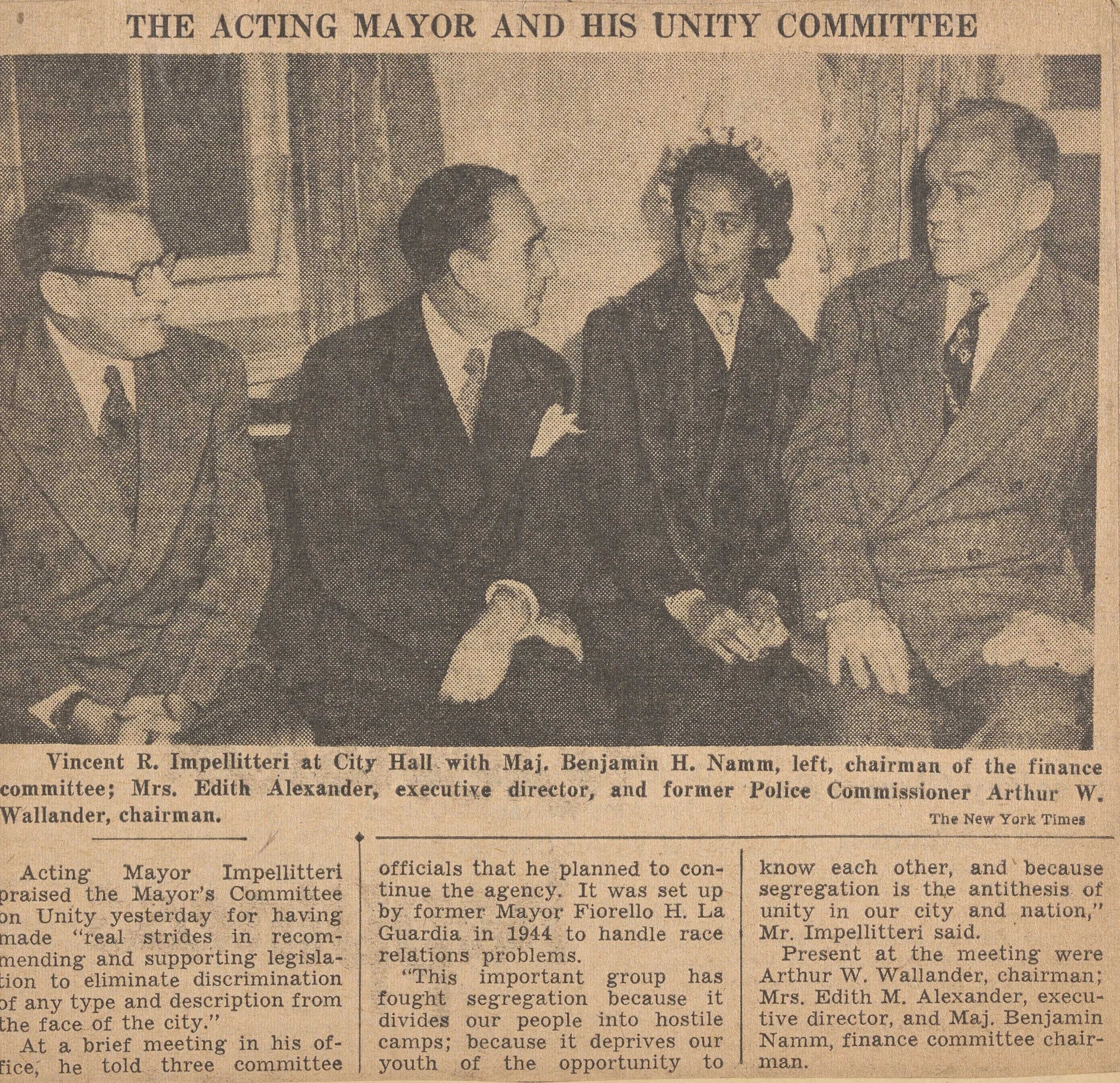
The New York Times ran this article showing Acting Mayor Impellitteri with the leaders of the Mayor’s Committee on Unity in 1948. Impellitteri stated that the committee had, “made real strides in recommending and supporting legislation to eliminate discrimination of any type and discrimination from the face of the city.” New York City Human Rights Commission, NYC Municipal Archives.
The story doesn’t end there. While her work ended, her son, Clifford Alexander, Jr. followed closely in her footsteps. He served as chairman of the Equal Employment Opportunity Commission under President Lyndon Johnson and became the nation’s first Black Secretary of the Army under President Jimmy Carter. Edith McAllister Alexander died on June 27, 1965, at Harlem Hospital.
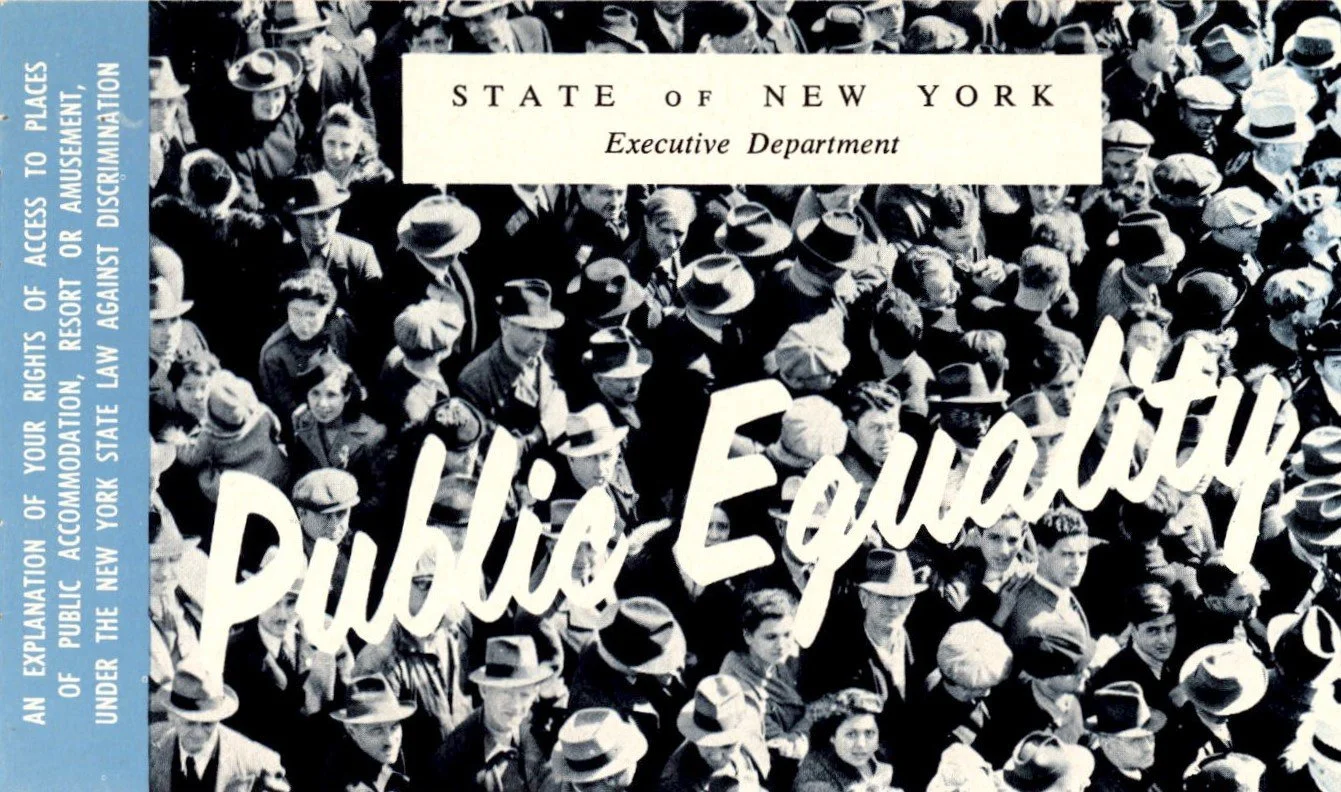
A brochure created by the New York State Executive Department. Many city, state and national organizations followed New York City’s lead in creating organizations to fight discrimination in all forms. New York City Human Rights Commission, NYC Municipal Archives.
Federal support for Documenting Democracy was provided by the National Historical Publications and Records Commission of the National Archives.