It Happened Here: 400 Years of NYC Government Records, 1636-2025

On Friday, July 3, 2025, the Department of Records and Information Services hosted an exhibit of unique items from four centuries of NYC history. Selected from the vast collections of the Municipal Archives and Library, the display kicks-off the It Happened Here weekend. Dating from 1636 to the present, the exhibit featured iconic documents, photographs, and ephemera that illustrated how the City evolved civil rights and made a new home for a population from around the world.

Petition, John Peter Zenger to Common Council, 1735. Common Council Records, NYC Municipal Archives.

From the 17th century, the display exhibited the first official edict of the colonial Director-General, Peter Stuyvesant, dated 1647. The edict banned the sale of alcohol every day after 8 p.m. and before 2 p.m. on Sundays, and enforced strict penalties for drawing a knife or sword in anger. The exhibit curators also included the original 1654 purchase of “Conyne Eylandt” (Coney Island) as a representative example of the many interactions between colonists and native peoples.

The 1734 trial of Peter Zenger is a signature event of the 18th century featured in the show. The exhibit displayed Zenger’s petition to the Common Council requesting repairs to his jail cell at the City Hall in 1735. He had been imprisoned for publishing articles critical of the colonial government. His acquittal by the jury established a powerful early precedent for freedom of the press in America.
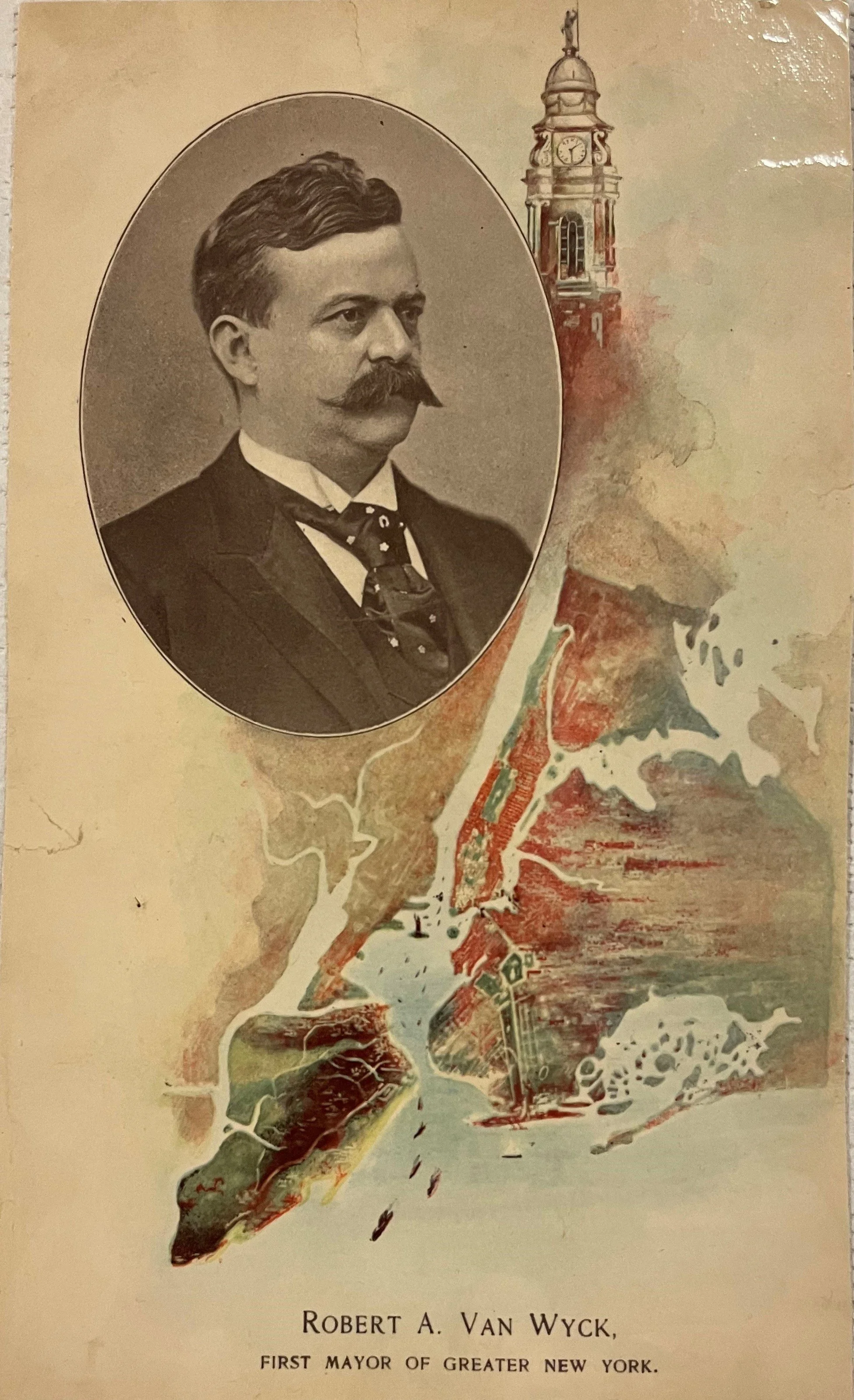
Pamphlet, 1898, Mayor Robert A. Van Wyck Records, NYC Municipal Archives.

Another highlight of the exhibit representing the 17th century was the “List of Schollars in the African Free Schooll,” from 1795-1796. Founded in 1787 by the New York Manumission Society, the African Free School educated the children of enslaved and formerly enslaved people.
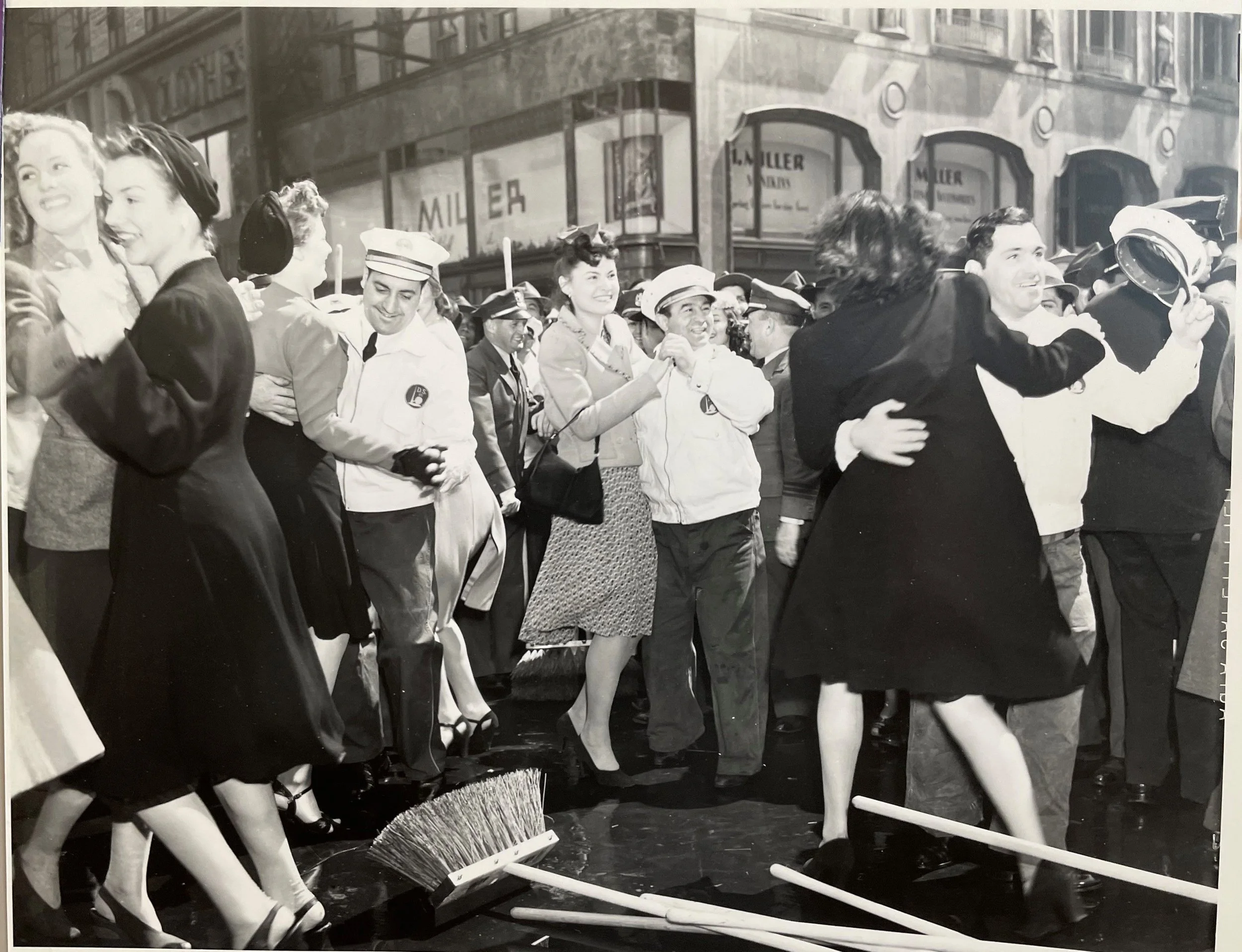
VJ Day, Times Square, August 14, 1945. Department of Street Cleaning Photograph Collection, NYC Municipal Archives.

For the 19th century, the exhibit highlighted items from three of the greatest public works achievements of the era—the Croton Aqueduct, Central Park, and the Brooklyn Bridge. An iconic photograph of workers on the Aqueduct in 1889 showed the scale of the project that brought abundant fresh water to the growing city. The display included an original drawing of the Central Park, designed as a democratic space offering all New Yorkers access to nature and recreation. The Brooklyn Bridge drawing in the exhibit illustrated how the suspension bridge—the longest in the world at that time—connected the two growing cities of Manhattan and Brooklyn. 

AIDS Pamphlet, Vertical Files, NYC Municipal Library.
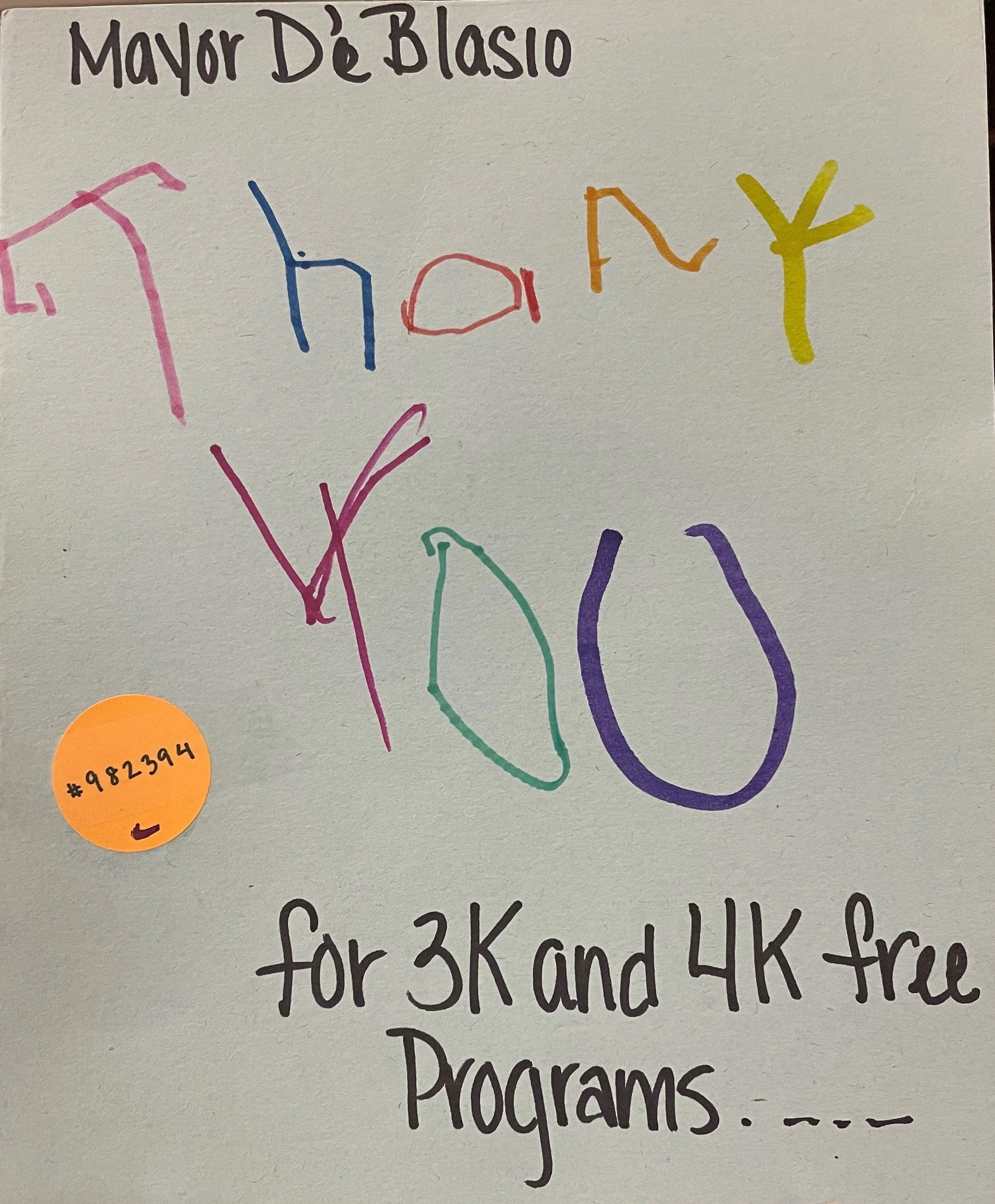
Thank you card, Mayor Bill de Blasio Records, NYC Municipal Archives.

The exhibit curators had an abundance of material to represent NYC municipal government in the 20th Century. Selected documents and photographs illustrated how the City welcomed waves of newcomers from Europe and the South, successfully consolidated Brooklyn, Queens, Staten Island and the Bronx into the Greater City of New York, revolutionized transportation with construction of the subway system, and coped with public health emergencies, the Great Depression, two World Wars, and a fiscal crisis.

Moving to the 21st Century, the exhibit reminded visitors of more recent events such as the attack on the World Trade Center on September 11, 2001, Hurricane Sandy in 2012, implementation of Universal Pre-K by Mayor de Blasio in 2014, the inaugural NYC Women’s March in 2017, and the parade for the Women’s World Cup in 2019, and finally, the COVID-19 pandemic in 2021.

What’s this? Discovered in the Municipal Archives, the origin of this document, its subject, or purpose is not known. If can help us identify this item, please do!
The Case Against Bruno Richard Hauptmann

On April 3, 1936, Bruno Richard Hauptmann was put to death in the New Jersey State Prison at Trenton for the kidnapping and murder of Charles Augustus Lindbergh, Jr., the 20-month-old son of Col. Charles Lindbergh and his wife Anne Morrow Lindbergh. It was the end of one of the most sensational investigations in American history, except the case never really ended. Like other famous murders, such as the JFK assassination, it birthed a whole industry of conspiracy theorists who think that the police and FBI got it wrong. Even today, they are working to reopen the case and test evidence for DNA samples, and they have been the subject of credulous articles in publications as diverse as The New York Times and The Free Press.

Love Counts: NYC LGBTQ History in the Municipal Library

This Pride Month, For the Record showcases selected publications in the NYC Municipal Library that illuminate the powerful and complex history of the City’s LGBTQ population in recent decades.  

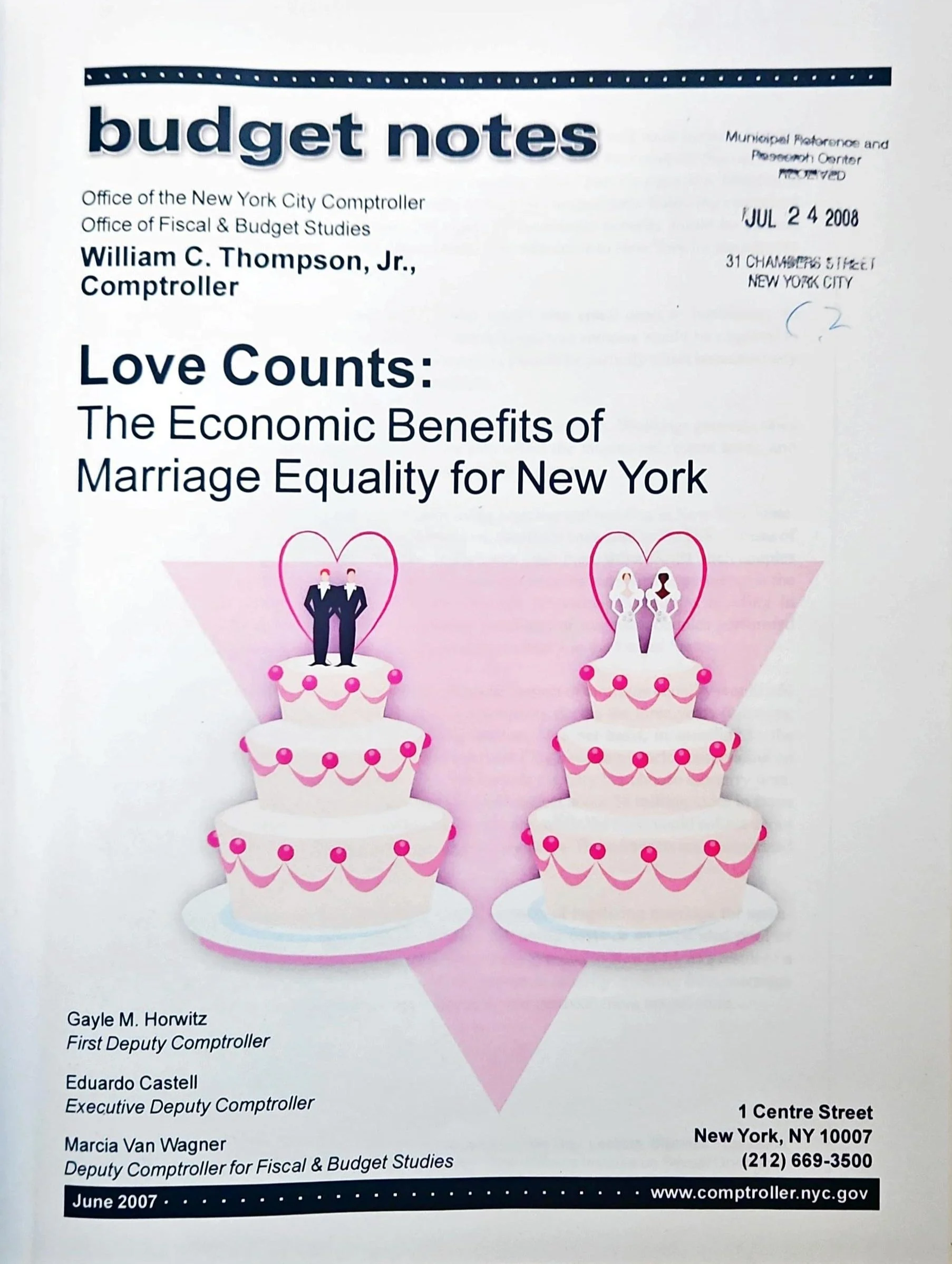
Love Counts: The Economic Benefits of Marriage Equality for New York. New York City Comptroller, June 2007. NYC Municipal Library.

Human Services and the Gay and Lesbian Population of New York City: Emerging Services, Emerging Issues. Community Council of Greater New York, 1986. NYC Municipal Library.

In the throes of the AIDS epidemic in 1986, the Community Council of New York prepared a report for the New York City Human Resources Administration entitled Human Services and the Gay and Lesbian Population of New York City: Emerging Services, Emerging Issues. The authors note that “the gay and lesbian population is primarily a hidden population, with many individuals afraid of disclosing their identity,” and acknowledge that despite NYC’s tolerance for different lifestyles, “homosexuality remains a subject of controversy and a target of prejudice.” 

End the Hate: A Report on Violence against Gay Men and Lesbians in New York City, a 1991 publication from the New York City Commission on Human Rights, was created at the request of Mayor David Dinkins “to provide a context for New York State legislators considering the passage of the Hate Crimes Bill and to illustrate the experiences which have led gays and lesbians to press for protections under it.” A questionnaire about bias incidents was returned by 508 respondents, largely people who had “never before contacted the police or other organizations about the attack.” The completed questionnaires “reveal a disturbing array of hate crimes which range from verbal abuse to vicious gang attacks.” (The Hate Crimes Act was eventually signed into law in New York State in 2000.)  

End the Hate: A Report on Violence against Gay Men and Lesbians in New York City, 1991. New York City Commission on Human Rights. NYC Municipal Library.

Love Counts (see above), a 2007 report from the Comptroller’s office, takes a decidedly practical approach to shoring up support for marriage equality in NYC. Subtitled “The Economic Benefits of Marriage Equality for New York,” it calculates that “New York City would receive a boost of nearly $175 million to its economy during the first three years after legislative approval of marriage for same-sex couples in the State.” (The Marriage Equality Act was signed into law in New York State in 2011.)

51 Christopher Street, ca. 1939. Tax Department photographs, NYC Municipal Archives.  

The June 2015 NYC Landmarks Designation Report for the Stonewall Inn, seen above in a 1940s tax photo before it became a gay bar, names it “one of the most important sites associated with Lesbian, Gay, Bisexual, Transgender history in New York City and the nation.” The narrative describes the events of June 28, 1969, when the bar's patrons fought back against a police crackdown, chanting “gay pride” and “gay power,” and sparking the nationwide struggle for LGBTQ civil rights.  

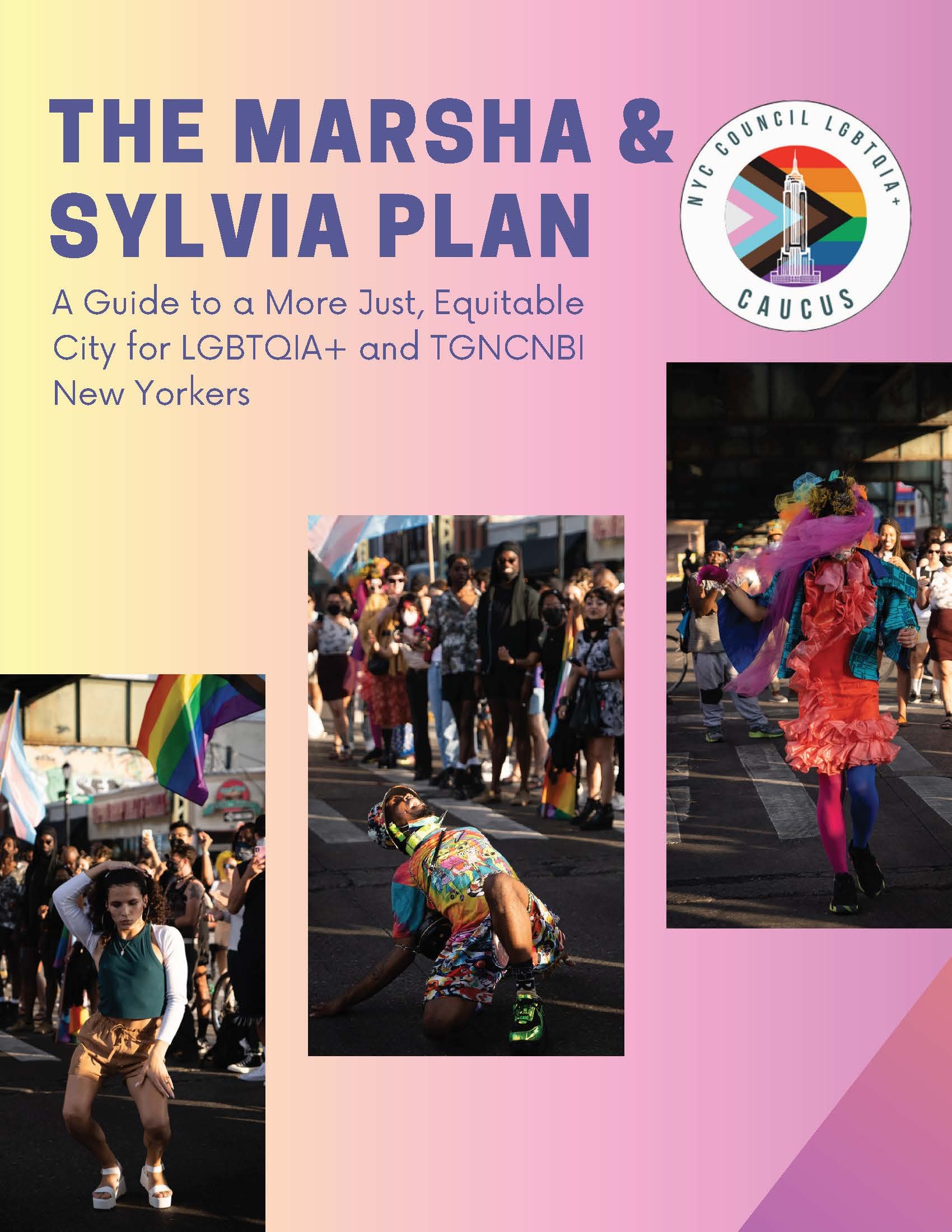
The Marsha & Sylvia Plan, City Council of New York, 2023. NYC Municipal Library.

The Marsha & Sylvia Plan, a 2023 submission to the Municipal Library’s Government Publications Portal, was issued by the City Council’s LGBTQIA+ Caucus. Acknowledging that “our work to secure and affirm the lives of our LGBTQIA+ (lesbian, gay, bisexual, transgender, queer, intersex, asexual, and more) neighbors is far from over,” it details initiatives in multiple fields that “empower us to deliver policies that affirm our place in the city we call home.”

Deportation and Immigration: NYC Mayors and Federal Officials

On April 27, 1972, Mayor John V. Lindsay sent a letter to the Hon. Raymond F. Farrell, Commissioner, Immigration and Naturalization Service, U. S. Department of Justice, in Washington, D.C.  Lindsay wrote to Farrell on behalf of John Lennon and Yoko Ono, “. . . who are currently facing deportation proceedings initiated by your Department.” Lindsay acknowledged to Farrell that the couple “. . . speak out with strong and critical voices on major issues of the day.” However, he continued, “If this is the motive underlying the unusual and harsh action taken by the Immigration and Naturalization Services, then it is an attempt to silence Constitutionally protected First Amendment rights of free speech and association and a denial of the civil liberties of these two people.” 

In his conclusion, the Mayor wrote, “In light of their unique past and present contribution in the fields of music and the arts, and especially considering their talent to be so outstanding as to be ranked among the greatest of our time in these fields, a grave injustice is being perpetuated by the continuance of the deportation proceeding.”

New York Senator Robert F. Kennedy and Mayor Robert F. Wagner, n.d., Mayor Robert F. Wagner Photograph Collection, NYC Municipal Archives.

A carbon copy of Mayor Lindsay’s letter is in his correspondence files. Archivists located the letter in response to a query from a patron who read contemporary newspaper accounts about the Mayor’s intervention on behalf of John Lennon and Yoko Ono in the deportation matter. The patron inquired if the Archives had any records of the correspondence.

Typing “John Lennon” into the Collection Guides did not produce a result. Similarly, scanning folder listings in Lindsay’s subject files looking for possibly relevant titles, e.g. “deportation,” also proved fruitless. Then, the archivist noticed folders labeled “U. S. Government, 1972” within the Departmental correspondence series. After a quick examination of its contents, success!

The existence of separately filed correspondence to and from officials and agencies of the federal government and New York City mayoral administrations dates to 1934 when Fiorello LaGuardia took office as Mayor. The recent For the Record article, New York and President Jimmy Carter explored the relationship between President Jimmy Carter and City Mayors Abraham Beame and Edward Koch beginning with the fiscal crisis in 1977, and the subsequent efforts to restore the City’s financial stability. This week’s article further explores the research value of the federal correspondence files in mayoral collections.

Mayor LaGuardia had friends in high places. Fiorello LaGuardia to James V. Forrestal, Acting Secretary of the Navy, September 8, 1941. Mayor Fiorello LaGuardia Photograph Collection, NYC Municipal Archives.

Fiorello La Guardia’s three terms as Mayor (1934-1945) coincided with a significant time in the city’s history, from the Great Depression through World War II. The collection demonstrates how closely he worked with federal officials at every level as they sought to ameliorate Depression-related conditions. There is voluminous correspondence regarding efforts to provide unemployment relief through public works projects such as highways, parks, and housing, that would forever change the physical landscape of New York City.

The first folder of “correspondence with federal officials” in Mayor LaGuardia’s collection shows how the City obtained federal funds for construction of the Henry Hudson Parkway. In May 1934, Harold Ickes, the Federal Emergency Administrator of Public Works, informed City officials that “the project is worthy of future consideration.” He asked for a detailed application. Within days, Parks Commissioner Robert Moses obliged with a detailed multi-page proposal, including blueprints and project cost estimates. Ickes approved, and construction began in February 1935; the portion south of the George Washington Bridge opened to motorists on October 10, 1937.

Clerks in the Mayor’s Office continued the practice of separately filing federal correspondence during the administration of LaGuardia’s successor, William O’Dwyer (1946-1950). And, beginning with the O’Dwyer administration they further separated letters to and from the President. Not all federal correspondence concerned fiscal matters. There are numerous letters concerning special events, and notes politely thanking one another for an invitation or hospitality during a visit to their respective cities.

Mayor O’Dwyer’s files, for example, include a letter to his Executive Secretary, John Tierney from Murray O. Smyth, Director of the Office of Public information in the Treasury Department. Dated May 4, 1950, it confirmed that Mayor O’Dwyer would ring an exact duplicate of the Liberty Bell set up on the steps of City Hall. Smyth suggested this would “make a fine event for the newsreels as well as for press photos.” He also noted that the Liberty Bell is an exact duplicate of the original bell in Philadelphia, “without the crack.”

Robert F. Kennedy, United States Senate to Mayor Robert F. Wagner, May 10, 1965. Mayor Robert F. Wagner Records Collection, NYC Municipal Archives.

Mayor Robert Wagner’s collection (1954-1965) also includes federal correspondence as a sub-series with the Departmental Correspondence files. His clerks further separated materials to and from members of Congress. On Aril 27, 1965, Wagner wrote to Emanuel Celler, the long-serving member of Congress from Brooklyn. In his letter he endorsed the Celler-Hart Bill to amend the Immigration and Nationality Act: “I consider the passage of this Celler-Hart Bill essential. This legislation is long overdue to rectify past injustices in our immigration policy.”

Wagner sent copies of the letter to New York Senators Robert F. Kennedy and Jacob K. Javits. Kennedy replied on May 10, 1965. He informed Wagner that “I agree that the present system is an affront to our ideals of equality and justice.” He added that “As you know, President Johnson has proposed the same bill, originally proposed by President Kennedy, which we drafted in the Department of Justice. I intend to give this bill – which I am a co-sponsor – my fullest support.”

In a related matter, Wagner’s files include a transcript of a telegram he dictated on July 27, 1965. Wagner sent it to the Hon. Jonathan Bingham, U.S. Congress.  Wagner recommended approval of the National Park Service proposal to establish Ellis Island as a National Historic Site: “For millions of Americans it has been the gateway to a new life of liberty and opportunity.”    

Researchers are invited to further explore the correspondence with federal officials in the files of New York mayoral administrations.

Indexing Felony Indictment Records, Update

“I was drunk all day, I did not mean to steal the child.” -Lizzie Colbert

On October 26, 1879, Lizzie Colbert, entered a guilty plea before the Police Justice at the First District Police Court in Manhattan. She had been charged with “decoying child.” The details of this unfortunate incident, and thousands of other felony offenses, can be found in the Municipal Archives collection of New York County Court of General Sessions Indictments, also known as the New York District Attorney Felony Indictment files.

Criminal Courts, a.k.a. “The Tombs,” Valentine’s Manual, 1864. NYC Municipal Library.

The felony indictment series date from 1790 through the 1970s and are a significant component of the Archives’ collections related to the administration of criminal justice. Beginning in 1990, the Archives received federal funding from the National Endowment for the Humanities (NEH) for projects to preserve, index and reformat these materials. The Archives successfully persuaded the Endowment that the records had national importance based on their volume (thousands of cubic feet), date span (1686 to through the 20th century), and for their intellectual content. Generations of both academic and family historians have mined these records for unique information about the people of the city, specifically, and more generally, American urban history.

In 1997, the Archives received support from the NEH to index and microfilm the felony indictment files from 1879 through 1892. A second award from the NEH supported digitization of the microfilm. Creation of the index to this series greatly expanded researcher access. Two years ago, the ongoing demand for information from the records prompted the Archives to launch a project to continue indexing the series. The work began with cases filed in 1879, and has proceeded in reverse chronological order. Currently, case files from 1868 are being indexed. For the Record described the indictment record indexing project in What We’re Working on Now - Indexing Felony Indictment Files. Since then, the names of 28,665 defendants have been added to the index.  

The indexing project includes entering names of the defendants, the offense, and date of indictment, into a searchable database. As noted in the previous article, the types of cases found in this series include indictments for a wide variety of felony crimes. As expected, there are hundreds of larceny, assault, and robbery cases. Prosecutors also charged numerous defendants with fraud, libel, forgery, arson, perjury, and keeping a disorderly house. The high volume of homicide, murder, and manslaughter cases points to the harsh reality of life in a densely populated growing city. Similarly, cases of cruelty to animals are a reflection of the vast equine population at that time.    

As noted above there are a wide variety of offenses handled by the prosecutors. Among the more notable cases, at least in terms of quantity, are the bigamy files. The case of the people vs. Marie Wellerdick, from June 1879, may be typical. A letter from her attorney in the file informed the District Attorney that the defendant “was abandoned by her [first] husband.” Then, some years later she “lived with Albert Weber as his mistress and had two children by him.” Two years later, Weber became very ill and “on his death bed he requested her to marry him.” She, believing her former husband dead, “complied with his wishes and the ceremony was performed on the 18th day of August 1873.” Inconveniently, the first husband was not dead. The prosecutor, Assistant District Attorney Horace Russell, however, decided to withdraw the charge. In a note added to the case file, he wrote that the defendant “was not of such a character as that she should be prosecuted further. A death bed marriage to satisfy the conscience of a dying man might not to be made an occasion of a criminal conviction.” June 7, 1879.

The People vs. Thomas O’Connor, June 15, 1869, New York District Attorney Case Files, NYC Municipal Archives.

Not all of the cases involve grievous harm to persons or property. In the newly indexed case files, there are about a dozen prosecutions related to the distribution of “obscene” materials. On June 15, 1869, prosectors indicted Thomas O’Connor, a.k.a. James Dexter, for “selling obscene books.” The file helpfully includes a copy of a flier listing the available publications and products. Books titled “Amours of a Modest Man,” and “Scenes in a Nunnery,” along with “French Transparent Cards,” and stereoscopic pictures, are just some of the items offered.

It is not entirely clear what prompted the indictment, but the case file includes a short letter, dated May 10, 1869, from Stuart A. Wilson of Nebraska City, Nebraska. In the letter to “James Dexter” he complained that he had sent 50 cents along with a request for one of his publications from “Cupid’s Own Library,” but had not received the requested item. He added that his order for another book had also not been fulfilled. Wilson warned Dexter that “if I do not hear from you within 20 days I will positively have you punished.” He added, “it is not the money I want but justice.” Apparently, Wilson followed through on his threat as the letter found its way to the prosecutor’s office.  

County Jail, Valentine’s Manual, 1870. NYC Municipal Library.

The O’Connor/Dexter case file also includes the deposition of Riley A. Brick. He stated that on January 30, 1869, he called at Dexter/O’Connor’s place of business, 60 Warren Street. He saw the defendant there and “inquired if he could purchase some obscene books.” Dexter said yes. Riley went on to state that he was a “member of the Young Men’s Christian Association of the City of New York and that “his purpose in this proceeding is to protect families and society against the circulation of said obscene and indecent books sold by [the defendant] and to punish him therefore.” It is not entirely clear from the documents, but it appears that O’Connor/Dexter switched his plea to “guilty,” and the charges may have been dismissed.

The People vs. Rebecca Kelly, September 17, 1879; The People vs. Lizzie Colbert, November 6, 1879, New York District Attorney Case Files, NYC Municipal Archives.

Lizzie Colbert was not the only defendant accused of “Decoying Child” in the autumn of 1879. On September 17, 1879, prosecutors charged that Rebecca Kelly “... did maliciously forcibly and fraudulently take, carry away, decoy and entice away” the child Prince Matthews from his sister Eugenia. The native-born Kelly, 20 years old, listed her occupation on the plea statement as “I do anything I can get to do.” She initially plead ‘not guilty,’ but then later “acknowledged that she found said child on the Bowery near Houston Street and that he was not her child.” The jury at her trial could not agree to convict and on October 24, 1879, the Court discharged Kelly.

Lizzie Colbert did not fare as well. Even though she voluntarily brought the child she admitted was not her own to the 27th Police Precinct Station, and offered the seemingly reasonable excuse that she had been drunk all day, the jury voted to convict. The Court sentenced her to one year in the State penitentiary.

Researchers are invited to access and further explore the collection.  Look for future For the Record articles that chronicle project progress.  

New Project: Processing and Digitizing Records of the New York City Commission on Human Rights

Project Overview

An Equal Chance booklet, published by New York State Commission Against Discrimination, 1951. NYC Commission on Human Rights Collection, NYC Municipal Archives.

The NYC Municipal Archives has launched a new processing and digitization project, Processing and Digitizing Records of the New York City Commission on Human Rights. It is supported by a grant from the National Historical Publications and Records Commission of the National Archives as part of their Documenting Democracy initiative. The project will enhance public access to a significant series of records created by the New York City Commission on Human Rights. Key activities of the project include rehousing and processing 268 cubic feet of records, digitizing the earliest 53 cubic feet, publishing digitized materials, an online finding aid, social media content and blog posts, and curating a digital exhibit that showcases both the collection and the project’s progress. Project activities commenced in March 2025 and will be completed in March 2026.

About the Collection

The collection spans 268 cubic feet and covers the years 1944 to 1976, bringing together the records of the New York City Human Rights Commission (1962–1976) and its predecessor organizations—the Mayor’s Committee on Unity (1944–1954) and the Committee on Intergroup Relations (1955–1961). It provides a comprehensive record of the research, policymaking, investigations, legal actions and studies that shaped New York City’s efforts to address discrimination over three decades.

The Mayor’s Committee on Unity (1944-1954)

In 1944, Mayor Fiorello La Guardia created the Mayor’s Committee on Unity by Executive Order in response to citywide concerns about race relations following riots in Harlem during the 1930s and early 1940s. The Committee focused on:

Mayor’s Committee on Unity Program and Purpose Document, October 18, 1946. NYC Commission on Human Rights Collection, NYC Municipal Archives.

  • Recommending and endorsing legislation beneficial to the causes of race relations.

  • Investigating and recommending action in New York City neighborhoods where tensions were acute.

  • Advising groups and agencies on how to adapt their programs to meet demands created by racial and religious conflict.

  • Exerting the pressure at their disposal to bring about desired changes in agency programs.

  • Extinguishing the little fires of conflict before they reach conflagration proportions.

  • Conducting research and investigations to determine the causes of intergroup differences.

These early materials consist of The Mayor’s Committee on Unity’s meeting minutes, topical reports, original research, surveys, correspondence, speeches, programmatic planning, interviews, press coverage, financial reports, conference proceedings, and legal documents. 

The Commission on Intergroup Relations (1955-1961)

Does the Light Reach Harlem? pamphlet, published by City-Wide Citizens’ Committee on Harlem, 1950. NYC Commission on Human Rights Collection, NYC Municipal Archives.

In the mid 1950s, the Mayor’s Committee on Unity evolved into the Commission on Intergroup Relations. The Committee had been privately funded and relied on donations. It lacked permanent city agency status. As its mission became more essential and long-term sustainability grew uncertain, the city formalized its work by establishing the Commission on Intergroup Relations as a permanent, city-funded agency.

The Commission on Human Rights (1962-Current)

In 1962, the Commission on Intergroup Relations was renamed the Commission on Human Rights. With the passage of the New York City Human Rights Law in 1965, the Commission gained the authority to prosecute discrimination in private housing, employment, public accommodations, and equal pay. This is the largest series in the collection, comprising 215 cubic feet of case files used in legal proceedings. Due to concerns about protecting personal privacy, this series will not be digitized.

Step 1. Surveying

Before the collection can be processed it will be surveyed. Surveying involves looking through a sampling of the boxes to determine a general timeline and content themes. The archivists aim to create a potential organization scheme for the collection during the survey. In the initial survey of the NYC Commission on Human Rights Collection, the archivists determined that the collection would be broken down into three main series that represented the three different entities and eras highlighted above.

The Puerto Rican Migration... a Report, published by The Committee of Puerto Ricans in New York City, 1955. NYC Commission on Human Rights Collection, NYC Municipal Archives.

Step 2. Processing and Re-Housing

Descriptive Information

Archivists identify and record key details about each folder’s contents, including topics and date ranges. This information is written on the physical folders and entered into a spreadsheet that  forms the basis of the online finding aid’s inventory.

Prejudice pamphlet, by Willard Johnson, National Conference of Christians and Jews, 1952. NYC Commission on Human Rights Collection, NYC Municipal Archives.

As noted above, only the first series of the collection—totaling 53 cubic feet—will be digitized during this project. The digitization specialist will scan, review, and edit the digital files for quality, then name and upload them to the online repository. The materials will be accessible to the public, after the full collection has been processed and open for research.

Step 4. Writing the Finding Aid

The finding aid brings together all the information gathered during   collection processing and transforms it into a structured, accessible guide for researchers. The finding aid provides essential context, including a historical overview of the collection’s development, a narrative of the Commission’s evolution, profiles of key individuals, and documentation of the Commission’s major contributions. The finding aid also situates the collection within broader historical movements, highlights themes relevant to current research trends, and includes comprehensive subject terms to support discovery.

Step 5. Publishing the Finding Aid and Uploading the Inventory Online

The final step is to publish the finding aid and folder-level inventory in the Municipal Archives’ online repository for public access. The online finding aid includes introductory material such as historical and biographical notes, a description of how the collection is organized, and a detailed inventory of folder titles and dates. This final product will help researchers understand the collection’s historical context and include a folder inventory.

Conclusion

Keep Your School All-American poster, published by the Institute for American Democracy, 1950. NYC Commission on Human Rights Collection, NYC Municipal Archives.

The New York City Commission on Human Rights collection holds immense value for understanding how one of the nation’s most dynamic cities confronted systemic injustice across multiple decades. Comprised of meeting minutes, topical reports, original research, surveys, correspondence, speeches, programmatic planning, interviews, press coverage, financial reports, conference proceedings, and legal documents, the records document New York City’s governmental response to racial unrest, religious intolerance, and discrimination from the World War II era through the height of the civil rights movement. As a city at the forefront of social change, New York City’s Commission on Human Rights played a significant role in shaping national conversations around equity and democratic values. The Municipal Archives expects the collection to attract a wide range of users—from students and scholars to advocacy groups and public agencies—who are invested in exploring the roots and ongoing impact of diversity, equity, and inclusion efforts. Its interdisciplinary relevance spans history, sociology, public policy, law, urban planning, critical race theory, gender studies, and beyond, offering deep insights into both historical and contemporary struggles for justice.

Look for future articles that will update project progress.