Puerto Rico

Remembering Willie Colón, El Malo del Bronx, 1950-2026

“The rhythms protected us...”

“The rhythms gave us... faces”

—Willie Colón in Low Rent: A Decade of Prose and Photographs From the Portable Lower East Side, Kurt Hollander, 1994, p. 90.

Willie Colón and Héctor Lavoe (1969 Fania Records publicity photo), Public Domain.

1950 Census Record showing Willie’s parents, William and Aracelis Colón.

695 East 139th Street, where Colón grew up, 1940s Tax Photos. NYC Municipal Archives.

Willie Colón, the King of Salsa, was born on 139th Street in the South Bronx on April 28th, 1950. Born William Anthony Colón Román, he was later known as El Malo Del Bronx (based on his debut album title) and referred to as El Maestro. Colón always recalled his Abuela (Grandmother), Antonia Pintorette, originally from Manatí, Puerto Rico, as being his primary caregiver.

Inspired by the street rhythms emanating from congas, bottles, and tin cans that he described as lullabies, Colón picked up the trumpet at age twelve. Two years later, he switched to trombone, which became his instrument of choice. Colón released his first album, El Malo, at age 17 in 1967 on Fania Records newly formed by Johnny Pacheco and Jerry Masucci. From there, he went on to help define the genre of salsa that took New York City and the world by storm. He collaborated with icons like Celia Cruz, Rubén Blades, Héctor Lavoe, and many others. He played in the Fania All Stars Band, became director of the Latin Jazz All Stars, and won multiple awards and accolades for his music.

The 1973 Fania All Stars concert at Yankee Stadium, recorded August 23rd, brought 40,000 salsa fans to see Celia CruzHéctor Lavoe, and Willie Colón.

Along with an abundance of Latin American artistic talent arising from the South Bronx, Colón helped compose the soundtrack of the area in the late 20th century—decades that saw political, economic, and social turmoil and change. Confronted with a “burning Bronx,” massive recession, redlining policies and diversifying neighborhoods, Latin American musicians from Puerto Rico, Colombia, Cuba, Panama, and more expressed stories, experiences, joy, and struggles through music, like salsa. Later, Colón wrote,

“We easily turned 139th Street into a tropical barriada. All the stores in the area had Spanish signs in front. In the mornings you could hear the radios blaring those Latin rhythms in an eerie but reassuring echoey unison—and the smell of hundreds of pots of Cafe Bustelo filling the air.”

Aerial photo of South Bronx showing Yankee Stadium, from New York (N.Y.). Police Department. Aviation Unit. NYC Municipal Archives.

Salsa music and the South Bronx go hand in hand. With an influx of migrants from Latin America and Puerto Rico to New York City in the 1960s, 70s, and 80s, many neighborhoods turned into hubs for Latin and Nuyorican culture. The sounds of the islands, mixtures of Afro-Caribbean, Taíno Indigenous, Latin Jazz, merged with cutting edge beats and vocals of R&B and Hip-Hop. Bronx legends like Tito Puente, Ray Barretto, Rubén Blades, Joe Bataan, and La India took the area by storm. One could not travel far down The Hub or Southern Boulevard without hearing congas, claves, and chants thundering from cars, windows, and boomboxes.

Tito Puente, contemporary of Colón, performing at City Hall, from WNYC, New York Hotline: Episode 401 - El Fieston de Nueva York, a Latin cultural festival, May 13, 1992.

Willie Colón distinguished his music from other salsa at the time with songs that brought to the forefront issues around identity, discrimination, and Colonization particular to Latin American experiences. Songs like Todo Tiene Su Finale (written by Héctor Lavoe in 1973), Pedro Navaja (written by Rubén Blades in 1978), and El Gran Varón (written by Omar Alfanno in 1986), told complex stories of love, life, and death.

Willie Colón featuring Héctor Lavoe & Yomo Toro - Aires de Navidad - Live/En Vivo, Fania Records, circa 1971. 

Throughout his career, Colón studied composition, orchestration, and arrangement, constantly revising his writing and performance practices. Many describe his songs as helping to connect Nuyoricans back to the island, as they inspired affection, celebration, and pride in Puerto Rican identity. Following news of Colón’s passing, his manager Pietro Carlos wrote:

“Willie didn’t just change salsa; he expanded it, politicized it, clothed it in urban chronicles, and took it to stages where it hadn’t been heard before. His trombone was the voice of the people, an echo of the Caribbean in New York, a bridge between cultures.” (FB)

Héctor Lavoe y Willie Colón - Presentación en los PBS Studios, NYC (1972).

Eventually, Willie Colón’s political interests influenced other aspects of his life. He advocated for social justice, most notably HIV/AIDS, Hispanic and Latin American representation in the U.S., and local political institutions. He was part of the Hispanic Arts Association, the Latino Commission on AIDS, the Arturo Schomburg Coalition for a Better New York, and the Congressional Hispanic Caucus Institute. In 1995, Colón became the first person of color to serve on the American Society of Composers, Authors and Publishers’ (ASCAP) national board.

In the early 1990s, Colón served as a special advisor to Democratic Mayor David Dinkins, appearing with him in numerous events, parades, and press conferences.

Mayor David Dinkins and Willie Colón, City Hall, November 16, 1990. Mayor David Dinkins Photograph Collection. NYC Municipal Archives.

A New York Times article in June of 1994 describes Willie’s transition into full-time politics owing to his observance of “disturbing trends.” He identified “a regression in race relations, misplaced government priorities like cutting back schools and social programs while spending billions in foreign aid” (NY Times, 1994). As result, Colón tried his own hand at electoral politics. In 1994 he unsuccessfully ran as a Democratic candidate for New York Congress. He tried and lost again in the 2001 election for New York Public Advocate. In 2014, Colón graduated from Westchester County Police Academy and was sworn in as a Deputy Sheriff for the Department of Public Safety.

Mayor David Dinkins presents the Certificate of Recognition to Willie Colón, City Hall, November 16, 1990. Mayor David Dinkins Photograph Collection. NYC Municipal Archives.

Later in his life, Colón switched from endorsing Democratic candidates like Hillary Clinton to voting for Donald Trump in 2016. He remained a vocal Republican until his passing in Bronxville, New York, on February 21, 2026. He was 75 years old.

Willie Colón was a New Yorker through and through. This blog illuminates the numerous examples of his legacy found in the NYC Municipal Archives; one can only assume that there is far more to discover about the ways he influenced New York City and the world.

Willie Colón & Hector Lavoe – “Che Che Cole” Live/En Vivo, Fania Records, circa 1971.

“Salsa is not a rhythm. Salsa is a concept. It’s an inclusion and a reconciliation of all the things that we are, here in the Bronx and the music that we make together.”

—Willie Colón

The Puerto Rican Study

On June 12, 2022, after a two- year hiatus due to COVID, New York City will host the 65th National Puerto Rican Day parade. This week, For the Record will feature a resource available in the Municipal Archives to research the history of Puerto Ricans in New York City. The focus is on the extensive Board of Education collection.

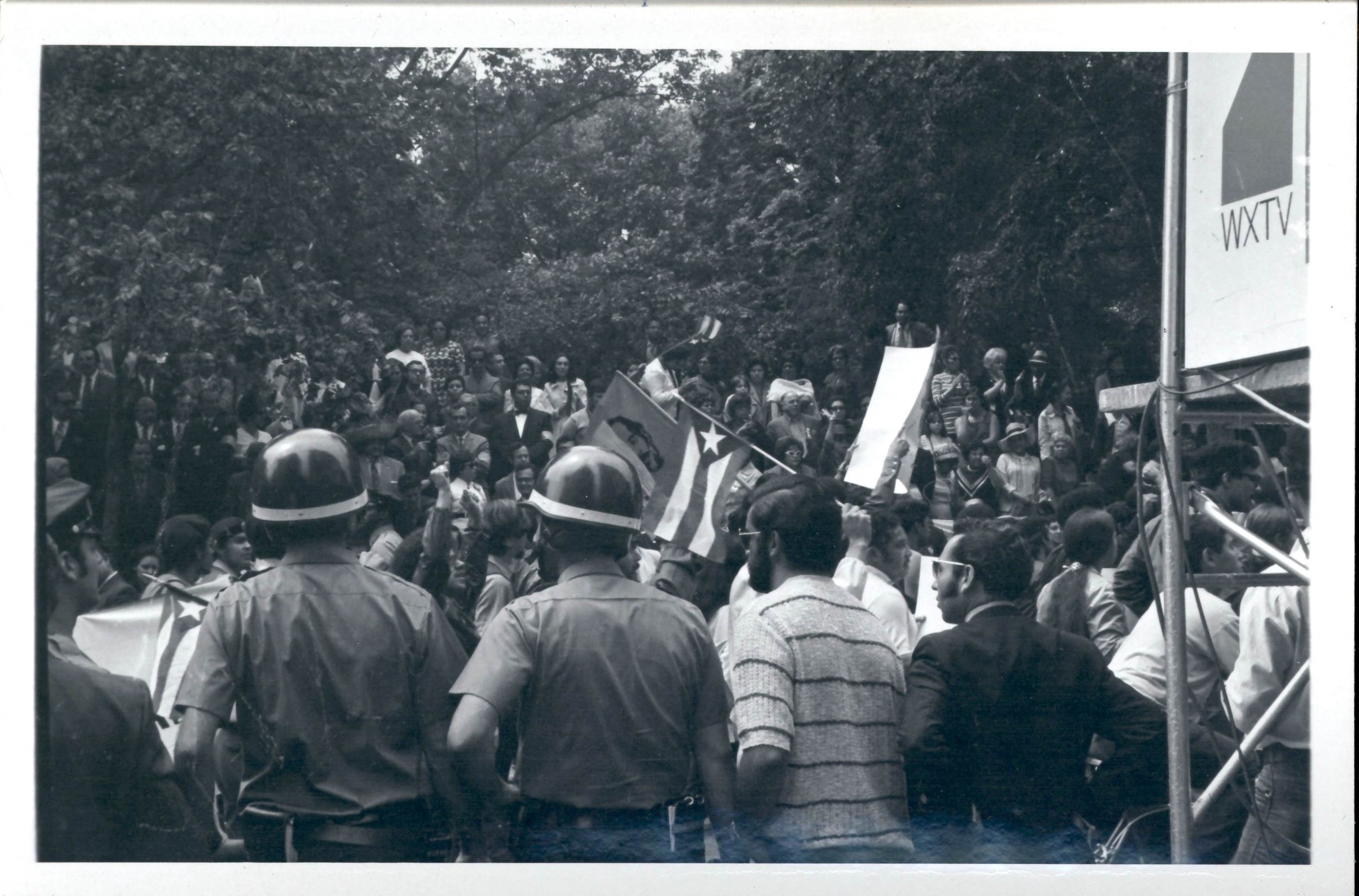
Puerto Rican Day Parade, June 7, 1970. NYPD Special Investigations Unit photograph collection. NYC Municipal Archives.

In the 1950s, the advent of air travel enabled many Puerto Rican families to move to New York City. The new immigrants impacted numerous aspects of New York City. Faced with this big population, many of whom spoke little to no English, the leaders of the City’s school system realized they needed to create programs to help the children of the new residents.

One program established by the Board of Education was called the Puerto Rican Study.  It was created to develop policies, curricula, and programs for the increasing number of students arriving from Puerto Rico. At three and a half cubic feet, the Puerto Rican Study collection is filled with draft letters, general correspondence, reports and subject files all detailing the different ways the study impacted newly arrived Puerto Rican children and, on a broader scale, the New York City school system itself.

The collection, housed at the Archives’ Chambers Street location, is a treasure trove of resources about this lesser-known aspect of NYC Puerto Rican history. The first half of the collection contains early drafts of reports and studies, as well as correspondence, including a letter from Mayor Robert Wagner concerning the Committee on Puerto Rican Affairs and the Mayor’s Commission on Inter-Group Relations.

Mayor Wagner to Dr. Clare C. Baldwin, Assistant Superintendent of Schools, page 1 of 2, January 6, 1956. Board of Education collection. NYC Municipal Archives.

Mayor Wagner to Dr. Clare C. Baldwin, Assistant Superintendent of Schools, page 2 of 2, January 6, 1956. Board of Education collection. NYC Municipal Archives.

The second half is filled with curriculum notes and reports. The curricula were extensive and detailed; there are series titled Resource Unit, Language Guide and other related materials.

Curriculum Materials Prepared by the Puerto Rican Study, 1956-1957. Board of Education Collection. NYC Municipal Archives.

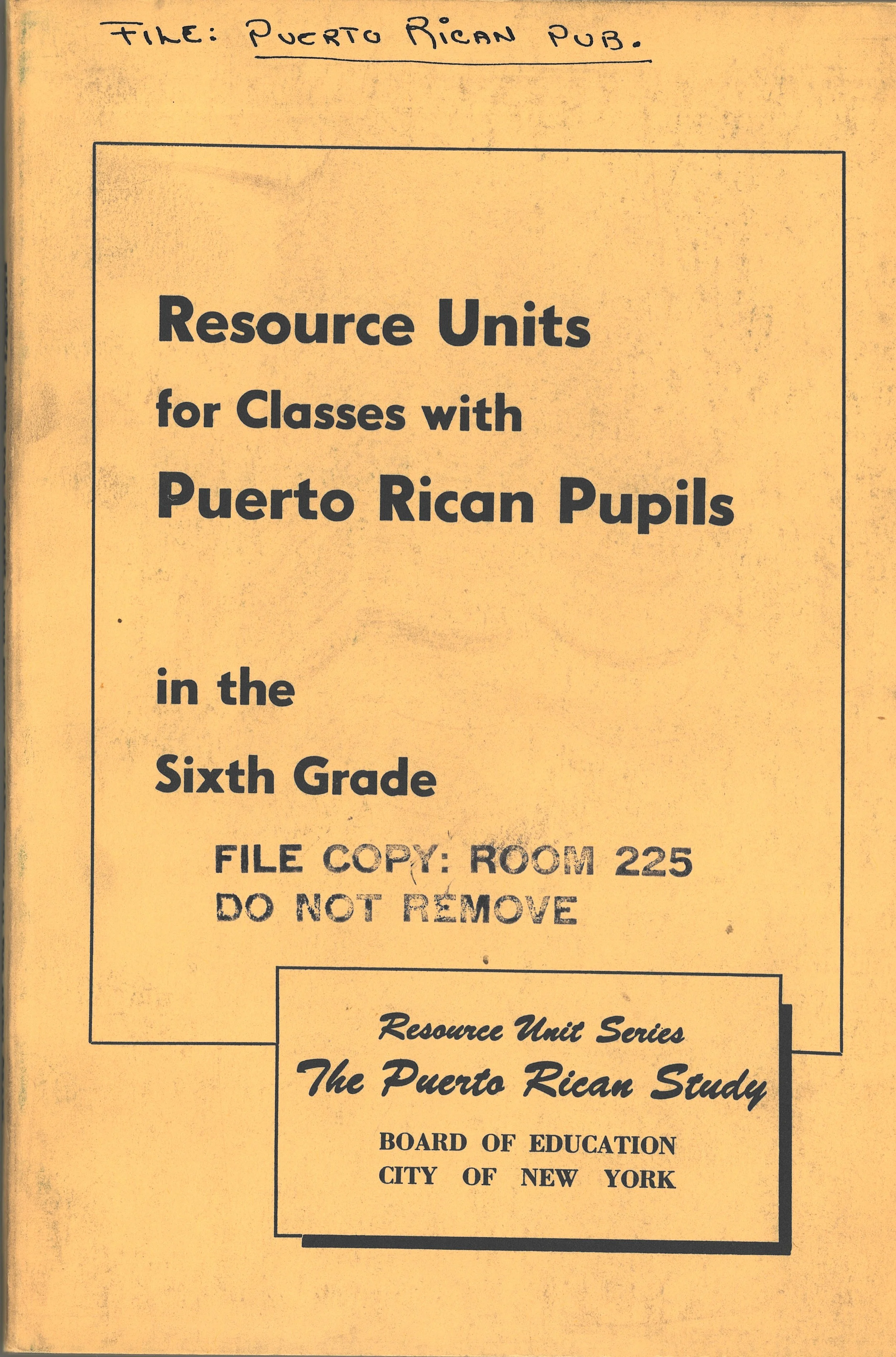
The resource units were based on New York City social studies guides but were intended to help teachers in classes with pupils who were recent arrivals from Puerto Rico. These resource units were organized by themes designed to help Puerto Rican students appreciate and assimilate into American culture. Examples of potential assignments included visiting the Statue of Liberty and “playing musical instruments found in Puerto Rico: maracas, guitar.” Below is an example of some of the resource unit themes:

Resource Unit, 6th Grade, cover. Board of Education collection. NYC Municipal Archives.

There were also units created to teach map skills, as well as how to appreciate technology designed to make life easier. The map skills assignments were connected to United States history, with examples such as having students locate Georgia, and then relate this knowledge to Eli Whitney and the cotton gin. The general theme of these resource units was to provide students the life skills to live in New York City and, more broadly, the United States itself. Other topics included transportation, how to navigate the subway system, and learning how to use a telephone. All of these were designed to create a group of students that could fully assimilate into American culture.

The Puerto Rican Study resulted in a large, bound comprehensive report covering the years 1953 to 1957, published in 1958 by the Board of Education.

The Puerto Rican Study, 1953-1957, cover. Board of Education collection. NYC Municipal Archives.

The Puerto Rican Study, 1953-1957, table of contents. Board of Education collection. NYC Municipal Archives.

The book, The Puerto Rican Study defines itself as a “four-year inquiry into the education and adjustment of Puerto Rican pupils in the public schools of the City of New York.” On a macro level, it describes school authorities’ efforts to “establish on a sound basis a city-wide program for the continuing improvement of the educational opportunities of all non-English-speaking pupils in the public schools.”

Resource Unit, Theme 3, Transportation. Board of Education collection. NYC Municipal Archives.

Did the Puerto Rican Study succeed? As a study, it never claimed to be able to solve the “Puerto Rican problem,” but it did succeed in bringing a level of awareness to the task of assimilating non-English speakers in public school systems in a way that had never been done before. Reviewing the report and related documents in the Municipal Archives collection highlights the thought and effort put into the report, as well as providing numerous examples of the way the project was implemented.

Puerto Ricans established themselves as a major and permanent part of New York City, and with the Puerto Rican Study, the future of those Puerto Rican children seemed brighter. According to the 2010 Census, Puerto Ricans make up 8.9 percent of the population of New York, and it is the state with the highest population of Puerto Ricans. The history of Puerto Ricans in New York City can be found everywhere in the Municipal Archives—from the NYPD surveillance collection to the mayoral collections. The Board of Education collection, and specifically the Puerto Rican Study, is simply one small part in a broader story, one that I, as a fellow Puerto Rican, am excited to keep celebrating.

New York City Hurricane Relief for Puerto Rico: 1899

In the song “America,” in “West Side Story,” Anita and her friends sing of Puerto Rico: “Always the hurricanes blowing/always the population growing/and the money owing...”

It may always have been that way, but in the last three years Puerto Rico has been hit with a devastating hurricane, a couple of minor ones, several earthquakes, island-wide power blackouts and a persistent financial crisis. But the deadliest hurricane in Puerto Rican history—even after Hurricane Maria devastated the island in 2017—remains Hurricane San Ciriaco, which killed more than 3,300 people as it barreled across the island in six to nine hours in 1899.

The entire storm, then known as the West Indian Hurricane or the Great Bahamas Hurricane of 1899, lasted 28 days—the longest-lived Atlantic hurricane on record—as it made its way up from Cape Verde through the Caribbean, Puerto Rico, Florida, North Carolina and finally out to sea. It lashed most of the Caribbean, but by far did the most damage and took the most lives in Puerto Rico.

The storm was so bad that it was front page news in The New York Times for several days at a time when the sensational Dreyfus Affair dominated the news—and it sparked a massive relief effort spearheaded by Washington and New York City, under Mayor Robert Van Wyck and Governor Theodore Roosevelt.

Much of the story is told in the Municipal Archives through letters and appeals for help from the Military Governor of Puerto Rico—which became a U.S. possession a year earlier as a result of the Spanish-American War—and the U.S. War Department to Van Wyck. An index to The New York Times articles about Puerto Rico from 1899 to 1930 compiled by the CUNY Centro de Estudios Puertorriquenos is very helpful.

It was spotted off Cape Verde on August 3, but it wasn’t covered by the The New York Times until the August 8 edition, which contained a small story saying that a cyclone hurricane had slammed into the Island of Guadalupe on August 7 and that “many houses had their roofs blown off and were flooded and some of them were destroyed but no fatalities were reported.”

The news soon grew ominous. In a dispatch filed on August 9th for the August 10th edition—this was, after all, decades before television, the Internet and news-as-it-happens—The Times ran a short story on Page One headlined “WEST INDIAN HURRICANE.” A sub-headline screamed: “GREAT HAVOC IN PUERTO RICO.” The story, filed from Washington, began: “Hundreds of houses have been destroyed and several persons killed by the hurricane that has swept over the West Indies...”

The story reported that military officials in San Juan said cavalry barracks had been destroyed, “many other public buildings partially demolished and hundreds of native houses wrecked; that telephone and telegraph wires are down, and that several people have been killed.” San Juan escaped with relatively minor damage compared to the south, center and west of the island as the storm made its way diagonally northwest from Guayama. 
Copy of cable from George Whitefield Davis, Military Governor of Puerto Rico, to the US War Department. Mayor Van Wyck Collection, NYC Municipal Archives.

Also on August 9, the military Governor of Puerto Rico, George Whitefield Davis, sent an urgent message to the Secretary of War in Washington D. C. It is among Van Wyck’s papers, and began: “A hurricane of extreme violence passed over Porto Rico [the American spelling at the time before it was changed back to Puerto Rico in 1931] yesterday.”

It went on to say that at least one temporary barrack had been destroyed, but that there was “no injury to shipping here save for two small local schooners, two sailors drowned and San Juan’s lights were temporarily disabled.” But it did warn that outside of San Juan “the losses by the inhabitants is very great and extreme suffering must result.” He noted that there were fears the damage would exceed that of the last big hurricane, San Felipe, in 1876, which caused a famine, and that “many thousands of families are entirely homeless and very great distress must follow."

The situation quickly became much worse. A front-page story filed from San Juan August 10th reported the grim news. “HUNDREDS DEAD IN HURRICANE.” The sub-headlines read: “PONCE A TOTAL WRECK,” and that “Gov. Davis Asks Gifts of Food, Clothing, and Money.” The story said the storm raged for nine hours over Puerto Rico and that in San Juan four “natives” had drowned, 80 homes were demolished and hundreds more unroofed.

Yet San Juan was largely unscathed compared to Ponce, The story continued: “A dispatch by cable from Ponce, sent at 10 o’clock this morning, says the town was almost destroyed. Almost all the frame buildings are down; the bridge is swept away, and there is no communication between the port and the city proper.” Early estimates put Ponce’s damage at $250,000, the equivalent of more than $7 million in today's dollars.

Reports from Humacao, Bayamon, Carolina and other cities and towns were similar, with dozens of deaths to people and livestock. Twenty-three inches of rain drenched Humacao in 24 hours and several other cities recorded similar tolls. The island’s coffee and orange crops were ruined and would not recover for years.

Copy of cable from George Whitefield Davis, Military Governor of Puerto Rico, to the US War Department. Mayor Van Wyck Collection, NYC Municipal Archives.

A cable filed by Davis from San Juan that day, which was circulated to Van Wyck’s office recounted the damage and made an urgent plea for supplies.

“Later reports show that hurricane was far more severe in interior and southern part of the island than here,” Davis reported. “Data for the number of Porto-Ricans who have lost everything is deficient but I am forced to believe the number on the island cannot fall below one hundred thousand souls and a famine is impending.... (I ask) that two and one-half million pounds of rice and beans, equal amounts of each, be immediately shipped on transports to Ponce, some here.... There have been many deaths of natives by falling walls.... Several towns reportedly entirely demolished.”

The next day, August 11, War Secretary Elihu Root wrote a letter to Mayor Van Wyck and mayors of other large cities saying that President William McKinley had sent him a telegram asking him to make a public appeal for support “for those who have suffered in Puerto Rico.”

Root wrote that at least 100,000 Puerto Ricans were homeless and destitute. “Unless immediate and effective relief is given, these unfortunate people will perish of famine. Under these conditions the President deems that an appeal should be made to the humanity of the American people… I beg that you will call upon the public-spirited and humane people of your city to take active and immediate measures.”

Appeal to Mayor Van Wyck from Secretary of War Elihu Root, August 11, 1899. Mayor Van Wyck Collection, NYC Municipal Archives.

Appeal to Mayor Van Wyck from Secretary of War Elihu Root, August 11, 1899. Mayor Van Wyck Collection, NYC Municipal Archives.

By August 12, a New York Times correspondent had arrived in Ponce and filed this report from that devastated city. The headline screamed: “2,000 DROWNED IN PONCE DISTRICT.” A subhead said: “300 Bodies of Storm Victims Already Buried… Natives Uneasy and Cavalry Patrol is Established… Villages Destroyed.”

The story said the storm had “destroyed the crops and demolished a number of houses on the higher ground, while the floods destroyed bridges and houses and caused great loss of human life.” Some major cities were destroyed and some “entire villages were swept out of existence.” In response, Van Wyck and then-New York Governor Theodore Roosevelt urged New Yorkers to contribute to the “Puerto Rican Hurricane Relief Fund.”

Appeal for aid from Randolph Guggenheimer, City Council President (and Acting Mayor of New York), August 12, 1899. Mayor Van Wyck Papers, NYC Municipal Archives.

Appeal for aid from Randolph Guggenheimer, City Council President (and Acting Mayor of New York), August 12, 1899. Mayor Van Wyck Papers, NYC Municipal Archives.

By August 13, the storm had left the Caribbean and churned on toward Florida, Cape Hatteras and the Outer Banks of North Carolina. But officials in Puerto Rico still had no idea of the exact death toll and the breadth of the devastation.

The following week, two ships, the military transport ship the McPherson and steamer Evelyn of New York and Puerto Rico, reportedly carried hundreds of millions pounds of rice, beans, green peas and bread to Puerto Rico The relief shipment included such supplies as 12,600 vests for women, 4,200 men’s undershirts, 600 pairs of pants and clothes for 215 children. Other transports followed.

Despite the efforts of relief agencies and the people of New York and other cities, the scars of San Ciriaco remained for decades. The final death toll from the entire hurricane was 3,855—with 3,369 of those in Puerto Rico alone. Total damage in Puerto Rico was estimated at $20 million—about $620 million today.

There would be other deadly hurricanes after San Ciriaco, but only Hurricane Maria came close to that death toll in 2017, when an estimated 3,000 perished on the island, though some claim the toll was higher.