The Handschu Collection

The Municipal Archives recently completed processing a significant portion of the New York Police Department Intelligence Unit records. Also known as the “Handschu” collection, the material totals 560 cubic feet and dates from 1930 to 2013. This exceptional material has already supported dozens of research projects. Processing and publication of the finding guide will expand its utility and encourage further exploration of important events and people during a significant period of American history. This week’s article will highlight the unusual origin of the collection and summarize series contents.

NYPD Intelligence Records, NYC Municipal Archives.

Most record collections are accessioned into the Municipal Archives in accordance with an official “retention schedule.” This document is created by DORIS record analysts. It specifies how long a series remains accessible to the record-creators in-house, and how long the records are maintained in an off-site storage facility (and retrieved by the record creators when needed). The schedule also indicates if the series has been designated as having long-term historical/archival value, and when it should be transferred to Municipal Archives for permanent preservation. If the record series does not have historical/archival value, it is disposed when it is no longer needed by the creating agency. Schedules are approved by the relevant agency Commissioner, DORIS Commissioner, and the Law Department.

Cassius Clay (Muhammad Ali) identification record, 1963. NYPD Intelligence Records, NYC Municipal Archives.

The Handschu collection, however, experienced a somewhat different trajectory to the Archives. The New York Police Department (NYPD) Intelligence Unit can be traced back to early decades of the twentieth century when police began investigating anarchists and other people and organizations thought to be a danger to public safety. During the 1950s, 60s and 70s, the NYPD Bureau of Special Services (BOSSI), called the Bureau of Special Services after 1971, investigated the Communist Party and organizations like the Black Panthers, Nation of Islam, and the Nazi Party. They monitored labor disputes, provided security detail for various dignitaries, secured information relating to political or social activities of individuals or groups seen as a threat, and cooperated with investigations conducted by the Immigration and Naturalization Services and other federal agencies. To support information gathering, the NYPD engaged in infiltration, wiretapping, and gathered information at events. Their tactics included overt and hidden photography, eavesdropping, and filming of various suspects and events.

In 1971, New York prosecutors tried members of the Black Panther Party for conspiring to blow up police stations and department stores. Evidence presented during the trial revealed the NYPD had infiltrated and kept dossiers on not only the Black Panthers but also on anti-war groups and other activists and civic organizations. The jury acquitted the Panthers after 90 minutes of deliberation.

Black Panther Party, free breakfast poster, n.d. NYPD Intelligence Records, NYC Municipal Archives.

Shortly after the acquittal, attorney Barbara Handschu, and others affiliated with various political organizations filed a lawsuit against the City of New York. The plaintiffs claimed that NYPD “informers and infiltrators provoked, solicited and induced members of lawful political and social groups to engage in unlawful activities.” They also alleged that the NYPD maintained files about “persons, places, and activities entirely unrelated to legitimate law enforcement purposes, such as those attending meetings of lawful organizations.” The case, known as Handschu v. Special Services Division was affirmed as a class action suit in 1979.

Environmental protest, 1967. NYPD Intelligence Records, NYC Municipal Archives.

In March 1985, federal judge Charles S. Haight, Jr. approved a settlement. It restricted surveillance of political activity by the NYPD. He agreed that  surveillance of political activity violated constitutional protections of free speech. His ruling resulted in a consent decree which prohibited the NYPD from engaging “in any investigation of political activity except through the … Intelligence Division [of the Police Department]” and then only in response to suspected criminal activity. The decree required that any investigations shall be conducted only in accordance with the Guidelines incorporated into the Decree.

“Files” is the important word in the above narrative. In September 1989, Judge Haight appointed Joseph Settani, a certified records manager, and former DORIS staff member, to audit records created by the NYPD’s Intelligence Division. Settani identified the records by series and created a retention schedule that designated the material as having permanent historical/archival value. In accordance with that schedule, the NYPD transferred the records to DORIS' Municipal Records Center in 2008-2009. In further accordance to the schedule, the Municipal Archives accessioned the collection in 2015. Archivists conducted surveys of the series in 2016, and formal processing began the following year and continued until February 2024.

The New York Police Department Intelligence Unit records is comprised of two groups of similar records: (ACC-2015-022) New York Police Department Intelligence Unit records, circa 1930-1990, and (ACC-2018-014) New York Police Department Intelligence Unit records (“Handschu, part 2”), circa 1960-2013.

Subgroup 1 is arranged into ten series.

Columbia University, student protests, 1968. NYPD Intelligence Records, NYC Municipal Archives.

1.1 Photograph files, 1961-1972, 16 c.f. Surveillance images of events and demonstrations, including the Columbia University protests in 1968, the first Earth Day celebration in 1970, civil rights rallies, and anti-war demonstrations. It also includes images of foreign dignitaries' visits and surveillance taken during covert operations. 

1.2 Numbered communication files, 1951-1972, 99 c.f. 

Numbered police reports addressed to the police commissioner. The reports detail surveillance and investigation activities. The files contain both drafts and final reports.

1.3 Columbia University disturbance files, 1968-1970, 2.75 c.f. 

Records related to the protests that took place at Columbia University during April and May 1968, including newspaper clippings, press releases, injury claims filed by students, letters received protesting police brutality, statistical data outlining arrests and injuries, and numerous photos and reports of areas affected by the protests. 

1.4 Small organizations files, 1955-1973, 24. 5 c.f. 

“Small Organizations” refers to the extent of material on a particular topic or organization rather than the size of that group.

1.5 Large organizations files, circa 1934-1990, bulk: 1955-1973 

“Large Organizations” refers to the extent of material on a particular topic or organization rather than the size of the group. Organizations documented include the Black Panther Party, Nation of Islam, International Longshoremen’s Association (ILA), Congress of Racial Equality (CORE), Students for a Democratic Society (SDS), and the East Coast Homophile Organization (ECHO). Events documented in this series include the Harlem “riots” of 1964 and the March on Washington (1963).

1.6 Individuals files, 1931-1973, 18.5 c.f. 

Documents pertaining to national and international personalities, Hollywood celebrities, politicians, and activists. Types of materials range from newspaper clippings to extensive surveillance and wiretaps.

1.7 Hard Hat demonstration files, 1968-1970, 1981-1985, 11 c.f. 

Hard Hat Riots, May 8, 1970. NYPD Intelligence Records, NYC Municipal Archives.

Records related to the May 8, 1970 riots in lower Manhattan during an anti-Vietnam War demonstration and memorial for the four students shot and killed at Kent State in Ohio. Consists of documents created in the months following the riots including reports, interviews, NYPD roll calls and rosters, forms, and newspaper clippings.

1.8 Index cards, 1960-1973, 200 c.f. 

Index cards of people and organizations surveilled by NYPD between 1960-1973.

1.9 Binder master lists, 1986-1987, 11 c.f. 

Binders contain name indexes of individuals, organizations, and events listed throughout the collection. The indexes were printed out on a dot matrix printer. There are three groups of binders; one group corresponds to Small Organizations Files otherwise known as Organization 1; Organization 2 corresponds to the Large Organizations Files; and the last grouping is a binder that serves as a master list for all organization names, photographs listed, and individuals in the collection. The indexes can include last name, first name, and page numbers the names are referenced in.

1.10 Audiovisual material, 1959-1971 3 c.f. 

There are two subseries:1.10.1 includes a/v material maintained by the New York Police Department (NYPD); and 1.10.2 consists of items separated from other series in the collection and removed for reformatting and preservation.

Sister Marlane, candidate for governor of New York, 1969. NYPD Intelligence Records, NYC Municipal Archives.

The second subgroup, ACC-2018-014) has content similar to the first group, but date from a later time period, generally 1960 through about 2013. There is documentation on organizations such as Fuerzas Armadas de Liberación Nacional (FALN), Black Liberation Army (BLA), Jewish Defense League, Black Panther Party, Students for a Democratic Society, the Ku Klux Klan, and more. Many of the later records document the surveillance of Muslim individuals and communities in New York City. Other records concern surveillance of and NYPD preparation for significant events like the Republican National Convention (2004), Democratic National Convention (1992), the Presidential inauguration of George W. Bush, and the Million Youth March. There are also documents related to court cases concerning NYPD surveillance of private citizens and social/political organizations, including Raza v. City of New York (2013), the Matter of Fernandez v. The New York Police Department (2014), Handschu v. Special Services Division (1985), as well as the NYPD's role in the investigation, arrest, and federal criminal trial of Ahmad Wais Afzali. This material has not been processed.

For the Record has referenced the Handchu collection in several previous articles. Most recently, Finding Bayard Rustin, explored how records in the collection documented Rustin’s influence on some of the most successful demonstrations in civil rights history.  Finding Marsha P. Johnson celebrated gay rights activist Marsha P. Johnson’s influence on New York City history using materials from Handschu.  The Playboy Plot told the bizarre story of how Cuban Nationalists plotted to fire bazookas at the Playboy Club, based on records in the collection. NYPD Surveillance Films highlighted newly digitized film footage from the collection.

Researchers are encouraged to explore the newly processed materials.
Bring the $5M with you. Two Eagles and a Post Office

Eighty-six years ago today, on August 16, 1938, The New York Times reported “Demolition Begun at Old Post Office.” What brought us to this seemingly benign newspaper story?     

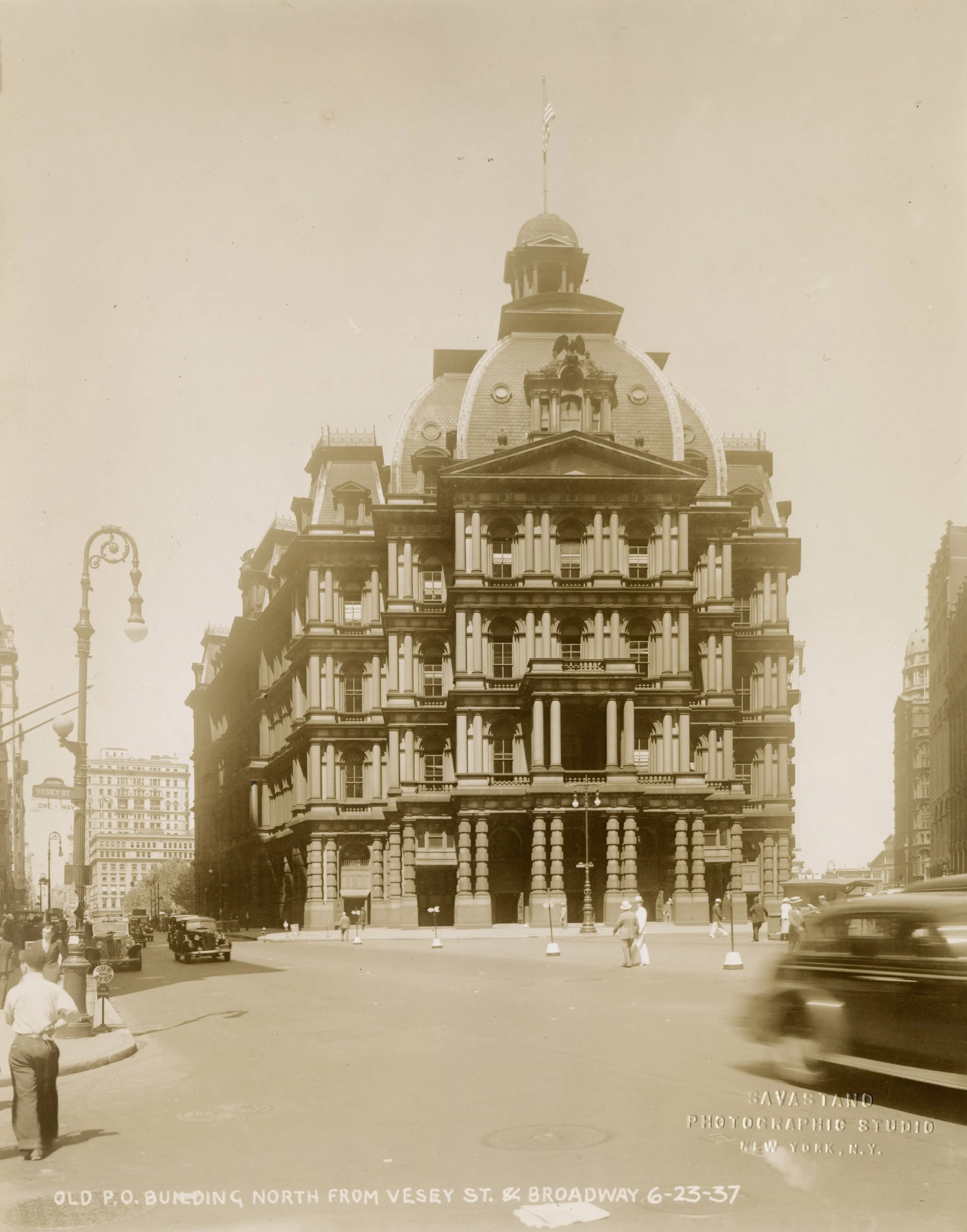
Old Post Office Building, North from Vesey Street and Broadway, June 23, 1937. Savastano Photographic Studio, Borough President Manhattan collection, NYC Municipal Archives.

Like many stories in twentieth-century New York City, Robert Moses, the legendary “Power Broker,” played a role. Among Moses’ notable attributes examined in several For the Record articles was his mastery of public relations. He issued press releases, contributed articles, and wrote “letters to the editor.” He especially liked to publish reports promoting his accomplishments. Literate, illustrated with striking graphics and ‘before-and-after' pictures and charts, commercially printed, and widely distributed, his numerous reports are well-represented in Municipal Archives and Library collections.

The 1941 report Construction and Restoration of Monuments, Memorials and Historic Buildings included an entry about the Grant National Memorial. Located in Manhattan’s Claremont Park on a high bluff overlooking the Hudson River, the Memorial, then called “Grant’s Tomb,” had been “the largest and most frequently visited monument in the United States with an attendance of approximately 1,000 people a day,” according to the report. Describing recent improvements to the Monument, the report concluded: “As a further embellishment of the approach to the building, two of the large granite eagles from the old Post Office building in City Hall Park were installed on new pedestals on the cheeks of the stairway.”  That seemed like a fun fact too good to ignore.

Old Post Office from Spruce Street, June 20, 1937. Savastano Photographic Studio, Borough President Manhattan collection, NYC Municipal Archives.

The New York Post Office - Views of the New Building, from sketches by Theo. R. Davis, Harper's Weekly, September 25, 1875

The New York Post Office - Views of the New Building, from sketches by Theo. R. Davis, Harper's Weekly, September 25, 1875

Would Municipal Archives and Library collections tell us more about how and why two granite eagles wound up guarding General Grant’s monument?  Well, maybe. But like many research expeditions, this journey went in an unanticipated direction.

“The Department of Parks of the City of New York Cordially Invites You to Attend the Ceremonies Incident to Commencement of Demolition of the Old Federal Post Office and Court Building in City Hall Park, 4 P.M. Monday, August 15th 1938.” Printed on heavy card stock, the invitation slipped out of a folder in Mayor Fiorello LaGuardia's subject files—one of six labeled “Post Office, Removal of, 1927-1944.” 

Invitation to Commencement of Demolition of the Old Federal Post Office, 1938. Mayor Fiorello LaGuardia collection, NYC Municipal Archives. 

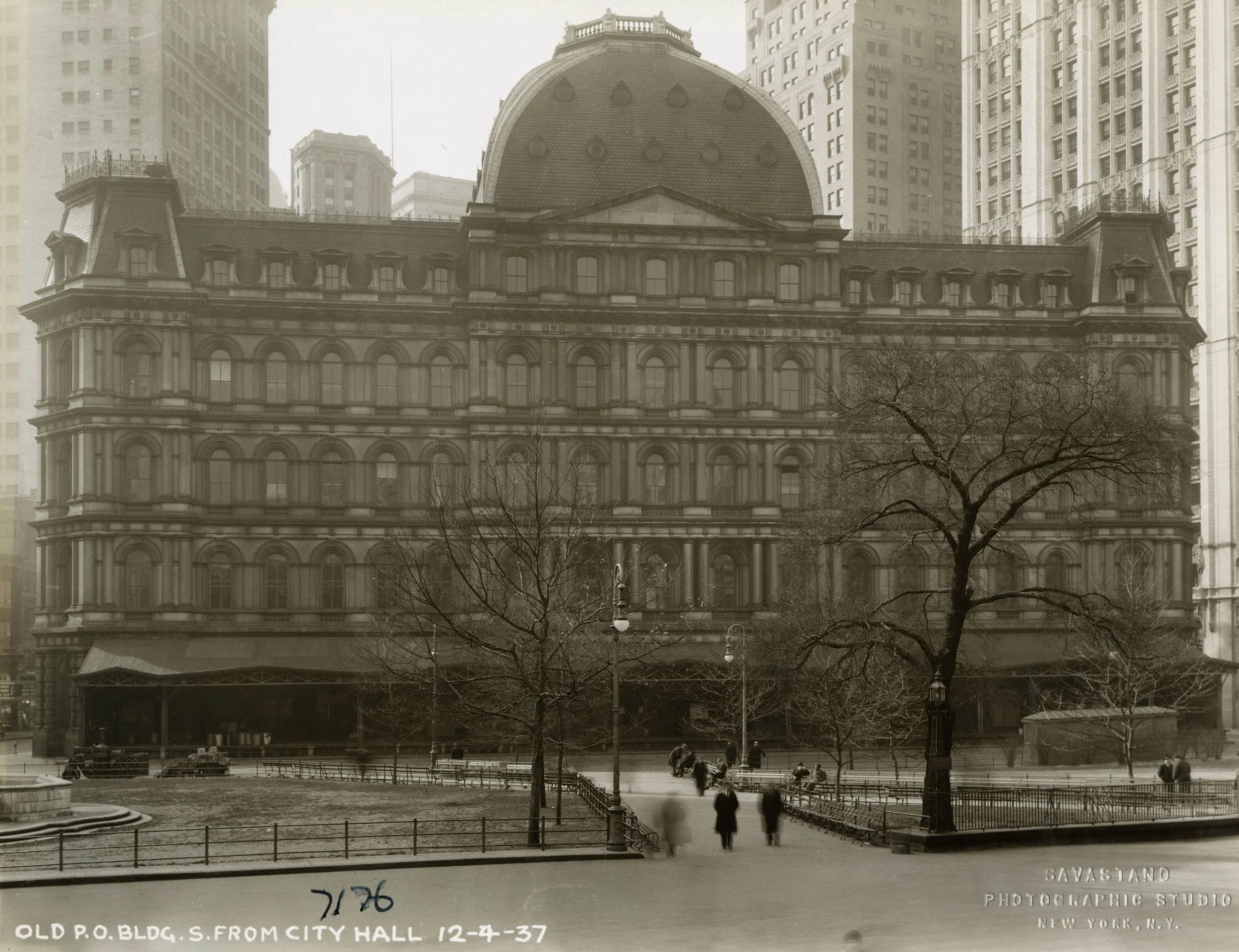
An invitation to a building demolition?  What building rated a “ceremony” upon its demise? Walking around City Hall Park today it seems impossible to believe that an enormous building once stood at the southernmost point. Designed in the Second Empire style by Alfred Muller, and constructed ca.1869-1870, it loomed over the relatively diminutive City Hall. Its massive scale is startling, even in photographs.

Old Post Office Building South from City Hall, December 4, 1937. Savastano Photographic Studio, Borough President Manhattan collection, NYC Municipal Archives.

Long considered an ‘eyesore,’ calls for its removal dated back decades as evidenced by records in Mayor LaGuardia’s collection. Indeed, the first folder contained letters addressed to his predecessor, Mayor James J. Walker. They referenced a Congressional Resolution from 1922 authorizing a Commission to investigate exchanging the site occupied by the Post Office in City Hall Park for another site or sites suitable for a new Post Office and Federal Court. The letters questioned the five-year delay in acting on the “exchange.” Other documents point to 1919 when a Board of Estimate “Committee on Court House” entered into negotiations with the Federal government to remove the Post Office and return its site to the City.

Parks Department, Plan for the Development of City Hall Park, n.d. Mayor Fiorello LaGuardia photograph collection, NYC Municipal Archives. 

The subsequent correspondence documents a saga spanning more than twenty years as the City and Federal governments conducted complex and protracted negotiations to replace the old Post Office. It even involved the intervention of President Roosevelt at several critical junctures.

Eventually, City and Federal officials worked out agreements for a new Federal Court building that opened in 1936 at Foley Square, and a new Post Office on Church Street that was completed in 1937.

When the Post Office moved to the new quarters in October 1937, negotiations regarding what to do with the old Post Office stalled. Among the issues to be worked-out was a $5 million payment the Federal government believed it was due for relinquishing the City Hall Park site. 

By December 1937, Mayor LaGuardia, having made no progress in negotiating with the Treasury Department, sent a telegram to President Roosevelt. “I am certain matter can be promptly settled rather than involving long tedious and unnecessary litigation. Stop. I will call any time to meet your convenience. December 14, 1937.”  

Aerial View, City Hall Park, n.d. Mayor Fiorello LaGuardia photograph collection, NYC Municipal Archives. 

The next day, Roosevelt replied in a letter marked ‘Personal.’ “Dear Fiorello: I have your telegram of December 14th before me. I gather from the same that the Secretary of the Treasury is out-trading you. If you insist on seeing “teacher” I wish to warn that “teacher” can be tougher than the Secretary of the Treasury.” Sincerely Yours, FDR.” He added a handwritten postscript: “Bring the $5,000,000 with you.”

It is not clear whether the meeting ever happened. But by mid-1938, with negotiations still proceeding apparently without conclusion, a compromise was proposed. LaGuardia described it at a special meeting of the Board of Estimate on May 20, where he requested approval of a “stipulation” between the City of New York and the United States government. The stipulation said the Federal government will dispose of the old Post Office building by sale; that the City may bid upon it; condition of sale being that the “purchaser will demolish the building.” LaGuardia added that this would not cancel impending litigation over the $5 million payment.

It took several months for the Federal authorities to conduct the sale; it happened on August 3, 1938. The City “won” the sale with a bid of one dollar. Then, finally, “Demolition Begun at Old Post Office” read The New York Times story on August 16, 1938, describing the event on the previous day. 

According to the article, Allyn R. Jennings, Superintendent of Parks, presided at the demolition ceremonies attended by 1,000 people. The news story quoted him as saying the city should have received change from the dollar paid for the building because the Federal Government “backed up a truck recently and took away every doorknob in the building.” One, retrieved, was mounted as a paperweight and presented to the Mayor.

Old Post Office Building North from South of Vesey Street, December 12, 1937. Savastano Photographic Studio, Borough President Manhattan collection, NYC Municipal Archives.

Not surprisingly, Robert Moses inserted himself into the proceedings at various times, eager to demolish the old Post Office in order to restore City Hall Park in time for the 1939 New York World’s Fair. Once the building was gone, he wasted no time in advocating for the demolition of the old ‘Tweed’ courthouse, located on the north side of the Park.

Request to serve as "honorary pallbearer," H. L Brant to Mayor LaGuardia, August 12, 1938. Mayor LaGuardia collection, NYC Municipal Archives.

An unexpected find in the files was a letter from George J. Miller, Director of the Historical Records Survey in N.Y.C. Dated October 1, 1937, and written on Works Progress Administration stationery, Mr. Miller informed the Mayor: “In our survey of the records of New York City, the conclusion is becoming more and more apparent that there is very little care or order taken with a large mass of New York records. We find them scattered in garages with broken windows through which the rain gives them a washing. In the Municipal Building we found a gallon can of turpentine upon its side gently gripping on records of Wills in 1686.”

Miller’s letter continues with a proposition: “A thought came to our attention that perhaps the Post Office Building could be utilized as an Archives Building to store all records. If the intention to raze the building is carried out, I feel that the problem of a City Archives Building will have to be solved some time in the future by erecting a new building.” Edmund L. Palmieri, Law Secretary, politely responded on behalf of the Mayor, explaining that “the pressure of budgetary matters and the necessity of carrying on a heavy assignment of routine duties” prevented LaGuardia from answering personally. Palmieri promised he would bring the Archives building idea to his attention. Perhaps it is for the best that LaGuardia did not act on this suggestion. 

United States Attorney General to Mayor LaGuardia, May 12, 1943. Mayor LaGuardia collection, NYC Municipal Archives.

The story continued even after the old Post Office came down. As noted by Mayor LaGuardia when explaining the ‘stipulation,’ demolition of the Post Office would not cancel litigation between the City and the Federal government. Based on documents in LaGuardia’s files, the dispute continued until at least 1943. On May 21, 1943, LaGuardia sent a check in the amount of $4,288,856.66 to the Office of the United State Attorney General as “payment on account of the judgment entered against the City of New York.” Further research will determine the ultimate conclusion of the matter.

And our two eagles now glaring at visitors to General Grant’s memorial?  Will we ever know anything more about their flight from City Hall Park to Claremont Park?  Stay tuned for the answer in a future For the Record post.

Notes from Eleanor

Defying archival practices, at some point the Department of Records and Information Services created a “Special Collection” which consists of historical City government records separated from a variety of other collections. Organized alphabetically, the trove is a hodge-podge of important documents including a 1728 petition to establish a Jewish burial ground, and a 1765 letter to restore peace from British General Thomas Gage.

This arrangement highlights the shortcomings of the Special Collection. Nothing is where it belongs! If processed and filed following normal archival practices, the letters would be in folders of correspondence related to the subjects, organized by year. This would make it possible for a researcher to trace the back and forth between letters received and responses sent.   

Photo illustration, This I Remember, by Eleanor Roosevelt, Harper & Brothers, 1949. Municipal Library

Within the Special Collection is a folder labeled Roosevelt, Eleanor. It contains correspondence written to and from Eleanor Roosevelt dating from 1924 to 1945. The 1924 letter is on stationery from the Women’s Division of the Democratic State Committee. The stationery lists a who’s who of prominent Democratic women including Miss Frances Perkins and Miss Lillian Wald. The letter is written by Eleanor Roosevelt to Mrs John F. Hylan, resident of St. Marks Avenue in Brooklyn, who was married to Mayor John Hylan. The letter introduced Mrs. Pounds who was setting up the Democratic Women’s Booth at an upcoming event. DORIS currently has an initiative to provide the actual names of women, not simply their married names. Today the metadata for the letter would include a reference to Marian O’Hara Hylan.   

Eleanor Roosevelt correspondence, Special Collection, NYC Municipal Archives.

An odd item in the folder is not correspondence—it’s a first day of issue envelope dated April 24 1972, honoring Fiorello LaGuardia. 

First Day Issue, Eleanor Roosevelt correspondence, Special Collection, NYC Municipal Archives.

All together, there are 44 pieces of correspondence; 39 are from Eleanor Roosevelt to Fiorello LaGuardia; three are from LaGuardia to Roosevelt, one is from Roosevelt’s secretary and one letter to Mrs. Hylan. Written on heavy 6” x 9” paper, the Roosevelt-LaGuardia notes date from April 9, 1935 to October 7, 1945. Most are typed on White House notepaper with a hand-written signature at the bottom. Some contain penciled notations with instructions from the Mayor. For example, the first note informs the Mayor that Eric Gugler, an architect who remodeled the West Wing of the White House also has a plan for a war memorial for Battery Park. Eleanor Roosevelt suggested that “it might interest you because of what could be done to improve that part of the city at a very small cost.” Scrawled at the top are the instructions from Mayor LaGuardia to staff: “ask Jonas Lie to look at this.”   

Eleanor Roosevelt correspondence, Special Collection, NYC Municipal Archives.

Who, you might ask, is Jonas Lie? Born in Norway, he moved to the United States in 1893 and trained at the Art Student League. An Impressionist landscape painter, he specialized in coastal scenes, New York City scenes and, famously at the time, a series of paintings depicting the construction of the Panama Canal. He was also a member of the Art Commission. Did Lie check out the exhibit and vet the architect?  We don’t know but we do know that the memorial to World War 1 soldiers was not built.

Many of Eleanor’s notes are banal, part of the give and take of government. They convey information about people looking for work, express gratitude for Birthday wishes, invite attendance at events. Most begin with the salutation, “My Dear Mr. Mayor:” One interesting missive was not written to the Mayor but to Mrs. LaGuardia (aka Marie Fisher LaGuardia) and signed not by Eleanor but by her secretary, Edith Helm, aka Mrs. James M. Helm. The letter expressed concern that an earlier note inviting the couple to stay overnight at the White House went astray and reiterated the offer of a sleepover.  Did that actually occur?  

Eleanor Roosevelt correspondence, Special Collection, NYC Municipal Archives.

A duo of notes inviting the LaGuardia family for lunch and a little party and then responding back to the Mayor, expressing understanding that the children’s bed time schedule would dictate how late they could stay at Hyde Park.

Eleanor Roosevelt correspondence, Special Collection, NYC Municipal Archives.

Eleanor Roosevelt correspondence, Special Collection, NYC Municipal Archives.

Photo illustration, This I Remember, by Eleanor Roosevelt, Harper & Brothers, 1949. Municipal Library.

Some are oblique: “I am enclosing a letter which has come to me and would appreciate it if you could look into the matter.”  We likely will never know the matter that aroused Eleanor Roosevelt’s interest on July 16, 1940. 

One note from August, 1940 generates curiosity.  “I am very anxious to have a talk with you and Mr. Flynn tells me that we had better talk in some quiet place,” it begins.  One presumes the reference is to Boss of the Bronx Edward Flynn, a strong supporter of President Roosevelt and, in 1940, the national chair of the Democratic Party.  The note continues, suggesting a visit that would require the Mayor to “climb three flights of stairs to have tea with me at my apartment, 20 East 11th Street (Miss Thompson’s name is on the bell…”  It was clearly urgent because Eleanor Roosevelt offered an alternative date when she would be back in town.  A handwritten date at the bottom, written by someone at City Hall, states “Sept 4 –“  So, presumably, the conversation happened.  

Eleanor Roosevelt correspondence, Special Collection, NYC Municipal Archives.

In August, 1941, Eleanor Roosevelt became an Assistant Director in the Office of Civil Defense, based in Washington. A September 1941 note to LaGuardia explained her approach to familiarizing herself with the organization and stated her intention, with LaGuardia’s permission, to visit the offices on Monday.

Her tenure at Civil Defense was short. Due to criticism of the President’s wife holding a position in government, she resigned in February, 1942.

One exchange of correspondence in August 1943 clearly concerns racial unrest in the City. Early that month, a white police officer shot a black soldier in Harlem.  Rumors that the soldier had been killed lit the fuse on simmering tensions over price gouging, lack of economic opportunity, discrimination and police brutality. Over two days, six black people were killed, more than 500 injured, thousands arrested and millions in property damage. Eleanor Roosevelt weighed in with a much longer note than any of the others.  Referencing her conversations with black residents of the City, she suggested hiring more black police officers, finding more summer employment for young people and expanding supervised play for the youngest residents. Further, she reported there was “a feeling that white policemen are unnecessarily harsh to young colored people.” 

This letter struck a chord. Famously pugnacious, Mayor LaGuardia responded with two single-spaced, double-sided missives in defense of the City’s efforts, dated only a day apart. Citing “lies, lies, lies and more lies concerning the situation” LaGuardia wrote that despite recruitment efforts the number of black police officers on the force had only increased by twenty since 1933 only twenty new  black police officers joined the force between 1933 and 1943. 

Eleanor Roosevelt correspondence, Special Collection, NYC Municipal Archives.

The final note in the folder dated October 7, 1945 does not use White House note paper but instead is from a New York City address on Washington Square. Written in response to LaGuardia’s request, it enclosed a pass for a Senator Farley to visit the Hyde Park grave of former President Franklin D. Roosevelt who had died on April 12, 1945 and instructed that further requests be sent to the Department of the Interior.  

Eleanor Roosevelt correspondence, Special Collection, NYC Municipal Archives.

Manhattan Building Plans – Project Update

In 2018, with support from the New York State Library Conservation/Preservation Program, the Municipal Archives commenced a project to preserve and re-house approximately 100,000 architectural drawings and reproductions of buildings in lower Manhattan. Dating from 1866 through the 1970s, the plans comprise sections, elevations, floor plans, and details, as well as engineering and structural diagrams of buildings on 958 blocks in Manhattan from the Battery to 34th Street.  

In the first year, project archivists cataloged and re-housed 11,882 plans for 977 buildings in the Tribeca and SoHo neighborhoods. With continued State Library support in 2021/22, the Archives preserved more than 18,000 plans for buildings in the Greenwich Village neighborhood. 

For the Record has described project progress in several articles. Re-discovering the Old Pennsylvania Station highlighted original plans of the iconic building found in the collection. The Curious Case of the Lighting of the Williamsburg Bridge told the story of an experiment to power lighting for school buildings via a trash incinerator. Stables and Auction Marts: Building Plans with Horses detailed the significance of horses in 19th and early 20th century New York City. And Loew's Canal Street Theater featured the plans for the ornate Loew’s Theater on Canal Street.

26 Ridge Street, ca. 1940. 1940s Tax Photograph Collection, NYC Municipal Archives.

Project archivists recently completed preservation and re-housing 11,350 plans for buildings in the Lower East Side and East Village with support from the State Library.  This week, For the Record explores some of the interesting “finds” identified over the course of the project.

The Lower East Side and East Village have long been recognized as iconic neighborhoods to which millions of Americans can trace their roots. Their streetscapes have served as a backdrop for countless books, films and stories that chronicle the experience of generations of newcomers to the United States from around the world.

Plans preserved over the course of the project illustrate how these communities developed with examples of buildings of all types necessary for a thriving neighborhood. They include every style of residential building—from simple “tenements,” and more modern apartment buildings, to elegant single-family townhouses. Plans of retail establishments, banks, hotels, houses of worship, entertainment venues, bathhouses, factories, warehouses, boardinghouses, stables, garages—are also evident in abundance.

The Department of Buildings practice of requiring plans to be filed when issuing permits to build new buildings or to alter existing structures began in the late 1880s. This coincided with a period of intense immigration to the United States by Eastern European Jews who settled in the Lower East Side neighborhood; consequently, the collection is particularly rich in drawings reflecting those immigrant communities. 


Religious institutions: 

242 East 7th Street, cross section. Gross & Kleinberger, architects. Department of Buildings Collection, NYC Municipal Archives.

242 East 7th Street, auditorium and balcony plans. Gross & Kleinberger, architects. Department of Buildings Collection, NYC Municipal Archives.

242 East 7th Street, ca. 1940. 1940s Tax Photograph Collection, NYC Municipal Archives.

Block 376 Lot 13 

Congregation Beth Hamedrash Hagadol Anshe Ungarin (Great House of Study of the People of Hungary), designed by the firm of Gross & Kleinberger, this synagogue was built in 1908 at 242 East 7th Street, after the congregation had grown too large for its previous site. The second image shows seating in the auditorium and balcony. 

172 Norfolk Street, plan for Russian and Turkish baths. Department of Buildings Collection, NYC Municipal Archives.

Block 355 Lot 4 

Hand-drawn plan for another Hungarian synagogue located at 172 Norfolk Street; this alteration drawing from 1893 shows the building had Turkish and Russian baths, and dressing rooms on the lower floors. 

26 Ridge Street. front elevation. Frederick Ebeling, architect. Department of Buildings Collection, NYC Municipal Archives.

Block 341 Lot 38   

A synagogue built in 1906, architect Frederick Ebeling, owned by Congregation Thebat Achim, and located at 26 Ridge Street; the front elevation plan shows an onion dome and a Star of David lunette.  


Housing: 

58-62 Hester Street, Longitudinal Section, Tenement House for Cortlandt Bishop, Esq. Ernest Flagg, architect. Department of Buildings Collection, NYC Municipal Archives.

58-62 Hester Street, Ground Floor, Tenemant House for Cortlandt Bishop, Esq. Ernest Flagg, architect. Department of Buildings Collection, NYC Municipal Archives.

Block 298 Lot 15  

1901 new build drawings for a “Model Tenement” by architect Ernest Flagg, located at 58-62 Hester Street; a longitudinal drawing featuring the building’s central staircase and a detail of the ground floor showing that although each apartment had its own “W.C,” showers and baths were shared spaces. 

128 Broome Street, elevation. Michael Bernstein, architect. Department of Buildings Collection, NYC Municipal Archives. Some of the architectural flourishes were never built or were gone by the 1940s.

128 Broome Street, ca. 1940. 1940s Tax Photograph Collection, NYC Municipal Archives.

Block 337, Lot 1 

An apartment building at 128 Broome Street at the corner with Pitt Street; built in 1899 by architect Michael Bernstein, the façade has lovely detail work. 

88 Ridge Street, Front Elevation, East Side of Ridge Street. Charles B. Meyers, architect. Department of Buildings Collection, NYC Municipal Archives.

Block 343 Lot 43 

80-82, 84-86, 88 Ridge Street; three adjacent 6-story brick tenements with stores on the ground floors and a shared tin roof and façade; built in 1892, architect Charles B. Meyers.

Architects Bernstein and Meyers are ubiquitous names in the Buildings Plans Collection, as they were prolific during the tenement housing boom.


Services and businesses: 

New Closet Building at Grammar School No. 4, 203 Rivington Street, 1894. Department of Buildings Collection, NYC Municipal Archives.

Block 343 Lot 50 

“New Closet Building” for Grammar School No. 4 from 1894, located at 203 Rivington Street. The drawing shows the old water closet facilities on the left and the much larger expansion facility, in the center a necessary alteration to keep up with the burgeoning population. Also notable are the separate “yards” for girls and boys. 

101 Broome Street, coal bunker. Department of Buildings Collection, NYC Municipal Archives.

Block 336 Lot 43 

More people meant a greater need for fuel. This is an interesting drawing of the interior of a concrete coal bunker featuring track and hopper; located at 101 Broome Street, built in 1907. 

Bank of Max Kobre, elevation. Benjamin W. Levitan, architect. Department of Buildings Collection, NYC Municipal Archives.

41 Canal Street, ca. 1940. 1940s Tax Photograph Collection, NYC Municipal Archives.

Block 298 Lot 33 

The Bank of Max Kobre, built in 1911, located at 41 Canal Street, was one of many privately owned “immigrant” banks that held deposits, made loans, and brokered steamship tickets to the community. The 1940 Tax Photograph shows it had become a funeral home, the Zion Memorial Chapel.

81-81 ½ Bowery, elevation. Samuel Sass, architect. Department of Buildings Collection, NYC Municipal Archives.

81-81 ½ Bowery, interior balcony and staircase. Samuel Sass, architect. Department of Buildings Collection, NYC Municipal Archives.

Block 303 Lot 9 

Delicate 1909 alteration plans by architect Samuel Sass, showing signage and interior staircase for Shulman’s Clothing Store located at 81-81 ½ Bowery. 

Department of Buildings Collection, NYC Municipal Archives.

Williamsburg Bridge, view showing fish market, south entrance [Delancey] and Pitt Street. February 20, 1925. Photograph by Eugene de Salignac, Department of Bridges/Plant & Structures collection, NYC Municipal Archives.

 Block 337 Lot 9 

1924 plan showing signage and zinc-lined wood tank for the Wenig Live Fish Company, located at 36 Pitt Street. A building that was photographed by Eugene de Salignac in 1925.

19 Ludlow Street, plan for a “Rockwell Matzoth Oven.” Max Muller Architect. Department of Buildings Collection, NYC Municipal Archives.

Block 298 Lot 24 

Colorful drawing for a “Rockwell Matzoth Oven” to be installed at 19 Ludlow Street in 1923; architect Max Muller’s name is seen on many plans for buildings on the Lower East Side.

Welcoming Home American Olympic Champions in 1924

Today, July 26, 2024, the opening ceremony for the 2024 Summer Olympic Games will take place in Paris, France, one hundred years after the “City of Light” first hosted Summer Olympic games.

Scrapbook clipping from the New York American, August 7, 1924. Mayor Hylan collection, NYC Municipal Archives.

On August 6, ten days after the 1924 games concluded, New York City welcomed home more than two hundred American athletes with a ticker-tape parade along Broadway and a ceremonial dinner at the Hotel Astor.  

This week, For the Record turns to Mayor John Hylan’s newspaper clipping scrapbooks and City Greeter Grover Whalen’s records to tell the story of New York’s celebration for the returning Olympians. 

Whalen had perfected the art of staging a ticker-tape parade during his five years leading the Mayor’s Committee for Receptions to Distinguished Guests. Whalen’s files typically contain minutes of planning meetings and lists of invitees for the event. For the 1924 Olympics parade and dinner, the folder includes a “Memorandum” from the President of the Board of Aldermen urging Whalen to extend invitations to the mayors of two dozen other big American cities to “…show that there is no disposition on the part of New York City to ‘hog’ it all.” Whalen apparently accepted their advice. The file includes a transcript of a telegram Whalen sent to mayors of Boston, Detroit, Chicago, Los Angeles and other cities, inviting them to attend a meeting to plan “… an entertainment for the returning victorious American Olympic Team.”   

Menu from Olympic Reception. Grover Whalen collection, NYC Municipal Archives.

Menu from Olympic Reception. Grover Whalen collection, NYC Municipal Archives.

Mayor Hylan’s newspaper clipping scrapbook documents the big day. Apparently, it did not get off to a good start. The New York World-Telegram newspaper headline for August 7, read “Olympic Athletes Welcomed Home by a Broiling City.” The article related how fog in the harbor delayed arrival of the ship returning the athletes from Europe. Then, the article continued, “bunglesome” customs formalities further delayed the athletes. Eventually, however, 5,000 people gathered at Battery Park and “braved the burning sun” to see the parade that finally got underway around 5 p.m.. At City Hall, Mayor Hylan shook hands with each of the athletes and gave them gold medals expressing the gratitude of New York City for their showing in Paris. Dignitaries made speeches over the then-new municipal radio station WNYC, and the day concluded with “a beefsteak supper” at the Hotel Astor.

Telegram from Grover Whalen to Andrew Mellon, Secretary of the Treasury, regarding the returning Olympians, July 21, 1924. Grover Whalen collection, NYC Municipal Archives.

Previous For the Record articles have discussed how the mayoral scrapbooks are a useful resource. The mayor’s staff clipped stories from all of the local newspapers—more than a dozen in the 1920s. Although back issues of a few papers, e.g. The New York Times are now available online in digital format, most are not.

The clippings also have value because they provide context and reveal information about contemporaneous events relevant to the research subject. We Shall All Be There: Dedicating Shea Stadium described how researching in Mayor Wagner scrapbooks for stories about Shea Stadium, led to discovery of articles about a “stall-in” planned by the Congress of Racial Equality to disrupt the opening day of the 1964/65 New York World’s Fair. According to the stories, hundreds of drivers would travel on the highways leading to the fairgrounds and deliberately stall-out their automobiles to cause massive traffic jams.

Scrapbook clipping from the Brooklyn Eagle, August 3, 1924. Mayor Hylan collection, NYC Municipal Archives.

Researchers investigating the Olympic athlete celebration in Mayor Hylan’s scrapbooks will find that the bigger story of the day was Grover Whalen’s resignation from his post as Commissioner of the Department of Plant and Structures. In his letter of resignation, effective July 1, 1924, Whalen explained that his decision was “based on personal and family considerations,” specifically, the expenses of educating his growing family. He also expressed concern that he would not be able to devote sufficient attention to Hylan’s plans for new subway construction.  

Whalen released a copy of his resignation letter to the press and several articles speculated about the “real cause,” of his departure from city government. The Eagle newspaper suggested that Whalen’s action may have been “a brilliant move for a possible candidate for Mayor.” Other reports cited Hylan’s decision to remove responsibility for city ferries and trackless trolleys from Whalen’s portfolio.

Whalen did not resign from his role with the Mayor’s Reception Committee, and he ably welcomed home the returning Olympians. Swimmer Johnny Weissmuller was among the victorious athletes. He won three gold medals for swimming as well as a bronze medal as a member of the water polo team. Weissmuller later made his way to Hollywood and became famous playing Tarzan of the Apes in several movies. Helen Wills won gold medals in the singles and doubles tennis events and gold-medal rower Benjamin Spock later achieved renown as a pediatrician and author.

In another film-related connection, the 1924 Paris Games themselves became immortalized in Chariots of Fire, the 1981 Oscar-winning film about British runners Eric Liddell and Harold Abrahams.

It remains to be seen how the American team fares in the 2024 Olympic Games but For the Record readers will certainly cheer them on.

“A True and Perfect Inventory” - The Municipal Archives Collection of 18th and 19th-century Estate Records, Part Two

Last week, For the Record reviewed Estate Inventories and demonstrated how documents in the collection offer unique insights into Manhattan life from the era of George Washington’s presidency through the runup to the Civil War. Remarkably rich with detail, these records simultaneously remind us of how different—and yet how familiar—New York City life was, 200 years ago. 

This week, For the Record continues the analysis of the collection focusing on three themes: Enslaved people in New York City, Tools of the trade: artisans and shopkeepers, and Booksellers and personal libraries


Enslaved people in New York City 

Ownership of human beings was not outlawed in New York State until 1827. The estate files therefore cover several decades when the practice was still legal. References to enslaved persons can be found in some of the estates. For example, consider the short asset list of Samuel Clews who died in 1808 and who owned a boarding house and livery stable on Water Street. His estate included a “Negro Man Slave,” whose appraised $100 value was greater than the combined value of all of Mr. Clews’ other possessions. The appraisers saw fit to note that Samuel Clews also owned a female slave who “ran away 14 Months ago.”  

Estate assets of Samuel Clews, 1808. Estate Inventories. NYC Municipal Archives.

Similarly, Samuel Kips of the Kips Bay family left a modest collection of household furniture, tableware, and “6 old books” whose combined value came to barely $350 at his death in 1804. But he also listed three “negro girls” whose appraised value was $492. 

Estate assets of Samuel Kip, 1804, page 1 of 2. Estate Inventories, NYC Municipal Archives.

Estate assets of Samuel Kip, 1804, page 1 of 2. Estate Inventories, NYC Municipal Archives.

A different story emerges from the estate of James Arden, a wealthy merchant whose estate inventory is notable for the methodical and detailed picture it paints of his home at 12 Greenwich Street. Arden’s appraisers worked floor-by-floor and room-by-room, allowing us to reconstruct how his residence was organized and appointed. The appraisers even distinguished between what was in his desk (silver knee buckles and certificates for bank shares) and what was on the desk (“ink stand paper quills & pencils”). James Arden’s estate file says nothing about enslaved people, although it lists the modest contents of a “Garret & Servants Bed Room:” 

Estate assets of James Arden, 1822. Estate inventories, NYC Municipal Archives.

More of the story emerges from Arden’s actual will, which is not part of the estates collection at the Municipal Archives. [The James Arden will record is accessible via Ancestry.com, New York, U.S., Wills and Probate Records, 1659-1999.] His will manumits “my two female slaves Nancy and Nan” as well as Nan’s son Frank. Arden may have had in mind something other than a guilty conscience or even benevolence, however—his will goes on to say that these manumissions were to be conducted “according to law so as to discharge my estate from all future responsibility on their account.” James Arden’s story shows the ways in which the estate lists may be combined with other sources to reconstruct life in old New York.  


Tools of the trade: artisans and shopkeepers 

As the United States developed its own workshops and factories and weaned itself from dependence on imported goods from Europe, how were these establishments stocked? What tools, equipment, and finished products might be encountered upon entering a cabinetmaker’s shop, or that of a cooper, a printer, or a weaver? New York became America’s largest city in 1790, and it manufactured a remarkable variety of products. One example of a workshop’s contents is found in the 1821 estate of Christopher Corley, a gunsmith on Water Street. 

Estate assets, Christopher Corley, 1821. Estate Inventories, NYC Municipal Archives.

Corley’s assets included a wide and formidable array of weapons, as well as the accoutrements needed to deploy them. Some of Christopher Corley’s weaponry from his estate inventory include manufacturing equipment such as “Two sets of gun smith tools,” anvils and bellows, a “lathe and apparatus,” vises, and emery. The large number of gun stocks (800!) and the presence of cannonades (a short cannon used at close-range) suggests that Morley’s customers may have included the military. 

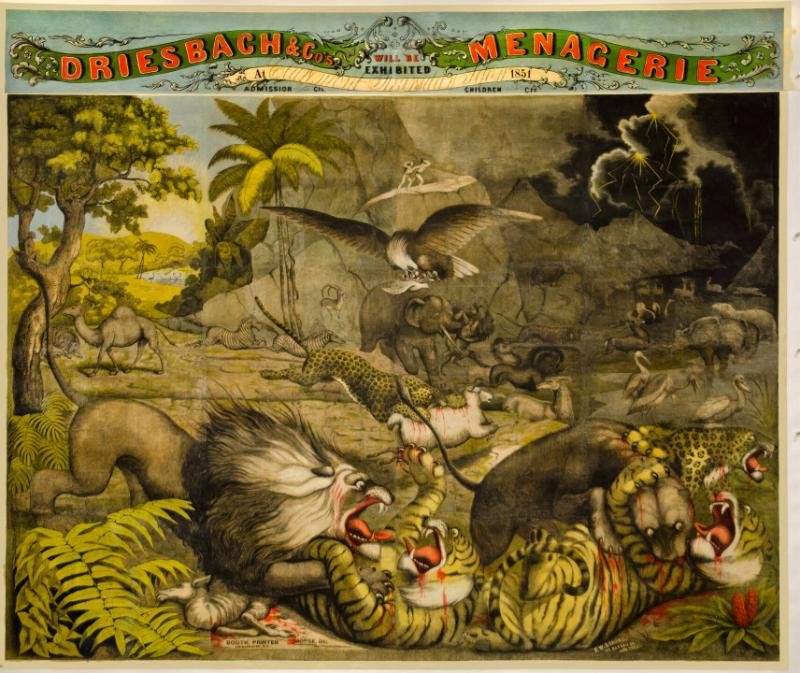
The printer Jonas Booth’s 1850 estate inventory offers a window into developments of interest to historians of information technology as well as historians of advertising, and even of the circus! Booth was an Englishman from Manchester, which has been called “the first industrialized city.” Booth learned the printing trade and arrived in America in 1822 with knowledge not merely of how to print, but how to design and even manufacture every component of the printing process, from making ink to designing and building the printing press itself. His business at 147 Fulton Street became known for Booth’s ability to print jobs fast (he built the first steam-powered printing press in America) and large. One of Booth’s specialties were enormous color posters, used especially to advertise traveling circuses. His estate inventory includes a Napier Printing Press, complete with steam engine, as well as large quantities of colored printing ink and a Harris paint mill that ground color ingredients for mixing up inks. Circus posters, some of which measured ten feet on a side, exemplify ephemera and examples from Booth’s shop are extremely rare and prized as works of art. 

Estate assets, Jonas Booth, 1850, 1 of 2. Estate Inventories, NYC Municipal Archives.

Estate assets, Jonas Booth, 1850,2 of 2. Estate Inventories, NYC Municipal Archives.

Driesbach & Co. Menagerie, published by Thomas W. Strong, 1851. Courtesy the Ringling Museum. Jonas Booth’s estate inventory lists materials and equipment for printing such extraordinary items as this 9x10 foot circus poster, now preserved at the Ringling Circus Museum. This poster is one of the earliest large-scale pictorial posters still in existence. The four-color print depicts Adam and Eve’s expulsion from Paradise and includes the names of the three printing pioneers who created it: printer Jonas Booth, engraver Joseph Morse, and engraver and publisher T.W. Strong.

Rope, twine, string: cordage was a big part of 18th and 19th century life. A large sailing ship could be rigged with up to 40 miles of rope of various sizes. Maps of Manhattan showed surprising numbers of ropewalks, where pre-industrial technology created all types of cordage by having men walk and twist fiber. The few surviving ropewalks document the equipment and supplies working ropemakers required 200 years ago. The 1848 estate of Samuel Abbott offers a scholar of industrial technology a wealth of detail, with an arcane set of specialized terms: crown wheel, side wheel, Jenny wheel.

Estate assets, Samuel Abbott, 1848, 1 of 2. Estate Inventories, NYC Municipal Archives 

Estate assets, Samuel Abbott, 1848, 2 of 2. Estate Inventories, NYC Municipal Archives. 


Booksellers and personal libraries 

Portrait of Richard Harison, 1929. Painting by Albert Rosenthal, copy after Unidentified Artist. Columbia University. From a Catalog of American Portraits, National Portrait Gallery, Smithsonian Institution.

The estate files contain numerous lists of books. Some were impressive personal libraries containing both literature and professional titles, such as law books or medical treatises. An example was the collection of Richard Harison (1747-1829), one-time law partner of Alexander Hamilton, whose obituary called him “the patriarch of the New-York Bar; a man of great legal acquirements, and much general erudition.”

Harison’s estate included a remarkably large library consisting of 1,200 titles, most of which were sets ranging from two to 25 or more separate volumes. His library therefore had perhaps 3,000 to 5,000 bound books! Most were kept at his “country seat,” which was a mansion on property stretching all the way from 8th to 9th Avenues and from West 30th to 31st Street! Harison’s library was astounding in its range and sophistication, supporting his reputation of having “much general erudition”—unsurprisingly it included Shakespeare, Cervantes, Milton and the 20 volume Encyclopedia Britannica but also Isaac Newton on physics, Samuel Johnson’s seminal Dictionary, and such obscurities as a two-volume poem entitled Botanic Garden written by Charles Darwin’s grandfather and Jean Baptiste Bellegarde’s long-forgotten Reflexions Upon Ridicule. Harison still found time to be the first United States Attorney for New York, a state assemblyman, and Alexander Hamilton’s law partner. 

Estate assets, Samuel Bartlett, 1822. Estate Inventories, NYC Municipal Archives.

Another fascinating book list is that of Samuel Bartlett, who operated a combined bookshop, publishing house, and circulating library at 78 Bowery until his death in 1822, after which his brother Caleb took over the business. 

A portion of Samuel Bartlett’s estate inventory, listing items from his shop that included books, plates for printing, sets of chessmen, and old songs valued at ½ cent each, more than 5,000 quills, and pinions—mechanical pieces used in hand-operated printing presses. Try finding a shop selling that combination today! 

Advertisement for Mrs. Bower’s Corset Establishment and Circulating Library (Evening Post, 1824 November 13) 

In the 18th and early 19th centuries there were no public libraries in New York, and few private libraries—The New York Society Library, founded in 1754, is a rare surviving example. However, small “circulating libraries” were not uncommon, offering subscribing members borrowing privileges. An idea of the cost to join a circulating library can be found in a startling ad for a combined “Corset Establishment and Circulating Library” operated on Maiden Lane by Mrs. Bower in 1824: $5 per year. Nonsubscribers could borrow individual volumes for 6 or 12½ cents, depending on their size.

The contents of Samuel Bartlett’s bookshop and library at his death in 1822 is in his estate file. Bartlett’s lending library of 1,384 volumes was described as “nearly all old books…mostly novels, plays, romances and similar works of little value,” and was valued altogether at just $200. However, three densely packed pages are devoted to books for sale. The list is particularly valuable because it indicates the number of copies of each work that were in inventory, giving us an idea of how many of each book Mr. Bartlett thought he could sell.

Many of the books represented by dozens or even hundreds of copies were evidently for student use, such as 485 copies of “Key to Dilworth.”  This was A Key to Dilworth’s Arithmetic, written by an anonymous “Teacher of Arithmetic” and intended to serve as a companion volume to the widely used arithmetic textbook by Thomas Dilworth. Twenty-two copies of American Cookery, followed by 387 copies of Dream Books represents an interesting juxtaposition in Samuel Bartlett’s estate inventory. 

American Cookery, widely considered to be the first fully American cookbook, was published in 1796. Samuel Bartlett had 22 copies in his shop in 1822.

Dream Books purported to associate dream imagery with specific numbers. Bartlett had over 1200 in stock.

American Cookery, widely considered to be the first fully American cookbook, was published in 1796. Its author, Amelia Simmons, is credited with being the first cookbook author to pair turkey with cranberry sauce, and to use the Dutch term cookey for little baked desserts. Samuel Bartlett kept almost two dozen copies in his shop. 

What about 387 copies of the next entry in Bartlett’s inventory, for “Dream Books”—plus more than 900 additional copies listed on another page? Did large numbers of pre-Freudian New Yorkers record or otherwise analyze their dreams? Hardly—Dream Books were cheap publications that purported to associate dream imagery with specific numbers, which in turn could be wagered on in popular but illegal Policy games. Samuel Bartlett appears to have had a thriving business selling Dream Books.  

Let’s close with a look at an unexpected record to emerge from the Municipal Archives’ estate inventories: a description of the elements of a funeral service in 1826! Elias Baldwin died in a voyage to Curacao in November 1825, and his body was returned to the New York area for burial. Unusually, his estate appraisers elected to list in considerable detail the costs associated with his funeral rather than confining themselves to his assets at death. Many of the items are self-evident (“the sailors who assisted on board the ship inlaying Mr. Baldwin out”); others less so (12 cents for “pyrogenous acid,” also known as wood acid. It has antimicrobial properties and may have been used to help preserve the corpse). There were clerks and coffin attendants and a hearse driver, and even—as in mythology—$8 to pay the ferryman to bring the deceased to New Jersey. 

Estate assets, Elias Baldwin, 1826, 1 of 2. Estate Inventories, NYC Municipal Archives.

Estate assets, Elias Baldwin, 1826, 2 of 2. Estate Inventories, NYC Municipal Archives.

In contrast to the detail lavished on Elias Baldwin’s funeral, the rest of his appraised estate listed only a handful of assets—but one stands out for its brush with history: an “uncertain” amount due from “Col Aaron Burr, for services rendered by deceased in his life time.” 

Readers are welcome to explore the updated collection inventory in the Collection Guide.