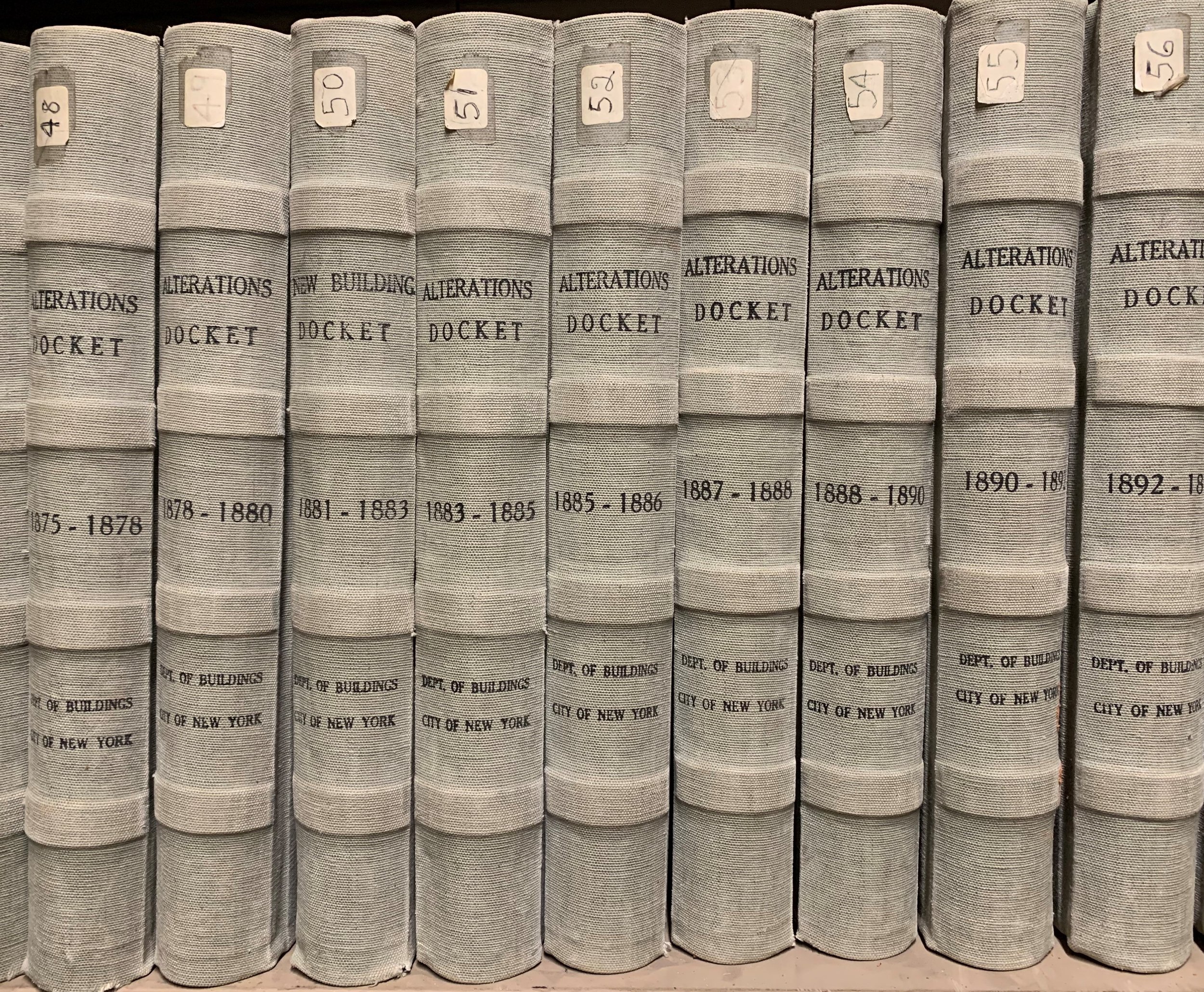
For the researcher investigating the built environment of New York City, material contained within the Municipal Archives is a gold mine. Recent blogs have described three of these resources, the Assessed Valuation Real Estate Ledgers, the Manhattan Department of Buildings docket books, and the Manhattan building plan collection, part 1, and part 2.
This week’s subject is another series from the Department of Buildings Record Group (025)—the application permit folders, a.k.a. the block and lot folders. The series is a subset of the Department of Buildings Manhattan Building Plan Collection, 1866-1977 (REC 074).
Totaling approximately 1,230 cubic feet, the permit folders provide essential and detailed construction and alteration information for almost every building in lower Manhattan from the Battery to 34th Street. In addition, a wide range of historical subjects can be explored using these records including the effect of planning, zoning and technology on building design, the role of real estate development as a gauge of national economic trends, and the evolution of architectural practice, particularly during the period of professionalization in the latter part of the 19th century.
Established in 1862, the Department of Buildings (DOB) “had full power, in passing upon any question relative to the mode, manner of construction or materials to be used in the erection, alteration or repair of any building in the City of New York.” All DOB personnel were required to be architects, masons, or house carpenters. Then, beginning in 1866, New York City law required that an application, including plans, be submitted to the DOB for approval before a building could be constructed or altered.
The provenance of the collection in the Municipal Archives dates to the 1970s when the DOB began microfilming the application files and plans as a space-saving measure. They intended to dispose of the original materials after microfilming. The project began with records of buildings in lower Manhattan, proceeding northward to approximately 34th Street when it was discovered that the microfilm copies were illegible. The DOB abandoned the project and the original records were transferred to the Municipal Archives for permanent preservation and access.