A recent For the Record blog received a good deal of attention and triggered a recalculation of the number of New York City mayors. Was it 111 or 112? Eventually, including all of the New York mayors from colonial times to the present, the conclusion was that the current mayor, Zohran Kwame Mamdani, is mayor number 112.
New York’s first government, authorized by the Dutch West India company and established in 1653, consisted of a sheriff, two burgomasters (who had duties similar to mayors) and five legislators as described in this blog post.
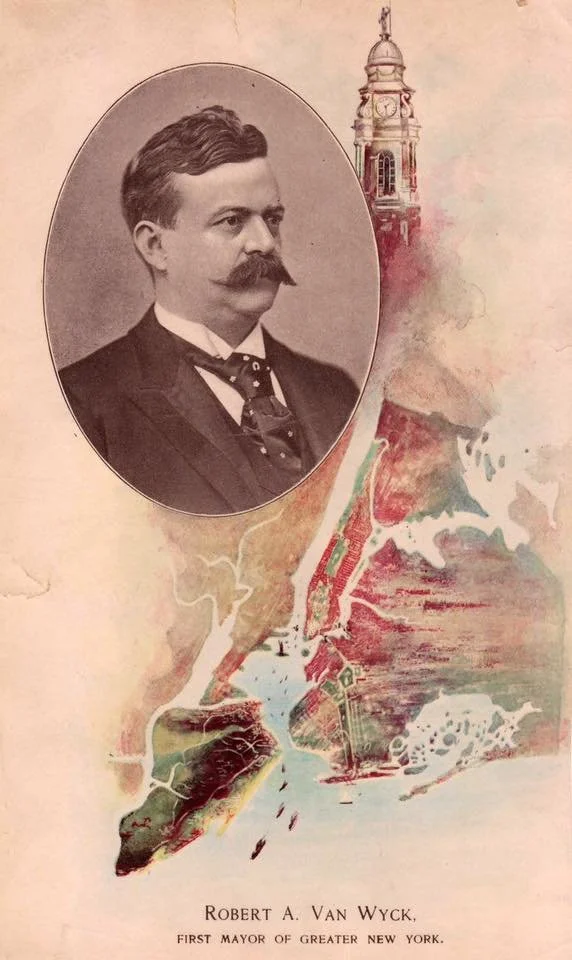
Robert Van Wyck, First Mayor of Greater New York.
From that auspicious beginning, subsequent English charters issued in 1655, 1686, 1708 and 1730 “all provided for an appointed mayor,” according to a 1929 article written by Rebecca Rankin, the City’s principal librarian. By 1775, the mayor was appointed by the Royal Governor, who in turn, was appointed by the King of England. Mayoral duties included Water Bailiff, Clerk of the Markets, and Justice of the Peace, as reported in the 1976 Green Book.
The majority—92 of the 112 mayors—presided over a smallish island, sometimes called Manhattan or New York. In the late 1800s, New York County annexed a large portion of what is now Bronx County including the towns of Morrisania and Kingsbridge. It became the last county in the State in 1914. The mayoral count does not include mayors of the City of Brooklyn or Long Island City… just those from Manhattan. Between 1834 and 1898 the City of Brooklyn had 27 mayors. Seth Low, Mayor of the City of Brooklyn from 1882-1885, went on to become the second elected mayor of the Greater City of New York. Williamsburg received city status in 1851 only to be annexed by the City of Brooklyn in 1854, along with Bushwick. The New York mayors held no sway over Staten Island, Brooklyn, Queens and the many towns and cities located in those counties.
The title page for the 27th Annual Report of the Department of Parks of the City of Brooklyn, shows the changes in governance that occurred between 1897 and 1898. NYC Municipal Library.
On January 1, 1898, the City of New York was transformed, becoming the largest city in the country—second largest in the world, behind London. Government and civic leaders had discussed and debated combining the cities of New York and Brooklyn for approximately 20 years prior to consolidation. Andrew Haskell Green, a storied civic leader whose ventures included creating the New York Public Library and Central Park, is largely credited with the notion of combining the four counties, the annexed Bronx territory and the many small municipalities into one entity.
Green conceived of one great metropolis—a city that had uniform regulations instead of the inconsistent and conflicting rules that made the multiple governments inefficient. Opponents to the scheme expressed concern about taxes—would Brooklyn be saddled with New York’s debt? They also questioned political control: the dread Tammany machine ran politics and government in New York while the Republicans controlled Brooklyn. Brooklyn was the third largest city in the country and its leaders were loath to cede power.
An earlier blog post dealt with the origin of the Greater City of New York, describing efforts that led to the consolidation of unannexed territory and local governments.
Another post showed the evolution of the mayoralty from 1810 when the Council elected the mayor from among its members to direct elections in 1834 (although only a small portion of residents could vote) and the increasing power of the office.
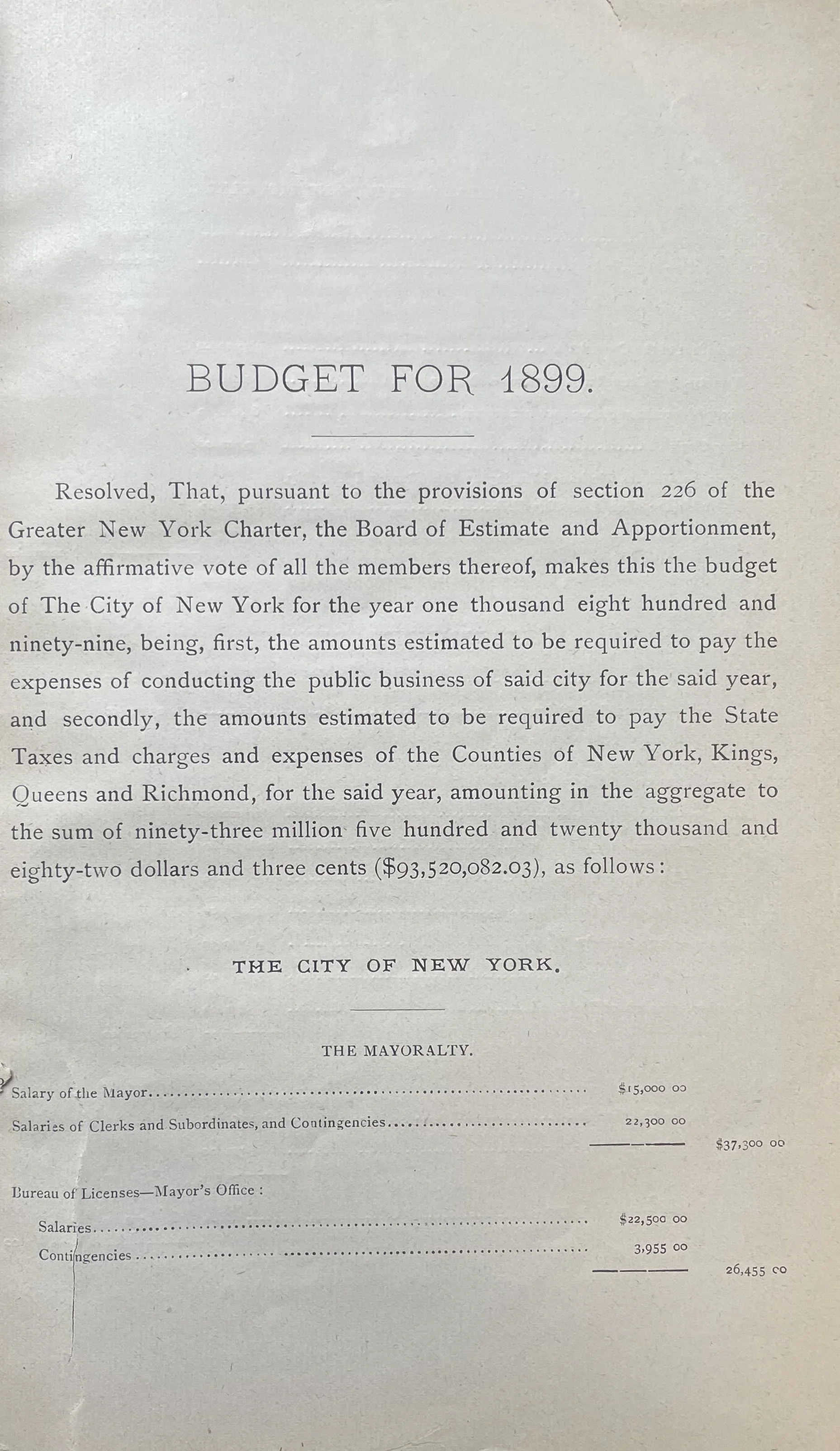
The budget for the fiscal year of 1899 was the first for the consolidated greater New York. NYC Municipal Library.
The creation of the Greater City of New York combined existing municipalities and counties into one government consisting of five boroughs: Brooklyn, the Bronx, New York, Queens and Richmond. A new government was established with a mayor, a board of estimate that included representatives from all of the boroughs as well as the Comptroller. This effectively ended the run of mayors from the preceding governments, including that of New York.
If the question instead is: How many Mayors have represented the Greater City of New York, the city that includes 50 Bronx neighborhoods, 76 in Queens, 77 in Brooklyn, 63 Staten Island neighborhoods and the 57 in Manhattan, the answer is very different. There have been 23 mayors representing the millions of City residents since 1898, including Acting Mayors Ardolph L. Kline, Joseph V. McKee and Vincent R. Impelleteri, who was subsequently elected Mayor.
Some might suggest that this is an outer-borough gripe. But, really it is a claim for full representation of the wonderful diversity that comprises the Greater City of New York.