July 4th

Revolutionary New York

Saturday, July 4, 2026, will mark the 250th anniversary of the signing of the Declaration of Independence in Philadelphia, Pennsylvania. Since then, Philadelphia, and to a similar degree, Boston, have woven their roles as centers of the American Revolution into a strong civic identity. In contrast, New York City has preferred to look forward and downplay its history during that tumultuous period. However, the fact is that New York City played a decisive role in the formation of a new country. This week, For the Record tells the story of New York during the Revolution.

“American Troops and Civilians tearing down the Gilt Statue of George III on Bowling Green.” [July 9th, 1776.] From a painting by F.C. Yohn, published in Father Knickerbocker Rebels: New York during the Revolution. NYC Municipal Library.

Before 1776, New York was sharply divided between Loyalists and Patriots, but revolutionary fervor was high. It was in the Merchant’s Coffee House at Wall Street and Water Street that New York’s merchants expressed their opposition to British taxes such as the Sugar Act of 1764. Even wealthy New Yorkers made their own homespun wool clothing rather than purchase British goods. In 1765, word of a new tax, the Stamp Act, infuriated New Yorkers. In October, the Stamp Act Congress met in New York’s City Hall (then on Wall and Broad Street) to develop a unified colonial objection to the Act. Some two thousand New Yorkers tried to prevent British boats containing the stamps from landing at the Battery. They were unsuccessful, and the stamps were delivered to Lt. Governor Cadwaller Colden at Fort George. On November 1, a crowd marched down Broadway and gathered outside the Fort. Colden and his family retreated to a British warship leaving Major Thomas James in charge. While James threatened to unleash his cannons, the mob burned a gallows with an effigy of Colden in Bowling Green Park. A faction marched north to the Vauxhall estate, the home of Major James. They trashed his belongings, made a bonfire of the furniture, drank his liquor and destroyed the gardens.

“A Plan of the City of New-York & its Environs to Greenwich, on the North or Hudsons River, and to Crown Point, on the East or Sound River, Shewing the Several Streets, Publick Buildings, Docks, Fort & Battery with the true Form & Course of the Commanding Grounds, with and without the Town. Surveyed in the Winter, 1775.” Reprinted for D.T. Valentine’s Manual of 1855. Courtesy Lionel Pincus and Princess Firyal Map Division, The New York Public Library.

“Reading of the Declaration of Independence to the Troops in New York. [July 9th, 1776] Each brigade in Washington’s army assembled on the Common, for the reading. Old St. Paul’s appears in the background.” From a painting by H.A. Oden, published in Father Knickerbocker Rebels. NYC Municipal Library.

The Stamp Act was eventually repealed in April 1766, and the Sons of Liberty erected a “Liberty Pole” in the Commons (now City Hall Park) on May 21, 1766. A sign on top read: “George 3rd, Pitt – and Liberty.” This thank you to the King and British Prime Minister William Pitt for repealing the Stamp Act was seen differently by British soldiers barracked nearby. That August a group of redcoats tore down the pole. Another pole was soon erected, which was again torn down. These back-and-forth actions culminated with a violent bloody clash on January 19, 1770, six weeks before the Boston Massacre, when redcoats armed with sabers fought the radical Liberty Boys led by Isaac Sears in what was called the Battle of Golden Hill. Soon after the fourth pole was dismantled by the British. A fifth pole was erected in February on a small plot of land purchased by Sears; it lasted until October 28, 1776, after the British army seized Manhattan.[1]

After 1775, the City’s population dropped precipitously as many Loyalists fled Manhattan to avoid harassment by Patriots. In the spring of 1776, after they drove the British out of Boston, General George Washington and the Continental Army moved into New York City. They intended to defend it against an anticipated British invasion led by General William Howe. New York Mayor David Matthews was arrested in May 1776, accused of participating in a plot to assassinate Washington.[2]

“The Phoenix and the Rose engaged by the Enemy’s Fire Ships & Galleys on the 16th August 1776.” George Hayward for D.T. Valentine’s Manual of 1864. NYC Municipal Library. On July 12th, the British Ships the Pheonix and the Rose ran the American batteries on Governor’s Island and Fort George and sailed up the Hudson to Tarrytown.

On June 29, 1776, 45 British troop ships anchored off Staten Island. Within a week there were 130 ships. On July 3, they landed on Staten Island without a shot being fired. On July 9, Washington ordered the Declaration of Independence read to his troops and the public in the Commons. Some citizens and soldiers took it upon themselves to rush down to Bowling Green where they pulled down the gilt lead statue of King George. Pieces of the statue were sent to Connecticut to be melted down for musket balls. By August, more than 400 British ships had arrived in New York Harbor, and some had made it up the Hudson to secure Tarrytown.

“Map of Brooklyn at the time of the Revolutionary War drawn by Gen. Jeremiah Jonson.” Lithograph by Geo. Hayward for D.T. Valentine’s Manual for 1858. Courtesy Lionel Pincus and Princess Firyal Map Division, The New York Public Library.

“A Topographical Map of the Northern Part of New York Island, Exhibiting the Plan of Fort Washington, now Fort Knyphausen with the Rebels Lines to the Southward, which were forced by the Troops under the Command of the Right Honerable Earl Percy on the 16th of Nov. 1776 and Surveyed immediately after by Order of his Lordship, by Claude Joseph Sauthier. To which is added the Attack made to the North by the Hessians. Surveyed by order of Lt. Generl Knyphausen.” Published 1777. Republished for D.T. Valentine’s Manual for 1859. Courtesy The Miriam and Ira D. Wallach Division of Art, Prints and Photographs: Print Collection, The New York Public Library. 

On August 22, 15,000 British troops left Staten Island and landed on Long Island, joined by 5,000 Hessians two days later. The Battle of Long Island, the largest battle in the Revolutionary War, was fought in present day Brooklyn from August 26-28, 1776. The Continental Army was routed, suffering heavy losses before falling back to Brooklyn Heights. Through the night of August 29, and the foggy morning of the 30th Washington saved the revolution by ferrying 9,000 troops across the East River to Manhattan.[3] Although his troops were safely back in Manhattan, Washington knew his position was untenable and he led the bulk of them to the northern part of the island. On September 15, British and Hessian troops landed at Kip’s Bay on the East River, quickly dislodging the American troops forming the rear guard. Washington then led a fighting retreat up to Harlem Heights (now called Morningside Heights) where he successfully repelled the overextended British troops the following day. After a month of little engagement, Washington grew concerned that the British were planning to outflank him and began a retreat to the north, leaving 1,200 men behind in Fort Washington. On October 18th the Continental Army engaged with a British landing party in the area of what is now Pelham Bay Park while the main force retreated to White Plains. Fort Washington was captured on November 16, 1776, by the Hessian commander Lt. General Knyphausen and renamed in his honor.

“Attacks of Fort Washington by His Majesty’s forces under the command of Gen. Sir William Howe K.B., 16 Nov. 1776.” For D.T. Valentine’s Manual of 1861. Courtesy Lionel Pincus and Princess Firyal Map Division, The New York Public Library.

New York City was now completely under British military control and would remain so until 1783. The Continental Congress vetoed Washington’s plan to burn the City in his retreat. Nonetheless, on September 20-21, 1776, a quarter of the City burned in the Great Fire, probably set by Patriot spies or allies, perhaps by British soldiers. Although never connected with the fire, Nathan Hale, one of Washington’s spies, was arrested on the 21st and hung the following day.

“This view of the Ruins of Trinity Church after the Great Fire of 1776 taken by Thomas Barrow is respectfully presented to the Corporation of Trinity Church by their obedient Servant, James Barrow, 1841.”  George Hayward Lithographer for D.T. Valentine’s Manual of 1861. NYC Municipal Library.

As a British stronghold, New York now became a haven for Loyalists from other colonies. Additionally, the British advertised freedom to any enslaved person who fled from a Patriot and could make their way to British lines.[4] The population boomed. Many of the refugees set up tent cities in the rubble left from the fire.

The “Jersey” prison ship moored at Wallabout, from “The Album of American History.” Published in Father Knickerbocker Rebels: New York during the Revolution. NYC Municipal Library.

Although never again the site of a battle, the war was still omnipresent.[5] Most of the American troops captured in the war were imprisoned in New York, many in the infamous prison ships anchored in Wallabout Bay in Brooklyn. More than 10,000 prisoners died, more than died in battle throughout the entire war. Ordinary New Yorkers also suffered during the occupation, as British troops seized food, cut down trees and broke up furniture for fires. Loyalty began to wane and Washington’s spy ring infiltrated officer’s households and reported on troop and ship movements.

Page from a record of property seized from Loyalists and resold by New York State in 1784. Commissioners of Forfeiture 1784-1787. NYC Municipal Archives.

All this ended on Evacuation Day, November 25, 1783, when the last British troops and Loyalists left the City and General Washington triumphantly returned. Amongst the Loyalists that left that day was Mayor David Matthews. Under the Confiscation Act, passed in 1779 by the New York Legislature, he was subject to summary execution if found in New York. The war had longer lasting effects. Throughout 1784 and 1785, properties “forfeited” by Loyalists were resold and subdivided, changing the face of the City and creating some of the neighborhoods we know today such as the Lower East Side. New York then became the nation’s first capital. From 1785-1790, Congress met at New York’s City Hall, renamed Federal Hall, and George Washington took the oath of office on its balcony in 1789.[6] Washington lived in Manhattan during these years at Franklin House on Pearl and Cherry Street.

In many ways the revolution began here and ended here. Since 1784, New Yorkers have been celebrating on July 4th, as revealed in Grog, Punch and Wine: New Yorkers Celebrate Independence Day. We hope you do the same this weekend.

“Federal Hall, Inauguration of General George Washington, the First President of the United States, on the 30th of April 1789.” H.R. Robinson for D.T. Valentine’s Manual, 1849. NYC Municipal Library.


[1] A flagpole to the west of City Hall commemorates the Liberty Poles, with this marker: “Here in the ancient commons of the city, where before the time of our national independence five liberty poles were successively set up, this flag pole of 1921 is placed in grateful remembrance of all lovers of our country who have died that the liberty won on these shores might be the heritage of the world.” For more on Liberty Poles see: https://www.gothamcenter.org/blog/monuments-roundtable-george-iii-and-liberty-poles

[2] Although Matthews later escaped captivity, the British had by then placed the City under military rule, and the Common Council disbanded. For more on Matthews see: https://www.archives.nyc/blog/2019/7/3/the-missing-common-council-records-of-the-revolutionary-war

[3] Although some accounts say Washington had planned to use the fog to aid the evacuation, it seems to have been a matter of luck that a heavy fog rolled in on the morning of the 30th concealing the small boats still evacuating the Heights. See: https://archive.org/details/ldpd_11290380_000/page/n243/mode/2up?q=fog

[4] In the waning days of the occupation, from May to August of 1783, a joint British and American Commission headed by Brigadier General Samuel Birch reviewed the claims of Black Loyalists. Over 3,000 were granted freedom and allowed to emigrate to British lands.  https://www.frauncestavernmuseum.org/birch-trials-at-fraunces-tavern

[5] The Battle of Van Cortlandt’s Woods occurred on August 31, 1778, in what is now The Bronx, but it was not then part of New York City. It was a devastating defeat for the Stockbridge Militia, an Indigenous infantry unit made up of Mohican, Wappinger, and Munsee men from Stockbridge, Mass.

[6] The 2nd City Hall of New York was torn down in 1812. The current building, Federal Hall National Memorial, was built in 1842 as a customs house. A topic previously explored in “The Dutch & the English Part 5: The Return of the Dutch and What Became of the Wall.”


Sources:

“Dining Room, Fraunces Tavern, corner of Pearl & Broad Streets: Representing the scene of George Washington taking leave of his officers.” A. Weingertner’s Lithographers for D.T. Valentine’s Manual of 1857. NYC Municipal Library.

Grog, Punch and Wine: New Yorkers Celebrate Independence Day

New Yorkers have been celebrating Independence Day since July 4, 1777.  Or, have they?  Municipal Archives collections are extensive and said to provide documentation on any topic in New York City history. However, there is one notable gap in the holdings. Municipal government was suspended during the period of British occupation from 1776, until the last troops left from the Battery on November 25, 1783. The existence and/or whereabouts of any administrative records for that period has been the subject of speculation ever since. For the Record examined the subject in The Missing Common Council Records of the Revolutionary War.

City Hall, Valentine’s Manual, 1852. NYC Municipal Archives

Researchers are not entirely without information about the city during the first decades of the new republic. The six-volume Iconography of Manhattan Island, by Isaac Newton Phelps Stokes, helps fill the documentation gap. Stokes relied on newspaper accounts and other sources, as well as the Minutes of the Common Council, to write a daily chronicle of key events in city history from 1498 to 1909. 
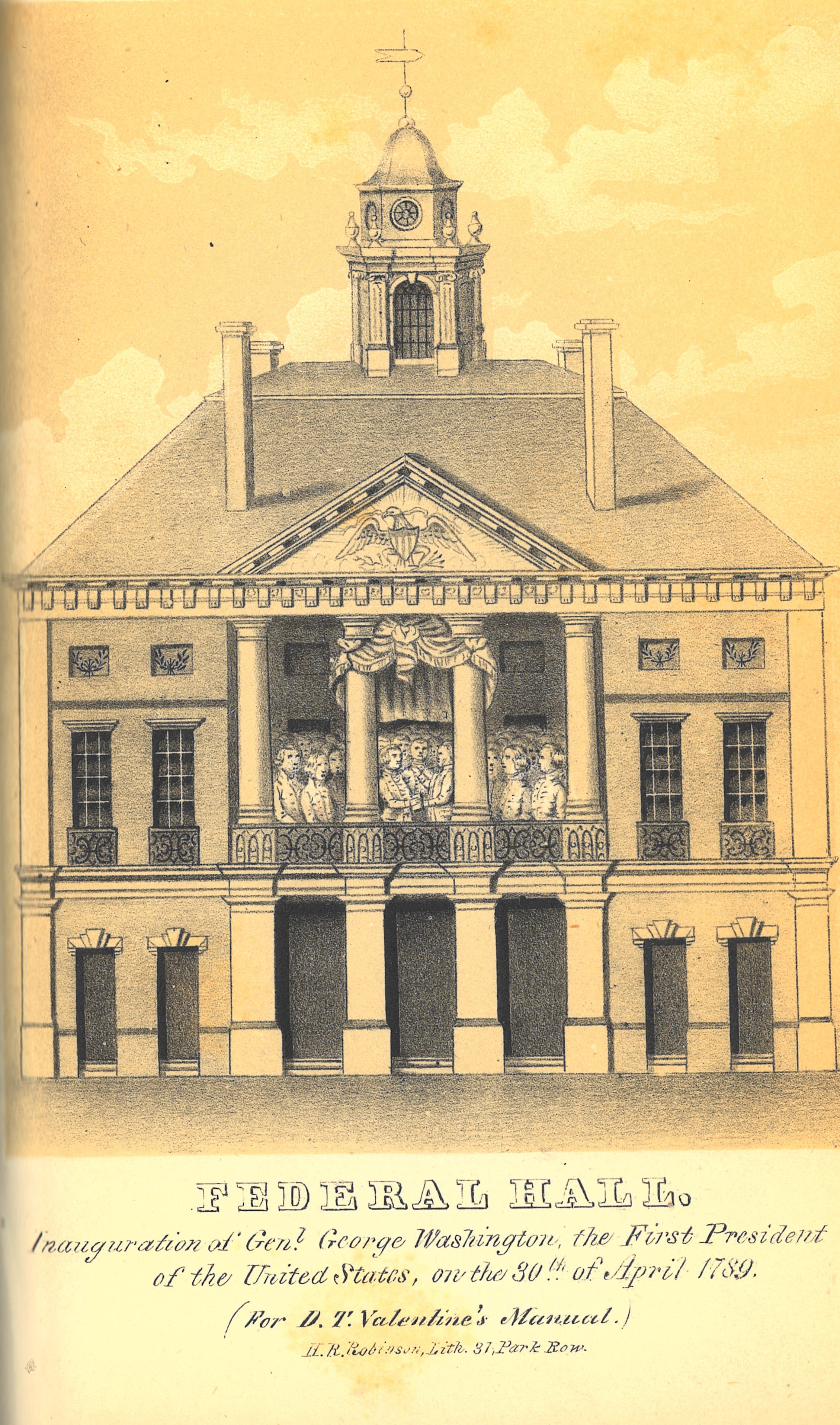
Federal Hall, 1789, Valentine’s Manual 1849. NYC Municipal Archives

The Municipal Library collection includes the Iconography and looking at entries during the Revolutionary War period reveals that Philadelphia celebrated the first “Anniversary of the Independence of the United States of America,” in 1777.  It is possible to imagine that at least some New Yorkers also managed to celebrate Independence Day, quietly, but Stokes makes no mention of festivities in New York City during the occupation.

Municipal government reconstituted in 1784, and the re-convened Common Council held its first meeting on February 10. When municipal government restarted, so too, did record-keeping in the form of the Minutes of the Common Council. The Minutes and the related series, Common Council papers, are two of the most essential collections in the Municipal Archives.   

There is a useful cumulative index to Minutes of the Common Council covering the period 1784 through 1832. Reviewing the entries for “Fourth of July,” shows the first mention of a celebration in 1785: “…That Alderman Broome & Bayard & Mr. Lawrence and Mr. Ten Eyck be a Committee to report the Measures proper to be taken by this Corporation on the Fourth of July; being the 9th anniversary of the Independence of this State.” (Common Council Minutes, 22 June 1785.)

The Committee to Report the proper manner of celebrating the 4th of July next (partial text), Minutes of the Common Council, June 21, 1796. NYC Municipal Archives

The Council established similar committees, on an annual basis, through at least the first several decades of the 19th century. In 1786, the appointed committee reported to the Council on the arrangements for Independence Day: “That at sunrise the day be announced by a display of colors, a discharge of 13 Cannon & the ringing of all the public Bells for one Hour. That at 12 O’clock there be a Procession of this Board & other public Officers & the Citizens from the City Hall down Broad Street & through Queens Street to the Residences of their Excellencies the Governor & the President of the United States and thence by way of Beekman Street to the City Tavern where a Collation be provided…” (Common Council Minutes, 28 June 1786.) 

Warrant to Daniel Phoenix, Treasurer, for payment of twelve Pounds for the ringing of the bells on the 4th of July, 1795. Common Council papers. NYC Municipal Archives.

Warrant to Daniel Phoenix, Treasurer, for payment of twenty-five Pounds for illuminations and fireworks on the 4th of July, 1795. Common Council papers. NYC Municipal Archives.

In 1789, according to Stokes, “The presence of [President George] Washington in New York makes the celebration of Independence Day especially noteworthy.” Unfortunately, as Stokes reports, Washington had been suffering an illness which “…Deprived the troops of the honor and satisfaction of being reviewed by him in the field.” But later in the day “…they passed the house of the President… who appeared at his door in a suit of regimentals, and was saluted by the troops as they passed.”  In the afternoon, a concert in St. Paul’s church was “honored by the presence of the First Lady and Family of the President, his indisposition (the inconvenience of which thanks be to Heaven, are nearly surmounted) prevents his personal attendance.”

The related series, Common Council papers, also provides information about Independence Day celebrations. The series consists of documents written by or presented to the Council. The date span of the entire series is from 1670 to 1934. However, the material after 1870 consists primarily of resolutions with little supporting documentation. From 1800 to 1831, the documents are separated by year into folders generally pertaining to the standing and special committees created by the Council, e.g. Arts, Sciences & Schools, Charity & Almshouse, Fire & Water, Lamps & Gas, Police, Watch, Prison, Streets, Wharves, etc. The folders are arranged alphabetically. With funding from the National Endowment for the Humanities, the Municipal Archives processed and microfilmed the Common Council papers.

Invoice for payment for punch, grogg, wine, etc., July 4, 1793. Common Council papers. NYC Municipal Archives

The papers helpfully include warrants for payment to vendors who supplied services for Fourth of July celebrations. In 1795, Captain Bauman’s bill for “…illuminations & fireworks… on the celebration of the late anniversary of American Independence,” amounted to twenty-five pounds.

In 1793, John Simmons’ bill for four large bowls of punch, nine bowls of grog, thirty bottles of wine, plus coffee, crackers, etc. came to twenty-six pounds, nine shillings and six pence.  What is less clear is who consumed the beverages. Perhaps this is typical of the “collation” referred to in the 1786 Minutes. In any case we will assume they enjoyed the celebration. 

From For the Record, wishing everyone a happy Fourth of July!