This guest post uses archival documents in the Municipal Archives and Library collections. Readers are advised that as with all U.S. history, there are references to race and its direct relationship to institutional choices. Please note that quotes in this post contain outdated language, e,g. use of the term “Negro.” These instances have been retained and referenced in their original form to maintain historical accuracy and context.
December 1950: Ralph Bunche, United Nations Under-Secretary-General for Special Political Affairs is awarded the Nobel Peace Prize for his leadership in resolving global conflicts including the 1949 Middle East peace accord.
July 1959: United Nations Under-Secretary-General Bunche inquires about membership in the Westside Tennis Club so his son, Ralph Jr., can continue lessons from the Club’s tennis pro. The Club president, Wilfred Burglund dismisses the possibility because “the policy of the club was to exclude Negroes and Jews.”
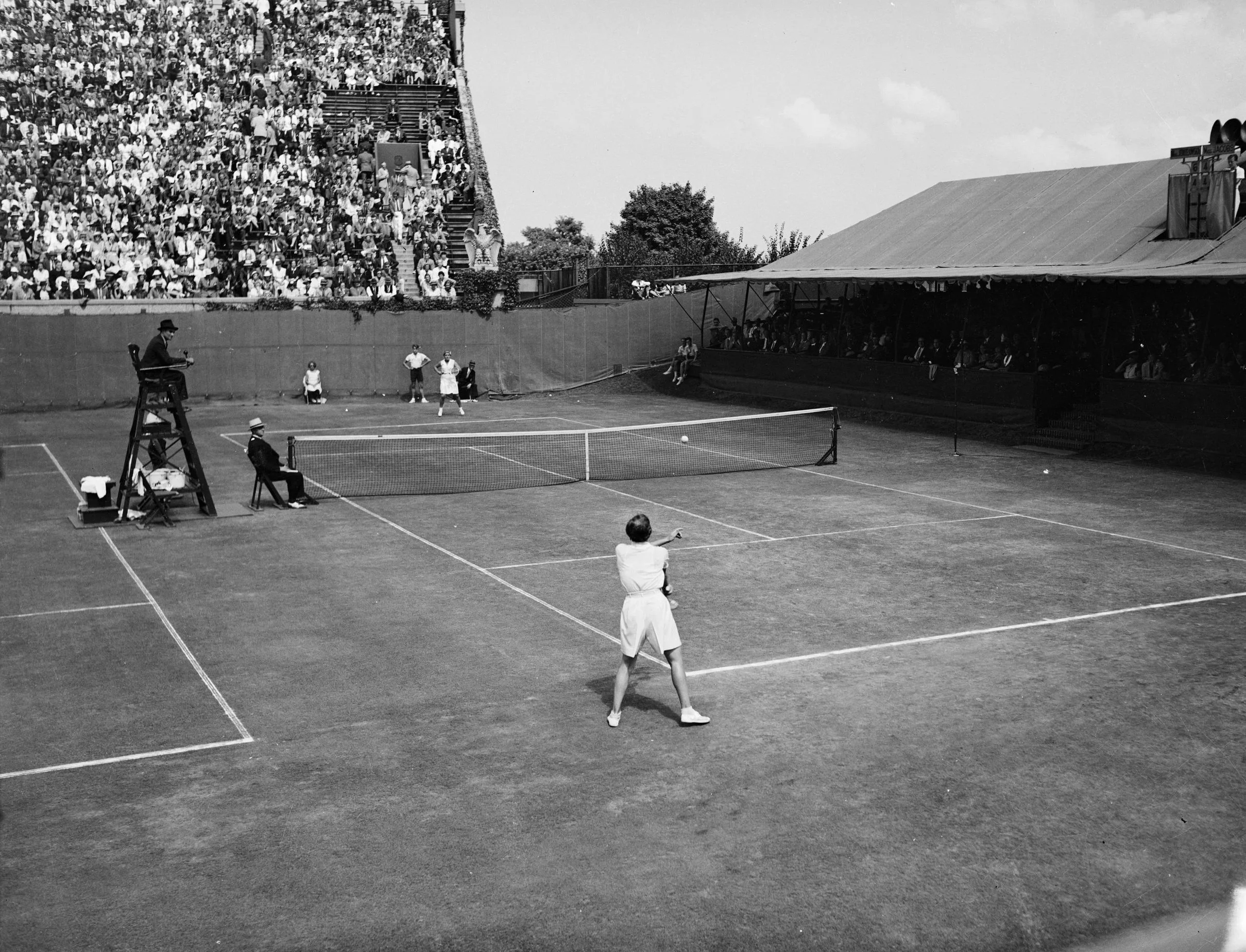
National Tennis Championships, Play in Men’s, Forest Hills, Long Island, September 1937. MSS0041_0569f, WPA Federal Writers’ Project photographs. NYC Municipal Archives.
On July 8, 1959, Bunche publicized the Club’s rejection and triggered a firestorm. As reported by Philip Benjamin in The New York Times, having been told by friends that the Club discriminated, Bunche called Burglund to inquire about membership and was told that “there were no Negroes or Jews… and there were not likely to be.”
The Times quoted the statement released by Bunche:
“I deliberately revealed this experience only because I find it to be rather shocking in New York City and think citizens of the city and of the country generally are entitled to know about it.
But I keep the story in perspective. Neither I nor my son regard it as a hardship or a humiliation. Rather it is a discredit to the club itself.
It is not, of course, in the category of the disfranchisement, deprival of other rights, segregation and acts of intimidation suffered by many Negroes in the South and of discrimination in employment and housing suffered by most Negroes in the North as well as the South.
But it flows from the same well of racial and religious bigotry. It confirms what I have often stated, namely that no Negro American can be free from the disabilities of race in this country until the lowliest Negro in Mississippi is no longer disadvantaged solely because of race; in short; until racial prejudice has been everywhere eliminated. I am in fact glad to have this unpleasant but necessary lesson made real in this way to my son.”
City officials weighed in. Mayor Robert Wagner, in Los Angeles to attend the Conference of Mayors, cited the City’s leadership in anti-discrimination efforts, telling The New York Times, “It is certainly no credit to the tennis club to discriminate against anyone.” Incidentally, Wagner was on the Board of the Town Tennis Club, headed by ex-Wimbledon champion Sidney Wood, which offered Dr. Bunche club membership.
Robert F. Wagner and Davis Cup tennis champs celebrate around trophy cup, February 10, 1955. Mayor REC0070_02_03_02583-02, Robert F. Wagner photographs, NYC Municipal Archives.
With the Mayor away, the President of the City Council[1] Abe Stark, stepped up. The Times reported that in his capacity as the “acting mayor,” Stark threatened to force the West Side Tennis Club to give up hosting both the Davis Cup and the U.S. National Championship, among other measures. The flamboyant Stark, who operated a clothing store, famously had a sign under the scoreboard in Ebbets Field promising a suit to any player who hit the sign. Although Walter O’Malley and the Dodgers had decamped to Los Angeles in 1957, Stark claimed the new owners of Ebbets Field would happily host both the 1959 Davis Cup and the national championship, as reported by The New York Times.
Losing these premiere events would have been a big blow to the West Side Tennis Club which had a contract with the United States Lawn Tennis Association to host the National Championship—now the U.S. Open.
Originally located on Manhattan’s Upper West Side (hence the name), the club moved to Forest Hills, Queens in 1914 to better accommodate the growing audience of tennis spectators. The club hosted the U.S. Open sixty times between 1915 and 1977, although not continuously. Some early years saw the championships in Staten Island or Philadelphia cricket clubs. In 1957 and 1958, tennis great Althea Gibson won the women’s national championship playing there—the first Black athlete to do so, making the Club’s membership policy even more galling. Despite the international outrage at the discriminatory response, the West Side Club leadership remained silent.
Bunche’s announcement galvanized the Commission on Intergroup Relations (COIR). Established by local law in 1955, COIR replaced the Committee on Unity established by former Mayor Fiorello La Guardia and was succeeded by the still extant Commission on Human Rights. The establishing law cited New York City’s “great cosmopolitan population consisting of large numbers of people of every race, color, creed, national origin and ancestry” and stated the agency “officially may encourage and bring about mutual understanding and respect among all groups in the city, eliminate prejudice, intolerance, bigotry, discrimination and disorder occasioned thereby and give effect to the guarantee of equal rights for all assured by the constitution and the laws of this state and of the United States of America.”
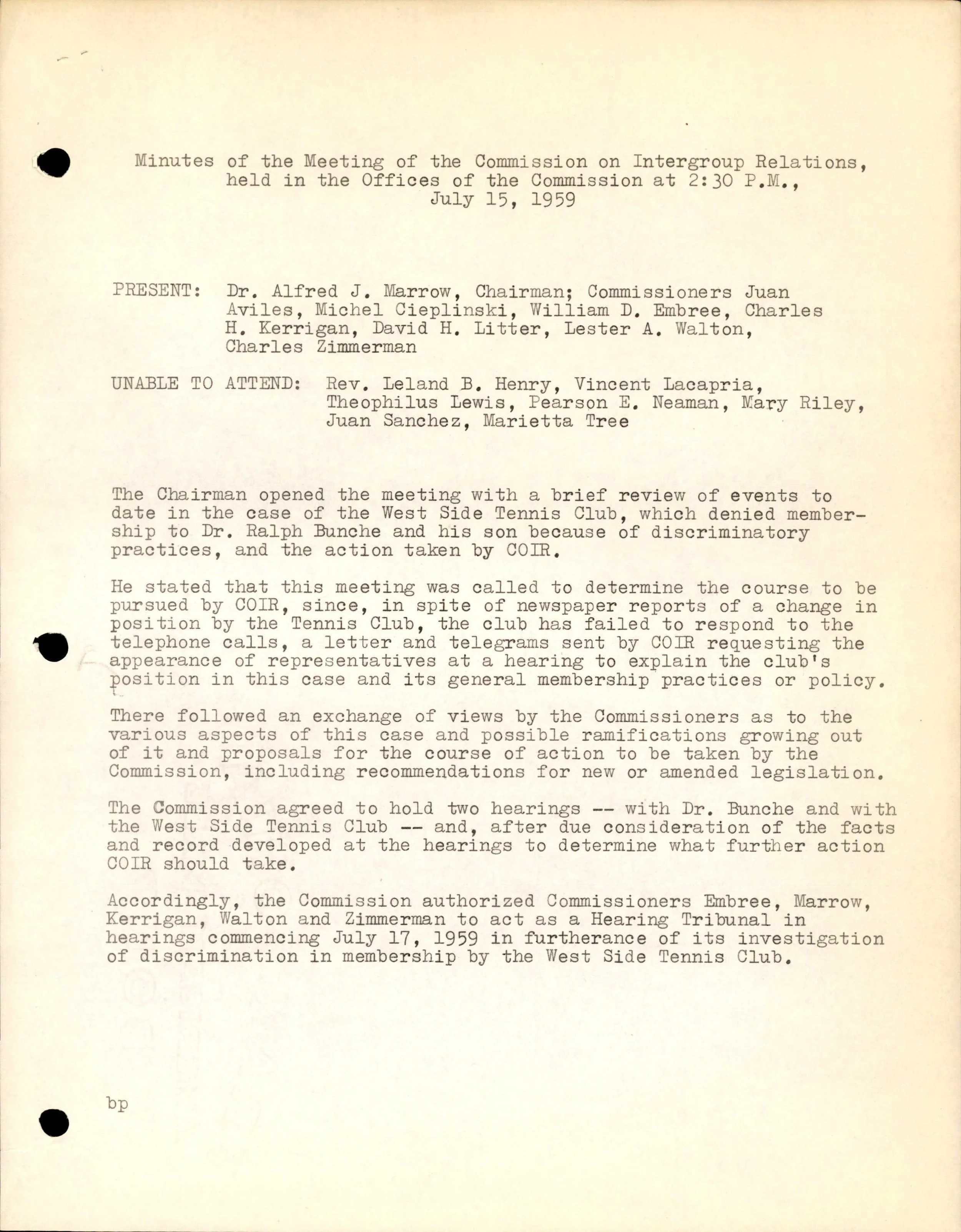
Minutes of the Meeting of the Commission on Intergroup Relations, July 15, 1959. REC0103_2_02_001_003_0002 New York City Commission on Human Rights administrative records and case files, circa 1935-1987, NYC Municipal Archives.
COIR meeting minutes from this period show that the body largely focused on housing discrimination matters. Typically, the commission would designate its members to serve on sub-committees that convened fact-finding hearings with the parties involved.
On July 15, 1959, COIR convened a special meeting to review the club’s decision, subsequent developments and determine a course of action. Meeting minutes show that Dr. Alfred L. Marrow, Commission Chair, said the meeting was “called to determine the course to be pursued by COIR, since, in spite of newspaper reports of a change in position by the Tennis Club, the club has failed to respond to the telephone calls, a letter and telegrams sent by COIR requesting the appearance of representatives at a hearing to explain the club’s position in this case and its general membership practices or policy.”
The minutes show that COIR established a five member “Hearing Tribunal” that was instructed to “hold two hearings—with Dr. Bunche and with the West Side Tennis Club—and, after due consideration of the facts and record… determine what further action COIR should take.”
Also, on July 15, the week of negative publicity, sponsorship threats and denunciations by prominent people had an effect. Burglund resigned from the club and its Board announced they would review a possible Bunche membership.
The club’s capitulation and Bunche’s response was reported by Time magazine on August 27.
For Ralph Bunche, Negro, Nobel Peace Prizewinner and United Nations Under Secretary, it was a peaceful moral victory. Only a week had passed since Bunche disclosed that his 15-year-old son had been barred from membership in New York City’s fashionable West Side Tennis Club (in Forest Hills, Queens) because of his race (TIME, July 20). Club President Wilfred Burglund, the Manhattan public relations man who had told Bunche that the club excludes Negroes and Jews, resigned last week amidst public clamor for his singed scalp. Then the club’s governors were moved to announce: “It is the policy of the club to consider and accept members without regard to race, creed or color.” But Dr. Bunche had no plans to push Ralph Jr. through the West Side’s newly opened door. He had amply proved his point. “This has not been a pleasant experience, and I’m glad it is over,” said Bunche Sr. “In this community, happily, bigotry cannot long stand the heat of public exposure.”
The club’s announcement would seem to resolve the matter. But it did not deter COIR’s investigation. On July 17, the committee met with Dr. Bunche; on July 21, they met with the tennis club representatives. The tribunal also acted quickly to expand the inquiry by adding another session on August 13 to hear from the leadership of the United States Lawn Tennis Association (now the United States Tennis Association). By convening an additional hearing, COIR moved beyond the initial incident. They began reviewing compliance with anti-discrimination laws at events open to the public throughout the City.
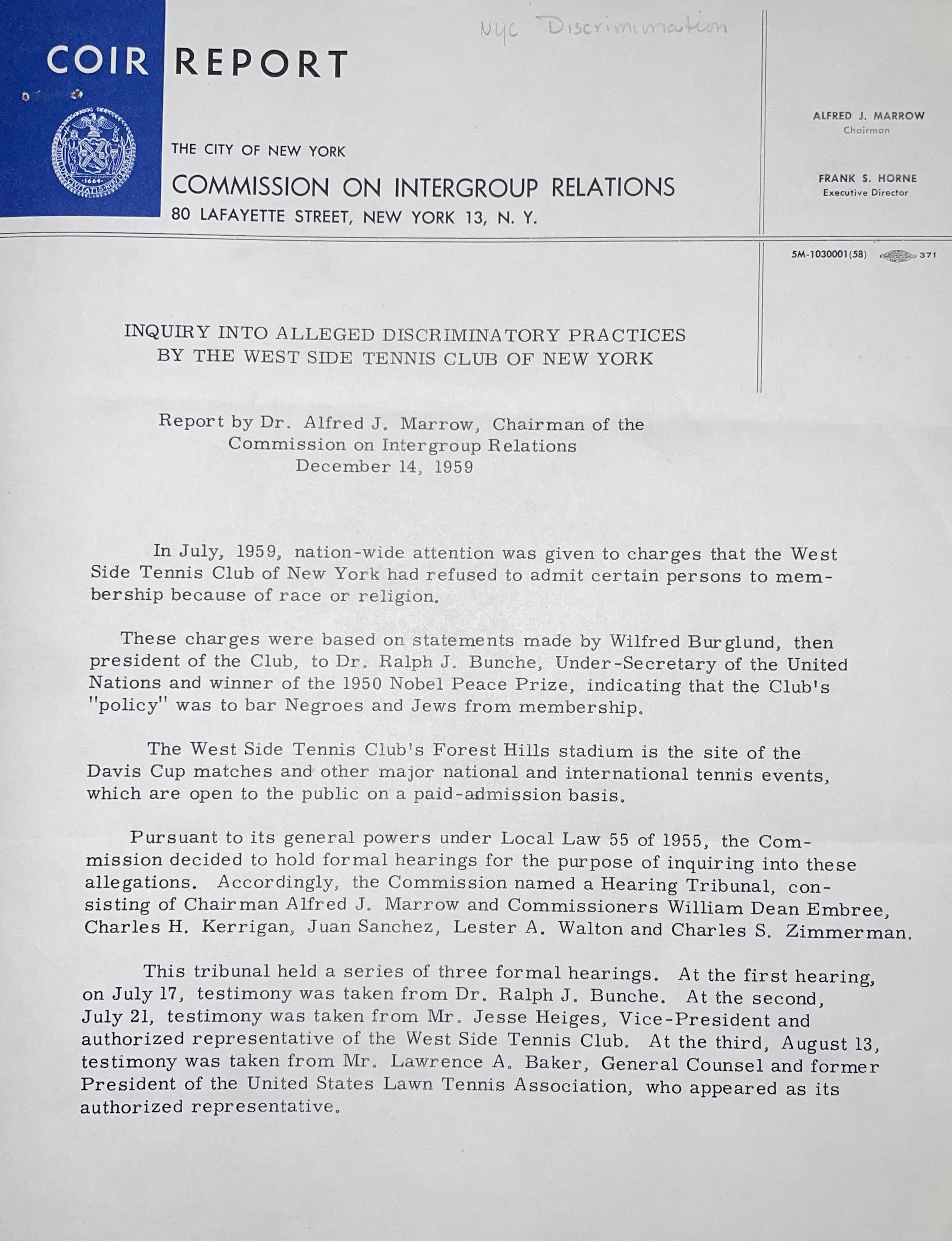
COIR Report, “Inquiry into alleged discriminatory practices by the West Side Tennis Club of New York,” December 14, 1959. NYC Municipal Library vertical files.
COIR issued a report on the investigation in December 1959. Titled, “INQUIRY INTO ALLEGED DISCRIMINATORY PRACTICES BY THE WEST SIDE TENNIS CLUB OF NEW YORK,” it recaps portions of the testimony. Bunche recounted a portion of his discussion with Burglund about how the membership would view the possibility of him joining. He said Burglund replied that “he felt sure that if the boy were taken in there would be 200 or 300 resignations because of the admission of a Negro.”
“When Dr. Bunche inquired as to whether there was any likelihood that this policy might change, “he (Mr. Burglund) indicated that he felt that it was unlikely that it would.”
On July 21 a representative from the West Side Tennis Club testified, replacing Burglund who had resigned as club president. He provided COIR with the Board’s statemen that its policy was “to consider and accept members without regard to race, color or creed.”
After questioning, the representative “conceded that there were no Negro members in the Club and—although stating that there were Jews on the membership roster—he was unable to give the name of any member who was of the Jewish faith.”
Despite the stated policy, the Commission’s report stated it “is strongly impressed by the fact that no Negro is a member of the organization and no case of a Negro ever being proposed for membership could be cited.” It also reiterated the club’s inability to name a single Jewish member and promised further scrutiny. “In view of the statements made by the Club’s counsel and representative, we expect the future policy of this organization to reflect the non-discriminatory principles which are consistent with its status in our community.”
The report then focused on its role in enforcing anti-discrimination laws. Distinguishing between private entities and entities that involve the public interest. “In this report we are not dealing with the “private” club whose activities are of such a nature that the public interest is not affected. The right of people to assemble for any lawful purpose, in groups of their own selection, is not questioned—but when the activities of these groups are extended into fields where the public becomes involved, as in this case, the group ceases to be only “private,” and assumes a nature that must clearly bring it within the area where certain definite standards of public policy are involved.”
The report concluded that organizations that sponsor events open to the public and charge the public admission fees “should not pursue a discriminator policy either in the selection of members or in admission to their public events. Foreshadowing further action, the report notes that COIR was studying several national fraternal orders compliance with anti-discrimination laws. “The Commission will maintain a continuing interest in the observance of a non-discriminatory policy by all organizations, clubs and associations which are, as in this case, affected with the public interest. They constitute important segments of the social structure of the community, and as such influence the opportunities for full and equal development of our citizens.
Pauline Toole is a former DORIS Commissioner.
[1] Since 1993, the office has been renamed “Public Advocate” because Council Speaker Peter Vallone thought the title led to confusion about who actually headed the Council.