The Transcription Project, Condemnation Proceeding Photograph Collection

In last week’s blog, conservators Virginia Buchan and Nora Ligorano described their work transcribing the original hand-written captions for the Brooklyn Grade Crossing Commission photograph collection into a searchable spreadsheet.  The transcription projects began when the Municipal Archives closed to the public on March 16, 2020, and all staff began to work remotely from home.  This week we will look at another transcription project, the Condemnation Proceeding Photograph Collection captions, one of the many lists and inventories previously inaccessible to patrons due to their analog format.  Archivist Sarah Capano and the team preparing to move a good portion of city government’s archival records to the new facility at Industry City—Abigail Wilson, Denise Roper, Enyonam Harlley, Francis Bross, Zachary Kautzman—tackled the Condemnation Proceeding caption list transcription project while working remotely. 

East corner of Coney Island Boardwalk and West 12th Street, January 3, 1940. Condemnation Proceeding Photograph Collection. NYC Municipal Archives.

East corner of Coney Island Boardwalk and West 12th Street, January 3, 1940. Condemnation Proceeding Photograph Collection. NYC Municipal Archives.

The Condemnation Proceeding collection totals approximately 20,000 images and date from 1935 to 1950.   They document buildings and structures demolished for construction of the Belt Parkway (originally called the Circumferential Parkway), North Beach Airport (now La Guardia), and the Interboro Parkway.

92 Carlton Avenue. Three-story frame house; little girl wheeling baby carriage, dressed in mother's hat and high-heeled shoes. June 19, 1940. Condemnation Proceeding Photograph Collection. NYC Municipal Archives.

92 Carlton Avenue. Three-story frame house; little girl wheeling baby carriage, dressed in mother's hat and high-heeled shoes. June 19, 1940. Condemnation Proceeding Photograph Collection. NYC Municipal Archives.

The photographers who created the pictures identified them using basic geographic location information.  After the Municipal Archives acquired the collection in 1988, the late Claire Rosenstein, long-time Archives photograph cataloger, transcribed the location information and added subject terms and notes.  During her quarter-century tenure, Ms. Rosenstein cataloged thousands of photographs.  Her specialty was identifying interesting scenes or details in what were otherwise pedestrian pictures of city infrastructure.

202 Park Avenue (mislabeled 204 Park Avenue), Shoe repair shop. Proprietor, cigar in mouth, seated, looking at camera; two chairs set up ready for shoeshine customers. Undated. Condemnation Proceeding Photograph Collection. NYC Municipal Archives.

202 Park Avenue (mislabeled 204 Park Avenue), Shoe repair shop. Proprietor, cigar in mouth, seated, looking at camera; two chairs set up ready for shoeshine customers. Undated. Condemnation Proceeding Photograph Collection. NYC Municipal Archives.

Sarah Capano and her team have been faithfully typing Rosenstein’s captions into the spreadsheet.  This information adds greatly to the basic place-identification data that came with the pictures.  For example, if a picture depicted a storefront, Rosenstein added the name and type of business, e.g. fruit market, bakery, butcher, grocery, delicatessen, or candy store, to the caption. Other commercial establishments such as coal factories, restaurants, service stations, undertakers, etc. were duly noted, as well as institutions like hospitals, schools, and churches.  Signs, movie posters, and other features of street life were indicated in the caption.  Most of the photographs depict building exteriors, but the collection does include interior scenes, particularly of commercial establishments, and in some cases, people at work.

201 Myrtle Avenue, Albert Rosen's Market; Meat Counter; butcher, customer and child, October 17, 1940. Condemnation Proceeding Photograph Collection. NYC Municipal Archives.

201 Myrtle Avenue, Albert Rosen's Market; Meat Counter; butcher, customer and child, October 17, 1940. Condemnation Proceeding Photograph Collection. NYC Municipal Archives.

The Condemnation Proceeding is the formal process by which a government takes possession of private property for a public purpose such as a highway, park, or housing development.  In New York City, the Law Department determines the value of the property to be taken and uses photography as a tool in the assessment procedure. The Law Department typically contracted with commercial photographers for this work.  Most of the pictures in the Condemnation series have the name “Somach” on the lower right corner.  Based on research in the digitized and searchable City Record newspaper, the “Somach Photographic Company” received more than 600 payments from City agencies, including the Law Department, between the mid-1930s and 1940s for their services.  Another commercial photographer, the Rutter Studio, is responsible for most of the pictures in the Brooklyn Borough President Photograph Collection (1910-1940) and the Savastano company took thousands of photographs for the Manhattan Borough President from the 1920s through the 1940s.   The good news for photo researchers is that the commercial studios typically used large-format cameras and the pictures are well-composed, properly exposed and carefully printed.  The Condemnation series provides many examples of their excellent work. 

Cropsey Avenue. Brick building, "Lion Beer-Ale" ad on side of building, March 3, 1939. Condemnation Proceeding Photograph Collection. NYC Municipal Archives.

Cropsey Avenue. Brick building, "Lion Beer-Ale" ad on side of building, March 3, 1939. Condemnation Proceeding Photograph Collection. NYC Municipal Archives.

The Condemnation photographs had been acquired by the Municipal Archives from St. Francis College in 1988.  Beginning in the 1940s, the Kings County Clerk had a long-standing agreement with the College to serve as a repository for Brooklyn-related historical materials originating in various government offices.  Condemnation proceedings are a court-action that take place in the Supreme Court of the relevant county.  It seems likely that the Kings County Clerk, who also serves as Clerk of the Supreme Court, received the pictures along with other documents related to the condemnation proceedings and transferred them to St. Francis College. 

259 Hamilton Avenue, Billiard parlor. Photos of boxers, "pin-up" girls; sign ‘Please Don't Sit on Table,’ June 1940. Condemnation Proceeding Photograph Collection. NYC Municipal Archives.

259 Hamilton Avenue, Billiard parlor. Photos of boxers, "pin-up" girls; sign ‘Please Don't Sit on Table,’ June 1940. Condemnation Proceeding Photograph Collection. NYC Municipal Archives.

Like much of 20th century New York City history, all roads eventually lead to Robert Moses, the City’s construction czar from the 1930s through the 1960s.  In this instance, literally.  Most of the condemnation photographs in the series depict buildings and structures demolished to make way for one of Moses’ many highway infrastructure projects.  The condemnation proceeding is a powerful tool, and not surprisingly, it is often contentious, controversial. and protracted.  Although property owners are compensated for their loss, people tend to not want to give up their homes and businesses.  Moses’s use of this process, without regard for the trauma he caused in neighborhoods throughout the city, is legendary, and has been the subject of historical debate for decades.  The value of the Condemnation photographs is that they provide a wealth of visual evidence to help historians better tell the story of how Moses transformed  the City. 

98 Flatbush Avenue Extension. Socony Gas Station, elaborate white quasi-marble building with cartouches and other classic details, July 24, 1936. Condemnation Proceeding Photograph Collection. NYC Municipal Archives.

98 Flatbush Avenue Extension. Socony Gas Station, elaborate white quasi-marble building with cartouches and other classic details, July 24, 1936. Condemnation Proceeding Photograph Collection. NYC Municipal Archives.

In the words of archivist Sarah Capano, the captions, “provide a great snapshot and insight into life in these long-vanished neighborhoods.”  

275 Myrtle Avenue. Interior; man standing by machinery, strands resembling spaghetti emanating, October 22, 1940. Condemnation Proceeding Photograph Collection. NYC Municipal Archives.
275 Myrtle Avenue. Interior; man standing by machinery, strands resembling spaghetti emanating, October 22, 1940. Condemnation Proceeding Photograph Collection. NYC Municipal Archives.

The Transcription Project, Brooklyn Grade Crossing Photographs

The Municipal Archives closed to the public on March 16, 2020 and all staff were instructed to work remotely from home, on computers. When we received this notice, we thought that’s okay for some, but we’re conservators, our job is to treat physical objects. We repair historical records and books. What could we do at home? Well, thanks to our colleagues who had been thinking ahead, it turns out that there was work we could do that would benefit the Archives and its researchers.

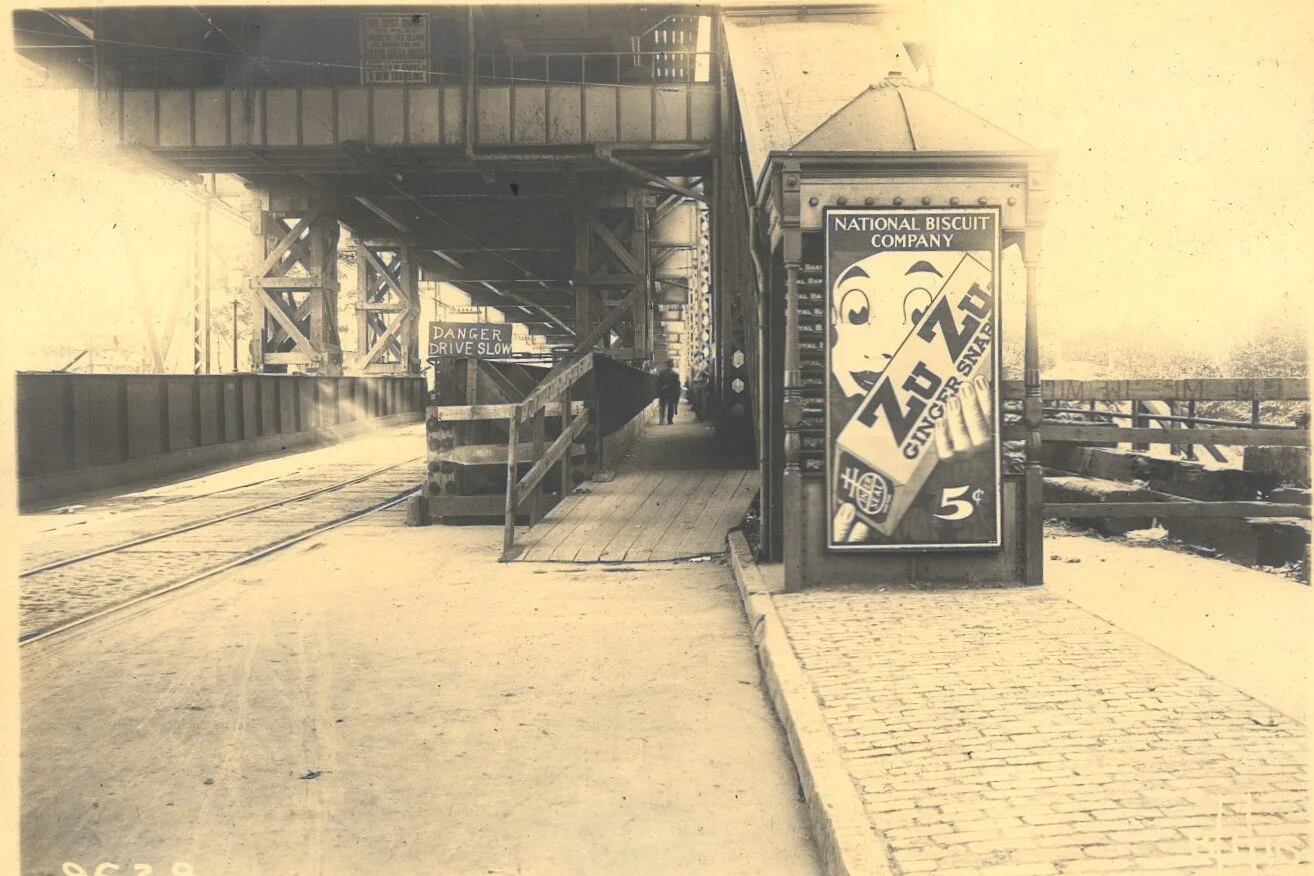
Curb line, 3rd Avenue and 65th Street. Billboard at bottom of EL stairs for National Biscuit Company’s Zu Zu Ginger Snaps, August 1, 1916. Brooklyn Grade Crossing Commission Photographs, NYC Municipal Archives.

Curb line, 3rd Avenue and 65th Street. Billboard at bottom of EL stairs for National Biscuit Company’s Zu Zu Ginger Snaps, August 1, 1916. Brooklyn Grade Crossing Commission Photographs, NYC Municipal Archives.

Many Municipal Archives collection inventories, lists, finding guides and other descriptive materials are still hand-written or typed documents. In the days before we closed, our colleagues quickly scanned many of these documents into pdf files that we could later access from our home computers. They provided us with templates and instructions, and we started transcribing the documents into searchable spreadsheets. When this information is made available on the agency website, researchers will learn about the content of these collections, many of which have been almost completely unknown, or inaccessible.

Looking south from west of bridge at Avenue C. Grocer and assistant with cartons, October 15, 1908. Brooklyn Grade Crossing Commission Collection, NYC Municipal Archives.

Looking south from west of bridge at Avenue C. Grocer and assistant with cartons, October 15, 1908. Brooklyn Grade Crossing Commission Collection, NYC Municipal Archives.

We were assigned to transcribe the Brooklyn Grade Crossing Commission photograph collection captions. The collection had been accessioned by the Archives in 1988 from St. Francis College in Brooklyn. The photographs were just one of dozens of series of Brooklyn-related records that had been maintained at the College. Beginning in the 1940s, the Kings County Clerk had arranged for the College to serve as a repository for Brooklyn’s historical records, some dating back to colonial days. By the late 1980s, the College determined it could no longer maintain the collections and the Municipal Archives quickly stepped in to accession these important materials.

Steel structure and maronry incline along siding between Prospect Place and St. Mark’s Ave. One girl, group of small boys face camera. Boys all wear caps; half of them are barefoot, August 4, 1904. Brooklyn Grade Crossing Commission Photographs, NYC…

Steel structure and maronry incline along siding between Prospect Place and St. Mark’s Ave. One girl, group of small boys face camera. Boys all wear caps; half of them are barefoot, August 4, 1904. Brooklyn Grade Crossing Commission Photographs, NYC Municipal Archives.

We first joined the Municipal Archives shortly after the St. Francis College collections were transferred from the College. Our assignment then was to preserve the ledgers of the original Kings County Towns—Flatbush, Gravesend, New Lots, New Utrecht, and Flatlands. The ledgers dated to the 1600s and had great historical significance. We de-silked the pages (silking was a common practice in the 19th century), repaired, leaf-cast (which is repairing and preserving the original paper by using a slurry of paper pulp to replace losses) and re-bound the ledgers. As a side note, we understand these ledgers are slated for digitization next year as part of a grant-funded project.

Houses south side, no. 618-620; 624-626 Park Place, January 10, 1906. Brooklyn Grade Crossing Commission Photographs, NYC Municipal Archives.

Houses south side, no. 618-620; 624-626 Park Place, January 10, 1906. Brooklyn Grade Crossing Commission Photographs, NYC Municipal Archives.

After a long hiatus pursuing other opportunities, we re-joined the Archives in 2015. And we find ourselves once again working on another of the series from St. Francis College—the Brooklyn Grade Crossing photographs. There are approximately 9,000 prints, most measuring 5 x 6 -inches. They had been pasted into an album—two on a page. They date from 1903 to 1917, and document the work of the Brooklyn Grade Crossing Commission. Established by the New York State Legislature, its purpose was to eliminate the dangers posed by the Long Island Railroad and Brooklyn Rapid Transit Company rail lines that ran through residential neighborhoods. The rail lines had been built in the 19th century to transport passengers from Manhattan and the City of Brooklyn to the popular resorts and amusement facilities at Brighton Beach. As noted in a 1908 article in the Brooklyn Daily Eagle charting progress of the Commission, “…At the time of the construction of these railroads, the territory through which they ran consisted mainly of farm land, but the rapid extension of population into the suburban districts of the Borough of Brooklyn resulted in the development of residential neighborhood adjacent to the railroads, attended with all the inconveniences and dangers pertaining to the operation of steam roads crossing highways at grade.”

Looking northeast at intersection of E. 15th Street and Kings Highway. Store, W. H. Curtis – Teas and Coffees. March 13, 1908. Brooklyn Grade Crossing Commission Photographs, NYC Municipal Archives.

Looking northeast at intersection of E. 15th Street and Kings Highway. Store, W. H. Curtis – Teas and Coffees. March 13, 1908. Brooklyn Grade Crossing Commission Photographs, NYC Municipal Archives.

Each print had been individually captioned with a short description of its location and date. After transfer to the Municipal Archives, the caption information was transcribed into hand-written lists. Our job was to type the lists into a spreadsheet. As soon as we started we recognized the hand-writing—it was the careful script of our former colleague, the late Claire Rosenstein. She had prepared the lists shortly after the Archives accessioned the collection, about the same time we were treating the County Town ledgers. We remember watching her tireless work, squinting at the pictures with a magnifying loop and flipping through street atlases to pinpoint the exact location of each picture.

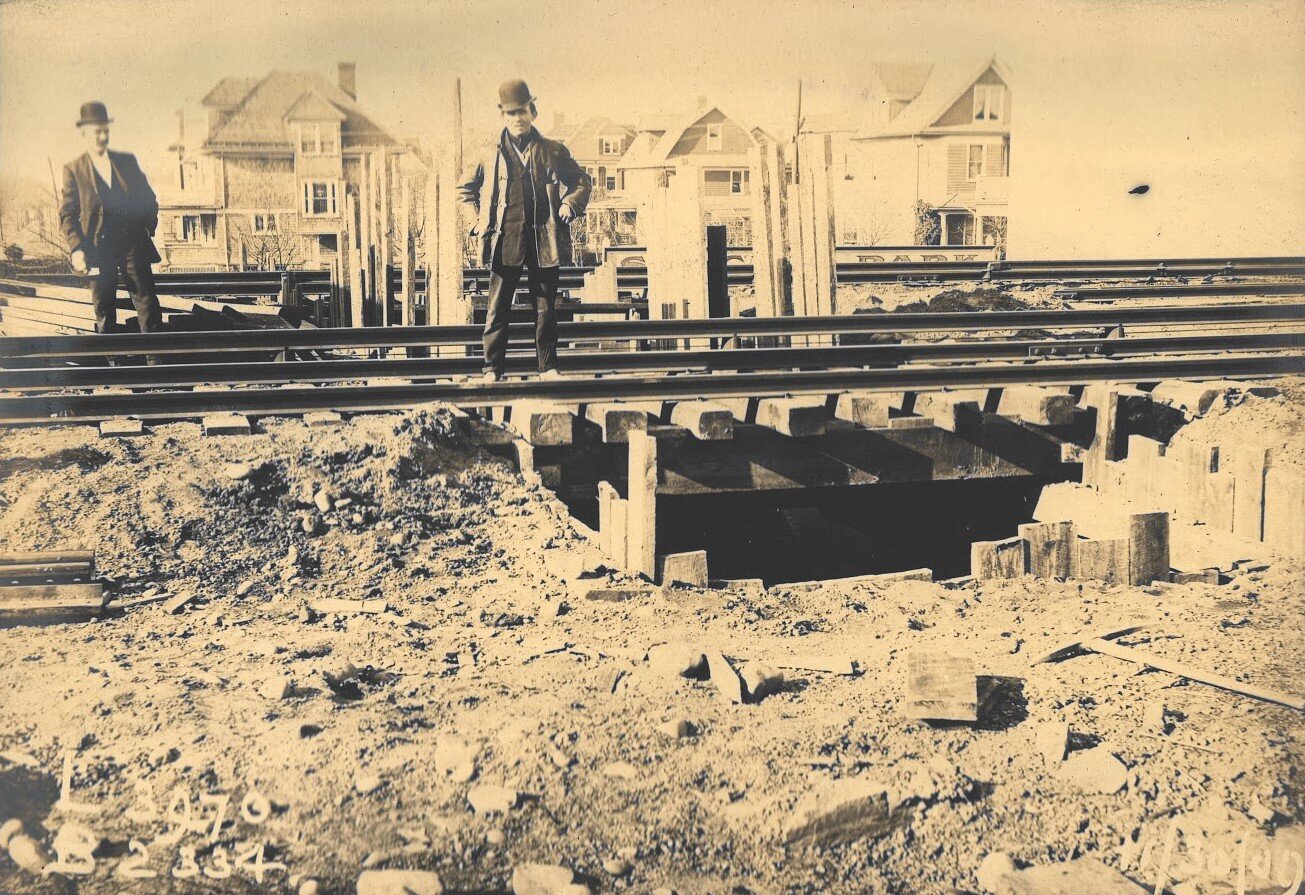
Looking west on north side of Avenue P. Two men wearing derbies on railroad tracks, November 10, 1909. Brooklyn Grade Crossing Photographs, NYC Municipal Archives.

Looking west on north side of Avenue P. Two men wearing derbies on railroad tracks, November 10, 1909. Brooklyn Grade Crossing Photographs, NYC Municipal Archives.

Claire Rosenstein had been working part-time in the Archives for about ten years when we joined the staff. She had retired from a career in television and photograph research. She applied her skill to cataloging the Archives’ many photograph collections. At first, she wrote index cards by hand; later she used a typewriter and towards the end of her more than twenty-five years at the Archives she migrated to the computer. We cannot calculate the number of pictures she cataloged, but it must number in the many thousands.

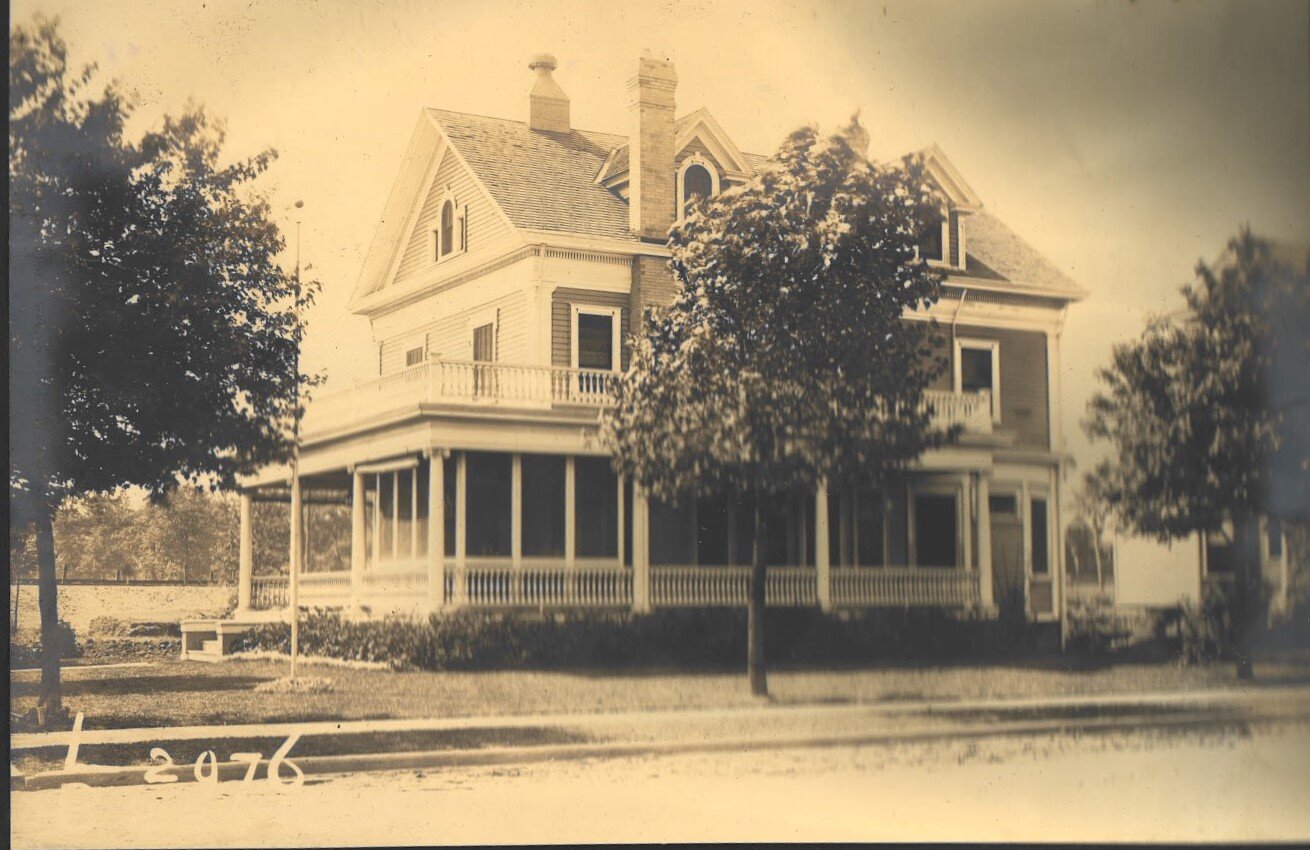
Looking northwest, house on corner of E. 17th Street and Avenue J, August 18, 1908. Brooklyn Grade Crossing Photographs, NYC Municipal Archives.

Looking northwest, house on corner of E. 17th Street and Avenue J, August 18, 1908. Brooklyn Grade Crossing Photographs, NYC Municipal Archives.

The original captions for the Brooklyn Grade Crossing photographs provided only basic information:  date, and place. With her keen eye for detail and her ability to succinctly describe the key features of a photograph in just a few words, Claire Rosenstein added immeasurably to the descriptions. She noted signs, billboards, businesses, and advertisements: Manhattan Beach Every Night…Fireworks Display; Lowney’s Chocolate Bon Bons; Hassan’s family Houses; B. Schellenberg Clothiers; Ryan’s Loan Office; For Good Shoes Go To A. Sonnenschein. She was careful to note people in the pictures: Girl with violin stands by track; One girl, group of small boys face camera; boys all wear caps; half of them are barefoot. She used her knowledge of residential architectural styles and noted unusual examples.

We are honored and humbled to be helping to carry forward her diligent efforts and to continue to advance public access to the Archives.

The Pleasures and Profits of Walking

The Municipal Library’s rare book collection includes a volume titled “Some of Mayor Gaynor’s Letters and Speeches.”  Published in 1913, it is a compendium of the Mayor’s writings on “…a wide range of topics . . . from lively to severe,” as noted in the introduction by W. B. Northrop.  “The Mayor’s Letters are, on the whole, genial; or, even, as he says in one of them, jovial.  Mostly he says just what he likes…”.  This letter had been published in The Independent newspaper, on June 1, 1911.  It is in conversational form, and was dictated.  Look for more of Mayor Gaynor’s literary output in future blogs. 

Mayor William J. Gaynor, portrait, frontispiece, “Mayor Gaynor’s Letters and Speeches,” New York, Greaves Publishing Company, 1913. Municipal Reference Library

Mayor William J. Gaynor, portrait, frontispiece, “Mayor Gaynor’s Letters and Speeches,” New York, Greaves Publishing Company, 1913. Municipal Reference Library


I fear you are taking me too seriously as a walker.  It is true that I have been walking for a good many years, but I do not pretend to be anything more than an ordinary trudger.  During the sixteen years that I was a Justice of the Supreme court I made it a rule to walk from five to seven miles a day.  I did this to keep myself in health. L I sat in bad air in the courtroom.  In the morning I walked a few miles, and after leaving court in the evening I walked a few miles more.

When I became Mayor I simply continued my walking.  I walk from my house to the City Hall in the morning and back in the evening.  That gives me seven miles a day. But I am no walker, nor am I an athlete.  I walk for health, and for the joy of walking.

In 1911 construction of the Municipal Building was well underway.  This is the view that Mayor Gaynor would have seen as he exited City Hall on his journey home to Brooklyn. May 4, 1911. Department of Bridges Plant & Structures Collection. NYC M…

In 1911 construction of the Municipal Building was well underway. This is the view that Mayor Gaynor would have seen as he exited City Hall on his journey home to Brooklyn. May 4, 1911. Department of Bridges Plant & Structures Collection. NYC Municipal Archives

I have for many years done my principal work while walking.  As a judge I frame my decisions and opinions in my mind while walking.  I can think best while walking, and then I can come in and sit down and write off-hand the whole subject.  But let me say again that I am no scientific walker although I take long walks.

It is with my walking as with my being a disciple of Epictetus.  During the campaign for the mayoralty, while every abuse and lie was being heaped upon me, I casually remarked in one of my speeches that what another saith of thee concerneth more him who saith it than it concerneth thee, as Epictetus says.  This seemed to astonish the whole journalistic fraternity in New York City, as though they had never heard of Epictetus before.  My walking seemed to astonish them in the same way.

New Yorkers have always enjoyed walking.  In the 1930s the WPA Federal Writers’ Project created a series of photographs called “Street Scenes,” to illustrate the New York City Guide and other publications. Pedestrians window-shopping on Fifth Avenue…

New Yorkers have always enjoyed walking. In the 1930s the WPA Federal Writers’ Project created a series of photographs called “Street Scenes,” to illustrate the New York City Guide and other publications. Pedestrians window-shopping on Fifth Avenue, near 53rd Street, April 5, 1938. WPA Federal Writers’ Project Collection. NYC Municipal Archives.

I prefer to walk alone and think.  I do not hurry; I just go along at my leisure.  It is true, now and then some one comes alongside of me and thinks the gait is not a very leisurely one, but to me it is leisurely because I am used to it.  I do not see why many or most people do not walk to and from their business every day.  A man wrote me a letter that it was all very well for me to do it, but that his business was two miles away from his house.  I wrote him back that mine was over three.  There is a feeling of independence and freedom when you are walking, and your blood warms up and flows freely, and your body becomes purified.  As I walk over the bridge every night and see the cars packed with anemic young men and women, some of them with cigarettes, I cannot help pitying them.  Why do they not get out and walk and make their bodies ruddy and healthy?  Some of them look out of the car windows, and point at me though I was a curiosity because I walk. I think they are curiosities because they ride, and I injure themselves with the foul air of the cars.

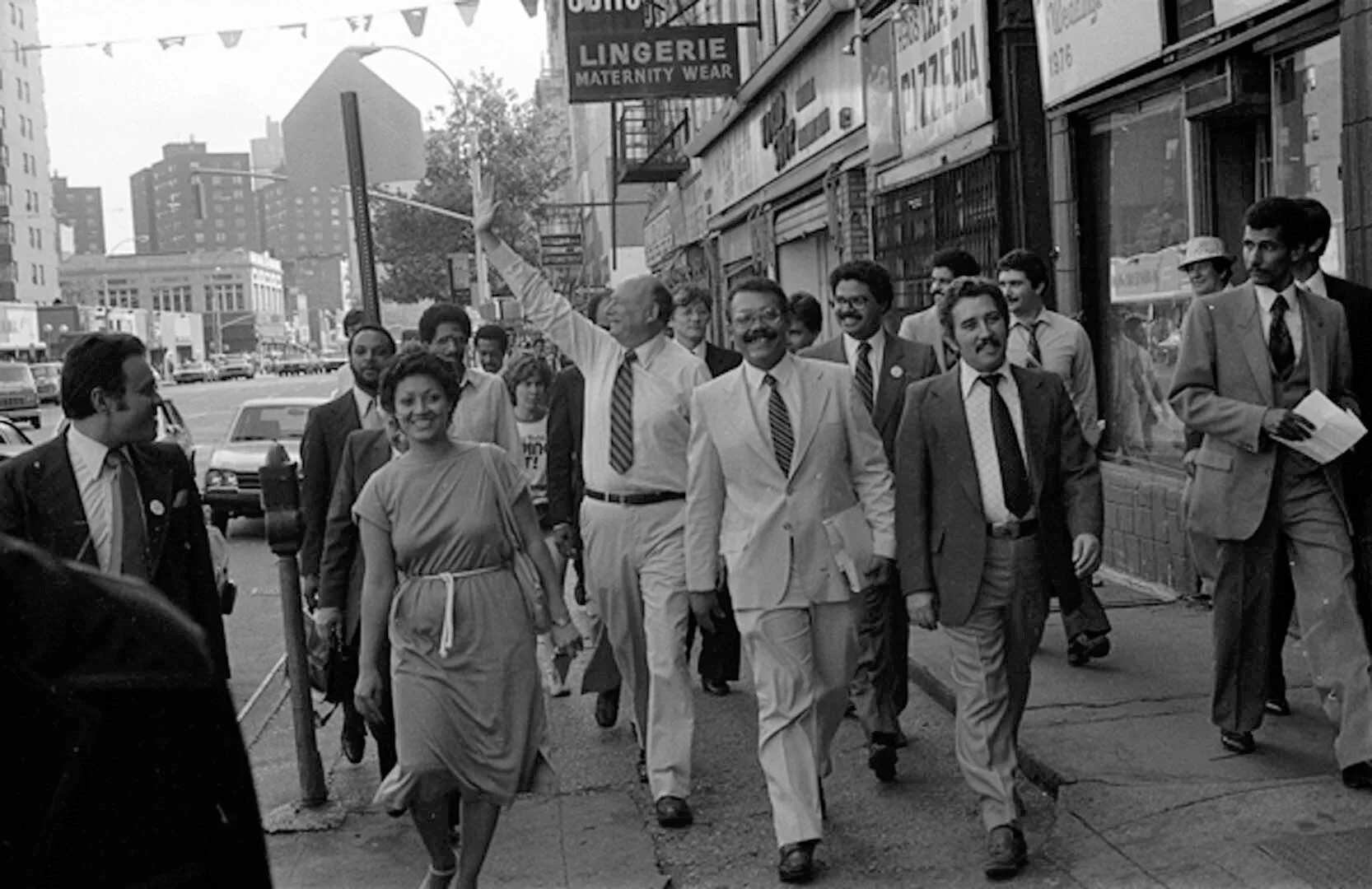
Mayor Gaynor may have preferred to “….walk alone and think,” but not Mayor Edward Koch. The Koch photograph collection includes dozens of pictures of the Mayor and his entourage walking and greeting constituents throughout the city. Walking tour of …

Mayor Gaynor may have preferred to “….walk alone and think,” but not Mayor Edward Koch. The Koch photograph collection includes dozens of pictures of the Mayor and his entourage walking and greeting constituents throughout the city. Walking tour of the Bronx, August 7, 1985. Mayor Edward Koch Photograph Collection. NYC Municipal Archives.

I used to be a horseback rider, but you have to keep that up or else drop it altogether, and you cannot always have time for it.  Besides, it is a rather violent exercise.  I do not think I know any one who has got a dividend out of it.  Then I drove for years.  Out of that I really got nothing.  The street car I always abominated.  They used to have stoves in them, and now they heat them by electricity, and the air becomes foul.  Some people write to me complaining that the cars are too cold.  They ought to be made to walk.

Streetcar on the Brooklyn Bridge, March 3, 1914.  Photographer:  Eugene deSalignac.  Department of Bridges Plant & Structures Collection. NYC Municipal Archives.
Streetcar on the Brooklyn Bridge, March 3, 1914. Photographer: Eugene deSalignac. Department of Bridges Plant & Structures Collection. NYC Municipal Archives.
You ask me the best time for walking.  The best time is in the sun in fall and winter, but if you cannot walk then, the best time is whenever you can walk.  Of course, if you walk home at night during the long winter months you walk after dark.  Morning walking is very refreshing.

Yes, the walking of men like Weston does much good by example.  It starts other people waking.

In the country, the best companion for a walk is a dog.  A half dozen dogs is better yet.

No, you do not want any book while you are walking.  You want to think.  In the country you can loiter about.  You do not need to walk fast and should not do so. Observe nature.  When you come to a barnyard go in and see the pigs, and the fowl and the cows.  Climb a fence now and then and go into the fields and look at the crops or the cattle.  I know of no place where there is more philosophy than in a barnyard.  You can learn much from animals.  Within their circle they know much more than we do.  Some of them see and hear things that we are incapable of seeing and hearing.  Very few animals improve by age.  A little pig a day old knows as much as his mother, and it is the same with a calf or a colt.

I do not like to walk in a park. I hate the roads and walks in parks.  I do not like winding roads.  I like to see where I am going.  Crooked roads are irksome. 

You want to know what about mountain climbing.  I have done some that in this country and in Switzerland, but I do not recommend it.  The hear should not be abnormally taxed.  Of course, if your weight is in your favor you can do some climbing. I went down the other day and walked up ten flights to the top of the building where the terrible fire was, as I wanted to see the floor which were burned out.  If you want to test your heart just walk up ten flights without stopping.  If you can do it, you are all right, no matter what your age is.

Yes, I regret the falling off in bicycling.  I enjoyed it for years and it did me the world of good.  If people will not walk I would advise them to ride the bicycle.  It will renew their lives.  They will be so changed in a month that they will be astonished.

The Queens Borough President photograph collection includes a series of  hand-colored lantern-slides.  This image of a bicyclist is undated.   Queens Borough President Collection.  NYC Municipal Archives.

The Queens Borough President photograph collection includes a series of hand-colored lantern-slides. This image of a bicyclist is undated. Queens Borough President Collection. NYC Municipal Archives.

What nation, you ask, gets the most out of walking.  The English.  They are great walkers.  When I go to London I love to just stand and see them walking down into London in companies in the morning.  The sight is inspiring to me. They walk in from miles around.  Here people are afraid to walk a mile. The greatest rapid transit facilities in the world are right here in our American cities, notwithstanding all the grumbling that is going on.  Wherever you are here in the city of New York you have a street car at your elbow.  The result is that everybody rides and almost nobody walks.  This is harmful.  It would be a good thing if we had to walk more or less.  In England they walk way out to places of recreation.  Now, I do not what else to say to you.  The subject is summed up very easily.  Cultivate the habit of walking and you will never give it up, and it will keep you in health and make you charitable and forbearing.  If you take no exercise you become dyspeptic.  Your blood gets thin, and you find fault with everybody, and by and by you hate everybody, and then you want to be mean to everybody.  That is a terrible condition to be in.  Don’t you think so?  But if you are in it just get out of it by walking a few miles every morning and evening.  Go out and walk in the dark if necessary.   

William J. Gaynor died at age 65 on September 10, 1913. In 1926, Mayor James J. Walker presided over a ceremony dedicating a monument to the late Mayor on the Brooklyn approach to the Manhattan Bridge, May 12, 1926. Photographer: Eugene deSalignac. …

William J. Gaynor died at age 65 on September 10, 1913. In 1926, Mayor James J. Walker presided over a ceremony dedicating a monument to the late Mayor on the Brooklyn approach to the Manhattan Bridge, May 12, 1926. Photographer: Eugene deSalignac. Department of Bridges Plant & Structures Collection. NYC Municipal Archives.

The Design for the Seal of the City of New York

Recently the question of whether the City’s seal has outlived its useful life circulated in the media. The seal is omnipresent on letterhead and other documents issued by City government agencies and officials. While news stories date the current seal to a local law enacted in 1915, the imagery dates back much further. The Municipal Library’s Vertical Files (so called because they consist of file folders of media releases, news clippings and other material held in vertical file cabinets, not shelves) yielded a surprising quantity of material on the subject.

Camera art for the City Seal, NYC Municipal Library vertical files.

Camera art for the City Seal, NYC Municipal Library vertical files.

An interesting history of the City’s seal was published in 1915 in the American Scenic and Historic Preservation Society’s twentieth annual report. Titled “SEAL AND FLAG OF THE CITY OF NEW YORK” it traces elements of the seal to the City of Amsterdam in 1342 at which time William Count of Henegouwen and Holland “made a present to the Amsterdammers of three crosses on the field of the City’s arms.” Not just any crosses but “saltire” crosses which means a diagonal cross—shaped like an X, not a t, and sometimes called a St. Andrew’s Cross. 

City seals and flags are outgrowths from the coats of arms and banners that initially came into use around 1100 when helmeted knights fought in battle. Distinctive color and design were required to identify who was behind a given helmet. An entire craft, heraldry, evolved. This “practice of devising, granting, displaying, describing and recording coats of arms and heraldic badges is complicated.” There are many rules around the shapes, designs, colors, patterns, and division of the shield into halves, thirds, quarters, etc. There is a separate set of directions for identifying where an item should be drawn or placed, consisting of numbered locations within the shield and, most important for our purposes, four cardinal points: chief for the top, base for the bottom, dexter for the left and sinister for the right (in Latin, dexter means right, and sinister left, but the positions refer to the shield bearer’s perspective). The design of New York City’s official seal incorporates all of these practices.

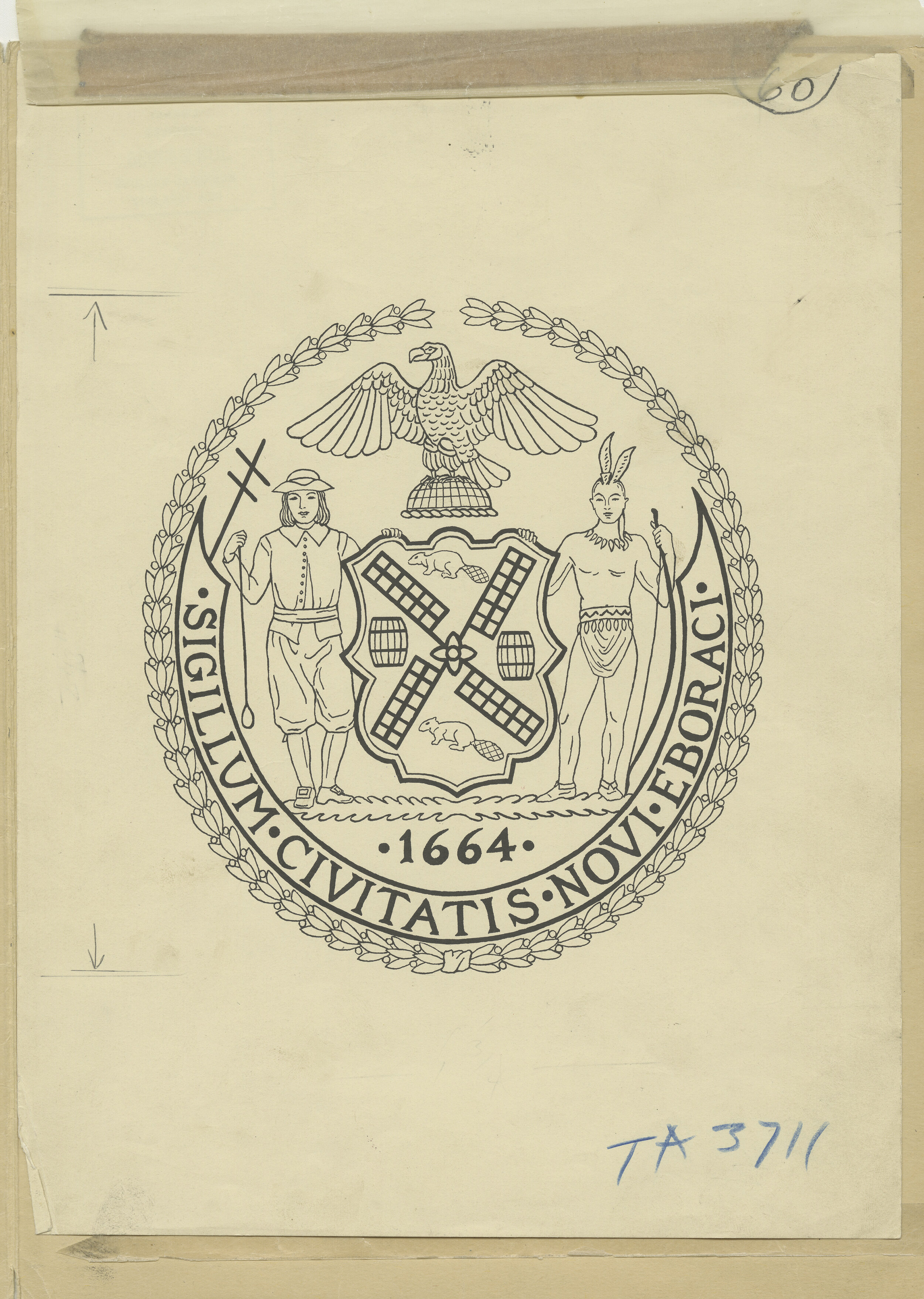
Evolution of the City Seal, NYC Municipal Library vertical files.

One consistent feature on the New York City seal is the image of a beaver. The fur trade formed the basis of commerce for New Netherlands, including New Amsterdam and the beaver was the foremost symbol. Interestingly a beaver both had value as a commodity and as currency itself. In the Scenic Society’s report the author notes, “The intelligence and industry of these little animals, their ingenuity as house-builders and their amphibious character make them eloquent symbols also for the City of New York. So far as we know, the use of the beaver in the arms of New Netherland, New Amsterdam and New York City is unique in heraldry.”

Documentation on the ornamental cast-iron seals that decorated the old West Side Highway shows the evolution of the City’s seal. The Seal of the Province of New Netherland, adopted in 1623, is made up of two shields—the smaller contains an image of a beaver and the larger, which surrounds the smaller, consists of a string of wampum. It is topped by a crown and the outer border is ringed with the Dutch words for “Seal of the New Belgium.”  (Holland and Belgium were united at that time.)

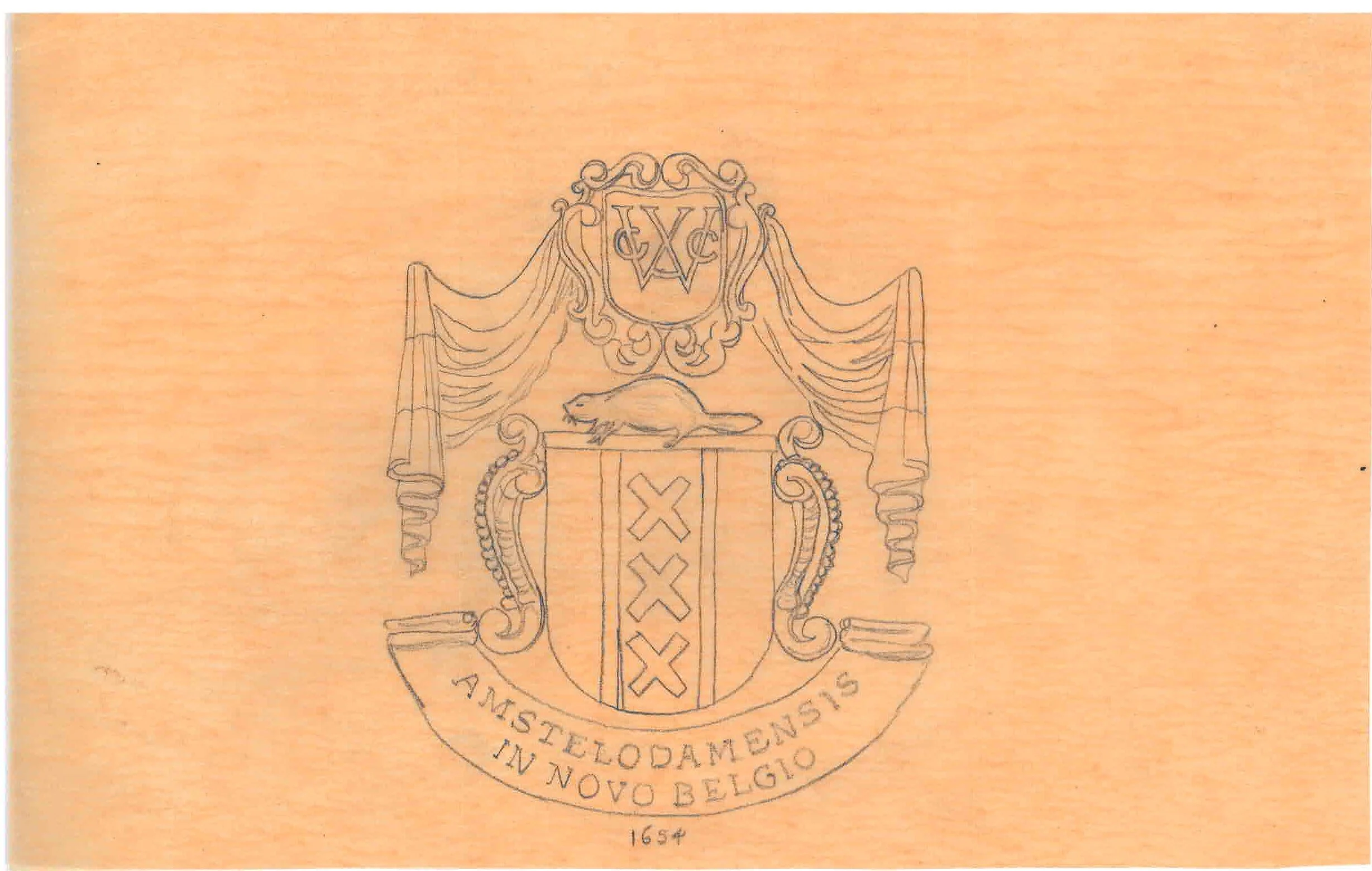
In 1653, New Amsterdam developed a municipal government, the Burgomasters and Schepens, which petitioned the West India Company for its own seal, which was received in 1654. Once again, there were two shields. Arranged one atop the other with a beaver between them, the larger shield contained three saltire crosses. There was drapery above and a label with the words “Seal of Amsterdam in New Belgium” at the bottom.

Tracing of the seal of New Amsterdam, NYC Municipal Library vertical files.

Tracing of the seal of New Amsterdam, NYC Municipal Library vertical files.

Ten years later, the Dutch surrendered New Amsterdam to the English and the City was renamed New York, after the Duke of York. The provincial seal was centered around the coat of arms of the Stuarts and was encircled with the Latin words meaning “Evil to Him who evil thinks.”  There is a crown atop the shield and all is encircled by a laurel wreath. This is the only seal without the otherwise ubiquitous beaver. In 1686, the rights of the City were affirmed by Governor Dongan in the Dongan Charter which also provided for a City seal. In the center is a shield on which the sails of a windmill are arranged in a saltire cross. There are two beavers and two flour barrels alternating between the crosspieces of the windmill. On either side of the shield are human figures—on the dexter side a sailor holding a device for testing the depth of water; on the sinister, a Native American image.

After the British evacuated the City in 1783, the new government updated the 1686 City seal to remove the Imperial crown. Atop the shield they placed an image of an eagle standing on a hemisphere. It’s dated 1686 to commemorate the Dongan Charter and the words “Seal of the City of New York” are inscribed in Latin. Most of these design elements are present in the City’s seal (and flags) today.

Seal of the Office of the Mayor, NYC Municipal Library vertical files.

Sometimes the use of the City seal was contentious. Common Council minutes from 1735 address an apparent wanton use of the city seal without proper authorization and there was some concern that the Mayor was not providing the Council with use of the seal. The Council passed an ordinance that “lodges and deposits the common seal in the hands and custody of the Common Clerk” of the city—today the city clerk—and further banned alternative city seals. The ordinance restricted the use of the seal to actions taken by the Common Council or the Mayor’s Court.

A review of the archival records in the Office of the Mayor collection starting with the so-called “early mayors” shows that correspondence was not bedecked with official letterhead. In many letters the tops of the pages were blank. In other instances, the name of the agency writing the letter was hand written at the very top of the page, followed closely by the text of the letter, written in flowing cursive. That’s not to say that there wasn’t a City seal in use. But, its’ use was sparing, apparently deployed to certify some official documents, not run-of-the-mill correspondence. A case in point is an 1816 certificate issued by Mayor Jacob Radcliff certifying that a woman named Nancy, approximately 60 years of age, was a free woman and could travel. An embossed seal is embossed at bottom of the document. It bears all the elements of the seal in effect today.

In 1914, a group of former members of the Art Commission was appointed to provide an accurate rendering of the corporate seal of the City, and a design for a City flag. The various departments and boroughs had been using variations of the seal which created confusion about the provenance of official documents.

Based on the recommendation of this committee, in 1915 the Board of Alderman amended the City’s Code of Ordinances relating to the city seal, flags and decorations on city hall. The Aldermen re-established the 1686 seal as updated in 1784 and required it to be used for all documents, publications or stationery issued or used by the city, the boroughs and the departments. They made some minor style changes-the shape of the seal, the position of the eagle, etc. and also changed the date on the seal from 1686, the date of the Dongan Charter to 1664, the year the City was named New York.

It is in this legislation that a major error was made. Apparently the bill’s drafters were not versed in the heraldic arts. As a result, the cardinal directions of “dexter” and “sinister” were assigned as the names of the figures in each location. So the sailor holding a depth reading device was named “Dexter” for the left sided placement and the Native American figure placed on the right was named “Sinister.” How this happened is lost to history. One would think the high-profile former Art Commissioners would have sounded the alarm and corrected the error, which still exists.

In 1975, City Council President Paul O’Dwyer sought to change the founding date on the seal from the existing 1686 date marking the issuance of the Dongan Charter, to 1625 when the Dutch established New Amsterdam. The legislation also invalidated all former seals bearing the 1664 date.

As mentioned, not only is there a City seal, but each of the boroughs have separate seals or emblems dating to the colonial period. After consolidation of the Greater City in 1898, the boroughs continued to use these seals for various official purposes until 1938 when the Board of Estimate mandated that the seal of the City of New York would replace any previous seals that had been in use. Thereafter, the various seals were to be found on the borough flags and not on official documents. But the use of the seal continued to vex officials and in 1970, the Board of Estimate mandated that the seal of the City be placed on each letterhead and restricted the use of a gold seal to the Board of Estimate and the Vice Chair of the Council.

Seal of the Borough of Queens, NYC Municipal Library vertical files.

The flag for the borough of Queens was announced in 1948 after a design competition.  The three-paneled seal included a tulip commemorating the Dutch on the dexter side, a double Tudor rose documenting the English on the sinister side. The border consists of shells used as money “wampum.”  At the very top of there is a crown signifying that the borough was named for a Queen, namely Queen Catherine Braganza wife of England’s King Charles the Second.

According to an excerpt in the files from a 1925 history, “the Boroughs of Brooklyn and Queens, Counties of Nassau and Suffolk Long Island, New York 1609-1924” Brooklyn’s seal was established by the West India Company in 1664.  It consists of an image of the Roman goddess Vesta (equivalent to the Greek goddess Hestia) holding fasces—or bunch of rods and an axe bundled together.  Apparently, this reflected the colony’s agricultural status. The motto surrounding the seal translates to “unity makes strength” which in 1664 was an update from the 1556 motto on the coat of arms of William the Silent, Prince of Orange. When the Village of Brooklyn officially incorporated in 1817, the seal was adopted by the common council.

Seal of Staten Island, NYC Municipal Library vertical files.

The seal of the Borough of Richmond, aka Staten Island, has gone through several evolutions. The Dutch named the island after the “Staten General” of their legislature. One seal consists of two doves facing each other with the letter S (for Staten) between them and N YORK beneath their feet. Another early seal has a female figure gazing toward the water in which two ships sail, one purportedly Henry Hudson’s Half Moon. In 1970, the then- Borough President held a contest to develop a better emblem. The winner was an oval with waves surrounding an island with birds flying in the sky above and STATEN ISLAND written between the waves and the island. However, this design was not universally admired. The Staten Island Advance reported that current Borough President James Oddo redesigned the emblem in 2017 to incorporate elements of the woman gazing out on the Verrazzano Narrows as well as oystermen, a moon and stars.

The Bronx, by contrast, maintained its seal, adopting the coat of arms of Jonas Bronck who settled in the area in 1639. A sun rises from the sea and a globe topped by an eagle stands above it. The Latin motto under the shield translates to “do not give way to evil.”  This same design was the basis for New York State’s post- revolutionary coat of arms.

Brooklyn Markets Seal, NYC Municipal Library vertical files.

Brooklyn Markets Seal, NYC Municipal Library vertical files.

Notwithstanding this requirement that the City seal be use on all official materials, some agencies developed their own seals. In 1940, Mayor Fiorello LaGuardia announced the conclusion of a contest, with a $10.00 prize won by a high school student, to design a seal for the Department of Markets. The seal featured a scale, a bundle of wheat and two full cornucopias. More recently, the New York Police Department (NYPD) developed a seal described in the agency’s 1987 annual report. It’s a somewhat cluttered design with the names of the five boroughs creating an interior ring. The City seal is at the bottom and the upper portion includes the words Lex and Ordo (Law and Order). The scales of justice are balanced atop the fasce and what looks to be a rocket (but probably isn’t) explodes from the top.

NYC Housing Authority Seal, NYC Municipal Library vertical files.

NYC Housing Authority Seal, NYC Municipal Library vertical files.

New York's Working Waterfront

New York City is an archipelago of islands.  Of the five Boroughs, only the Bronx is connected by land to the continental United States. When temperatures rise many New Yorkers naturally gravitate to the 520 miles of shoreline along the rivers, bays and ocean that surround the city.  Or would, if they could. 

In recent years, sections of the waterfront have been reclaimed for housing and recreation; Brooklyn Bridge Park and Hudson River Park are two notable examples.  But from the days of the first Dutch colonial settlement in the 1600s, until the 1960s, most of the waterfront had been virtually inaccessible except to those involved in the commercial maritime activities that had been the basis of the city’s economy.   And if not consumed by docks, piers, factories and other structures, transportation arteries – railways, parkways, and highways – girded many more miles of the waterfront, further impeding access.    

The Municipal Archives collections includes extensive documentation of the City’s investment in its waterfront.  The records date from the earliest years of the Department of Docks (1870– 1897); Docks and Ferries (1898 -1918); Department of Docks (1919-1942); Marine and Aviation (1942-1977); Ports and Terminals (1978-1985), through its final iteration, the Department of Ports and Trade (1986-1991).  These series offer hundreds of cubic feet of maps, surveys, official correspondence and photographs.

Here are some of the more evocative images of New York’s working waterfront in its glory days.

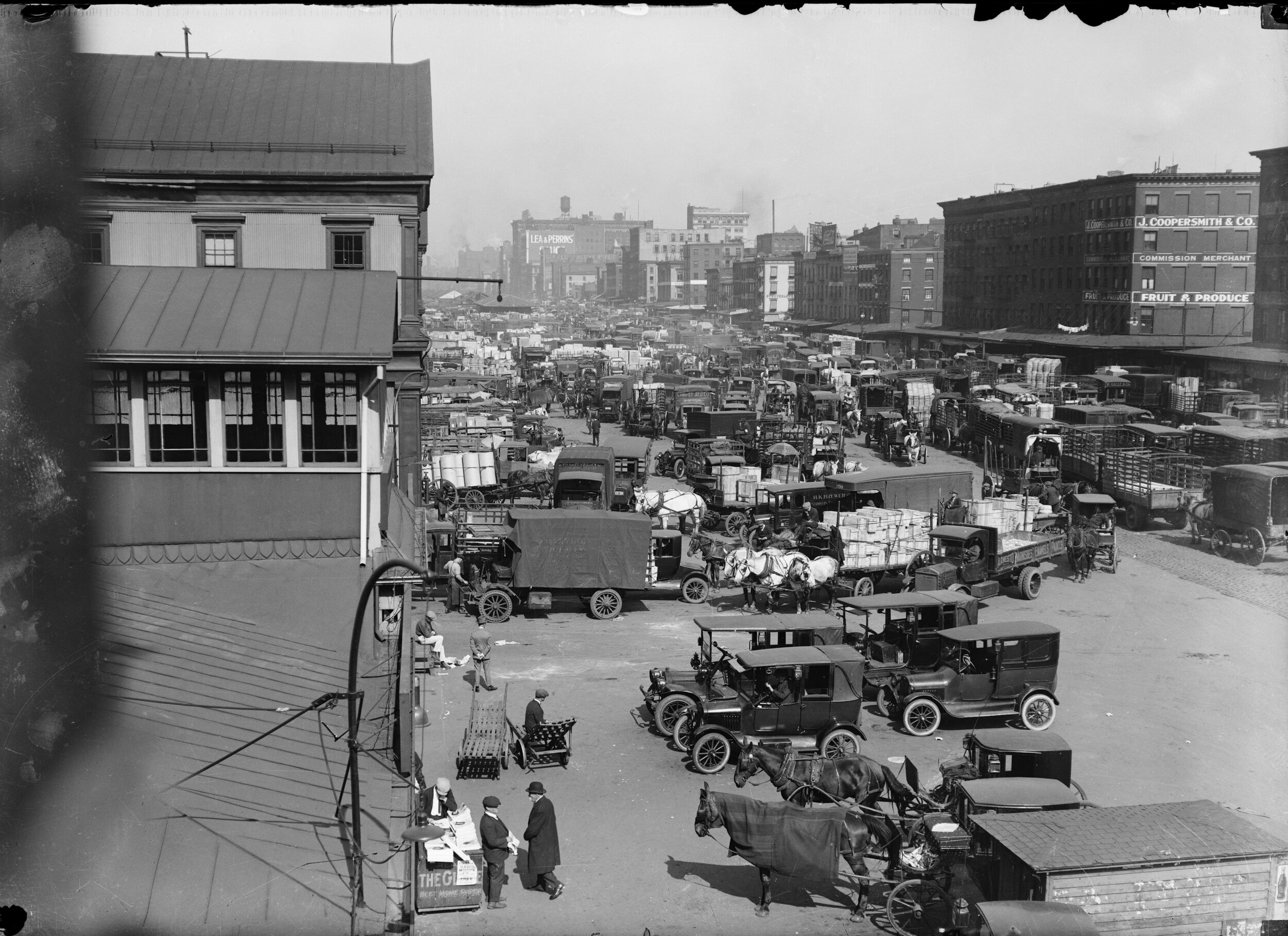
The Department of Docks photograph collection includes numerous large-format glass-plate negatives that depict the intense commercial activity along both the East and North (Hudson) River waterfronts. West Street, ca. 1922. Department of Docks Colle…

The Department of Docks photograph collection includes numerous large-format glass-plate negatives that depict the intense commercial activity along both the East and North (Hudson) River waterfronts. West Street, ca. 1922. Department of Docks Collection. NYC Municipal Archives.
Teams waiting at East 35th Street for the ferry to Brooklyn, November 1910. Department of Docks Collection. NYC Municipal Archives.

Teams waiting at East 35th Street for the ferry to Brooklyn, November 1910. Department of Docks Collection. NYC Municipal Archives.

Dozens of steamship lines brought hundreds of thousands of immigrants to the United States via New York City. Italian Line, West 34th Street, 1903. Department of Docks Collection. NYC Municipal Archives.

Dozens of steamship lines brought hundreds of thousands of immigrants to the United States via New York City. Italian Line, West 34th Street, 1903. Department of Docks Collection. NYC Municipal Archives.
Not every inch of the waterfront was devoted to commercial activities. In 1897, the Department of Docks built the first Recreation Pier at Corlear’s Hook in Manhattan; others were added on the East River at 112th Street, and the Hudson River at Chri…

Not every inch of the waterfront was devoted to commercial activities. In 1897, the Department of Docks built the first Recreation Pier at Corlear’s Hook in Manhattan; others were added on the East River at 112th Street, and the Hudson River at Christopher Street and 50th Street. Designed in the French Renaissance style they featured seating for 500 on the second floor and typically offered musical entertainments and food concessions. Recreation Pier Rendering, undated. Department of Docks Collection. NYC Municipal Archives.
Recreation Pier. The sign over the entry doors reads: “Dancing on this Pier for Children from 3 to 5 p.m. Daily Except Sunday." Recreation Pier, undated. Department of Docks Collection. NYC Municipal Archives.

Recreation Pier. The sign over the entry doors reads: “Dancing on this Pier for Children from 3 to 5 p.m. Daily Except Sunday." Recreation Pier, undated. Department of Docks Collection. NYC Municipal Archives.

The Cty began building the East River Drive in 1929 and the West Side Highway in 1931. By the time master builder Robert Moses finished construction in the 1950s, multi-lane arterial highways would line the waterfronts of four of the five Boroughs. …

The Cty began building the East River Drive in 1929 and the West Side Highway in 1931. By the time master builder Robert Moses finished construction in the 1950s, multi-lane arterial highways would line the waterfronts of four of the five Boroughs. Elevated Public Highway, looking south from Duane Street, June 23, 1937. Borough President Manhattan Collection. NYC Municipal Archives.
Completed in 1910, the Chelsea Piers along the Hudson River between Little West 12th Street and West 23rd Street were built to accommodate the new Titanic-class of ocean liners coming from Europe. Warren & Wetmore, architects of Grand Central Te…

Completed in 1910, the Chelsea Piers along the Hudson River between Little West 12th Street and West 23rd Street were built to accommodate the new Titanic-class of ocean liners coming from Europe. Warren & Wetmore, architects of Grand Central Terminal, designed the pier sheds. Pier 56, Chelsea Piers Elevation, Department of Ports and Trade Collection. NYC Municipal Archives.

In the 1930s, W.P.A. Federal Writers’ Project staff photographed dockworkers loading and unloading cargo on piers throughout the city. By the 1960s, containerization would eliminate thousands of these jobs. Unloading coffee from Brazil at the Gowanu…

In the 1930s, W.P.A. Federal Writers’ Project staff photographed dockworkers loading and unloading cargo on piers throughout the city. By the 1960s, containerization would eliminate thousands of these jobs. Unloading coffee from Brazil at the Gowanus Bay Pier, Brooklyn, ca. 1937. WPA-Federal Writers’ Project Collection. NYC Municipal Archives.

The fishing industry persevered in lower Manhattan until 2005 when it relocated to the Hunts Point Market in The Bronx. Fulton Fish Market, April 14, 1952. Department of Marine and Aviation Collection. NYC Municipal Archives.

The fishing industry persevered in lower Manhattan until 2005 when it relocated to the Hunts Point Market in The Bronx. Fulton Fish Market, April 14, 1952. Department of Marine and Aviation Collection. NYC Municipal Archives.

By the mid-20th century, New York was one of the worlds’ greatest port cities. At its peak this vast infrastructure extended well beyond lower Manhattan and included miles of Brooklyn’s waterfront. Aerial view of the Brooklyn waterfront near Atlanti…

By the mid-20th century, New York was one of the worlds’ greatest port cities. At its peak this vast infrastructure extended well beyond lower Manhattan and included miles of Brooklyn’s waterfront. Aerial view of the Brooklyn waterfront near Atlantic Avenue, September 19, 1956. Department of Marine and Aviation Collection. NYC Municipal Archives.

The Department of Marine and Aviation collection includes large format color transparencies. Aerial view, East River, Manhattan, November 5, 1953. Department of Marine and Aviation Collection. NYC Municipal Archives.

The Department of Marine and Aviation collection includes large format color transparencies. Aerial view, East River, Manhattan, November 5, 1953. Department of Marine and Aviation Collection. NYC Municipal Archives.

Until the advent of jet air service in the 1960s, luxury ocean liners dominated the trans-Atlantic market. The S.S. United States and the S.S. America, New York harbor, April 7, 1963. Department of Marine and Aviation Collection. NYC Municipal Archi…

Until the advent of jet air service in the 1960s, luxury ocean liners dominated the trans-Atlantic market. The S.S. United States and the S.S. America, New York harbor, April 7, 1963. Department of Marine and Aviation Collection. NYC Municipal Archives.

In the 1960s the commercial cargo industry defected to the Port of Newark in New Jersey which had space to accommodate the mechanized equipment needed to load and unload the containerized shipments. Many of the City’s plans to improve its waterfront…

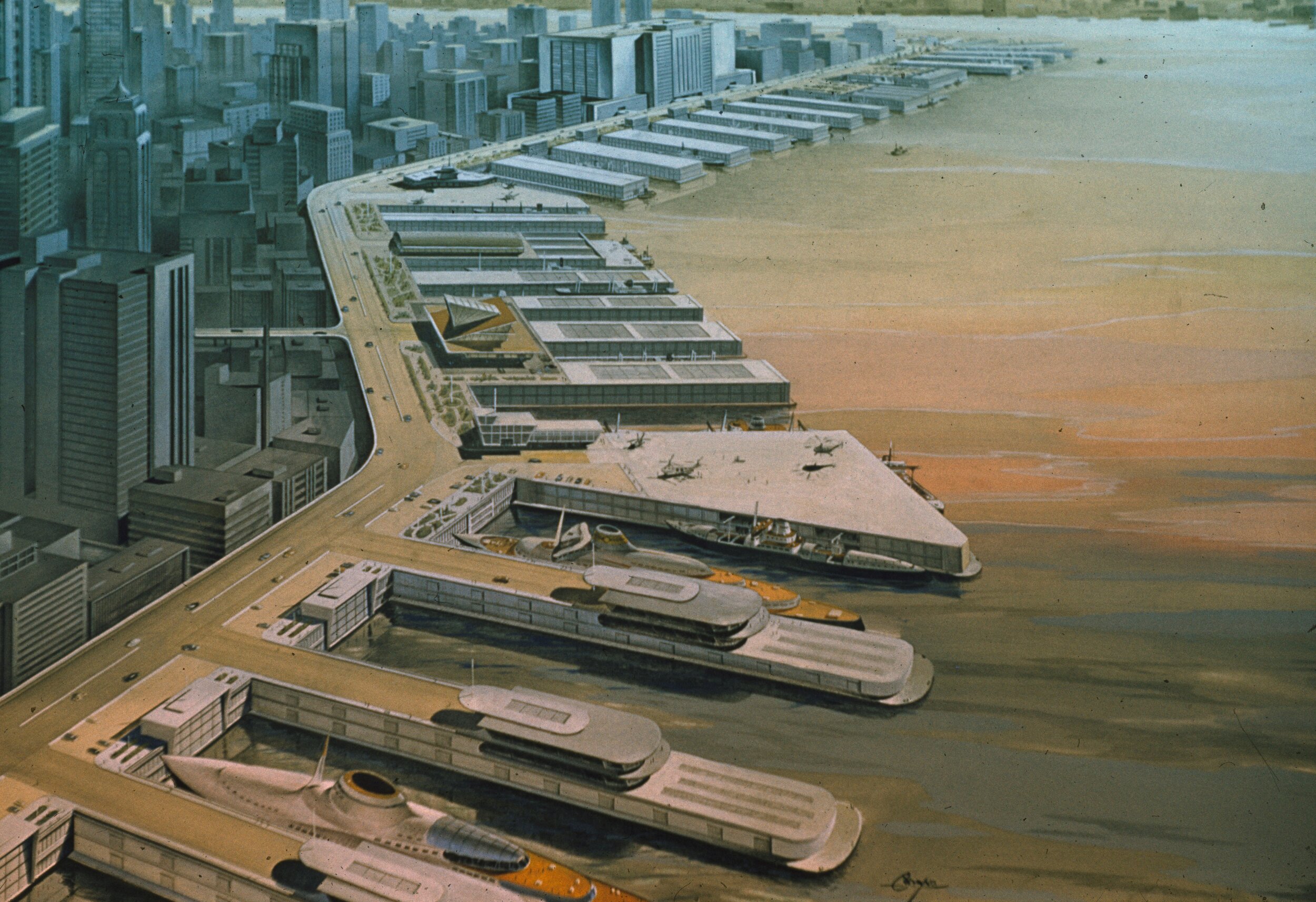
In the 1960s the commercial cargo industry defected to the Port of Newark in New Jersey which had space to accommodate the mechanized equipment needed to load and unload the containerized shipments. Many of the City’s plans to improve its waterfront infrastructure during that time period went no further than the drawing board. East River, Manhattan, Pier Improvements, Rendering. Department of Marine and Aviation Collection. NYC Municipal Archives.

Perhaps Department of Marine and Aviation Commissioner Edward F. Cavanagh was mourning the end of an era as he watched the arrival of the Queen Mary in New York harbor on February 6, 1953. (Negative damaged.) Department of Marine and Aviation Collec…

Perhaps Department of Marine and Aviation Commissioner Edward F. Cavanagh was mourning the end of an era as he watched the arrival of the Queen Mary in New York harbor on February 6, 1953. (Negative damaged.) Department of Marine and Aviation Collection. NYC Municipal Archives.

Inspiring Women – The Women’s Activism Story – Writing Contest

1.jpg

Who are the women who inspire you? Public figures, historic change makers or perhaps women you know personally and admire.  Our communities are home to countless inspirational women – friends and neighbors, teachers and community leaders - yet their stories are seldom told.  Now, you’re invited to enter the WomensActivism.NYC  Story Writing Contest for a chance to win prizes of $500, $350 and $150 by sharing the important role these women played in your life, your community or the world. 

WomensActivism.NYC is a project spearheaded by the NYC Department of Records and Information Services (DORIS) in celebration of the 100th anniversary of women gaining the right to vote in the United States.  The stories collected for the contest will be preserved by the Municipal Archives to inspire future generations.  The goal is to collect 20,000 stories honoring women across the globe by the close of 2020. 

This is your opportunity to help write the women who inspire you into history.

The contest is sponsored by the New York Archival Society, which acts as a fiscal agent, advocate, and promoter of the City's archives and library.  Story submissions will be accepted from July 15 – August 15, 2020. Winners will be announced by August 25, 2020. For contest rules and guidelines visit  NYArchivalSociety.

 On August 26, 2020, the centennial of women’s suffrage in the U.S., DORIS will mark the occasion by lighting up the New York City skyline in purple and holding a virtual write-in event. For more information, please email: womensactivism@records.nyc.gov

Read the stories of these inspiring women, add your own, and, maybe, win a prize!


Helen Praeger Young

Helen Praeger Young, 1932 – Today.  By Ann Reisenauer

My neighbor, Helen Young, is a remarkable woman. She’s an ardent supporter of women’s rights, a role model and mentor for many women including myself. Although she’s now in her 80s, she’s still feisty and outspoken. She’s played many roles in her life – mother, teacher, writer, and women’s rights activist. When she went back to college in her 40s, her classmates were the same age as her kids. But that didn’t stop her. She moved to China and learned another language and culture in her late 40s and 50s. She gave her first academic paper and published a book about women Red Army soldiers on the Long March in her 60s, and presented her first paper at an international conference at 70. Although Helen’s been a feminist her entire life, she became more active in the women’s movement while teaching at the Beijing Foreign Studies University. There she was a founder of the Women’s Studies Forum and later started a branch of WSF at Stanford as a visiting scholar. In 1995 Helen was an NGO delegate to the 4th UN conference on Women in Beijing. Helen is still going strong in her 80s – championing women’s rights and pushing for adoption locally of the Convention on the Elimination of All Forms of Discrimination against Women (CEDAW). This major UN treaty says that all discrimination against girls and women must end. The US is one of six countries left to ratify this treaty. Helen is working to change that. Helen’s advice for others: “If there’s an issue that interests you, learn what you can, find an organization to work with and get busy. Try to generate enthusiasm – but stay with it.” What keeps her motivated? She wants to see CEDAW implemented while she’s still alive – that and stubbornness, the key to success.


Annie Harper

Annie Harper, 1920 – 2015, by Sandye Wilson

Annie Harper was fearless, unyielding, bigger-than-life, and at times, a bit of a tyrant. She was tough. Annie was Born in Saluda, South Carolina, on October 19, 1920 or ...maybe it was October 20. Annie often said, ‘They didn’t always get the birth certificate right with colored folks back then, but, no matter… I am here.’ Yes, she was. Annie Harper was SO here. She was a nurse and a matriarch to many. Annie had a no-nonsense demeanor; a big laugh and personality but she didn’t suffer fools, lightly. Incredibly generous, there were many folks that counted on her in some kind of way... whether they needed money or food or a way out of a situation that was much too painful for them. Annie gave without expecting in return. She was direct and stern but supported anyone in need. She taught me to do the same; to walk in other's shoes; to live in truth and integrity and to always be in service...but not to be a fool. Annie was something... She filled my childhood with laughter, southern rituals, church, car trips up north, coconut pies, boiled peanuts, fried fish with biscuits and Annie-isms that will last a lifetime. One of my fondest memories was when my boyfriend and I went to visit Annie in Columbia, South Carolina, in the 1980’s before we took a cross country road trip. We had an old, sexy, white, two seater, spitfire car. We were just in the midst of saying our goodbyes… I was a bit teary-eyed when Annie pulled me aside and said ‘Take a little walk with me before you get back on that road.’ She handed me an envelope with a wad of cash in it… I tried to give it back to her. I told her that we had both saved up for the summer for this trip so we were prepared. I wanted her to know I was all grown up. Annie shook her head and said ‘Take this money, you gon’ need it—That car ain’t gonna make it cross country’… She was right. Annie died on June 17, 2015 at age 94. I was unable to stand up and speak at her funeral… I felt my legs and heart unstable… Here’s to Annie: Thank you for the love, the fierce care, for straightening my hair and letting it out so I could feel it down my back… Thank you for making sure I woke up in church in time for the sermon, for sewing my clothes so beautifully, for the car trips, the coconut pies, the money when I needed it. Thank you for sharing the brandy with me when I was finally an adult… and telling me that I could re-invent myself at any time because the world really was mine....


Meghan Farina

Meghan Farina

Meghan Farina, 1995 - 2008

Meghan’s amazing sense of humor is the first thing you’ll notice about her, next to her warm smile. Although she only was given 13 years with us, in those 13 years she filled everyday with laughs and love. Even after she was diagnosed with Diffuse Intrinsic Pontine Glioma (DIPG), a rare childhood brain tumor located on the brainstem, her personality was unchanged. Meghan joked with all the nurses and doctors, and kept my family positive in a time that was not. Her perseverance in the difficulty that was thrown at her was and is truly inspiring, refusing to give up. One memory that paints a picture of her wonderful sense of humor and tremendous heart was when she was asked by the Make a Wish Foundation if she had a wish. She could ask for anything in the world, but asked for a dozen Krispy Kreme donuts. My dad asked her if that was all she wanted, and she responded, “Okay… TWO dozen donuts.” She ended up asking to go to the filming of High School Musical 3, but they didn’t have room. When told that she wouldn’t be able to go, my sister apologized for taking too long to decide. This is how my sister was; genuine, giving, hilarious, and strong; and she refused to let this terrible disease change that.


On August 26, 2020, the centennial of women’s suffrage in the U.S., DORIS will mark the occasion by lighting up the New York City skyline in purple and holding a virtual write-in event. For more information, please email: womensactivism@records.nyc.gov

5.jpg