Today’s For the Record is another installment of a new series we are calling “These are a Few of Our Favorite Things.” The staff at the Department of Records has the lucky task of working directly with the historic materials held in the country’s largest archive, and every now and then they come upon a real gem. Usually, they snap a picture on their phone, maybe share with a colleague or two and then the image lingers in the cloud with all their other quick pics. “Our Favorite Things” aims to end that and share some of these little treasures with you. We hope to highlight some of our lesser-known collections and share the passion and dedication that our archivists and records professionals have as they work to preserve the history of New York City.
We hope you enjoy!
Patricia Glowinski
One of my favorite things about being an archivist at the NYC Municipal Archives is that there are no boring days on the job. I am surrounded by millions of stories documented and preserved in the records stewarded here. One of my favorite things about living in New York City is the people. Every New Yorker has a story. Dig a little deeper into these stories and you’ll find connections.
My favorite part of the New York City Historical Vital Records are the Maritime birth, death, and marriage records, 1901-1948. They document people who were born, married, or died at sea. Though there are very few of these records in the Archives, they are revealing.
REC0051_05_01_M-01: Lortel-Schweitzer Marriage Certificate, 1931. NYC Municipal Archives. Lucille was actually 30 in 1931. Like many actresses of the era, she was known to lie about her age.
On March 23, 1931, Lucille L. Wadler and Louis Schweitzer were married at sea aboard the S.S. Leviathan at Latitude 42-35N and Longitude 56-05W. I came across their marriage certificate when I was preparing the collection guide. When I searched for their names on the Internet, I found two incredible New Yorkers.
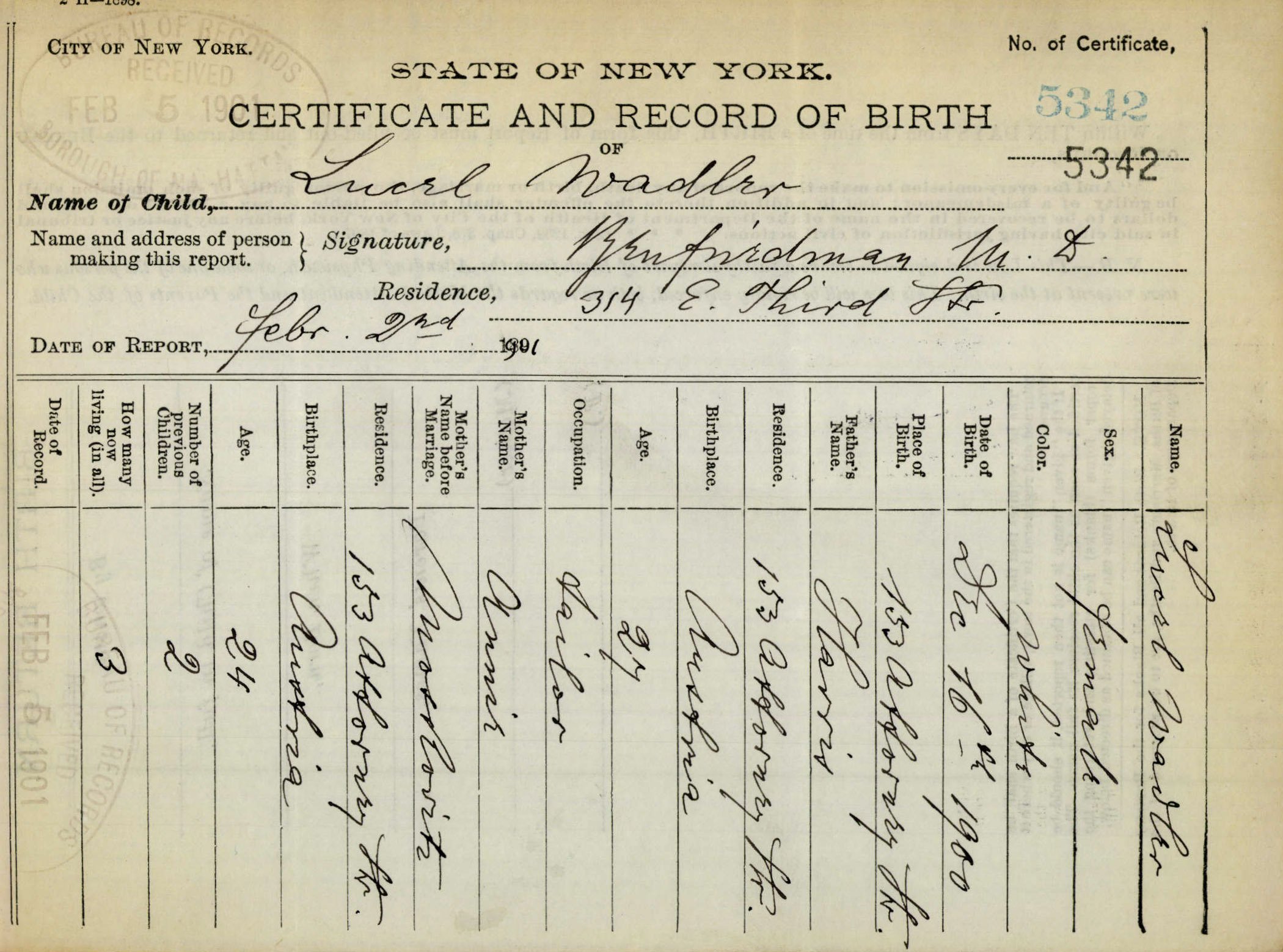
B-M-1901-0005342: Luciel Wadler Birth Certificate, 1901. NYC Municipal Archives. Lucille was born on December 16, 1900, but her birth was not registered until February 2nd, 1901. Not unusual for home births.
Their occupations are listed on their marriage certificate as “actress” and “motion picture business,” respectively. Lucille’s stage name was Lucille Lortel. Her Broadway debut was in 1925. She gave up acting in 1939 and founded a theatre in Connecticut and then took over another in Greenwich Village, the Theatre De Lys (now the Lucille Lortel Theatre) at 121 Christopher Street. Focusing on experimental theatre, the production of The Threepenny Opera was the first to win a Tony Award for an Off-Broadway production.
121 Christopher Street, ca. 1939. Dept of Finance Tax Photo Collection, NYC Municipal Archives.
Born in Russia, Louis came into money from his family’s paper company. Like myself, he was a lover of radio, and he purchased WBAI in 1957. If you’re a fan of local, listener-supported, news, art, and music radio, then you probably know WBAI. Louis also founded the Vera Foundation (now the Vera Institute of Justice) in 1961 to “end the overcriminalization and mass incarceration of people of color, immigrants, and people experiencing poverty.”
Depending on which location I work at (the Archives are stored in Manhattan or Brooklyn), I walk past the Lucille Lortel Theatre in the Village and the Vera Institute of Justice in Sunset Park on a regular basis. With just a simple dive into the archives, I feel more connected to the past and present city I live in.
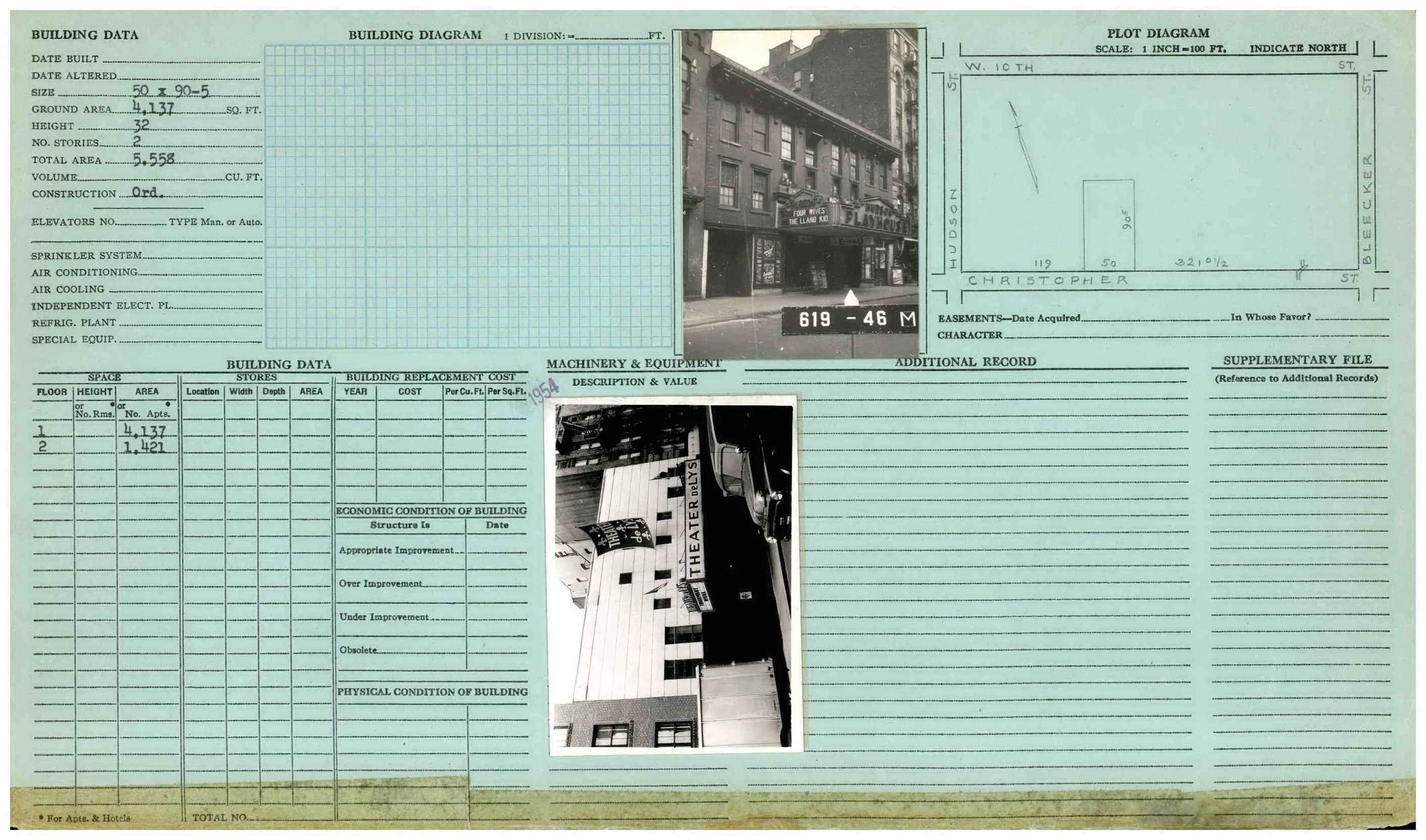
121 Christopher Street. Department of Finance Property Card, NYC Municipal Archives.
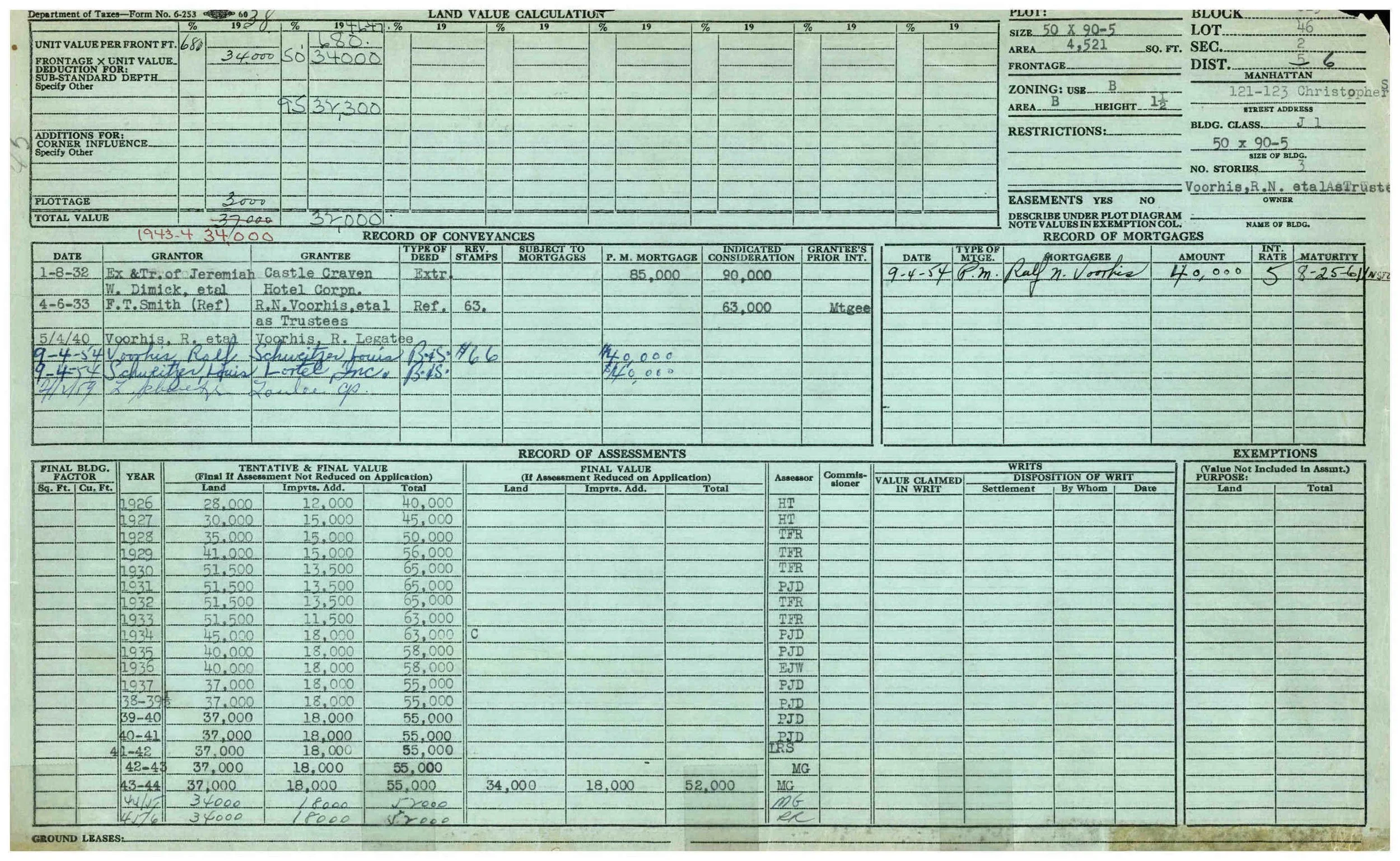
121 Christopher Street. Department of Finance Property Card, NYC Municipal Archives.
Matthew Minor
REC0044_01_02_067_040_014: NYPD Intelligence Records, NYC Municipal Archives.
Working in digitization, I see items from all sorts of collections; and at a place like the Municipal Archives, the variety is unbelievable. For the last several months, I've been working on the NYPD Intelligence records with our digitization technician, Raquel Phipps. For decades the City’s police kept tabs on all sorts of groups and individuals. The records include police paperwork, correspondence from federal agencies and other police departments, and even materials from the subject organizations themselves.
The folders from the mid-1960s show this diversity. Among the groups the NYPD was watching were American religious groups, such as the Full Gospel Business Men’s Fellowship International, which held its Northeastern Regional Convention in the City in October 1963. While the group sounds like any of a number of Evangelical groups today, their convention materials promote the idea of “the whole gospel for the whole world” with a cover image of a giant Jesus knocking on the United Nations building like a door.
Inside the brochure, the introduction strikes a darker tone, saying that:
“WITHOUT A SHADOW of doubt, I believe that the world is set in a pattern that will bring about the close of this dispensation... You and I are in the generation that is seeing the culmination of all prophecies...because enough energy has been harnessed, which when released could burn up the world. Our main line churches have strayed so far from God they are vulnerable. Bible standards have been by-passed for a liberal, social, and political status.”
While groups like this were anticipating the end of the world, others were feeling optimistic. In 1964, the Esperanto Information Center sent Mayor Wagner a letter praising him for promoting “peace, harmony, and happiness,” and suggesting that adopting Esperanto as an international language could be in an important step towards those ideals. The author of the letter, Vojslav Pytloun, thanked Wagner for not treating this idea “lightly,” as perhaps many others had.
REC0044_01_02_075_005_002: NYPD Intelligence Records, NYC Municipal Archives.
Then as now, everyone had ideas about the future of the world, and somehow those ideas and the people who support them always find their way through New York.