NYC Parks Department

A Century of Play: A History of New York City’s Playgrounds

As the summer heats up, we are taking a look at the history of New York City’s public playgrounds through the collections of the NYC Municipal Library. Government reports, manuals, photographs, and planning documents reveal how playgrounds have reflected the city’s changing priorities for more than a century, from public health and crime prevention to patriotism, accessibility, and safety.

“Children love the see-saws,” Views of Tercentenary Celebrations and of Playground Activities, 1914. NYC Municipal Library.

A book titled Grounds For Play: The Movement that Built Playgrounds for the People of New York traces the origins of the playground movement in the late 19th century, when the city had no municipal playgrounds. As immigration surged, families crowded into squalid tenements, leaving children with little place to play beyond the congested streets. Reformers argued that public playgrounds would promote children’s health, provide safe spaces for recreation, and keep them away from the temptations of street life.

Report of the Bureau of Recreation, Department of Parks, Boroughs of Manhattan and Richmond, City of New York, on Public Park Playgrounds and Recreation Centres for the year ending December 31, 1911. NYC Municipal Library.

A 1911 annual report from the newly created Bureau of Recreation illustrates how quickly these ideas took hold. Citing Children’s Court statistics showing that more than 10,000 children were arrested annually for trivial offenses, many stemming from what the report described as “an outburst of suppressed energy” that “if committed in the playgrounds, would not be a violation of law,” the report made the case that recreation was an essential public service. By then, the Bureau oversaw 30 park playgrounds, attendance had doubled over the previous year, and organized athletics had flourished. The Commissioner of Parks proudly described “the largest baseball league in the history of the national game,” in which 6000 boys played a series of elimination tournaments around the city, culminating in the City Park Playground Championship before a crowd of 10,000 spectators at Jasper Park.

Playgrounds in this era reflected the social values of their time. Facilities were divided into separate sections for boys and girls, and activities were organized accordingly. While boys competed in athletic leagues, girls participated in events such as amateur theatricals featuring costumes, song, and dance. Referring to a Thanksgiving week pageant, the Commissioner noted approvingly that “the little ragamuffins had the time of their lives.”

Report of the Bureau of Recreation, Department of Parks, Boroughs of Manhattan and Richmond, City of New York, on Public Park Playgrounds and Recreation Centres for the year ending December 31, 1912. NYC Municipal Library.

A 1914 Board of Education photo album documents that year’s playground activities including the city’s Tercentenary celebrations, commemorating 300 years since the Dutch established the first permanent trading post in New York. Among the festivities was an enormous “Melting Pot,” which girls entered wearing the traditional costumes of other nations. Emerging dressed in red, white, and blue, they were presented as transformed into “real Americans,” a vivid illustration of the era’s attitudes towards immigration and assimilation.

“The Melting Pot of the Nations,” Views of Tercentenary Celebrations and of Playground Activities, 1914. Photograph by Underwood & Underwood. NYC Municipal Library.

During World War I, organized recreation took on an increasingly patriotic character. In September 1918, the Mayor’s Committee of Women on National Defense organized “Patriotic Play Week,” built around the idea that “play promotes patriotism.” The organizers asserted that the program would transform “the liabilities of adolescent leisure into the asset of juvenile citizenship.” The week featured parades, games, exhibitions, and entertainments, culminating in a grand march led by the American flag and the flags of allied nations.

The educational value of recreation remained a central theme into the 1930s. A 1930 Manual for School Playgrounds outlined plans for summer “vacation playgrounds,” designed to prevent idleness and maintain discipline during the long recess. The manual offered detailed guidance on everything from decorating playgrounds and maintaining equipment to organizing tournaments and, notably, instructing supervisors to “seek out bullies and eliminate them.”

Similarly, a 1932 Board of Education fact sheet promoted a summer “play program” combining free play with games, assemblies, drills, civic training, quiet hours, handwork, and housekeeping activities. The stated goal was to guard the children against “the loss of discipline,” “the tendency toward idleness,” and the dangers caused by heat, illness, and traffic accidents.

Recognizing that many neighborhoods still lacked adequate playground facilities, especially in low-income areas, the Department of Public Works launched an innovative “Play Streets” program in East Harlem in 1934. Streets were temporarily closed to traffic and staffed by trained recreation leaders equipped with sports equipment and other supplies for games and crafts. According to the 1937 volume Play Streets and Their Use for Recreational Programs, the initiative sought to not only provide recreation but also to “train the people to use leisure time properly.” Organizers credited the program with giving children “a truly good and healthy play life” while reducing juvenile delinquency.

[Playgrounds in the Five Boroughs], 1941-1961. NYC Municipal Library.

That’s same year, Mayor Fiorello La Guardia consolidated the city’s five separate borough departments into a unified Department of Parks under Commissioner Robert Moses. After World War II, Moses oversaw an unprecedented expansion of neighborhood parks and playgrounds, particularly in the rapidly growing communities on the outskirts of the city. Collections of press releases, plans, and photos along with a volume of construction schedules in the Municipal Library document this postwar playground building boom.

A 1956 report, Jointly Operated Playgrounds, described the long-running partnership between the Department of Parks and the Board of Education to build and operate playgrounds adjacent to public schools. First launched in 1938, this cooperative model continues through the present day with the “Schoolyards to Playgrounds” initiative.

Jointly Operated Playgrounds, 1956. NYC Municipal Library.

By the mid-1960s, however, attention shifted from expansion to quality. In a 1965 report, Mayor John Lindsey lamented, “Today when a park is even halfway decent we are stunned.” He proposed creating new playgrounds in underserved communities while replacing traditional asphalt surfacing and immovable equipment with European-inspired “Adventure Playgrounds,” where children could build, climb, and rearrange play structures themselves. Lindsey also advocated expanding the use of play streets as neighborhood parks.

The 1970s brought another significant shift, as the emerging disability rights movement influenced playground design. In 1975, the Board of Estimate set aside $100,000 for the design of an integrated playground that would serve children both with and without disabilities.  The city published A Playground for All Children in 1976, followed by a companion resource guide in 1978 that established design principles for inclusive playgrounds. The resulting playground, which was the first of its kind in the city, opened in Flushing Meadows Park in 1984.

A Playground for All Children, 1976. NYC Municipal Library.

By the 1990s, public discussion increasingly centered on playground safety. A 1993 report by Comptroller Elizabeth Holtzman noted that the city had paid $7 million in liability claims for playground injuries between fiscal years 1988 and 1992. Inspectors found that every playground they visited contained at least one condition that failed to meet Consumer Product Safety Commission (CPSC) guidelines or otherwise posed a potential hazard.

A 1998 report by the New York Public Interest Research Group (NYPIRG) documented additional safety concerns, including deteriorated equipment, inadequate protective surfacing, chipped lead paint, and excessive fall heights. The report urged the city to adopt national safety guidelines and encouraged parents, educators, and park personnel to use standardized inspection checklists to identify hazards and advocate for improvements.

Today, the Municipal Library continues to collect and preserve this history through the Government Publications Portal (GPP), where city agencies now submit publications electronically rather than in print. Recent additions include a 2022 estimate of the cost of extending public access to school playgrounds outside of school hours (for those not already participating in the Schoolyards to Playgrounds program), and a 2025 report on playground inspections.

Taken together, these records trace more than the history of playgrounds. They document a century of changing ideas about children, public space, and the many roles that play has been expected to serve in public life.
The Aerial Views of Robert Moses

By the late 1950s, Robert Moses, the legendary “power broker,” was at the peak of his decades-long career in public service. He served, simultaneously, as Commissioner of the Department of Parks, City Construction Coordinator, Chairman of the Mayor’s Committee on Slum Clearance, Commissioner on the City Planning Commission, Chairman of the Triborough Bridge and Tunnel Authority, Chairman of the New York State Council of Parks, President of the Long Island State Park Commission, and Chairman of the Power Authority of the State of New York. 

New York Midtown Skyline View south (Lincoln Center), November 1955. Department of Parks photograph collection, NYC Municipal Archives.

The Municipal Archives collection of records created by Moses as Parks Department Commissioner, described in an earlier For the Record article, documents not just city parks, but also the highways, bridges, tunnels, housing projects, playgrounds, and beaches he constructed. It includes information about the Lincoln Center complex, the United Nations’ building, the New York Coliseum, Shea Stadium and both the 1939 and 1964 New York World’s Fairs.

This week, For the Record highlights aerial photographic views in the Parks Department collection. Moses contracted with commercial photographers for the aerial views. Images in the collection date to the 1930s, the samples below are from the mid-to-late 1950s when Moses’ portfolio had expanded beyond parks to all of the other construction projects. The photographers flew in planes over the city and used large-format cameras.  The original negatives were scanned at high resolution. All of the images can be viewed in the Municipal Archives Gallery.  

These spectacular images show New York from above in its thriving post-War years when the old city was giving way to the new.

Orchard Beach, Pelham Bay Park, Bronx, 1956. Department of Parks photograph collection, NYC Municipal Archives.

Midtown Manhattan (Lincoln Center), 1955. Department of Parks photograph collection, NYC Municipal Archives.

West Park Title 1 Housing, March 14, 1956. Department of Parks photograph collection, NYC Municipal Archives.

Soundview Park and Throgs Neck Expressway, June 12, 1957. Department of Parks photograph collection, NYC Municipal Archives.

Mid-Harlem and City College, June 12, 1957. Department of Parks photograph collection, NYC Municipal Archives.

Penn Station South Slum Clearance, June 12, 1957. (Note strut from airplane wing in upper left.) Department of Parks photograph collection, NYC Municipal Archives.

Battery Park, June 12, 1957. Department of Parks photograph collection, NYC Municipal Archives.

Corlears Hook Park, November 3, 1958. (Note car float in East River.) Department of Parks photograph collection, NYC Municipal Archives.

East River Park , Title 1 housing, November 3, 1958. Department of Parks photograph collection, NYC Municipal Archives.

Washington Square South-East, November 3, 1958. Department of Parks photograph collection, NYC Municipal Archives.

George Washington Bridge (not yet double-decked) and Harlem Speedway, November 1958. Department of Parks photograph collection, NYC Municipal Archives.

Bruckner Expressway, November 1958. Department of Parks photograph collection, NYC Municipal Archives.

Brooklyn-Queens Expressway progress, November 1958. Department of Parks photograph collection, NYC Municipal Archives.

Harlem River, Major Deegan Expressway and Yankee Stadium, November 17, 1953. Department of Parks photograph collection, NYC Municipal Archives.

Throgs Neck Expressway, November 1958. Department of Parks photograph collection, NYC Municipal Archives.

Long Island Expressway, looking west from Cross Island Parkway, November 1958. Department of Parks photograph collection, NYC Municipal Archives.

Soldiers and Sailors Monument

On Memorial Day, May 30, 2022, New York City Council Member Gale Brewer spoke before a gathering at the Soldiers and Sailors Monument, in Riverside Park, Manhattan, near 89th Street. The monument, erected in memory of the New York regiments that fought in the Civil War, served as the terminus for Memorial Day parades for decades after its dedication in 1902. In recent years it suffered extensive deterioration and in 2017 was fenced off to protect people from the cracked and crumbling stone. At the 2022 ceremony, Brewer rallied support for a long-overdue restoration of the landmark and urged the audience to sign a petition urging the City to fund desperately-needed repairs. “Our servicemen and women, our citizens, and our City deserve better,” Brewer said.

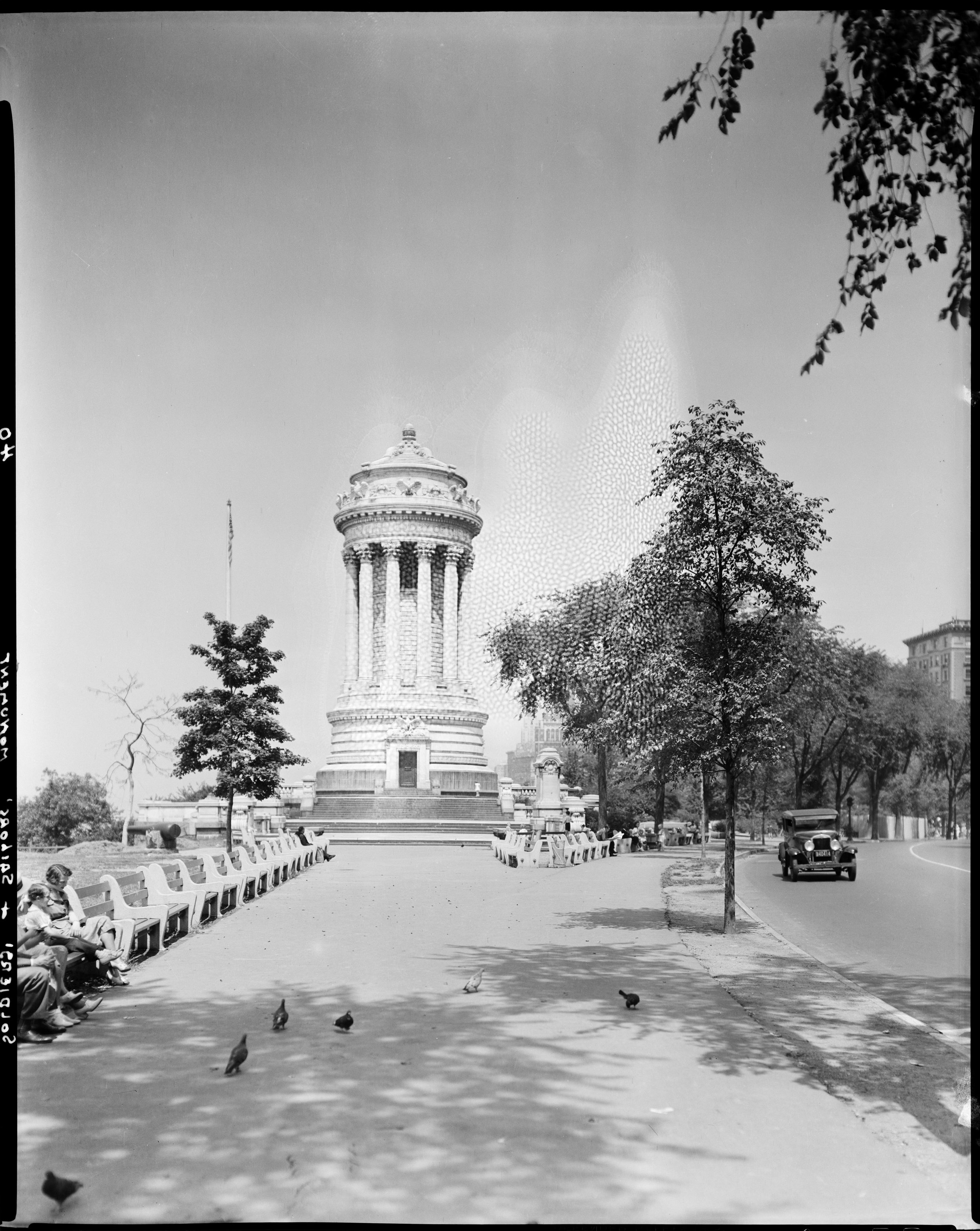
Soldiers and Sailors Monument, Riverside Park, New York, ca. 1936. WPA Federal Writers’ Project Photograph Collection, NYC Municipal Archives.

Six months later, Council Member Brewer’s efforts were rewarded with a $62.3 million allocation in the City’s capital budget for the restoration.

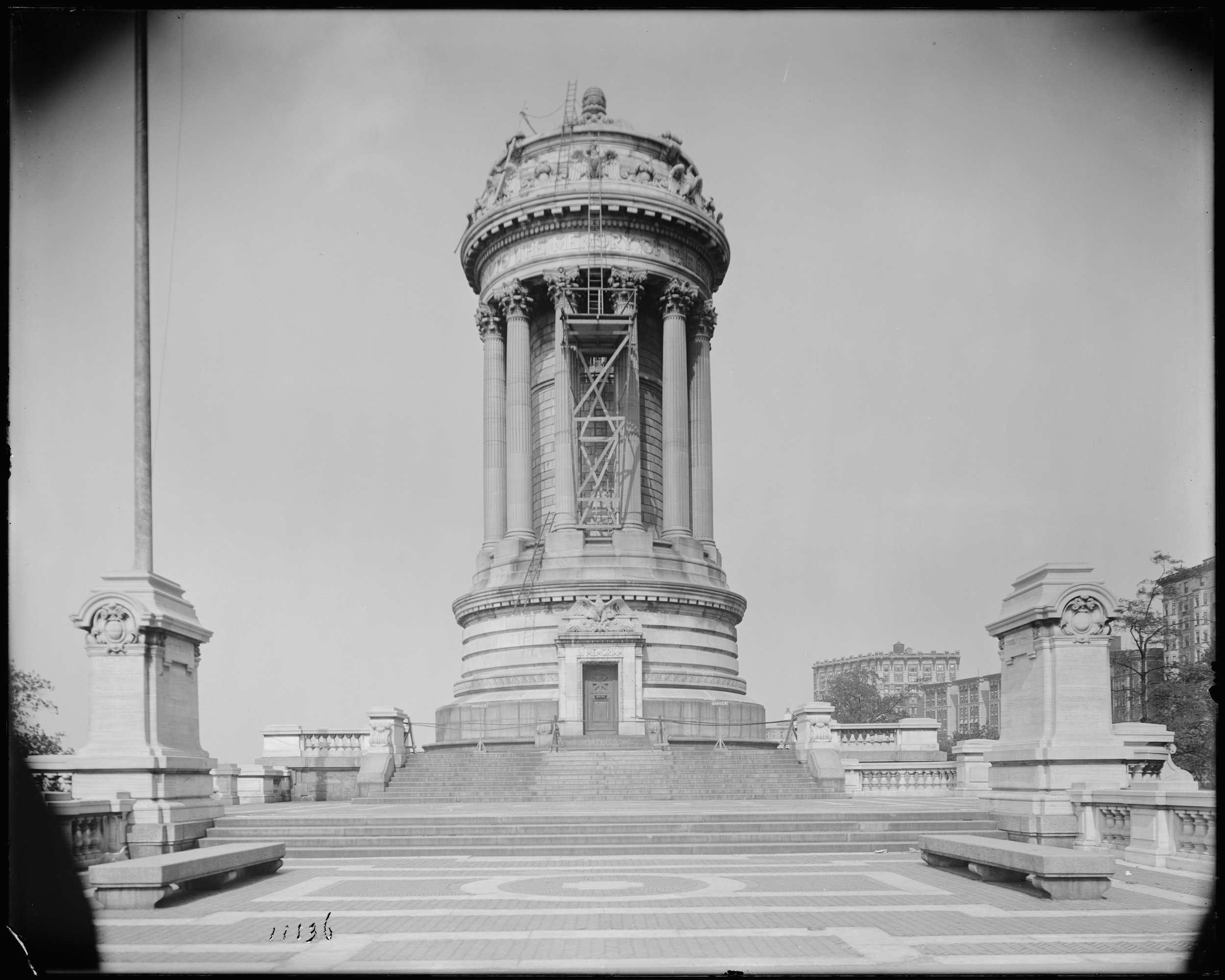
The monument is located on a promontory along Riverside Drive at West 89th Street. The Stoughton brothers, engineer Charles W. (1860–1944), and architect Arthur A. Stoughton (1867–1955), won a public competition for their design inspired by Greek antiquity. An example of the City Beautiful movement, the monument is in a cylindrical form with 12 Corinthian columns of white marble. The monument is capped with a richly carved ornament of eagles and cartouches sculpted by Paul E. Duboy (better known for his work on the Ansonia Hotel). 

Commissioned by the City of New York and the Memorial Committee of the Grand Army of the Republic in 1893, the competition was held in 1897. New York State Governor Theodore Roosevelt officiated at the cornerstone laying ceremony in January 1900. On Memorial Day 1902, with then- President Roosevelt presiding, the completed monument was unveiled following a parade of Civil War veterans up Riverside Drive. For many years the project was delayed because the City could not agree on a site for the monument. The Municipal Art Society vetoed the initial location at Fifth Avenue and 59th Street. Eventually it was sited along the axis of Riverside Drive, looking south and out toward the Hudson River, a companion structure to the Grant National Memorial located two miles north.  

Aerial view, Soldiers and Sailors Monument, Riverside Park, January 1934. Department of Parks & Recreation Photograph Collection.

In the early 1960s, the City spent over $1 million in extensive repairs to the monument, including a new roof. It was designated a municipal landmark in 1976. 

The Landmark Designation Report for the Soldiers and Sailors Monument and the Department of Parks and Recreation 2017 Soldiers’ & Sailors’ Memorial: Conditions Survey & Restoration Treatment Study can be accessed in the Municipal Library’s Government Publication Portal.

“History and dignity restored,” read the New York Daily News article on January 15, 2023, reporting on funding for the restoration in Mayor Eric Adam’s budget. Following the announcement, Council Member Brewer thanked the Mayor and remarked, “The 120-year-old monument was built to honor Union Army soldiers who fought against slavery in the Civil War and brings together veterans and civilians to remember all those who have died serving this country. The future of this memorial is bright. Restored to its former glory, it will again speak of our memory of war and the dream of peace.”   

Monument 89th Street, Soldiers and Sailors, showing scaffolding, September 15, 1927. Photo by Eugene de Salignac, Department of Bridges/Plant & Structures Collection.

For the Record readers are invited to visit the Monument this Memorial Day, May 29, at 10 a.m. to enjoy a ceremony planned in conjunction with Fleet Week, dedicated to honoring our nation’s military personnel who died serving in the United States Armed Forces. The event will commence with a musical prelude by the U.S. Marine Corps Band, followed by a processional featuring the Piper New York Caledonian Club, Sons of United Veterans of the Civil War and Veteran Corps of Artillery at 10:30 a.m. Retired Commander Peter Galasinao of the United States Navy and President of the Soldiers’ and Sailors’ Memorial Association will deliver welcoming remarks. Guest speakers will include City Council Member Brewer, Commissioner of NYC Department of Parks & Recreation Sue Donoghue and other City officials.   

From the Dank Recesses—the Department of Parks General Files

“Swim” original art for subway, 1937. Tempura water color on tissue paper; artist unknown. Department of Parks General Files, NYC Municipal Archives.

A life-long swimmer, Parks Commissioner Robert Moses vastly expanded access to aquatic facilities for New Yorkers. In 1936, he opened ten new swimming pools and during his long tenure he built and improved public beaches throughout the city.

Recently, the Municipal Archives received an inquiry from a potential patron asking if it was true “…that their [Department of Parks] internal records from 1934-45 are offsite and inaccessible, perhaps rotting away in a barn somewhere in New Jersey, piled up in banker’s boxes...” The answer is . . . not true! Although the Parks records did make a brief trip to New Jersey, they are very much accessible in the Municipal Archives and constitute one of the most important collections documenting the built environment of New York City and the decades-long era of Parks Commissioner Robert Moses.

It is possible that this patron’s remarks concerning the Parks records originated from Robert Caro’s epic Moses biography, The Power Broker [Knopf, 1974]. In notes about his sources Caro described gaining access to the “internal memoranda” of the Parks Department, then located “… in the dank recesses below the Seventy-ninth Street boat basin near the West Side Highway.”

In 1984, the National Endowment for the Humanities (NEH) awarded the Archives a grant to identify and appraise historical records still held in municipal offices. During the course of the project, City archivists visited the Parks storage facility at the Boat Basin and discovered nearly 800 cubic feet of administrative records. Despite their location only a few hundred yards from the Hudson River, directly below a busy traffic interchange, the archivists found the records to be in remarkably good order.

Aerial view of the 79th Street Boat Basin and Henry Hudson Parkway interchange, ca. 1936. NYC Municipal Archives Collection. Moses leveraged federal highway funding to complete an earlier “West Side Improvement” plan and added a marina, known as the 79th Boat Basin in Riverside Park.

Recognizing the importance of this material, City archivists transferred the records to the Municipal Archives, after a detour to a laboratory in New Jersey for mold remediation.

The significance and value of this collection cannot be overestimated. It provides a complete chronicle of the achievements of Robert Moses, New York’s legendary “Master Builder.” Moses planned and constructed public works on a scale that was the envy of the world in its day and all but inconceivable now. The list of his accomplishments in the New York City metropolitan area—well documented in the collection—includes fifteen parkways and twelve expressways; eight bridges and two tunnels; over one thousand housing projects; more than six hundred playgrounds; and thirty new parks and beaches. He was responsible for the Lincoln Center complex, the United Nations’ building, the New York Coliseum, Shea Stadium and both the 1939 and 1964 New York World’s Fairs. In the words of Columbia University Professor of History, Kenneth T. Jackson, “More than any other person or institution, Robert Moses was the single-minded genius who molded New York City into a twentieth century metropolis.”

Astoria Pool, Queens, August 20, 1936. Department of Parks Collection, NYC Municipal Archives. Opened July 2, 1936, Astoria Pool is the largest of the eleven pools Moses built with funding from the federal Works Progress Administration program.

And fortunately for generations of historians, Commissioner Moses and his staff were prolific correspondents and meticulous record-keepers. The records extracted from the Boat Basin consisted of two series—740 cubic feet of the Department of Parks General Files, 1934-1966, and 44 cubic feet of the Office of the Parks Commissioner/City Planning Commissioner files, 1940-1956. The material includes carbons or originals of incoming and outgoing correspondence, memoranda, transcripts, reports, contracts, news clippings, maps, blueprints, plans, printed materials, press releases, invitations, and photographs. The records document virtually every component of the Department’s administrative actions from 1934 through 1966. The General Files series is further divided into three subseries: Administrative Files, Borough Files and Index Cards.

Sara Delano Roosevelt Park, March 6, 1934. Department of Parks Collection, NYC Municipal Archives. Several blocks of tenements in Manhattan’s lower East Side, from Houston to Rivington Streets, were razed for construction of the Sara Delano Roosevelt Park.

The Parks/City Planning Commissioner series comprises the files created by Moses in his capacity as Commissioner of the Department of Parks, Commissioner of the City Planning Department, and after 1946, City Construction Coordinator. (Moses simultaneously held up to twelve official positions.) The material in this series is 100% Robert Moses. With the exception of a few folders labeled “Hazel Tappan,” his personal secretary, it does not contain the correspondence of any of his deputies or assistants.

Both series provide abundant examples of Moses’ direct and vivid writing style. “I say its spinach!” he wrote to Mayor LaGuardia, in a letter dated August 25, 1943, reporting on a meeting about the Brooklyn Navy Yard. The letter also contains a typical Moses comment on social workers: “These people never get anywhere, and it is a waste of time to get excited about their plans.” Moses believed parks and playgrounds would solve all social ills and so concluded to the Mayor: “If I had the sense God gave geese, I would have insisted that the only thing worth accomplishing was to get rid of Raymond Street and substitute a playground.”

Pelham Bay Park: Concessions Building and comfort station, October 22, 1941. Department of Parks Collection, NYC Municipal Archives. No detail was too small or building too insignificant for Moses and his talented team of architects as illustrated by the handsome design of this comfort station.

Moses was a fearless correspondent. He even took on the United States military at the height of World War II. On May 24, 1943, he replied to Brigadier General P. B. Gage, Commanding Officer of the U.S Army, stating: “I cannot possibly give you permission to overrun Jacob Riis Park. This is one of the most important summer recreation areas in the Metropolitan district, and there is no reason on God’s green earth why it should be turned over for maneuvering of troops.”

Invitation to the Menagerie in Central Park, 1934. Color half-tone on paper; artist unknown. Mayor LaGuardia Parks Department correspondence, NYC Municipal Archives.

Good design was a hallmark of Commissioner Moses’ public works as evidenced by this 1934 invitation and during the Great Depression he could draw on a large pool of readily available talented architects and designers.

As he did with parks and arterial highways, Moses played a major role in the development of public housing projects throughout his career. In a letter dated July 7, 1958, Moses took the opportunity to express his views on the European model: “As to Sweden, I have just come back from that highly socialized country. I did inspect some of the housing, and while I found it good, it was no means as marvelous as it is described by Mr. Straus [owner of the WMCA radio station and life-long advocate for improved housing], and I found few things which could be successfully imitated in this country. I am no chauvinist, but I get rather weary of Americans who can only find achievements abroad.”

In 1998 the NEH awarded $64,000 to the Municipal Archives to microfilm the entire Commissioner series, and selected documents from the General Files series.

Robert Moses’ career and the physical changes he wrought on New York City, for better or worse, have long been the subject of analysis and debate. Beginning even before his death in 1981, there has been a steady stream of works pertaining to Moses ranging from the Caro biography to innumerable articles, dissertations, papers, conferences, documentary films and at least one opera. Access to the voluminous Parks collection—and its rich content of Moses-related material—will continue to facilitate the ongoing debate about one of the most influential figures of 20th century New York City history.