Department of Sanitation

The Dog Days of August in the Municipal Library

Dog Owner’s Guide to Scooping, 1973. NYC Municipal Library.

In honor of National Dog Month, we are taking a look at the history of rules, recommendations, and practices surrounding dog ownership in NYC through the collections of the Municipal Library.

There has been a law on the books since 1859 requiring all dogs in “any street or public place, in either the cities of New-York or Brooklyn,” to be “properly muzzled, or unless being led by a chain or string” as recorded in the 1866 Code of Health Ordinances from the Metropolitan Board of Health. (This was, of course, before the consolidation of New York City’s five boroughs in 1898.)

Information for Dog Owners: Why Dogs Must Be Muzzled When at Large, 1919. NYC Municipal Library. 

In 1878, as reported in the daily City Record, Mayor Smith Ely, Jr. issued a proclamation establishing a dog pound at 16th Street and the East River, where all seized dogs would be delivered by the appointed dog catchers. Rather harshly, any dog “not claimed within forty-eight hours, and redeemed by the owner, by paying the sum of three dollars” was to be “killed and destroyed by drowning.”

A small 1919 pamphlet from the NYC Department of Health, Information for Dog Owners: Why Dogs Must Be Muzzled When at Large, cited a new sanitary code Section 17, which stated that “no unmuzzled dog shall be permitted to be … in any public park or place in the City of New York.” The reasoning for this new mandatory muzzling provision was that rabies, which was “almost always caused by the bite of rabid (mad) dogs,” was an “absolutely fatal disease.”

The 1919 pamphlet also reminded dog owners that they were required to “procure a yearly license and pay the sum of two dollars for each dog” and provide their dog with a collar bearing the license number. Failure to comply could result in seizure of the animal, followed by the same severe penalty noted in 1878: “if not claimed and redeemed within forty-eight hours thereafter, they may be destroyed.” Fortunately, while the licensing requirement remains on the books, the enforcement provision now simply states that officials may issue “notices of violation for failure to comply.” (Since at least 2017, as recorded in their annual reports, NYC shelters have completely stopped euthanizing healthy animals.)

Beginning in 1934, an amendment to the Sanitary Code specified that all dogs in public should be restrained by a leash of less than six feet in length, with muzzling no longer required. As reported in the New York Times that year, the Health Department believed this would be easier to enforce than the struct muzzling provision, and that greater compliance would reduce the then-growing number of dog bites in the city. The leash law remains in effect today, except in designated dog runs and during off-leash hours in public parks.

Annual Report, Department of Sanitation, 1946. NYC Municipal Library.

In 1918, the sanitary code was amended to require dog owners to prevent their pets from “committing any nuisance upon any sidewalk of any public street, avenue, park, public square, or place in the city of New York.” This provision, which came to be known as “curb your dog,” became the target of public campaigns beginning in the late 1930s. By 1946, according to that year’s annual report from the Department of Sanitation, there were 9,047 “curb your dog” signs placed in all five boroughs.

Pet ownership grew in the post-war period, and by 1961, the “curb your dog” campaign was deemed insufficient to address the growing piles of dog waste on streets and sidewalks. At the requests of Mayor Robert F. Wagner, Municipal Library Director Eugene Bockman compiled a report “concerning the methods used by other large cities to control dog nuisance.” While researching practices in cities across the country, he found that “very little has been accomplished elsewhere which would help New York City with its problem.” While most cities had nothing on the books beyond a leash law, Milwaukee was then going so far as to propose an ordinance that would “forbid owners to have pets anywhere in the city… except in their own premises.” This was expected to be met by “loud protests from dog lovers and the humane society.”

Annual Report, Department of Sanitation, 1952. NYC Municipal Library.

Even in NYC, according to Library Director Bockman, former Sanitation Commissioner Paul R. Screvane believed that “dogs should be toilet-trained inside the house and continue that way instead of using city streets. In his opinion, it is inconsistent with modern hygiene to allow such a mess in the streets where many children play and people walk.”
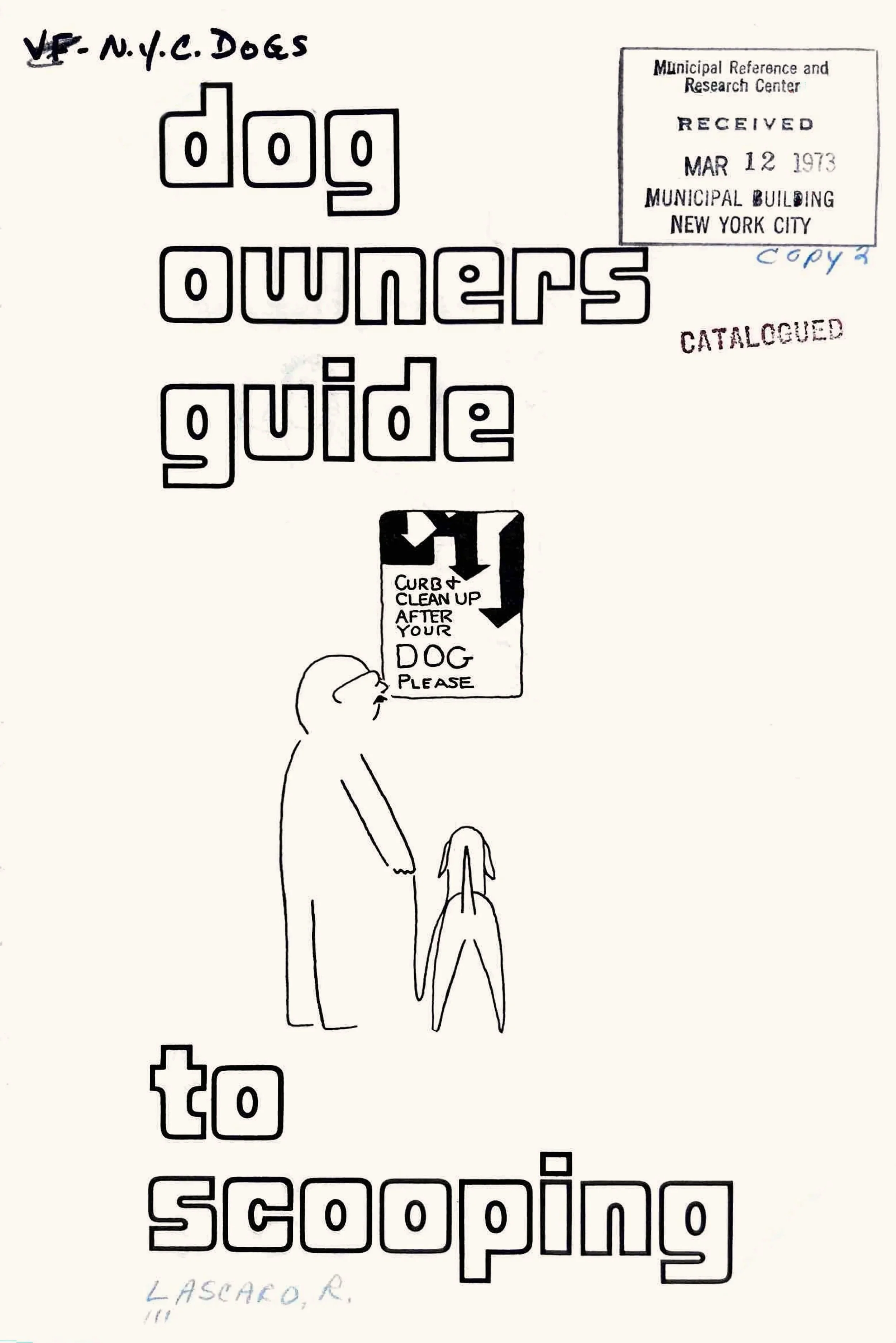
Dog Owner’s Guide to Scooping, 1973. NYC Municipal Library. 

In 1973, the city’s Environmental Protection Agency published a charmingly illustrated Dog Owner’s Guide to Scooping. While “pooper scooping” had not yet been codified into law, the small pamphlet appealed to pet owners’ “respect of property and good manners,” explaining how to clean up after ones dog with newspapers or a scoop, either homemade or purchased. A note from the EPA Administrator added, “Thanks for helping us make New York City a cleaner, more pleasant place to live.”

It was not until August of 1978 that a New York State law took effect in cities with a population of 400,000 or more, requiring dog owners and handlers to clean up after their dogs on public sidewalks, streets, gutters, and other public areas. Clipped articles from that era in the Library’s “Dogs” Vertical File highlight the controversy surrounding the new law. Those opposed to it, largely dog owners and even the ASPCA, argued that it would either be unenforceable or would lead to pet abandonment. Supporters insisted that it would change habits and create a climate of respect.

Dog Owner’s Guide to Scooping, 1973. NYC Municipal Library.

A July 28, 1978, article in the Westsider described the new scooping gadgets then on sale, as well as what must have been a short-lived, city-provided “Doggie Flush” at 207 West 10th Street—a 45-inch bowl set into the sidewalk that the owner flushed “by stepping on a conveniently located valve handle.” According to an August 2 article in the New York Times, a young woman in Greenwich Village who was openly flouting the new law intended to “read Thoreau to my cocker spaniel and teach her civil disobedience.”

A press release issued by Mayor Ed Koch in 1979, on the first anniversary of the “pooper scooper law,” announced that 1616 people had received summonses for failing to clean up after their dogs, following a 3-month grace period during which 7000 warnings had been issued. The Mayor took this as proof that the law was enforceable and noted that public peer pressure had also been effective in encouraging compliance. By 1985, on the seventh anniversary of the law’s passage, a joint statement from the Commissioners of the Sanitation and Parks Departments reported that 18,230 summonses had been issued, resulting in fine revenues exceeding $435,000. Parks Commissioner Henry J. Stern called the law “one of the best things that ever happened to New York City parks.”

Of course, as any New Yorker could tell you, the original “pooper scooper” law did not completely solve the problem. Just last week, the City Council passed an additional package of four bills known as the SCOOP (Safe and Clean Outdoor Ownership Practices) Act, aimed at combatting “rising complaints about the poop smeared across the city’s streets.”

After 9/11, as the city turned its attention to disaster preparedness, the NYC Office of Emergency Management issued a 2002 guide to Disaster Preparedness for Animals in New York City. A 2015 version, called My Pet’s Emergency Plan, is now available in multiple languages through the Library’s online Government Publication’s Portal.

My Pet’s Emergency Plan (Haitian Creole), 2015, NYCEM. NYC Municipal Library

As reliance on “emotional support” animals has increased over the last decade, the NYC Commission on Human Rights issued a 2020 FAQ about Emotional Support Animals in Housing. It explained that “housing providers… must permit residents to keep emotional support animals as a reasonable accommodation for a disability,” and that emotional support animals are exempt from “no dog” policies.

Dog bites have remained a problem in NYC into our current century. The July 2017 issue of NYC Vital Signs, a monthly publication of the NYC Department of Health, was devoted to Preventing Dog Bite-Related Injuries among New York City Residents. Vital Signs revisited the topic in April of 2026, declaring that the rate of reported dog bites to New York City residents was at a ten-year peak.

While some issues remain constant, others transform over time, reflecting changing notions about public health, animal welfare, and the nature of our relationship with our pets. The Municipal Library’s collections offer a glimpse into that evolution through laws and official reports, as well as pamphlets, newspaper clippings, guides, and other everyday documents that capture how New Yorkers have been asked to coexist with their canine companions.

Department of Street Cleaning Photographs

“You Live in the Greatest City in the World – Let’s Make it the Cleanest and Healthiest,” is the wording on the sign on a Department of Street Cleaning cart photographed around 1908. The same sign today would not seem out of place on a Department of Sanitation truck and probably would have been a reasonable exhortation two hundred years ago. Except, until 1870, the City mostly contracted-out street cleaning services.  

Rack Cart with Officer, 1908, Department of Street Cleaning Photograph Collection. NYC Municipal Archives. 

The photograph of the cart is one of approximately 300 black-and-white prints depicting Department of Street Cleaning workers, equipment, and activities dating from the 1890s to 1925. Recently accessioned by the Municipal Archives, they are uniform in size, measuring approximately five by seven inches. Each is captioned on the reverse. Originally mounted in an album, the prints have been re-housed in acid-free envelopes.

Roll Call and Inspection of Drivers, 1908. Department of Street Cleaning Photograph Collection. NYC Municipal Archives. 

Like many City agencies, the Department of Street Cleaning began using photography in the early years of the twentieth century to document their work. Although relatively few in number, the Street Cleaning pictures capture an essential municipal function at a time of transition from an exclusively human (and horse) powered operation to one with motorized and mechanical assistance. The many pictures of trucks, tractors, snow “scoops,” flushers, and other equipment attest to the Department’s growing reliance on machinery.

One striking feature of the photographs, especially those from the earlier time period, is the ubiquity of horses. Two recent For the Record articles, Stables and Auction Marts: Building Plans With Horses and Horsepower: The City and the Horse discussed the importance of horses to transportation, construction and recreation in the city. The Street Cleaning pictures add to that theme with an abundance of images that document how critical horses were to the Department’s mission. In addition to the many photographs of horse-pulled carts and wagons, the Street Cleaning series includes several pictures of veterinarians employed by the Department, illustrating how they cared for their equine population.

Inspection After Hook-Up, n.d. Department of Street Cleaning Photograph Collection. NYC Municipal Archives. 

Department Veterinarian Treating Horse, n.d. Department of Street Cleaning Photograph Collection. NYC Municipal Archives. 

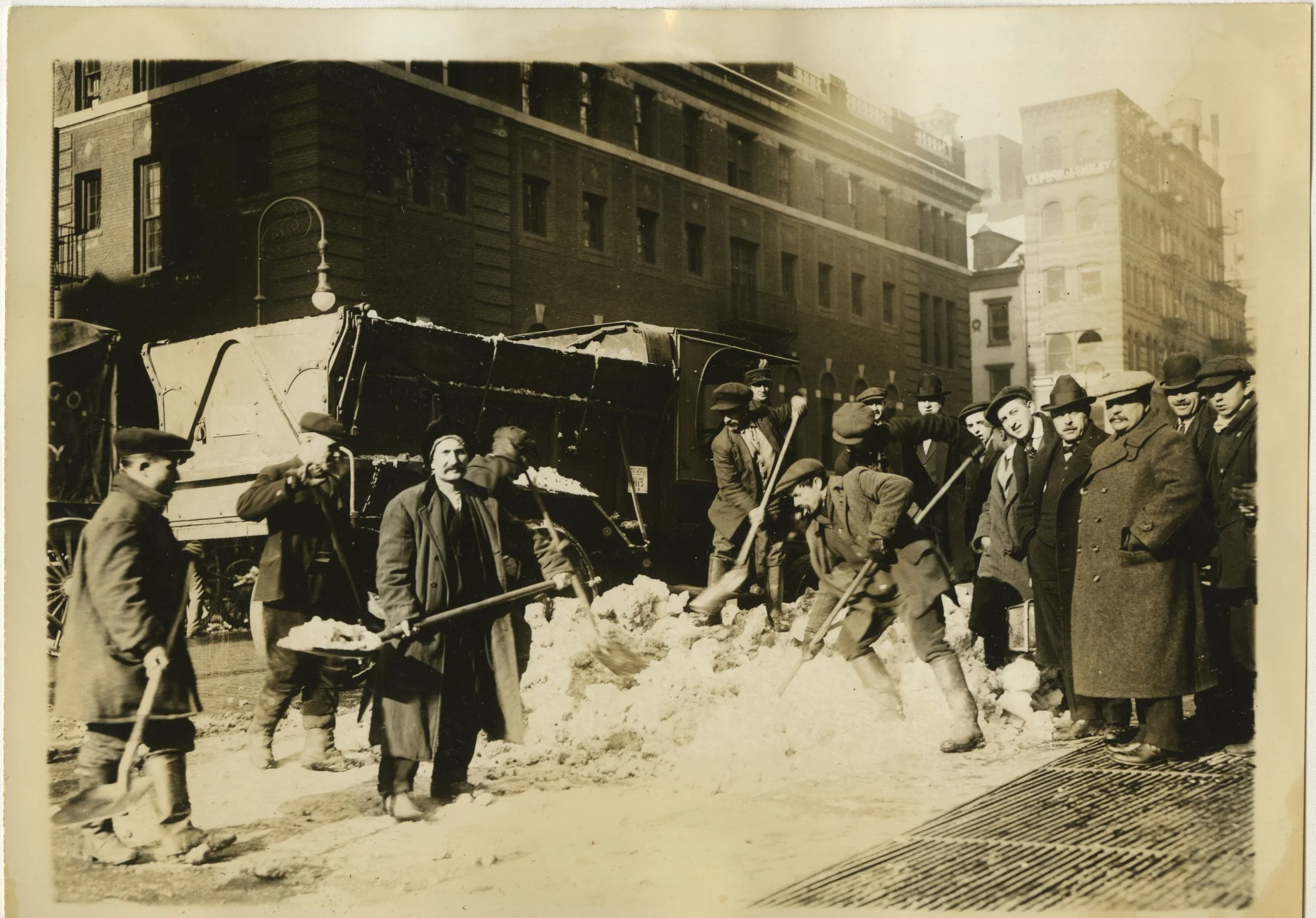
Another aspect of Street Cleaning work that quickly becomes apparent in the pictures is snow, and the removal thereof. The snow-related images vividly illustrate the effort it took to clean snow from the streets. A 1915 survey of City departments, with budget information, shows that out of their total annual budget of $4.5 million, the Street Cleaning Department spent more than $650,000 to employ “contractors,” i.e. day laborers, mainly for snow removal. (Government of the City of New York, A Survey of Its Organization and Functions, 1915, Municipal Library.)

Fifth Avenue, 1908. Department of Street Cleaning Photograph Collection. NYC Municipal Archives. 

Contractors Loading Snow, 1920. Department of Street Cleaning Photograph Collection. NYC Municipal Archives. 

Contractor Dumping Snow into North River, 1916. Department of Street Cleaning Photograph Collection. NYC Municipal Archives. 

As noted above, many of the pictures depict newly acquired mechanical equipment, obviously important to the Department as it modernized in the twentieth century. But equally apparent is the human effort needed to perform the work. “New York’s Strongest” is, and has always been, an apt motto for workers in the Street Cleaning Department. 

In addition to the Street Cleaning pictures, Municipal Archives collections include a series of photographs originating from the Department of Sanitation, successor agency to the Department of Street Cleaning in 1930. The Collection Guides provide information about this larger (35 cubic feet) collection.

The Commissioner’s Carriage Before Motorization, n.d. Department of Street Cleaning Photograph Collection. NYC Municipal Archives. 

Model T Ford, 1914. Department of Street Cleaning Photograph Collection. NYC Municipal Archives. 

The Street Cleaning pictures have not yet been digitized, but they are available for research. In the meantime, For the Record readers can take a look at sample images from the collection. Like so many other pictures in Municipal Archives collections, the aspects that are ancillary to the subject of the photograph that add interest, e.g. the pedestrians, signs, storefronts, automobiles, and advertisements. The Street Cleaning collection is another good example.

Carts On Way to Inspection Points, n.d., Department of Street Cleaning Photograph Collection. NYC Municipal Archives. 

Four-wheel Cart Used for Recruiting Help During World War, ca. 1917. Department of Street Cleaning Photograph Collection. NYC Municipal Archives. 

The Curious Case of the Lighting of the Williamsburg Bridge

Every now and then, while processing a collection, an archivist stumbles into a mystery that just needs to be solved. This is exactly what happened recently to our team cataloguing the Manhattan Building Plans collection at the Municipal Archives. 

The current portion of the ongoing grant-funded project is focused on Lower East Side buildings. An interesting set of 18 plans for Block 318, Lot 10, dating from 1905, depict two city-owned structures along the shore of the East River, under the Williamsburg Bridge anchorage, between Tompkins Street and South Delancey Slip. Both buildings had the same designer, Henry De Berkeley Parsons, but each had a different use and were created for two separate City agencies. In one portion of the plans, the Department of Bridges proposed an electric lighting station for the Williamsburg Bridge, while the other half of the plans were for a Department of Street Cleaning rubbish incinerator.

Façade and exterior view of Incinerator Plant – Designed by Henry De Berkeley Parsons, the incinerator plant included exterior ramps for the rubbish carts and a 250 foot smokestack. Dept. of Buildings Plans, NYC Municipal Archives.

The label included on the architectural drawing that was the start of our mystery. Dept. of Buildings Plans, NYC Municipal Archives.

Archivists processing the architectural plans have many resources to help to identify buildings, confirm locations and unravel the story of a city that is constantly growing, shifting and changing. These include commercially-published Sanborn and Bromley Fire Insurance atlases, Topographic and Property Maps, the Department of Buildings Building Information Search (BIS) website and the Department of Finance Property Information Portal. These resources provided scant information about the two buildings, except to confirm that both were standing in 1911, and by 1921 one of the buildings had been demolished.

Sanborn map c. 1906 showing the Department of Street Cleaning’s incinerator building, the Department of Bridges lighting plant and one of the Department of Education’s temporary school buildings. NYC Municipal Archives.

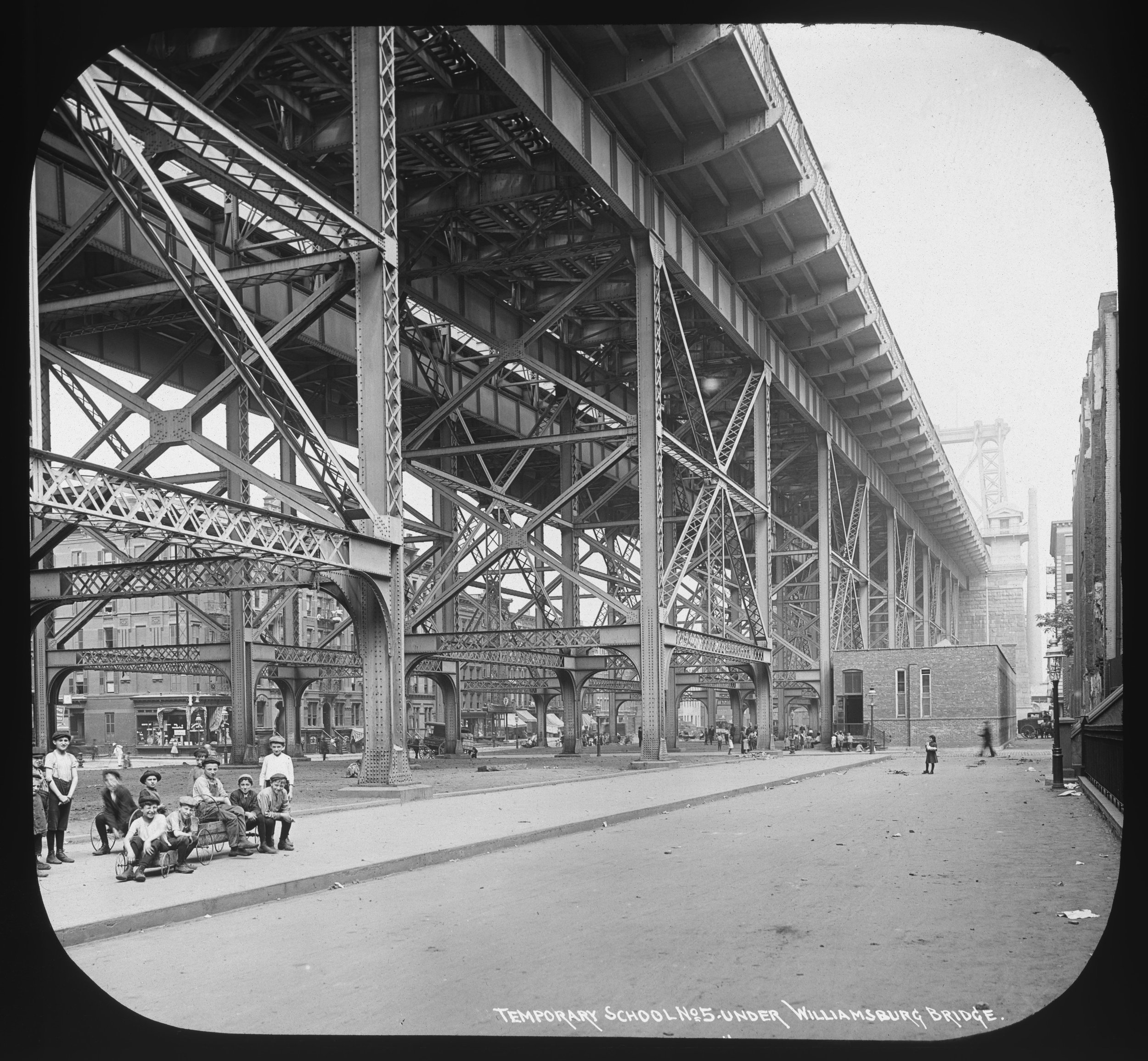
The next logical stop was a Google search. This led to our first real clue, a January 26, 1905 New York Times story titled, “City Lighting Plant Plans are Approved.” The article stated, “Mayor McClellan announced that within four months he will turn the switch to set in operation the first municipal electric lighting plant in New York City. The plant, which will be experimental, will be located under the Williamsburg Bridge, and will be used to light the bridge itself and the temporary school buildings in the vicinity.” This was a good start, but it also added many more questions to be answered. What was an experimental lighting plant? And were there really schools built directly under the Williamsburg Bridge?

A quick search through the Municipal Archives digital gallery answered the temporary school question. Images taken by Department of Bridges staff photographer Eugene De Salignac and lantern slides in the Board of Education collection show several schools on Delancey Street beneath the overpass with children playing in the street. In total, there were eight small school buildings under the bridge to accommodate the ever-growing population of the Lower East Side.

Williamsburg Bridge showing old school house Delancey Street and Mayin Goerick Street, March 27, 1916. Eugene de Salignac, Dept of Bridges/Plant & Structures Collection.

Williamsburg Bridge showing old school Delancey Street Willell and Shuff Street, March 27, 1916. Eugene de Salignac, Dept of Bridges/Plant & Structures Collection.

PS 98 (e), Manhattan: exterior. Temporary building under the Williamsburg Bridge, May 22, 1906. Board of Education Collection, NYC Municipal Archives.

PS 98 (c), Manhattan: exterior. Temporary School #5 under the Williamsburg Bridge, May 22, 1906. Board of Education Collection, NYC Municipal Archives.

PS 98 (d), Manhattan: exterior. Temporary building under the Williamsburg Bridge, May 22, 1906. Board of Education Collection, NYC Municipal Archives.

Having established that there were indeed schools and a lighting plant constructed under the bridge, it was time to find out the real story. City department annual reports in the Municipal Library provide a treasure trove of insightful information. The Department of Street Cleaning Report for Four Years Ending December 31, 1905, provided the missing information.   

The Department of Street Cleaning, precursor to the Department of Sanitation, had many functions designed to maintain sanitary conditions in the City. Street Cleaning men swept streets, cleared snow, collected and separated rubbish, hauled vast quantities of ash and even removed dead animals from the streets. For many years they loaded rubbish onto scows along the waterfront and dumped the contents into the sea. The resulting pollution fouled waters up and down the eastern coastline. 

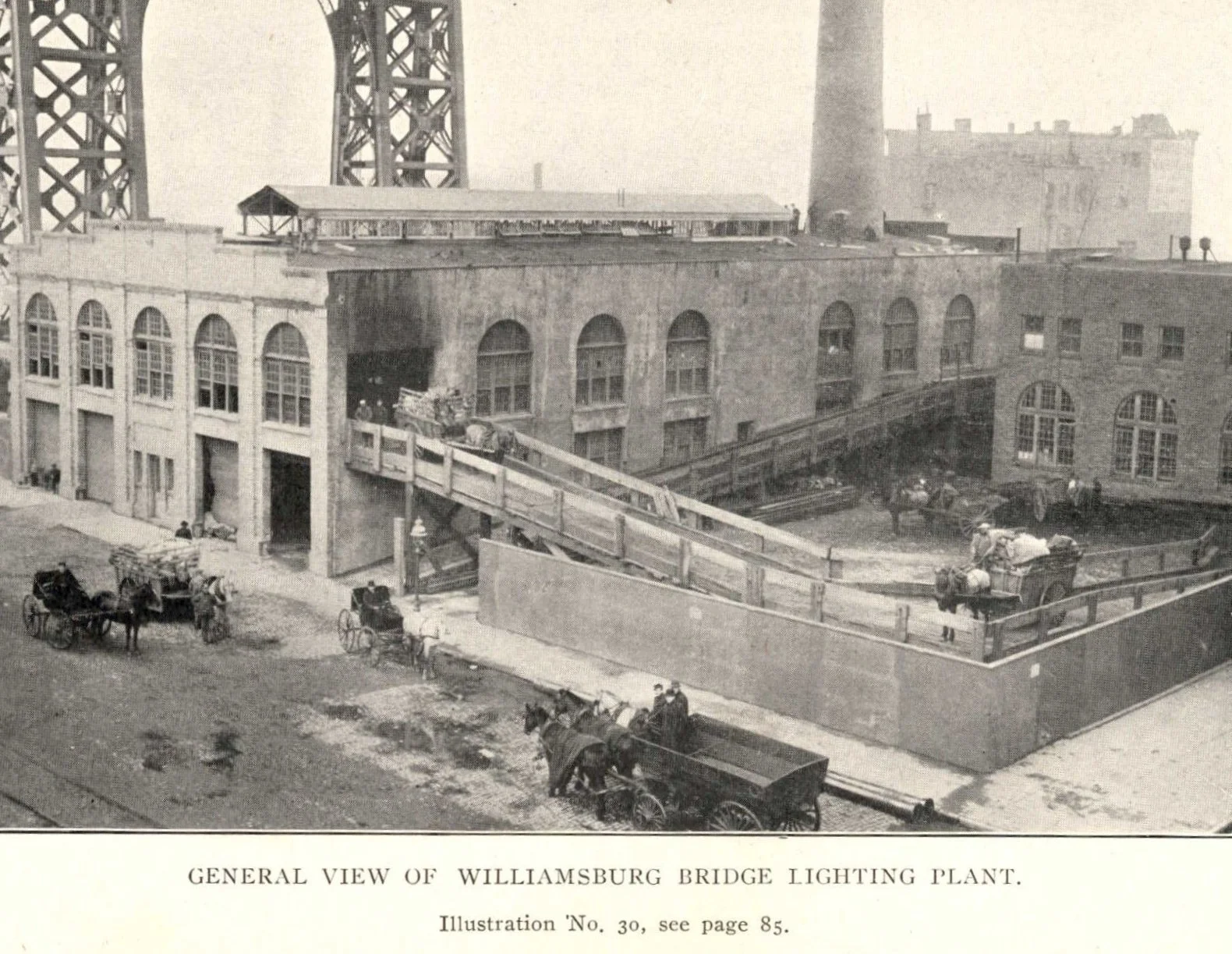
Williamsburg Bridge Lighting Plant. Annual Report of the Department of Street Cleaning, 1905. NYC Municipal Library. The Department of Bridges Lighting Plant is on the right, while the Department of Bridges Incinerator with its’ ramp and smokestack are on the left.

Department of Street Cleaning workers at the furnaces in the incinerator plant. Annual Report of the Department of Street Cleaning, 1905. NYC Municipal Library.

In 1895, newly-hired Street Cleaning Commissioner Colonel George E. Waring brought the department into the modern age. Almost immediately, Waring banned large-scale ocean dumping and instituted a recycling system. Ashes were taken to landfills, while animal wastes were rendered for fertilizer. Rubbish including rags, paper, and other recyclable goods were further separated into items that could be sold for profit. By 1902, whatever couldn’t be recycled was burned in several new municipal incinerators. The 47th Street incinerator had a small electrical plant capable of creating enough electricity to light the Department’s stables as well as docks and piers in the neighborhood.  

Sorting – The incinerator plant was fitted with with a large sorting ramp where workers separated garbage from materials that could be sold for a profit. Annual Report of the Department of Street Cleaning, 1905. NYC Municipal Library.

Williamsburg Bridge from roof of Grand Street long focus, June 19, 1911. Eugene de Salignac, Dept of Bridges/Plant & Structures Collection. The smokestack visible in front of the bridge was built to bring the smoke above and away from the bridge.

Finally, by 1905, enough trials had been carried out, and it was time to prove the concept of creating enough electrical power by burning garbage on a large scale. This brings us to our original architectural plans. The two buildings were elegantly rendered with simple facades. The Department of Street Cleaning building incinerator plans included details such as the ramps used to bring rubbish into the building as well as the 40-foot sorting machine that was used to separate recyclable materials from the garbage that would be burned. The plans also show that one side of the building would be adjacent to the Delancy Slip for easy extraction of rubbish coming in via scows on the East River. A 250-foot smokestack standing nearly 75 feet above the Williamsburg Bridge would carry smoke away from bridge traffic. The Department of Bridges building was fitted with access to two boilers that were connected to electrical generating equipment on the first floor and a storage battery on the second.  

Plan for smokestack, Williamsburg Bridge Incinerator. Dept. of Buildings Plans, NYC Municipal Archives.

On November 31, 1905, a New York Times headline read, “The Mayor Starts New City Light Plant – The New Bridge All Aglow” after Mayor McClellan pulled down a copper switch to illuminate the 2793 foot span with electricity made by burning the City’s garbage. (In truth, the bridge was not fully illuminated until January 1906.)  

The Engineering Record, from November 11, 1905, stated “The first attempt on a large scale in this country to utilize the electricity made available by burning rubbish has begun.” It was hoped that the $90,000 plant would not only pay for itself but would also save the city $12,000 per year in annual lighting costs. While initial reports claimed that the experiment was a success, it would be short lived. 

The first hint that something was amiss was the absence of information about the experimental plan in the Department of Bridges reports. The only notation came in a single line in the 1906 Annual Report about the use of the land under the bridge: “the greater portion of the land between East and Tompkins Streets has been given over to the use of the Street Cleaning Department, for a rubbish incinerator, and to the construction of an electric light plant for the bridge.” In addition, the 1906 Street Cleaning report did not mention the project, although they had dedicated nearly 30 pages to the experiment the previous year. 

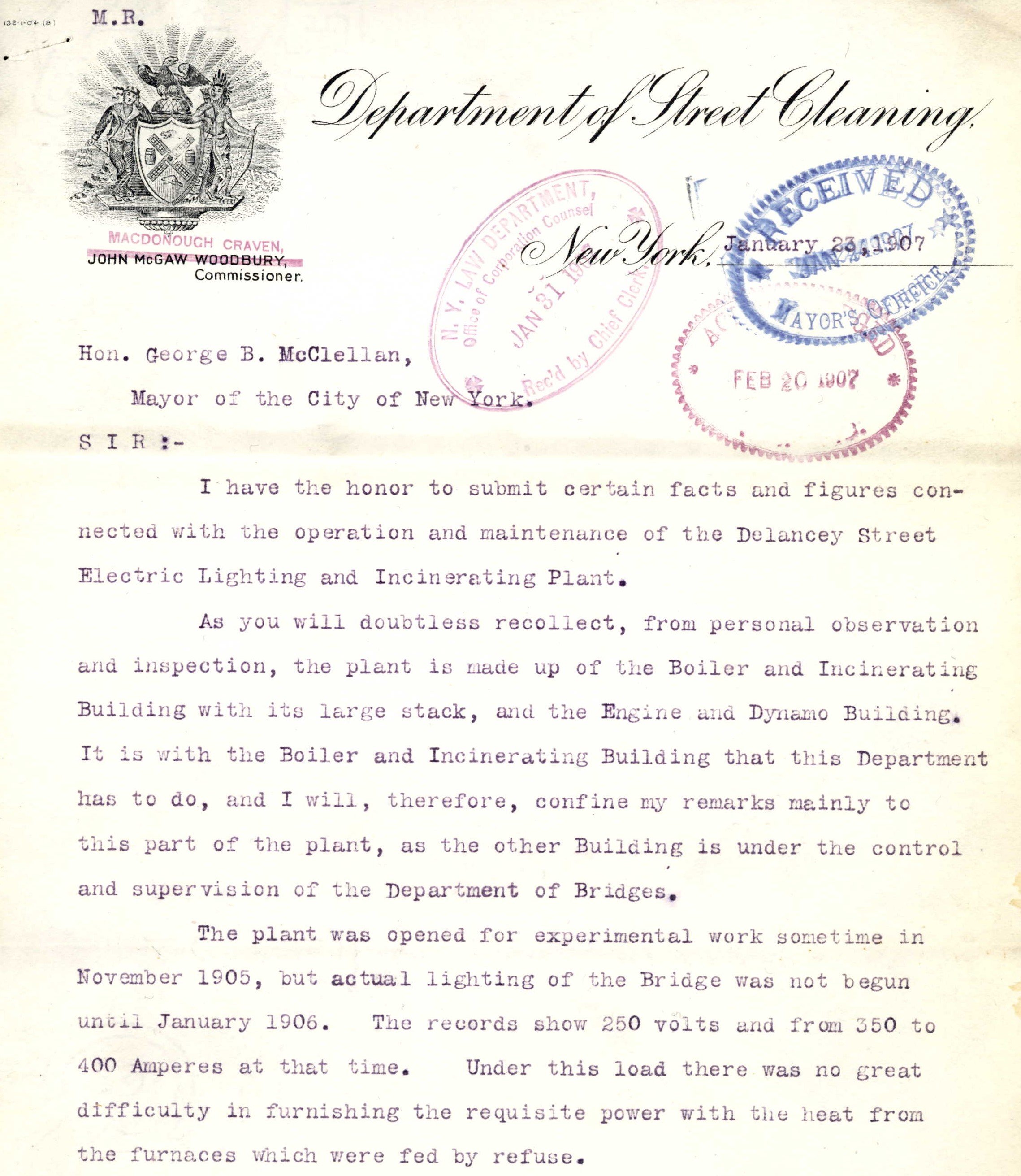
Answers came in a letter to the Mayor from the Street Cleaning Commissioner Macdonough Craven, dated January 23, 1907. Craven spelled out the problems of the project. It seems that when devising his plan, Henry De Berkeley Parsons had not accounted for the difference in electrical usage during the long spring and summer days, versus the darker winter and fall period. The Street Cleaning department discovered it needed to burn more than 1,100 tons of coal to compensate, which appeared to have been an unexpected cost. After one year of operation, the department experienced a net loss of $19,621.  

Letter to Mayor McClellan from Street Cleaning Commissioner Macdonough Craven, dated January 23, 1907. Craven wrote to explain the disappointing results from the experiment of lighting the bridge by burnings the City’s rubbish. Mayors Papers, NYC Municipal Archives.

On the other hand, Craven reported that the Department of Bridges had a net gain of $19,617 for the same period compared to what they would have to pay for the Edison Electric Light Company to supply the power. Craven proposed a solution to the mayor - “All the forgoing has led me to the following conclusion: that because of the large benefit on the part of the Department of Bridges, the entire plant be turned over to them, this Department merely furnishing the paper and rubbish, the heat from which they can use to augment that produced by coal.” 

The final news of the demise of the lighting experiment came in two short 1907 reports. In the first, the Department of Street Cleaning stated that incineration should only be used as a method of disposing of rubbish and not as a power source for the city. In the second the Department of Bridges stated that “the Bridge Lighting Sation opened on November 30, 1905, by Mayor McClellan. Light and power for the bridge was furnished until April 30, 1907, when the station was shut down, current being obtained from the Edison Company.” 

And with that, our facinating mystery of lighting the Williamsburg Bridge was solved.

New Accession: Department of Sanitation Photographs

This week’s blog will show a few sample images from a recently acquired series of Department of Sanitation (DOS) photographs. The collection of approximately 32 cubic feet spanning 1900-2007, is comprised of glass plate and acetate negatives as well as prints. This series will is a great addition to the Municipal Archives’ comprehensive photographic documentation of New York City.