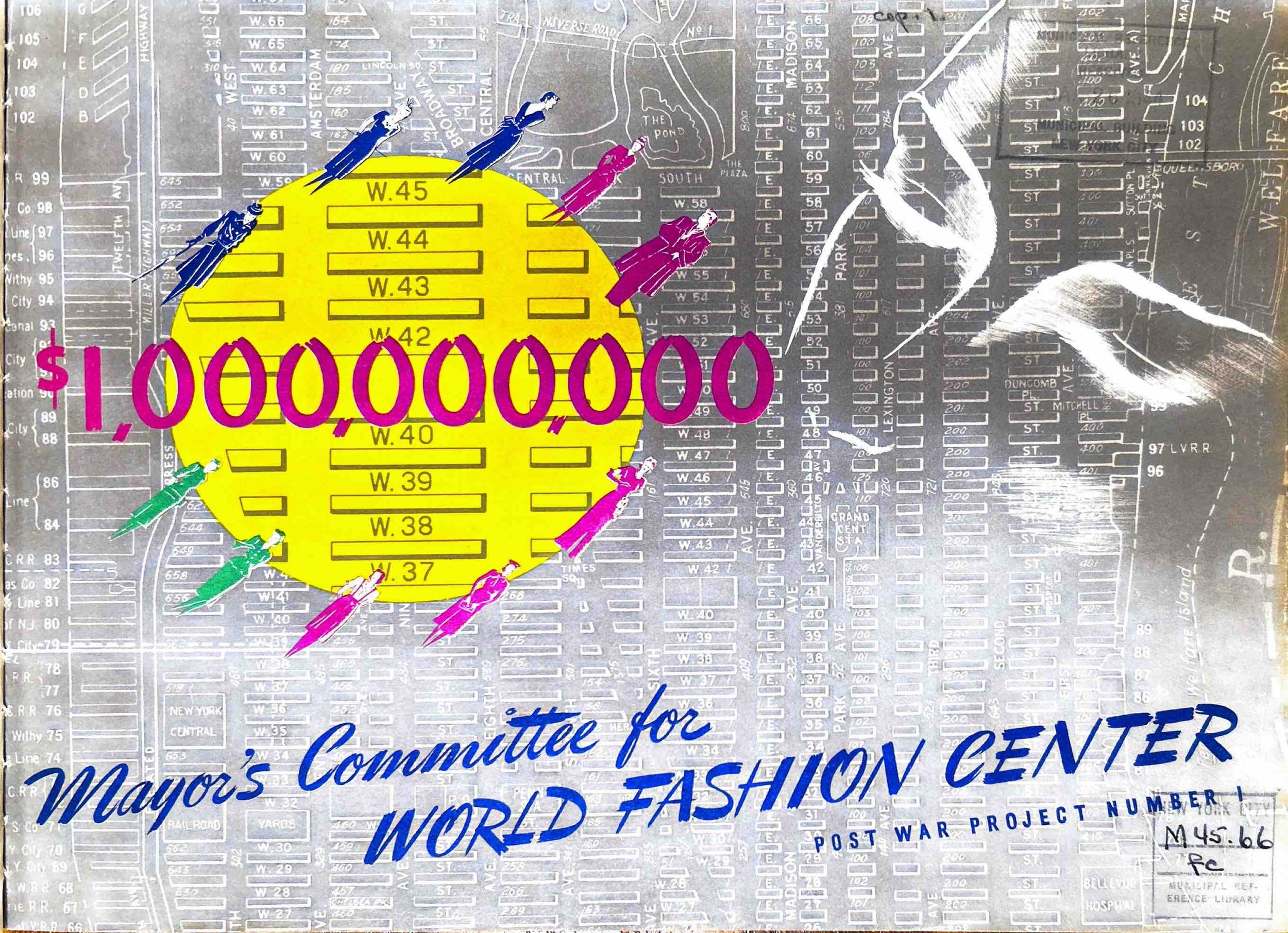
The World Fashion Center: New York City’s Post War Business Project No. 1, 1944. NYC Municipal Library.
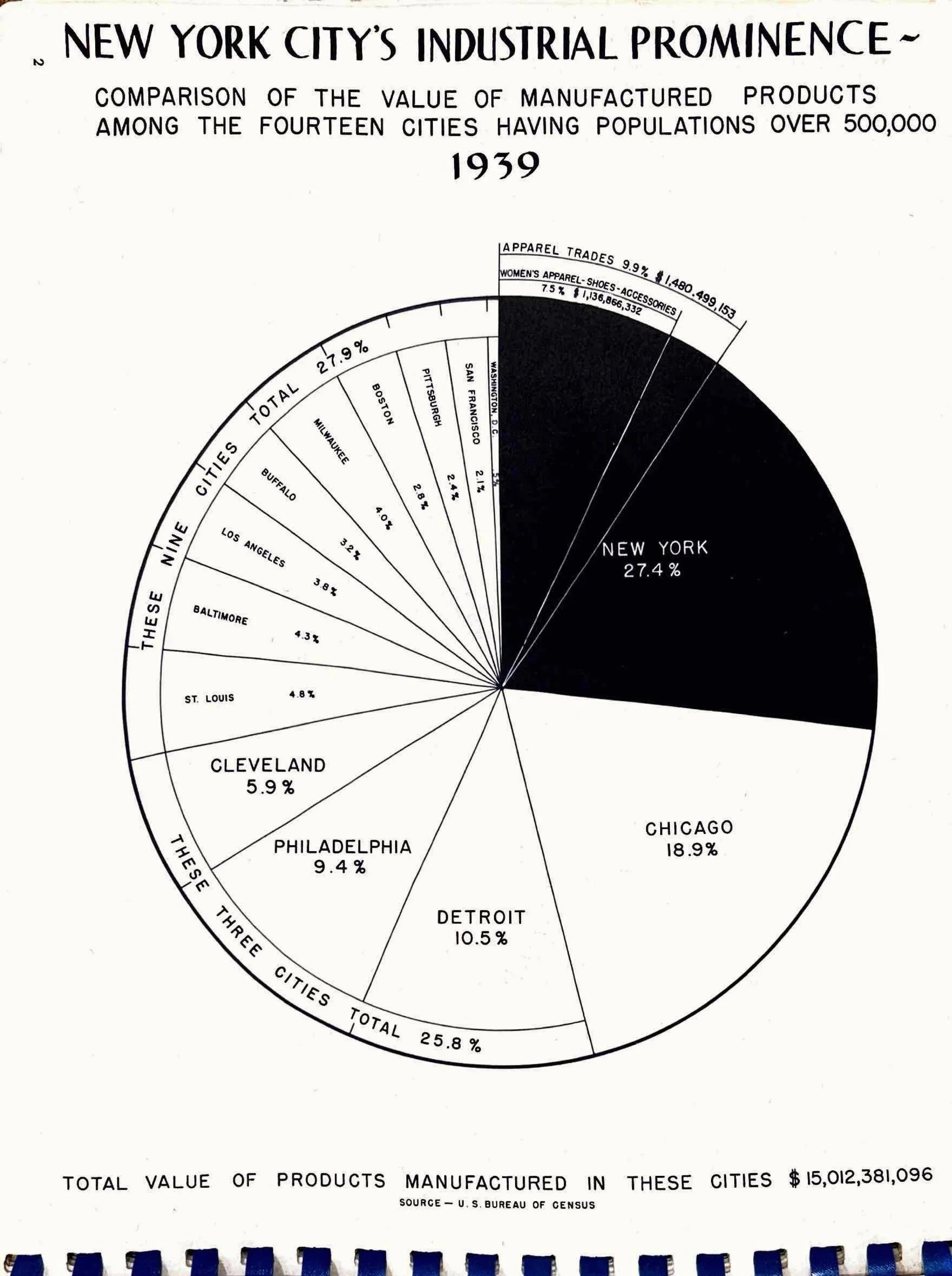
The World Fashion Center: New York City’s Post War Business Project No. 1, 1944. NYC Municipal Library.
As NYC Fashion Week wraps up, we are taking a look back at earlier visions for the city’s fashion future, as preserved in the collections of the Municipal Library. During World War II, the garment industry remained New York City’s single largest employer, supporting 223,156 wage earners, and the city was the undisputed national leader in apparel manufacturing. With an eye toward the postwar economy, Mayor Fiorello La Guardia created the Mayor’s Committee for World Fashion Center. In 1944, the committee’s chairman, Grover A. Whalen, a prominent New York official who had served as Police Commissioner and president of the 1939 New York World’s Fair, submitted a report to the mayor titled The World Fashion Center: New York City’s Post War Business Project No. 1.
The report confidently declared that “In the creation of fashion, as well as in the production of fashion merchandise, New York City stands supreme.” It proposed the creation of a World Fashion Center that would serve as a “focal point for the design, display, and marketing of apparel and allied merchandise.” The ambitious project was intended to strengthen New York’s position in the national apparel industry, stabilize the city’s garment trades, and prevent further erosion of its market share at a time when apparel manufacturing was expanding in cities across the country.
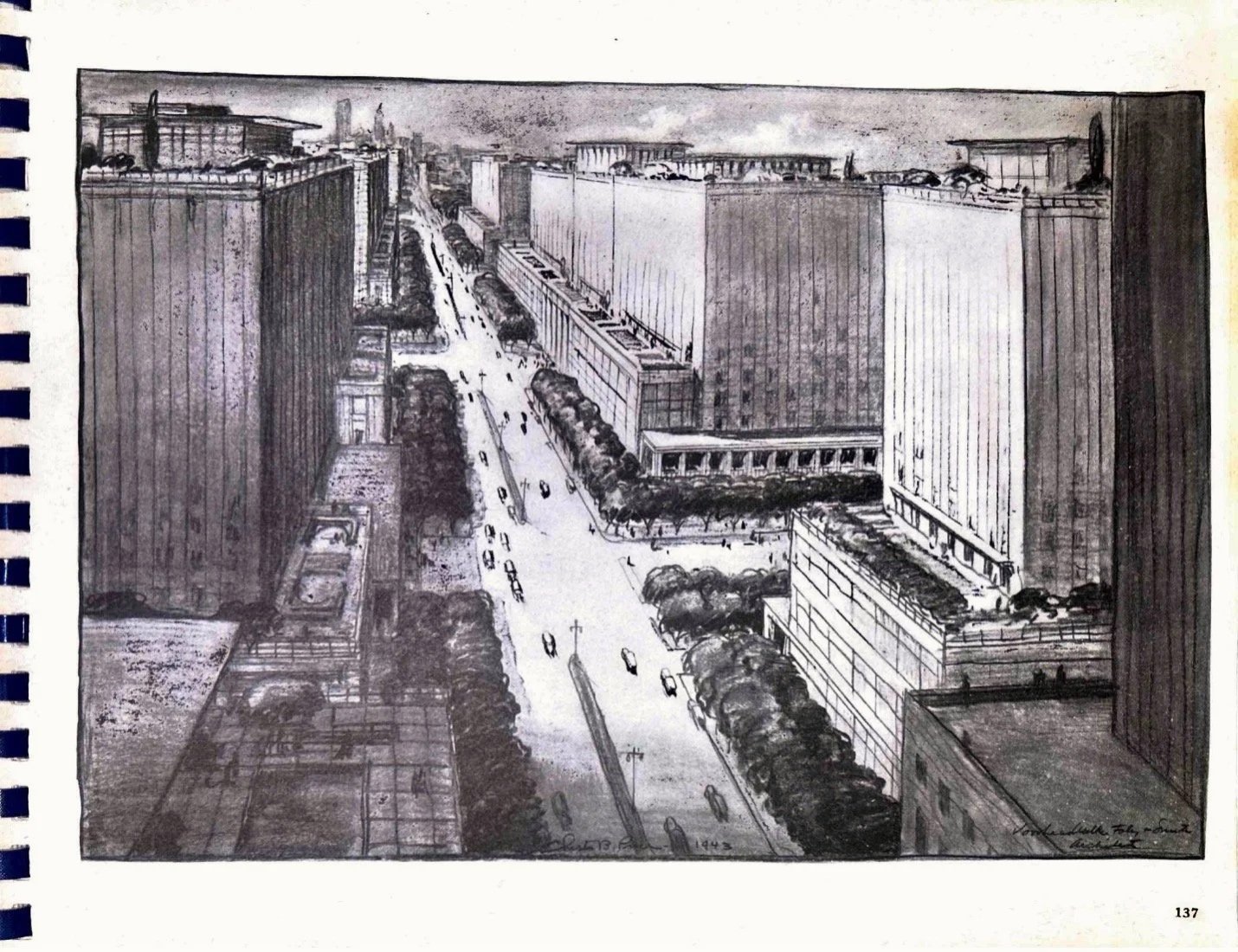
Sketch of proposed center. The World Fashion Center: New York City’s Post War Business Project No. 1, 1944. NYC Municipal Library
The committee acknowledged that after the war “the world will undoubtedly turn again to Paris for much of the design of the luxury apparel,” but argued that America’s opportunity lay “in the direction of mass production design.” New York, in other words, could maintain its leadership by combining its existing strengths in design, manufacturing, and marketing with the enormous potential of the American mass market.
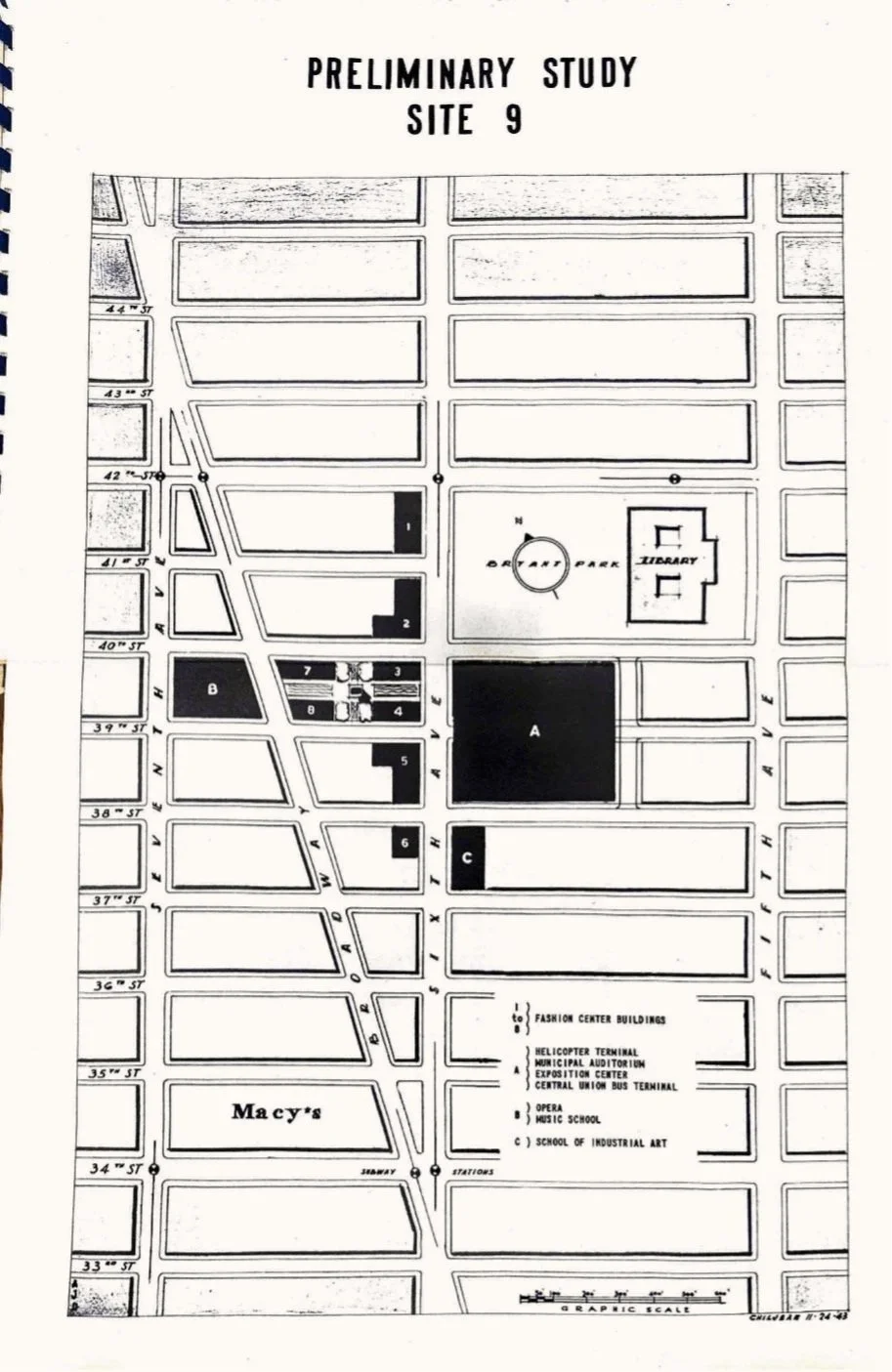
Map from Study for Site 9. The World Fashion Center: New York City’s Post War Business Project No. 1, 1944. NYC Municipal Library.
Ten sites in and around the Garment District were considered for the proposed center, and the report included detailed estimates of the costs associated with each. Depending on the site, the total expenditure was projected to range from approximately $88.7 million to $126.8 million, a staggering investment for the period.
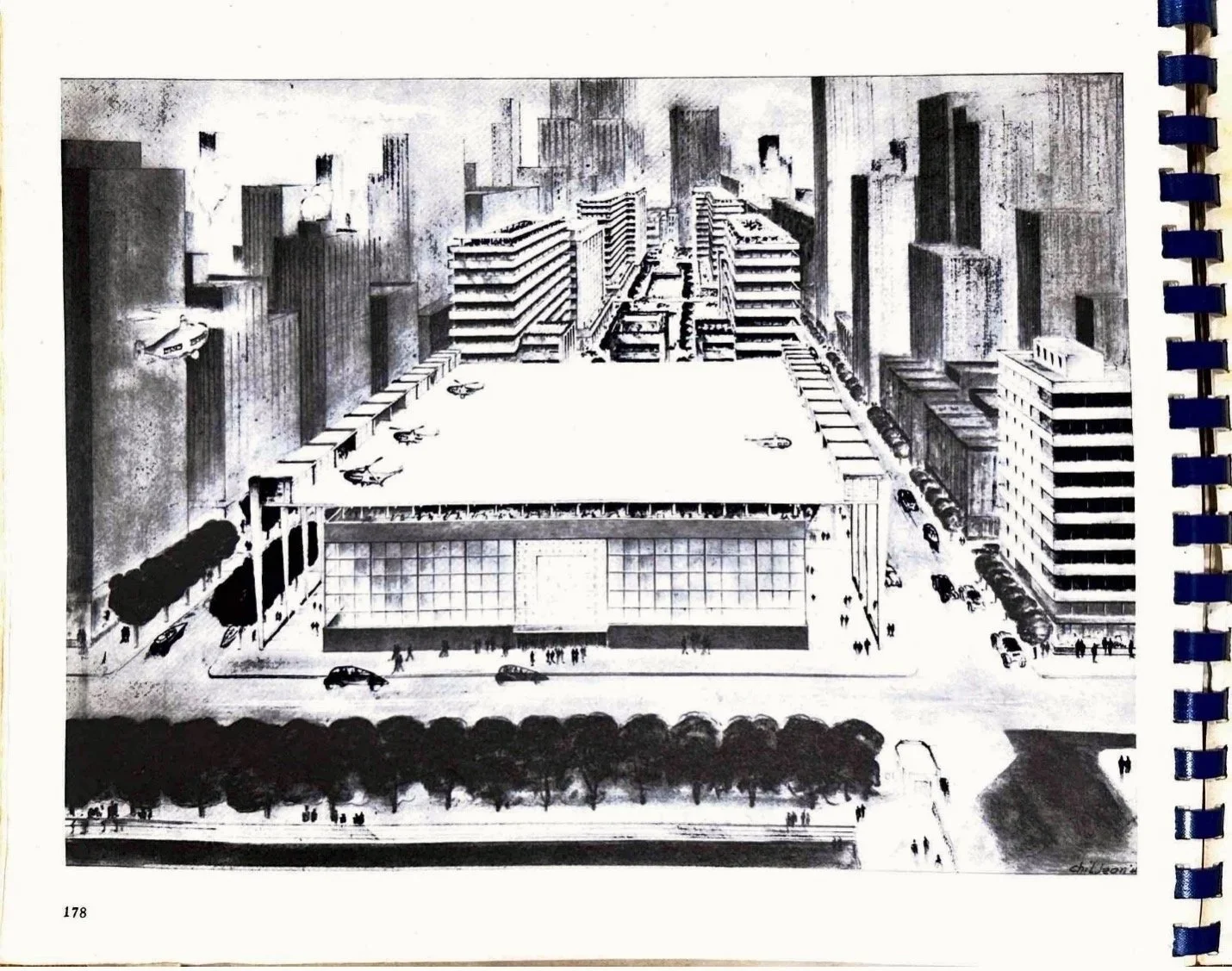
Sketch showing rooftop helicopter terminal. The World Fashion Center: New York City’s Post War Business Project No. 1, 1944. NYC Municipal Library.
The proposed complex would have been much more than a collection of fashion showrooms. In addition to the main fashion center, the plans called for a large convention center, a new home for the Metropolitan Opera, a school of industrial arts, and a helicopter terminal. Many of these functions would eventually find homes elsewhere in the city. The New York Coliseum opened in 1956, later replaced by the Jacob K. Javits Convention Center in 1986, while the Metropolitan Opera moved to Lincoln Center in 1966.
A Stitch in Time, 1957. NYC Municipal Library.
Though nothing came of the wartime World Fashion Center proposal, the idea did not disappear. More than a decade later, in 1955, Mayor Robert F. Wagner Jr. revived the Mayor’s Committee for World Fashion Center, again placing Grover Whalen at its helm. In 1957, the committee released a new plan, A Stitch in Time. Fittingly, as this was a report created by and for the fashion industry, it was a stylish and carefully designed volume, complete with the distinctive visual character of the 1950s.
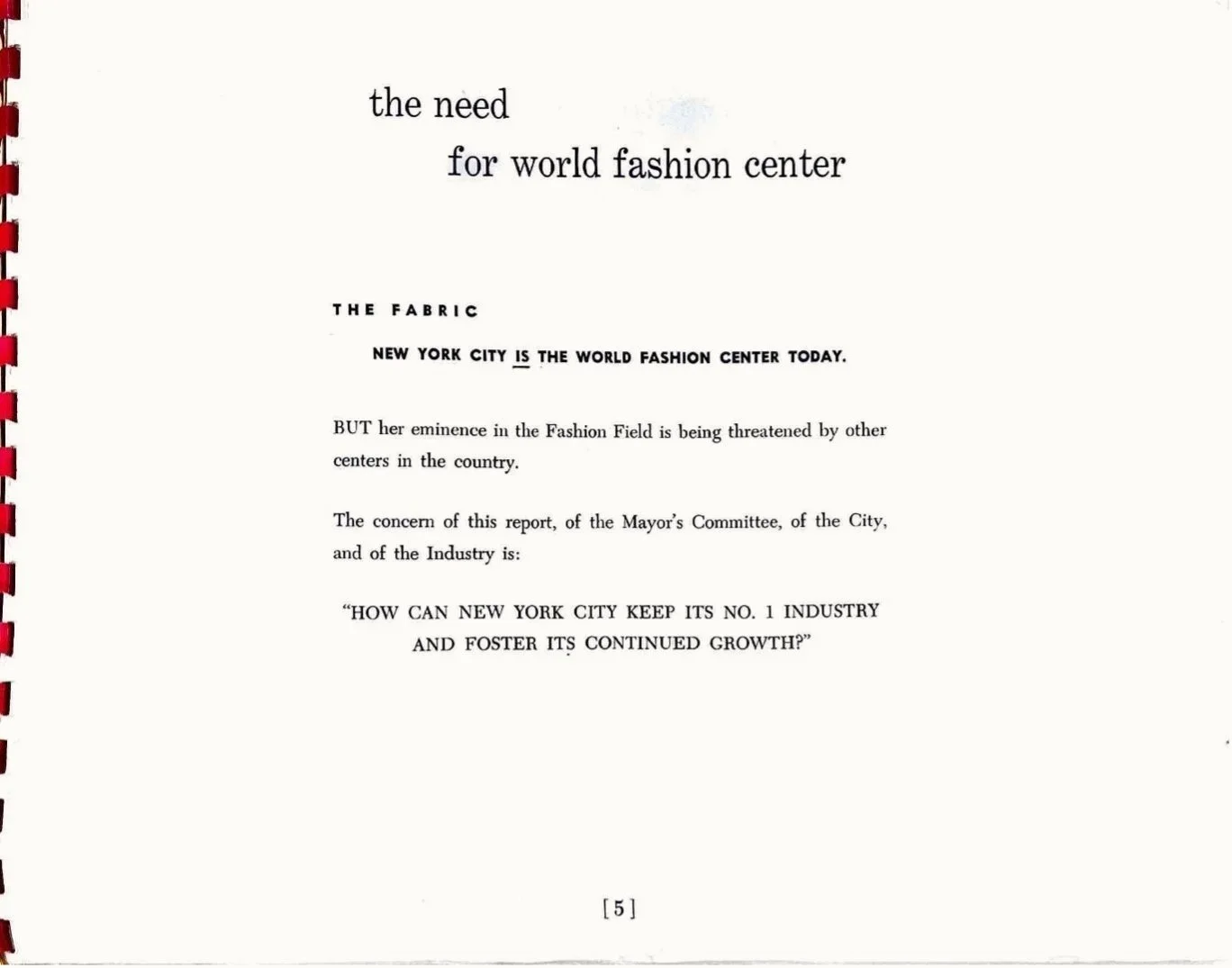
A Stitch in Time, 1957. NYC Municipal Library.
The circumstances, however, had changed since 1944. While still supporting over 300,000 workers in apparel manufacturing, New York’s so-called “needle trades” had continued to lose ground to other American cities, while worsening traffic congestion had made the Garment District increasingly difficult to navigate. A Stitch in Time proposed a modernized, scaled down, $100 million complex encompassing showrooms, offices, and advanced underground loading and trucking facilities. The development would have been centered around the intersection of Broadway and Avenue of the Americas and connected to the proposed Midtown elevated expressway, a highway project that itself was never built.
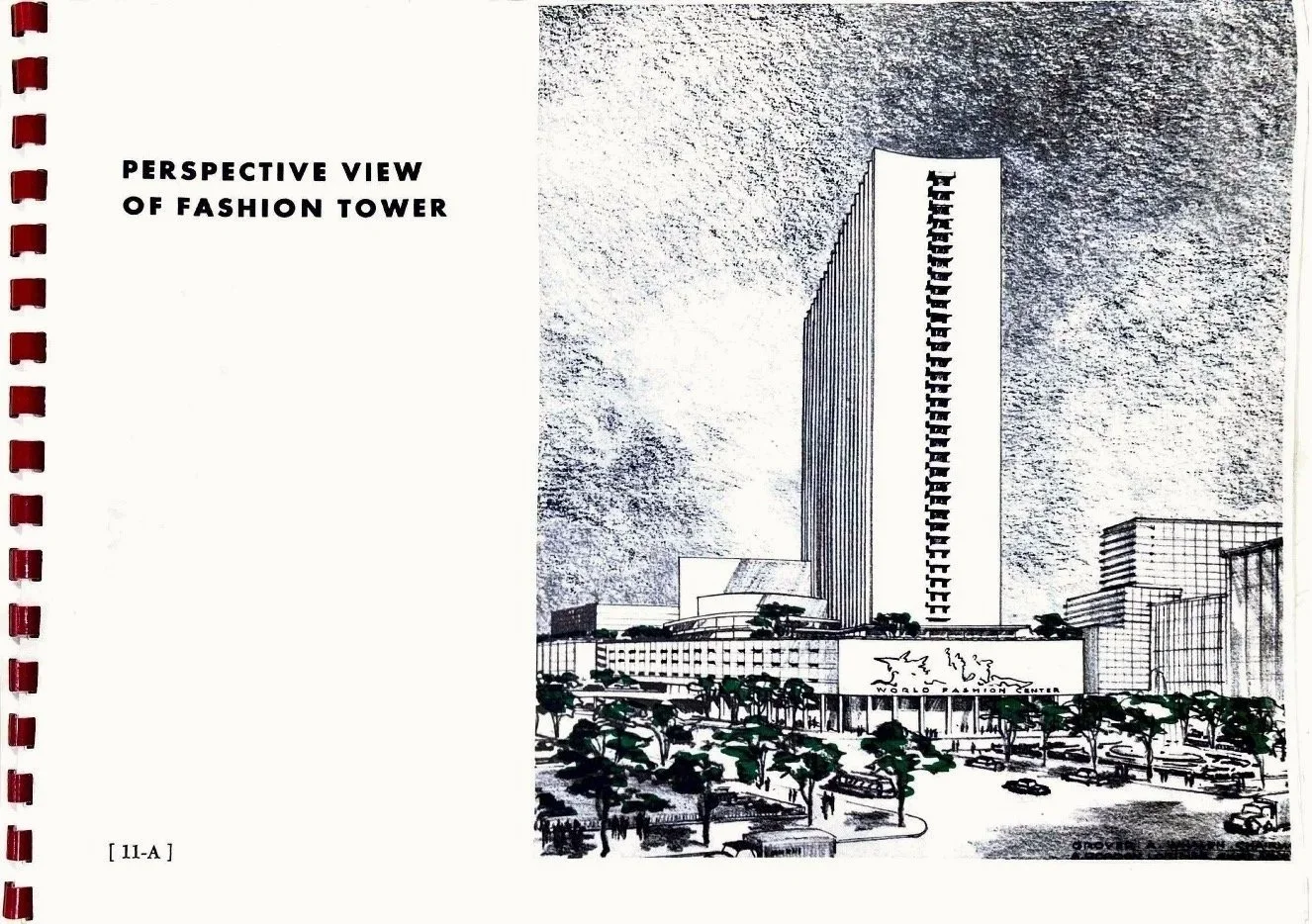
A Stitch in Time, 1957. NYC Municipal Library.
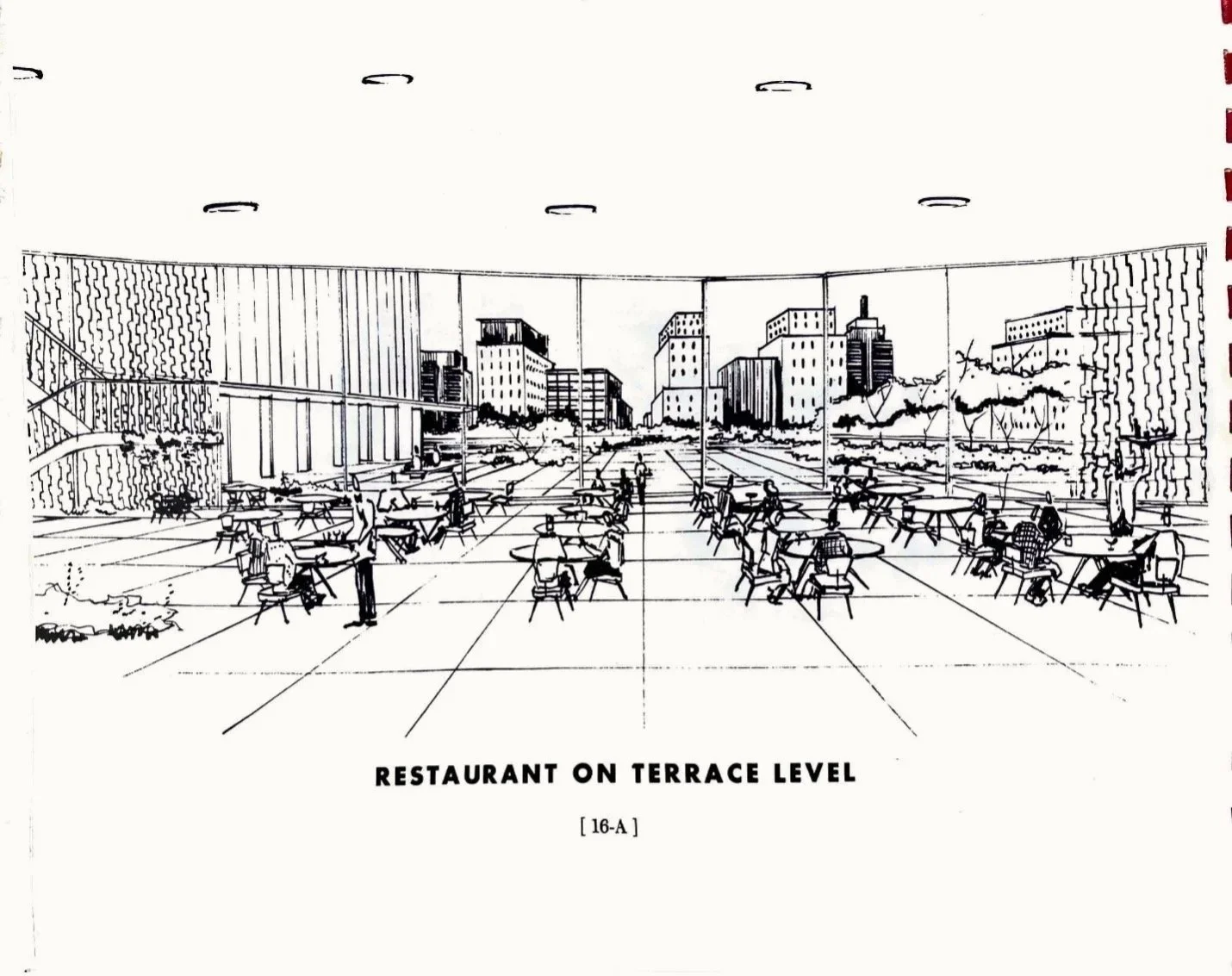
The proposed center was conceived as a self-contained environment for the fashion industry. Its plaza level would include restaurants, club rooms, airline offices, beauty parlors, and other amenities for industry executives and buyers visiting from out of town. One floor above, an 1,800-seat theater would provide a venue for fashion shows and other performances.
A Stitch in Time, 1957. NYC Municipal Library.
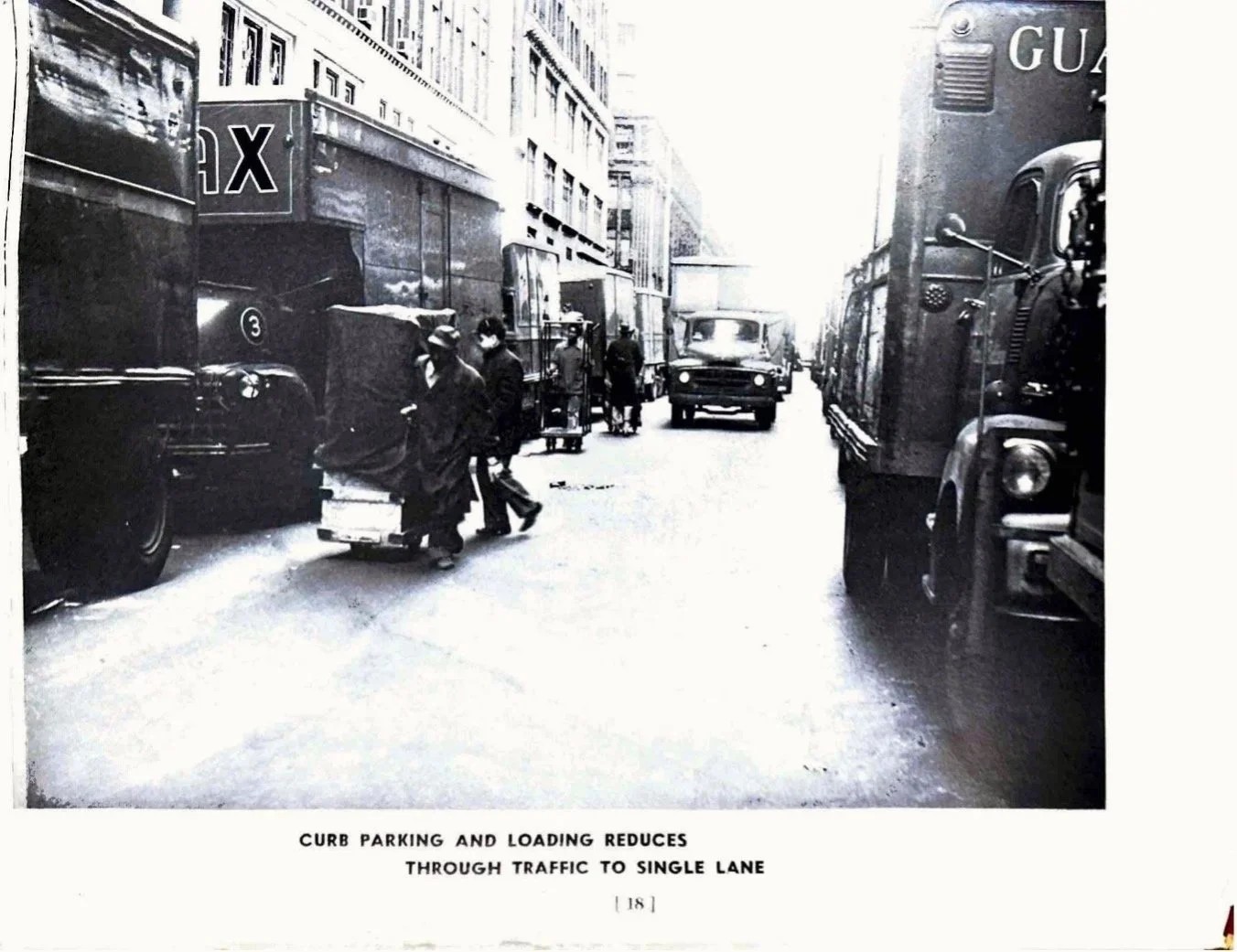
The report remained optimistic about the underlying strength of the American apparel market, and singled out Puerto Rico as a vital supplier of labor for the garment industry, which had always depended on immigrants. Given the country’s growing population, it argued, there “could be no question about the growth of the apparel industry in the nation as a whole.” The question was whether New York would capture that growth or continue to stagnate and lose business to competing regional centers. The city’s dwindling supply of manufacturing space and increasingly severe traffic congestion on streets “originally laid down to accommodate pushcarts, carriages and horses” were identified as major threats to its future as a fashion capital.
A Stitch in Time, 1957. NYC Municipal Library.
Once again, however, the ambitious plans appear to have stalled. The problems confronting the Garment District did not disappear, and traffic conditions continued to deteriorate. By 1967, the city’s response had become considerably more modest. Mayor John V. Lindsay announced a plan to ease congestion by coordinating the work schedules of major utilities and city agencies. Consolidated Edison, New York Telephone, and the Department of Sanitation would “revise their work schedules in the district in such a way as to reduce to a minimum the impact of the work on midday traffic.” A grand World Fashion Center had given way, at least temporarily, to efforts to make the existing district function more efficiently.
Manhattan Garment Center Urban Goods Movement Study, 1976. NYC Municipal Library.
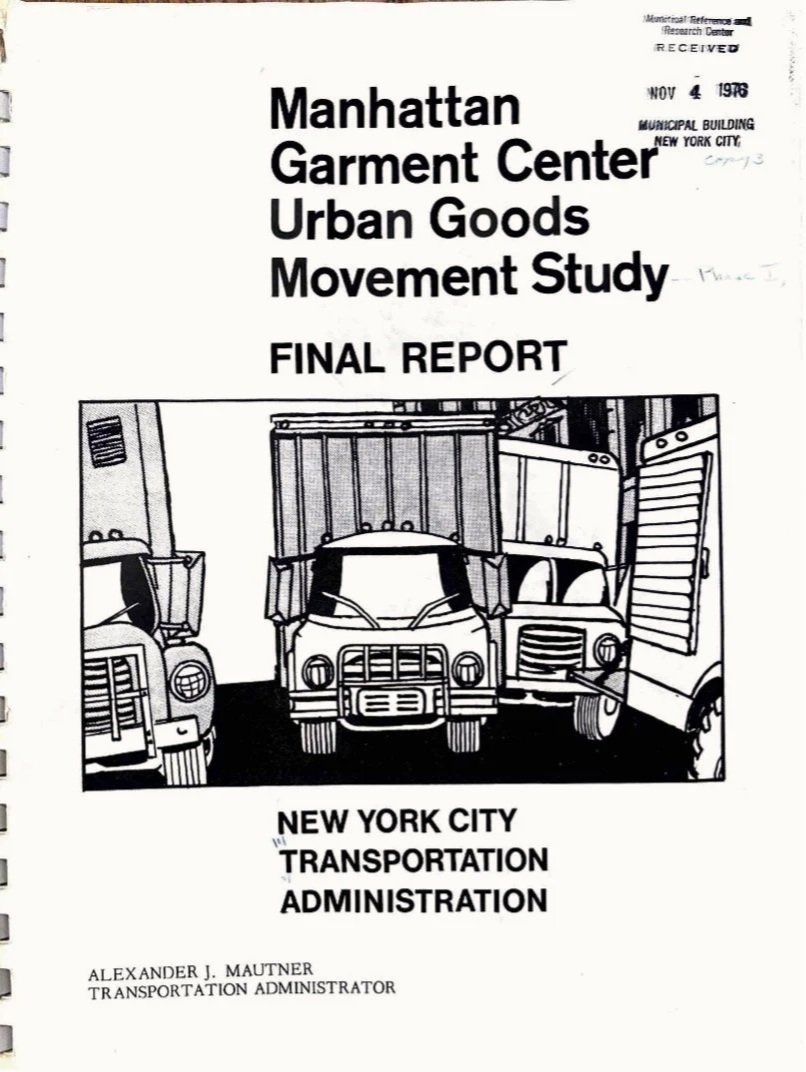
These same traffic concerns prompted the Manhattan Garment Center Urban Goods Movement Study, first published in 1976 as a multi-phased project of the NYC Transportation Administration to assess and propose solutions to congestion, delays, environmental impacts, and economic decline in the garment district.
The city continued to search for ways to preserve the garment industry. In the early 1970s, amid rising crime and the continued departure of apparel manufacturers, Lindsay created the New York City Office of Apparel Industry Planning and Development. The office was charged with supporting and revitalizing the local fashion manufacturing sector, with particular attention to security, cleanliness, and infrastructure in the Garment District.
A 1974 analysis by the Office of Apparel Industry Planning and Development illustrates both the continued importance of apparel manufacturing and the scale of the transformation already underway. Although manufacturing in New York City as a whole was in steep decline, apparel manufacturing still employed 202,012 people and accounted for 26.7 percent of all manufacturing jobs in the city. The office itself was short-lived; in 1976, it was abolished and its functions absorbed into the Mayor’s Midtown Action Office.
By the 1980s, the city was also increasingly attempting to promote garment manufacturing by protecting the physical space that remained for it. In 1987, New York created the Special Garment Center District, an effort to preserve loft space for apparel manufacturers who were increasingly competing with commercial offices and other businesses in a rapidly changing and gentrifying Midtown.
Concerns over personal safety as well as the preservation of dedicated manufacturing space persisted into the early 1990s, as recorded in the annual and quarterly reports of the short-lived Garment Center Enforcement Project, a specialized task force dedicated to policing compliance in the areas of zoning, health, and safety.
In retrospect, one of the most significant forces behind the garment industry’s decline was something the mid-century World Fashion Center plans largely failed to anticipate, namely the globalization and overseas outsourcing of apparel manufacturing. The city’s planners understood that New York faced competition from other American manufacturing centers, but the eventual scale of international competition was even more consequential. Manufacturing jobs continued to move overseas through the late 20th century and into the 21st, dramatically reducing the role of production within New York’s fashion economy.
There have nevertheless been periodic efforts to rebuild the city’s manufacturing base. Among them was Mayor Bill de Blasio’s 2017 “Made in NY” initiative. which sought to support local manufacturing alongside the city’s broader fashion and entertainment industries.
The history of the proposed World Fashion Center is therefore more than the story of two unrealized development schemes. It illustrates a recurring dilemma in New York’s economic history: how to preserve an established industry as the conditions that made it successful begin to disappear. In the 1940s and 1950s, city officials and industry leaders believed that better facilities, improved infrastructure, and closer integration of design, manufacturing, and marketing could secure New York’s position as a world fashion capital. Later efforts shifted toward managing congestion, improving the Garment District, protecting manufacturing space, and eventually encouraging the remaining manufacturers to remain.
The World Fashion Center was never built, but the underlying aim of ensuring that New York City remained a place where fashion was manufactured continued in various forms. That vision proved increasingly difficult to sustain as manufacturing moved first to other parts of the United States and then overseas.
Today, the fashion industry remains a major part of New York’s economy, employing approximately 180,000 people and accounting for about 6 percent of the city’s workforce. But manufacturing now represents only a small part of that ecosystem, which is concentrated primarily on design, wholesale, and retail. The unrealized World Fashion Center thus stands as a fascinating artifact of an earlier moment, when New York still imagined that its dominance in fashion could continue to extend from the designer’s sketchbook all the way to the factory floor.
This blog originally appeared in the monthly newsletter, Municipal Library Notes, which has been published since 1913. Sign up here to receive it by email.