Municipal Library

The Municipal Library is a Library—A Conversation with Julie Robbins

On June 24, 2026, sometime late afternoon, encircling the wooden conference table of the Department of Records and Information Services headquarters at 31 Chambers, where on the walls, assembled as asymmetrical triptychs are framed historical black-and-white photographs of bridges, street scenes, or graphic news clippings, three DORIS staff sat. At the center of the table two cell phones recorded a conversation: Commissioner Smith-Cruz with Assistant Commissioner Cobb, sat across from the Deputy Librarian, Julie Robbins. At the eve of her retirement, what began as an interview quickly became a recalling of the role and its impact on our city’s records. Below is a snippet of the conversation.  
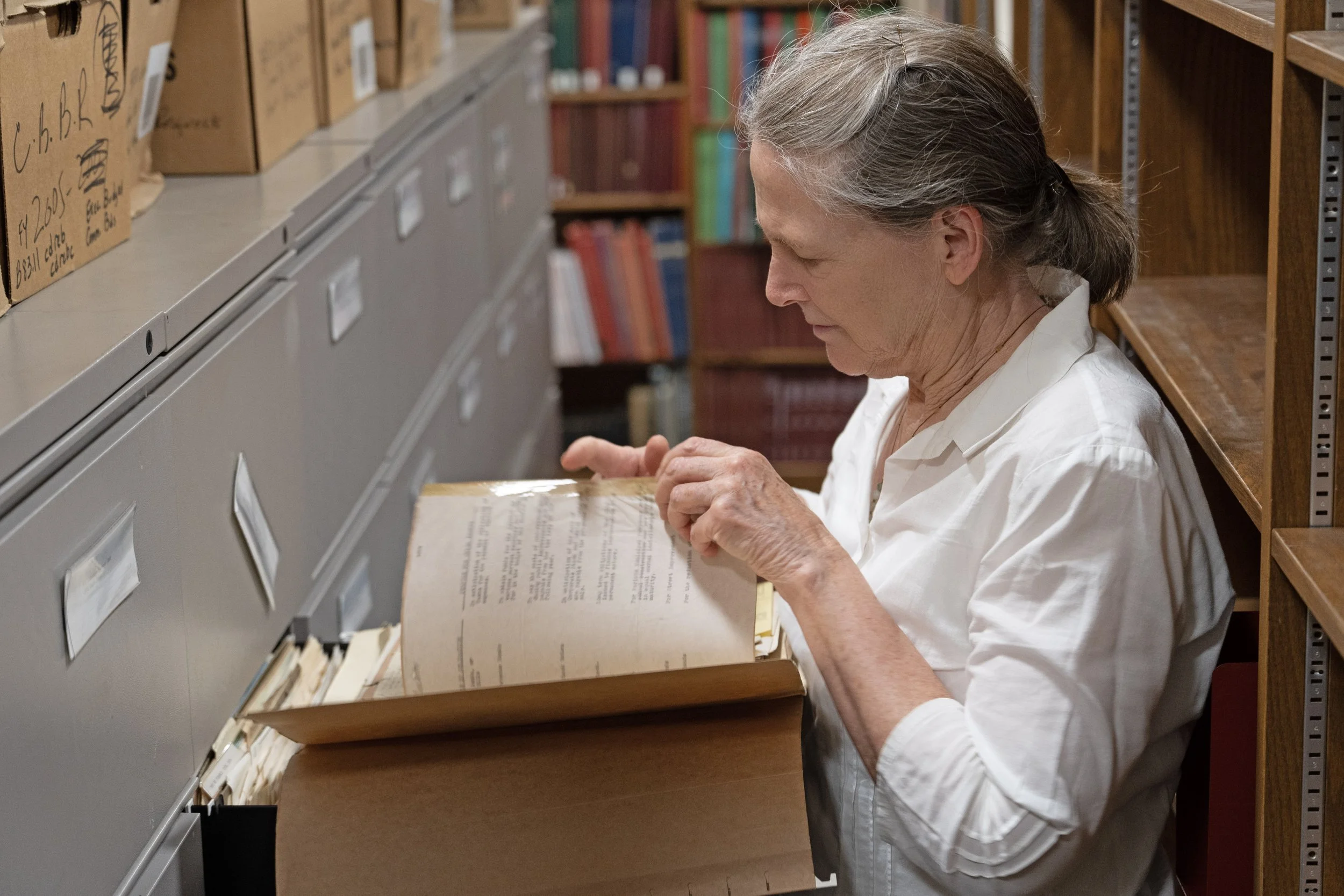
Photos of Julie Robbins by Matt Minor

Shawn(ta) Smith-Cruz: Julie, Ken may already know this, but I’m new. Tell us what brought you into the Municipal Library.

Julie Robbins: I worked as a lawyer for many years until I finally smartened up and realized that it wasn’t what I wanted to be doing. I was already quite mature and decided to go to library school. I think I may have been by far the oldest in my class, but it was great. Then I noticed an internship posting for the Municipal Library. I applied, and I never left. 

Ken Cobb: The Municipal Library is a library, obviously, and it is open to the public. But it is not a public library. Tell us how that informs the operation of the library and or the services.  

JR: The last commissioner, Pauline Toole, had a very strong commitment to having the Municipal Library be fully open to the public. That does inform how we handle the reading room, for instance, because walk-ins are still allowed and encouraged to come in. There were times when that made us more like a branch of the New York Public Library. Our rules and regulations for use are informed by what a regular public library has to put in place for safety, and so on.  

SSC: Tell us about the GPP. What is it? What is it good for? And what have you done for it?  

JR: The Government Publications Portal! I’d say I’m “cheerleader in chief,” probably. Joel Castillo was the head of applications development. He started here when he was in college and went on to head the applications development team. Early on in his tenure, he wrote the code to create a digital library. And so, the government publications portal is a digital library. And we are actually tasked by the charter to maintain a digital library of the City’s publications. It used to be that the charter required every agency to send us four copies of every single thing they published. But the agencies gradually phased out paper publications, and we started not having room for all the hard copy.  

SSC: What’s the status of the GPP now? How can it grow? 

JR: Oh, it can get a lot better. Our search is a little wonky. It’s a little too thorough, but better too thorough than not, I suppose. Our user experience, both for the agency submitters, and for the public, is in need of a tune up. We haven’t linked WorldCat to the digital items. Our regular catalog Koha, which is powered by Bywater, is available in WorldCat. At some point, syncing the GPP would make both discoverable. I don’t have the technical chops to do that myself, but somebody probably does. 

SSC: I'm curious about reference work. Explain to me the reference ecosystem.  

JR: Differently than archives, as it relates to the library, it’s actually fairly straightforward. You show a researcher the library catalog. We either have it or we don’t. We pull it for them. One thing we do find often is that researchers access our collections through the Archives. They know the Municipal Archives. It is better known than the Library. So sometimes we have to, like, chivvy our Archives’ colleagues into making sure that researchers know that there are published materials from the agency that they want, and it’s not just the archival material.  

KC: The Municipal Library is more than just the GPP. Maybe you could tell us about some of your favorite library publications or items you think our readers would be surprised to know are in the library.  

JR: I would say one interesting thing is that almost every mayor had a sort of a “pet topic” or nurtured a particularly fun thing. For example, [Mayor William] O’Dwyer, liked the fashion industry. And LaGuardia has this whole section about civil defense activity because he served during wartime and the Feds appointed him to do emergency work.  

KC: And then there are the vertical files! 

JR: The vertical files are so cool!  

SSC: I know about this collection.  

JR: Yeah, yeah! The librarians gathered campaign brochures and informational materials. The political ones I find particularly amazing, all the way from 1927 to the ’80s. Here’s an example you can research: what role did the German Bunds play in the 1920s political situation in New York? 

KC: The neighborhood files are good, too. 

JR: And the neighborhood files are really good, too. Yeah. 

KC: And the biographical, they have a whole section. 
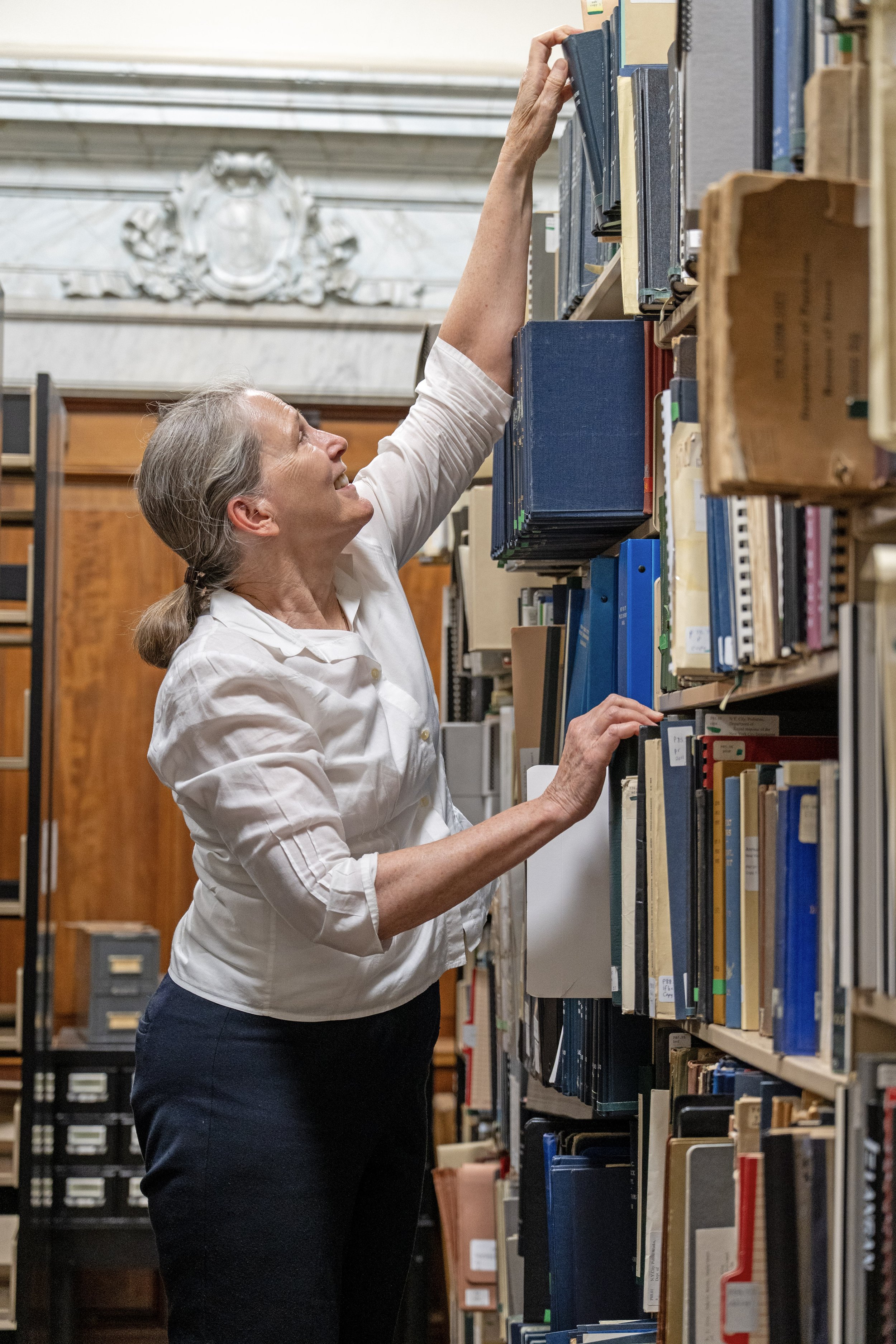
JR: You know, hardly anybody ever looks at those. It’s so interesting. We have clippings about almost every prominent New York City agency employee or politician. It usually includes at least the obituary, and if some police captain gets promoted to a district captain, there’s that. They’re all in binders. They got glued onto pieces of paper, a preservation nightmare, of course; the glue is giving out on a lot of it. 

SSC: Are there any biographies or stories of people that have stood out to you during your time as Deputy Librarian? 

JR: I have a standing coffee date with a previous researcher here, Gil Tauber, who is part of a group called the Bloomingdale Neighborhood History Group. He’s 91. And when he started coming here when he was 87, he was creating a database of street names in New York and building a website, Old Streets, New York. He physically tracked through the entire Board of Aldermen series and wrote down the origin for all street names. We saw a fair amount of him, and I realized that he lived in the neighborhood, so I would run into him on the street, and eventually, Gil and I started having coffee together pretty much every week now.  

SSC: That’s wonderful that you generated this personal relationship! 

JR: The personal relationships in any job are a big part of it. Getting to know the people who are so knowledgeable about, and so committed to City government, and making City government accessible. People like Ken Cobb, and Pauline Toole, and Lauren Gilbert, and, you know, many of my colleagues, has really been wonderful.... I really like being able to help people figure out how to access different city materials. That’s one of the things I’m going to miss.   

KC: Well, is there anything else that you would want to share with the world?  

JR: No.  

SSC: You’ve done it all.  

KC: You said it all.

JR: I’ve said enough. Yeah. Yeah.  

SSC: What’s next for you?  

JR: I’m gonna be traveling! Both on my own, you know, for pleasure and also to visit my, my daughter and granddaughter. Grandma stuff. That’s pretty much the agenda. I’m gonna become bicoastal.  

KC: Nice. And I’ll see you at the farmer’s market.  

JR: And you’ll see me at the farmer’s market. I go in the early morning.  
The Municipal Library: A Progressive Ideal is Realized and Endures

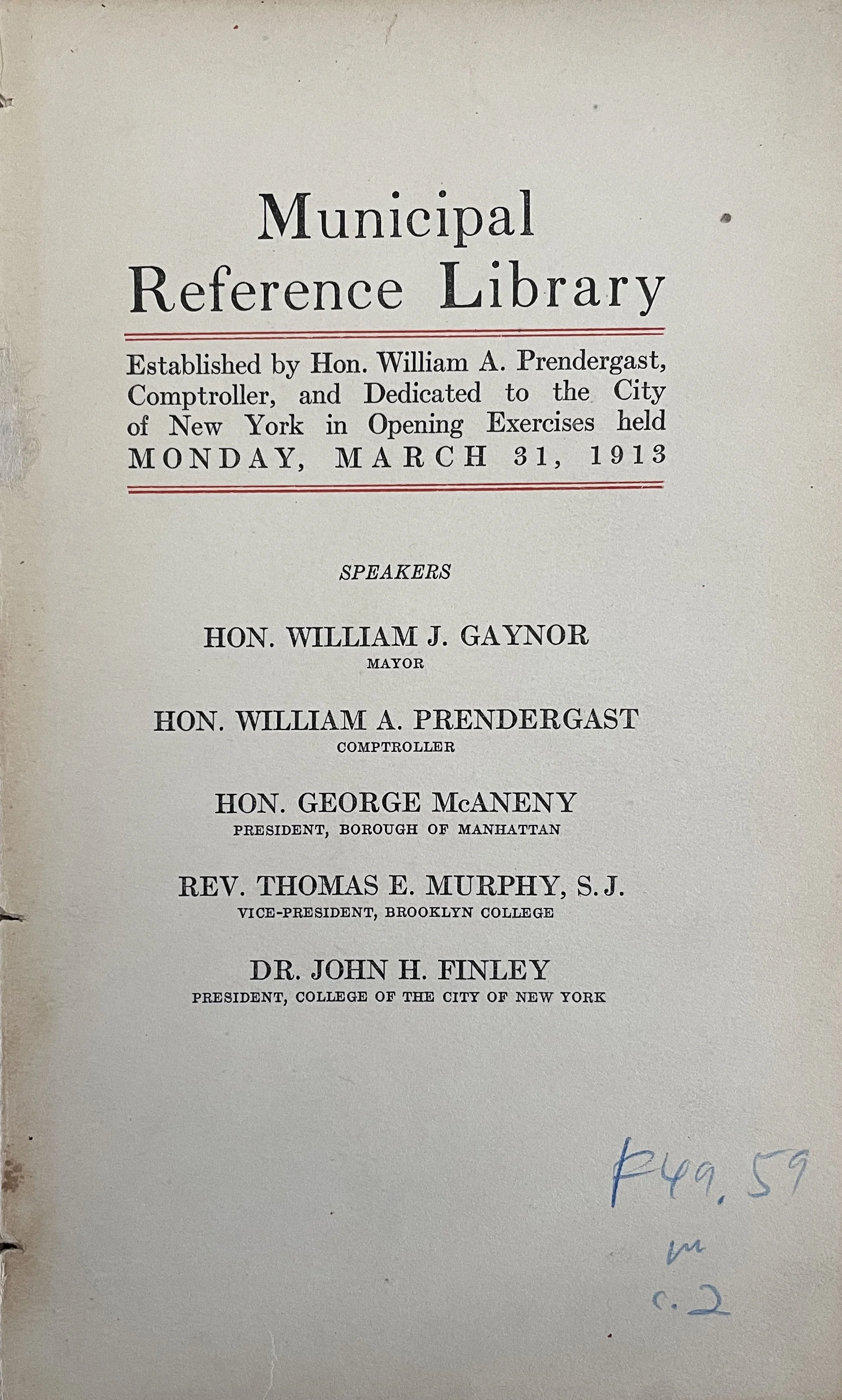
New York City’s Municipal Reference Library initially opened to the public at 280 Broadway on March 31, 1913, with a dedication ceremony attended by many municipal officials. A small booklet commemorating the event was recently located on the shelves of the current Library at 31 Chambers Street.

Cover page of Municipal Reference Library, 1913. NYC Municipal Library.

All texts from glass lantern slides, ca. 1930. Municipal Library Collection, NYC Municipal Archives.

Noting that the library contained over 5,000 books and pamphlets, “Out of the 5,000 books, only 368 were actually purchased for the library. The others were contributed by the Comptroller from the shelves of the libraries in the Department of Finance. This was possible because the department had been engaged for some time in gathering books of the kind most suitable to a municipal reference library.”

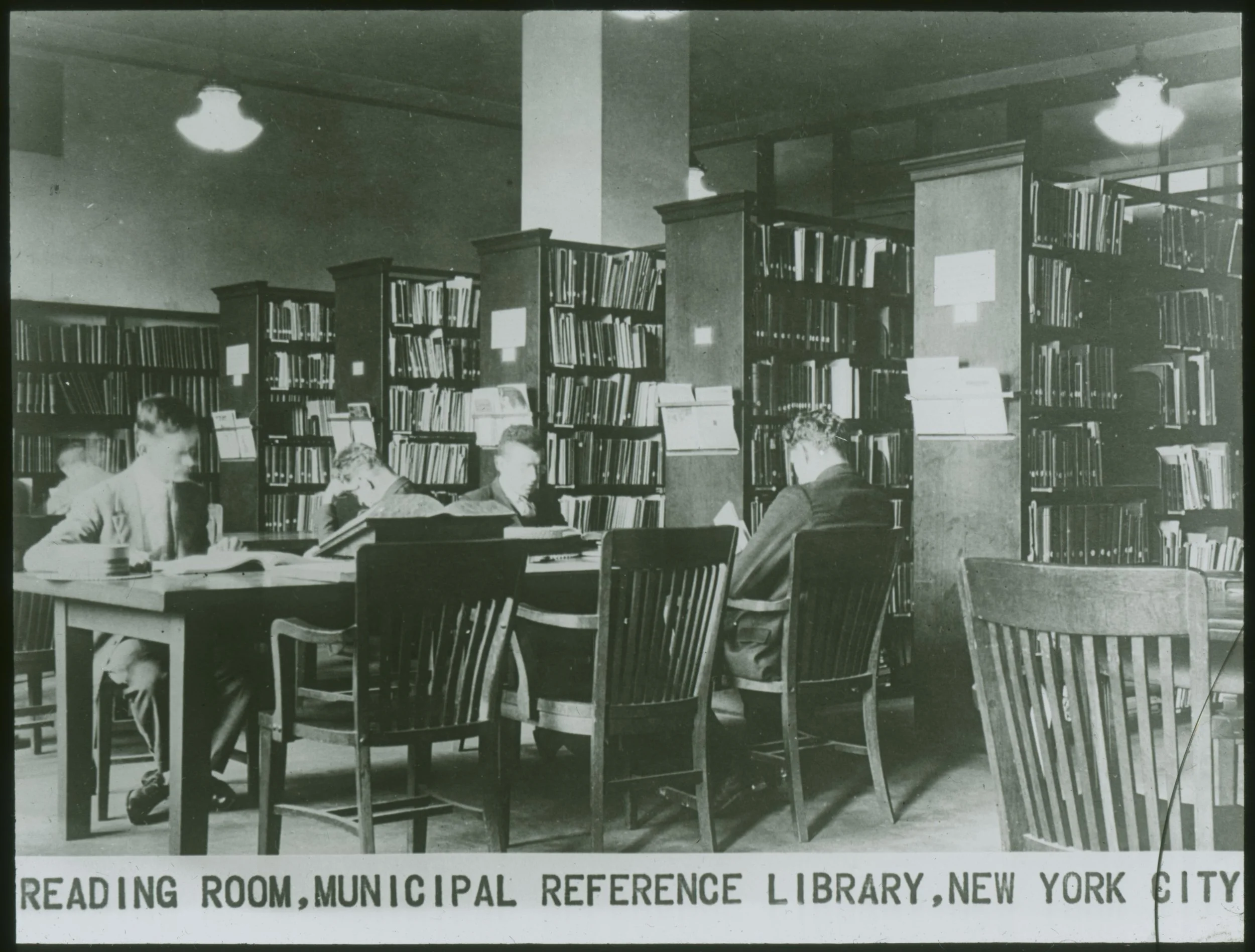
Long a goal of City Comptroller William Prendergast, the Library was one of the many new institutions proposed by reformers in the late 19th and early 20th centuries. This period, the Progressive Era, was a period of widespread activity to reform institutions, both public and private. Movements to improve conditions for workers and immigrants led to the development of labor unions and settlement houses. Efforts to reduce government corruption focused on government efficiency including the introduction of business practices into government and establishing criteria-based hiring practices to reduce patronage in employment. Municipal libraries fit into this by providing government decisionmakers with studies and statistics about government operations so decisions might be fact-based.

Reading Room, Municipal Reference Library, New York City, ca. 1930. Municipal Library Collection, NYC Municipal Archives.

New York was not the first municipality to open a library with a focus on government efficiency. In 1908, the National Municipal League, a reform-minded organization promoting civic engagement, proposed that local governments establish municipal libraries. Several cities took up the charge: St. Louis, Baltimore, Kansas City, Milwaukee and Minneapolis all established libraries before New York. In his opening address, Prendergast acknowledged this and said, “No city has as great municipal problems as those which confront New York, and consequently New York should be in the vanguard of those communities that are quick to recognize the utility of such an institution.”

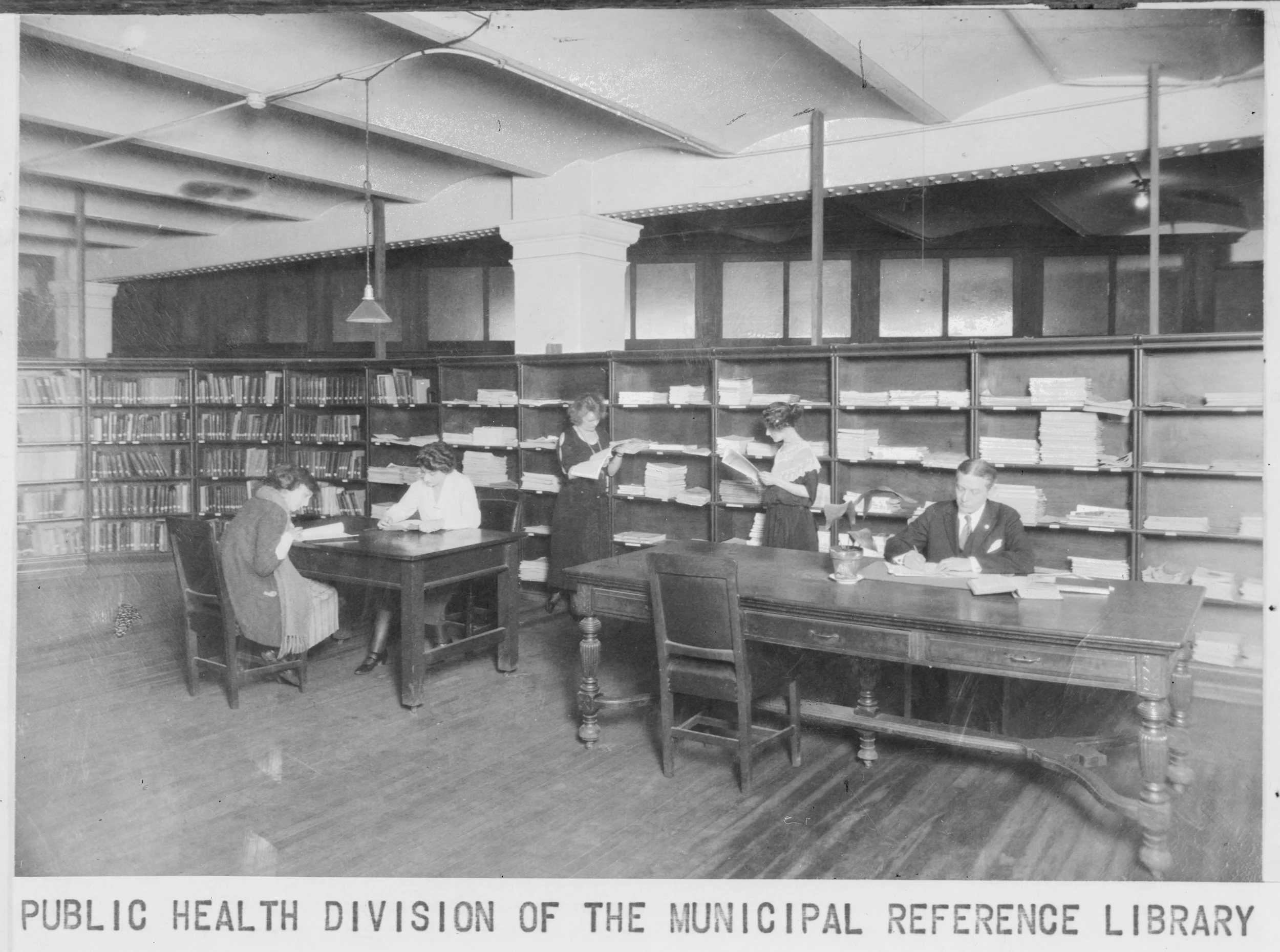
The Municipal Reference Library maintained a separate Public Health Division at the Department of Health, ca. 1930. Municipal Library Collection, NYC Municipal Archives.

Prendergast, a Republican, ran unsuccessfully for Congress before being elected as the City’s Comptroller in 1909, and re-elected in 1913. An online search shows that he authored several publications about finances including: “The business of New York City:  how the city gets its money and how it spends it” and “Report on the Tax Levies of the City of New York.” The Municipal Library Catalog includes these publications and thirty more on topics ranging from west side improvements, centralizing city purchases, street improvements and the telephone situation in municipal departments. All in all, he seems to fit the mold of a progressive-era reformer.

The library’s first home at 280 Broadway (then known as the Stewart Building and later as the home of the New York Sun newspaper) consisted of two rooms on the 4th floor. Getting that space was an achievement, described in the proceedings. Prendergast, Mayor John Purroy Mitchel and Manhattan Borough President George McAneny comprised the budget committee of the Board of Estimate in 1910 and proposed funding a Municipal Library. (Mitchel actually was the President of the Board of Aldermen but temporarily was a member of the Board of Estimate because he served as Acting Mayor for several months in 1910 when Mayor William Gaynor was recovering from an assassination attempt.) Regardless, his status did not help because the Board of Aldermen refused to appropriate the meager sum needed to fund the library.

Municipal Reference Library, New York City, ca. 1930. Municipal Library Collection, NYC Municipal Archives.

As New York prepared for a municipal election in 1913 that would pit Tammany against reformers, the three elected officials determined that the library should be established before the end of Gaynor’s term. So, Comptroller Prendergast used funds allocated to his office to set up the library—$750 to purchase new books and $500 for the furniture. The librarian was also funded through the Department of Finance (then part of the Comptroller’s Office). As stated in the introduction: “The limited appropriations for the Department of Finance were not sufficient to provide entire equipment for the library. The library cases in the Bureau of Municipal Investigation and Statistics, of the Finance Department, were used for one of the rooms, and wooden shelves were erected in the other. It was necessary to buy a desk, some chairs and tables, but except for these and the 368 books already mentioned. The library was built up with equipment already owned by the Department.”

Files and Catalogue in the Municipal Reference Library, New York City, ca. 1930. Municipal Library Collection, NYC Municipal Archives.

Despite the obstacles, Prendergast seemed optimistic in his address at the opening. “This Municipal Reference Library should be a “fact centre.” To it, public officials public employees, civic organizations and citizens generally, should be able to appeal for information on any subject that may reasonably be considered within the domain of municipal performance. If the library should not happen to have adequate data relating to a subject regarding which inquiry is made, it will be the duty of those in charge to immediately secure the necessary information.”

Library of the Public Health Division of the Municipal Reference Library, ca. 1930. Municipal Library Collection, NYC Municipal Archives.

He continued, “The functions of this library can be made very far reaching. They could include the making of investigations, the preparation of reports, the drafting of legislative bills and city ordinances, lecture courses and public discussions…. If facts are required they should be secured by the library, but the quest must be for facts. Any attempt to use it for personal or political advantage would destroy the value of the library as an element of municipal service.”

Page from the Municipal Reference Library, 1913. NYC Municipal Library.

Prendergast praised the assistance of the New York Public Library and support of the Brooklyn Public Library and envisioned a future with branches of the Municipal Reference Library in all of the boroughs, through partnerships with the library systems. This was not to be. He also recommended that the 8,000 volumes and 500 pamphlets in the Aldermanic Library be transferred to the Municipal Reference Library, which eventually did occur.

Mayor Gaynor, who would die from complications of the assassination attempt in September, paving the way for Mitchel to be elected the City’s youngest mayor on the Fusion ticket, then spoke. Praising the work of the Comptroller, and noting the modest beginning, he said, “It will grow, and grow rapidly, the object being to bring into one library all information and statistics, not only regarding our own city, but regarding all cities, and when I say all cities I mean the cities abroad as well as here. In that way much can be gathered together of the greatest value. It will be a place not only where those working in municipal government may go to get information, but it will be a place to which the writers on municipal topics may go. The future historian, Mr. Comptroller, will make use of it.”

Another speaker, the Reverend Thomas E. Murphy, Vice President of Brooklyn College, warned attendees that statistics were insufficient without people with open minds. “We have all had occasion to observe at times that figures and statistics, like presumed facts of history, may easily become an accumulation of things that are either not so or are not the expression of the whole truth. For instance, a certain class of undeniable facts and statistics about our city might give—should I not say, have given?—outsiders the false impression that this is the most immoral city in the world and that our police and other officials are a corrupt and inefficient band of public servants. Other instances might also be cited, if necessary, to convince us that no man needs breadth of view and an unbiased mind more than the student of statistics.”

By 1930, the Library had moved to the Municipal Building and its collection included more than 50,000 books. Fast forward 112 years from its founding and we see that the Municipal Library is well used. Historians, government officials, political scientists, students, city workers and more benefit from this reform. By 2025, the Library expanded to offer City agency reports online via the Government Publications Portal, official social media post and hosts the City’s centralized Freedom of Information Law (FOIL) portal.

Rebecca Rankin

As Women’s History Month draws to a close, we are reminded of the remarkable Rebecca Rankin and her essential role in the development of the Municipal Library and establishment of the Municipal Archives. Rankin served as Municipal Reference Librarian from 1920 until her retirement on June 30, 1952, the day the Municipal Archives and Records Center—long championed by Rankin—was officially opened.