The NYC Municipal Archives holds a collection of criminal indictment files stretching back to 1790 that is believed to be the oldest unbroken series of indictment records in the United States. A years-long project to index the indictment files is confirming what professional historians who have examined the files already knew: it’s a treasure trove containing—literally—a million stories. Because of its vast size, the files can be mined for statistics on changing patterns of crime, occupations and addresses of victims and the accused, and racial or ethnic arrest and conviction patterns. In addition, the process of indexing the records is turning up interesting glimpses into American history: a theft of copper that was destined for Robert Fulton’s steamboat factory, prices of foodstuffs in an era before grocery stores, or the chaotic state of the banking system in the early republic as revealed by numerous indictments for currency forgery. Occasional blogposts will offer examples of the riches in these files.
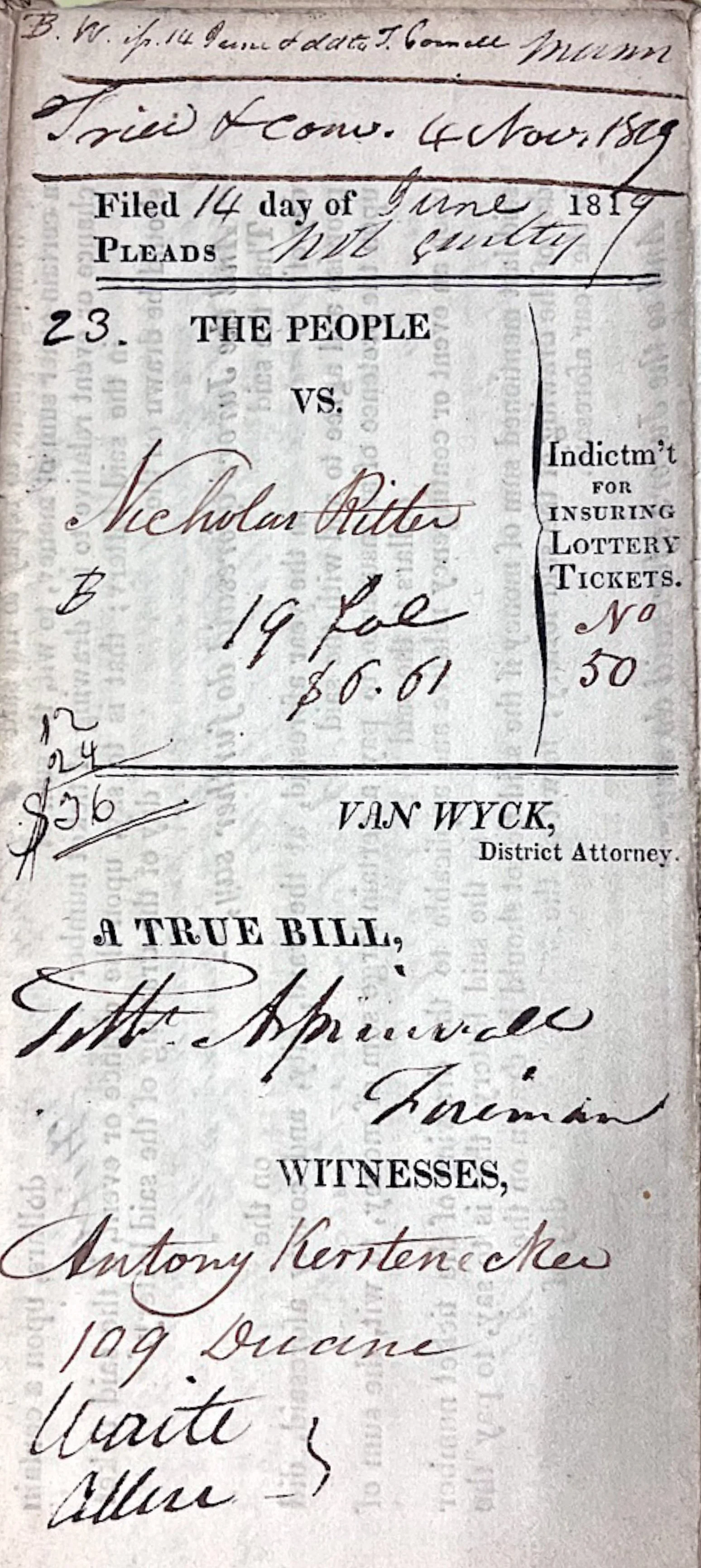
Cover page from an indictment of Nicholas Ritter for insuring lottery tickets.[4]
Long before “Hey, you never know” or “All you need is dollar and a dream,” New Yorkers bought tickets for state-authorized lotteries intended to raise funds for educational institutions, hospitals, and public infrastructure such as roads or canals. Economic historians have interpreted the lotteries of the colonial era and the early American republic—in particular, the overlapping businesses of lottery ticket sales, currency exchange, and ticket reselling—as paving the way for the development of financial institutions that ranged from the New York Stock Exchange to branch banking networks. However, lotteries had a seamy underside and numerous lottery-related criminal cases may be found in the Municipal Archives’ indictment files.[1] The most common involved “insuring” of tickets. In fact, indictments for lottery insurance were so frequent that the District Attorney’s office had a dedicated form printed for the purpose.
Lottery insurance was a form of gambling that was separate from the actual purchase and redemption of lottery tickets, as explained in an article by University of Pennsylvania financial historian Anders Bright.[2] Lottery insurance developed as a consequence of the fact that lottery tickets in New York State during the 1810s were surprisingly expensive: $7 for an 1819 Health Sciences Lottery ticket, for example. Seven dollars in 1819 had the equivalent purchasing power of more than $150 in 2026 and represented a week’s wages for an unskilled worker. Fractional tickets were also available, but the gambling community was as creative in the early 19th century as it is today, and a new marketplace emerged: wagering on whether a given lottery ticket number would be drawn on a given day (to prolong ticket sales, New York lotteries in the 1810s were spread out over a period of weeks and required a dozen or more separate drawings to pick all of the winners).
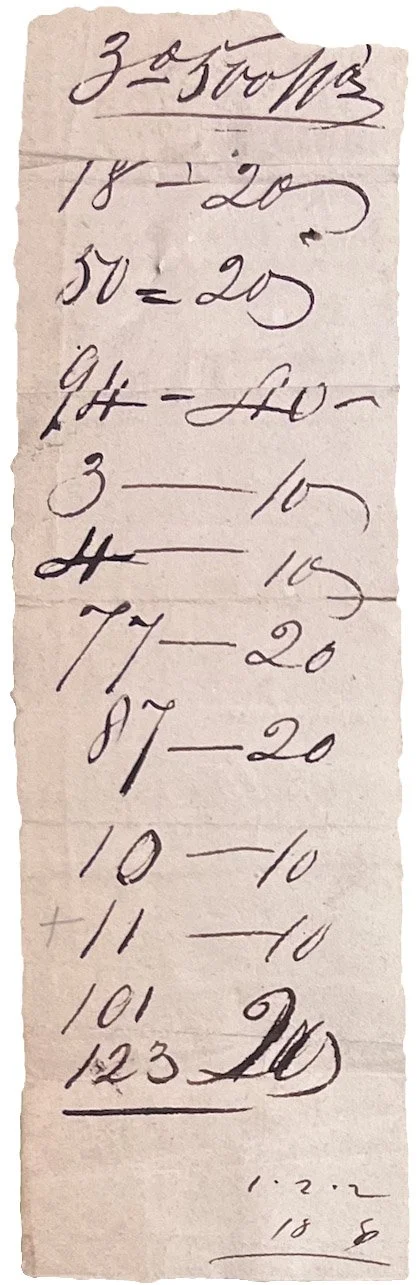
Receipt for payment of an insurance premium to Ritter. “3d500Nos” at the top means the third day of the lottery drawing, when 500 tickets would be drawn. Each line below gives the ticket number and the insurance amount. The third entry from the bottom was ticket #11, insured for $10. The indictment includes a deposition by Anthony Kerstenecker claiming that the broker Nicholas Ritter refused to pay when ticket #11 was in fact drawn on the third day. Ritter was convicted.
The same ticket brokers who legitimately sold lottery tickets also sold chances linked to the lottery drawings, and these wagers were called insurance. For much less than the cost of a lottery ticket, a customer could pick one or more ticket numbers and pay a small amount to “insure” a payout if a particular ticket number was drawn on a specific day. Payouts were typically on the order of $5 to $25—small compared to an actual winning lottery ticket’s value, but significant relative to the small daily premium that the customer paid to the broker.[3]
Selling lottery insurance became wildly popular among New Yorkers who couldn’t afford to buy actual tickets and is believed to have generated at least as much revenue for brokers than sales of actual lottery. The practice was made illegal because the state derived no revenues from it, defeating the purpose of the lottery itself. Because each lottery consisted of multiple drawings, the number of undrawn but potentially winning tickets decreased steadily, necessitating repeated recalculation of odds by the brokers selling insurance, who priced premiums dynamically. Given the slow speed of communication in the 1810s, savvy bettors and lottery middlemen both developed systems to quickly learn each day’s winning numbers, then calculate the odds on remaining tickets having their numbers drawn. The whole ecosystem of lottery managers, ticket brokers and resellers, ticket buyers and insurance gamblers was, as Anders Bright points out, “the first fully articulated and continuous financial market in the history of the United States.”
Lottery-related indictments spiked in the 1810s-1820s. The state legislature had passed laws outlawing insuring tickets in 1807, 1809 and 1813. Ticket brokers in New York City were indicted for insuring tickets at least 50 times between 1813 and 1819. Interestingly, conviction rates were low—only about 20% of the indictments resulted in a conviction or a guilty plea. In the majority of cases, the defendants were either found not guilty, or the prosecutor decided to drop the case by filing a nolle prosequi motion.
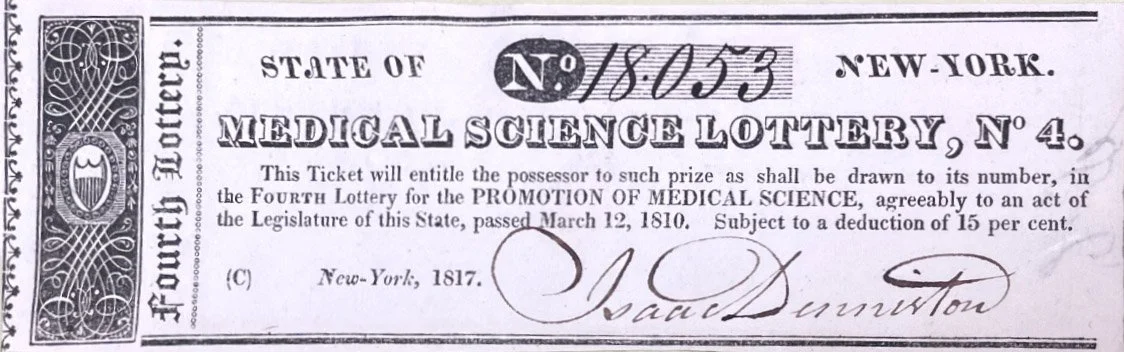
Of greater significance than the indictments for lottery insurance was the 1818 indictment and trial of Charles N. Baldwin for libel.[7] Baldwin was the publisher of the Republican Chronicle newspaper, and in September 1818 he published a sensational exposé claiming that the lottery system was riddled with fraud. Baldwin’s righteousness was arguably hypocritical because he was also a lottery broker and had been convicted more than once of insuring lottery tickets.[8] He had even been a business partner of Naphtali Judah, whom Baldwin accused in the Republican Chronicle of corruptly colluding with lottery officials—a point that the prosecution emphasized at Baldwin’s trial. But his defense team responded that Baldwin’s dual role as newspaper publisher and lottery ticket broker simply reinforced that he was an insider deeply familiar with the lottery system. During three days of testimony, Baldwin’s claims of suspicious irregularities, if not outright fraud, were abundantly confirmed. The jury reportedly returned its not guilty verdict “in a few minutes.”[9]
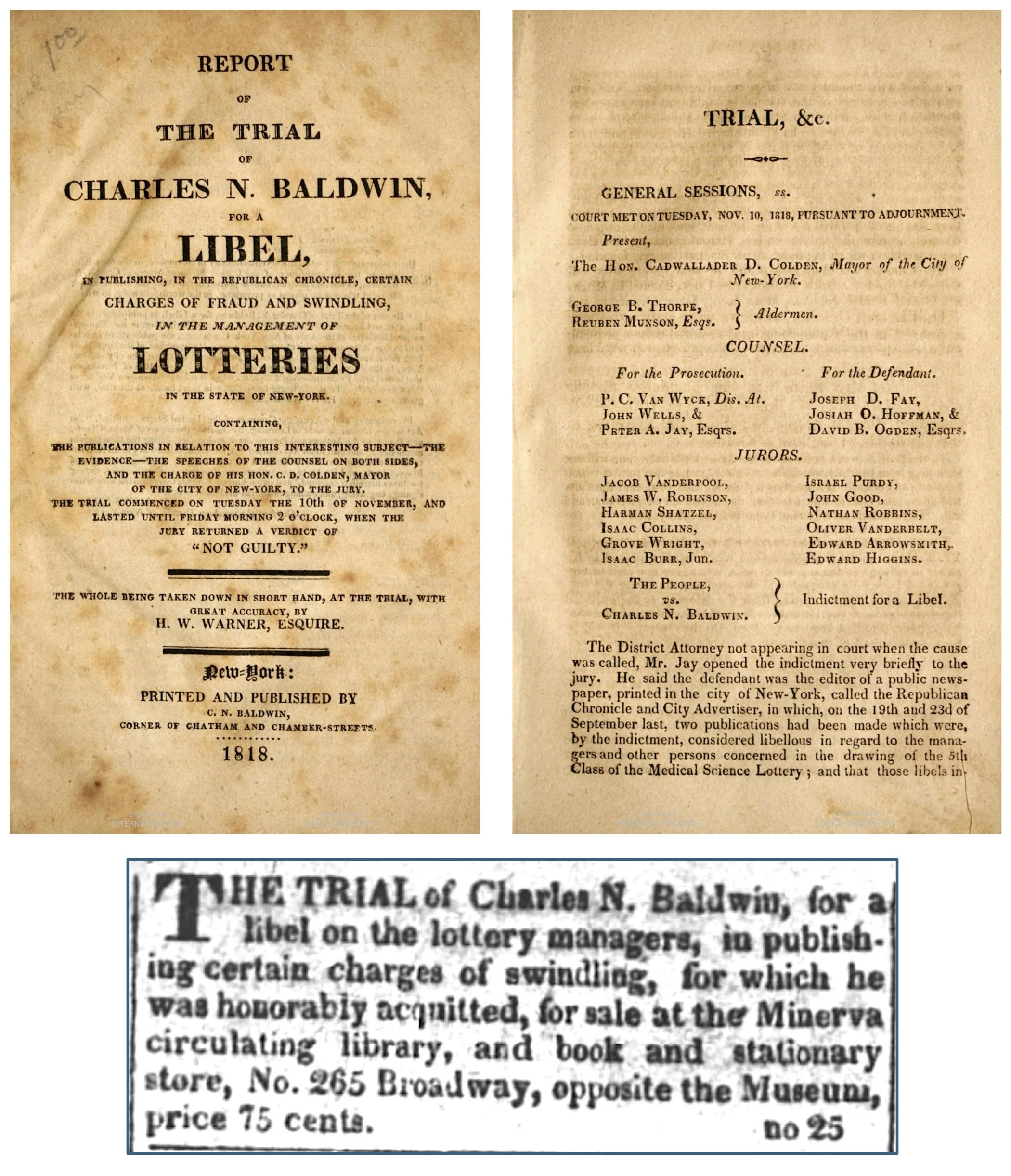
Top Left: cover page of an instant book about Charles N. Baldwin’s libel trial, published by…himself. Top Right: page from the book listing the dramatis personae, including the names of the jurors. Bottom: ad for Baldwin’s book. The verdict had been rendered just 12 days before this ad appeared![10]
Baldwin’s trial was important in the history of American jurisprudence, because it underscored the difference in libel laws between England and the United States. In England, the truth of an assertion that was deemed libelous didn’t matter—only the harm it caused to someone’s reputation. In America, the veracity of a libelous publication or statement could be used as a defense, a tradition dating back to the trial of printer John Peter Zenger in 1735. Baldwin’s acquittal not only reinforced truth as a libel defense; it also served to strengthen the principle of a free press in the still-young republic.
The trial and its revelations of rot in the lottery system put pressure on the state legislature, which held extended hearings that further turned public opinion against lotteries and led to their banishment when the state constitution was rewritten in 1821. However, a provision allowed already-authorized New York lotteries to continue for another twelve years, and betting on out-of-state lotteries extended the practice of lottery insurance even longer.
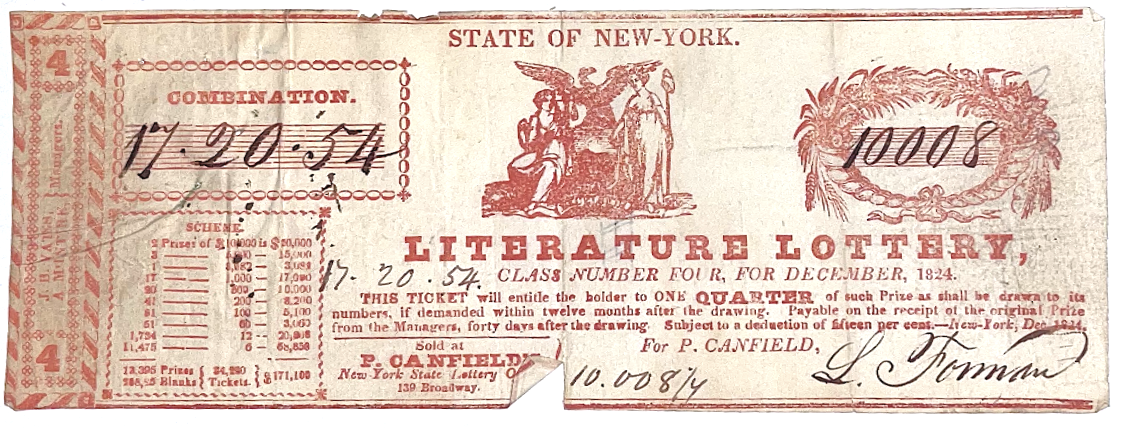
Ticket from an 1824 New York State Literature Lottery that was grandfathered into the 1821 state constitution.

Quarter ticket from an 1824 New York State Lottery.[11]
Australian historian Shane White used the Archives’ indictment files to make the point that Black New Yorkers were heavy participants in lottery insurance wagering, so the financial impact fell disproportionately on them.[12] The practice never fully went away and was reborn as the policy racket of the early 20th century.
[1] https://a860-collectionguides.nyc.gov/repositories/2/accessions/5830
[2] Bright, Anders. 2026. Luck’s Metropolis: Lotteries, Class, and Finance in Early New York. Early American Studies 24(1): pages 67-98.
[3] Ezell, John S. 1960. Fortune’s merry wheel: The lottery in America. Harvard University Press, page 95.
[4] New York Municipal Archives REC00015, Box 113 Folder 6, The People v Nicholas Ritter, filed 14 June 1819.
[5] New York Municipal Archives REC00015, Box 102 Folder 1, The People v Abraham P. Brower, filed 13 March 1818.
[6] Myers, Gustavus. 1917. The History of Tammany Hall, second edition, page 51.
[7] New York Municipal Archives REC0015, Box 107a Folder 10, filed 17 October 1818.
[8] New York Municipal Archives REC0015, Box 85 Folder 6, Reynolds v Baldwin, filed 15 February 1816 and Box 101 Folder 11, Reynolds v Baldwin, filed 5 March 1818.
[9] Anonymous. 1819. Report of the trial of Charles N. Baldwin, for a libel, in publishing, in the Republican Chronicle, certain charges of fraud and swindling, in the management of lotteries in the state of New-York. https://babel.hathitrust.org/cgi/pt?id=dul1.ark:/13960/t2h71925t&seq=3
[10] Evening Post 25 Nov 1818, page 3
[11] Both images from New York City Municipal Archives REC0015, Box 150 Folder 14, Canfield v Mead, filed 10 May 1825
[12] White, Shane. 2012. The Policy Rackets. New York Archives (Summer): 15-17.